
How does a water softener work?
How does a water softener work? Simply put, it removes lime, calcium, and magnesium from your tap water through ion exchange: the hard water flows through a resin bed and comes out soft and lime-free. This gives you soft water throughout your entire home: less limescale, appliances that last longer, and softer skin, hair, and laundry. We take care of it for you with advice and installation by a specialist.
- Removes limescale for soft water throughout your entire home
- Less limescale on taps, glass, and appliances
- Longer service life for washing machines, boilers, and pipes
- Low-maintenance: only periodic salt refills required
In short
A water softener softens hard water through ion exchange: lime (calcium and magnesium) is exchanged for sodium in a resin bed, after which the resin is periodically regenerated with salt (brine). This gives you soft, lime-free water throughout your entire home.
- Works via ion exchange and regenerates with salt (approx. 50 to 100 kg per year)
- Softened water is safe to drink: sodium levels remain well below the standard of 150 mg per liter (RIVM)
- The Joep (from 1,699 euros) is economical and smart; the PureAqua AquaCell (from 2,348 euros) works entirely without electricity
- Differs from reverse osmosis: that purifies drinking water at a tap, a water softener softens all the water in the house.
On this page
Quickly go to the topic you are looking for.
What is a water softener?
A water softener is a device that turns hard water into soft water. Hard water contains high levels of calcium and magnesium (limescale), which cause limescale buildup on taps, in pipes, and in appliances such as washing machines and water heaters. Through ion exchange, these minerals are replaced with sodium, resulting in soft water with less limescale, less cleaning, and lower soap and energy consumption. In short, that is how a water softener works: limescale out, soft water in.
The result: soft, limescale-free water from every tap, from the shower to the washing machine.

This is how a water softener works, the process in 4 steps.
In short, every ion exchanger (such as the AquaCell and the Joep) works according to the same principle:
Waterontharder in cijfers
Hoe hard je water is, wat een waterontharder kost en hoe ionenwisseling zich verhoudt tot andere systemen.
Waterhardheid: wanneer is water hard?
| Classificatie | Waterhardheid (°dH) | mmol/l |
|---|---|---|
| Zacht | onder 7 °dH | onder 1,25 |
| Gemiddeld | 7 tot 14 °dH | 1,25 tot 2,5 |
| Hard | boven 14 °dH | boven 2,5 |
In Nederland ligt de hardheid gemiddeld rond 8 °dH. Bron: waterbedrijven en Vewin.
Gemiddelde waterhardheid per regio
| Regio | Gemiddelde hardheid (°dH) | Type |
|---|---|---|
| Overijssel | ca. 9,65 | Hard tot gemiddeld |
| Groningen | ca. 9,35 | Gemiddeld |
| Noord-Holland | ca. 8 | Gemiddeld |
| Flevoland | ca. 6,25 | Zacht tot gemiddeld |
| Zuid-Holland | ca. 4,98 | Zacht |
Gemiddelden per provincie. De exacte waarde voor jouw adres vind je bij je waterbedrijf (Vitens, Brabant Water, PWN, Dunea) via je postcode.
Waterontharder vergeleken met andere systemen
| Systeem | Verwijdert kalk? | Echt zacht water? | Zout nodig | Stroom nodig | Bewezen werking |
|---|---|---|---|---|---|
| Waterontharder (ionenwisseling) | Ja | Ja | Ja | Meestal weinig; PureAqua AquaCell zonder stroom | Ja |
| Omgekeerde osmose | Nee (zuivert drinkwater: PFAS, zware metalen) | Nee (alleen aan 1 kraan) | Nee | Soms | Ja |
| CO2-ontkalker | Nee (water blijft hard) | Nee | Nee | Ja | Beperkt |
| Magneet of elektronisch | Nee | Nee | Nee | Ja | Niet wetenschappelijk bewezen |
Voordelen en nadelen van een waterontharder
| Voordelen | Nadelen |
|---|---|
| Geen kalkaanslag op kranen, douche en apparaten | Aanschafkosten |
| Apparaten (cv-ketel, boiler, wasmachine) gaan langer mee | Periodiek zout bijvullen (ca. 50 tot 100 kg per jaar) |
| Minder wasmiddel, zeep en ontkalker nodig | Kleine natriumtoevoeging (blijft ruim onder de norm) |
| Zachtere was en huid, glanzend serviesgoed | Wat spoelwater bij de regeneratie |
Afmetingen van de waterontharders
| Model | Breedte | Diepte | Hoogte |
|---|---|---|---|
| Joep | 27 cm | 48,5 cm | 48 cm |
| PureAqua AquaCell | 20,5 cm | 44 cm | 49 cm |
Compacte afmetingen, geschikt voor plaatsing in de meterkast of bijkeuken.
Wat kost een waterontharder?
| Kostenpost | Indicatie |
|---|---|
| Aanschaf Joep | vanaf € 1.699 (excl. installatie) |
| Aanschaf PureAqua AquaCell | vanaf € 2.348 (excl. installatie) |
| Installatie door monteur | ca. € 250 tot € 400 |
| Regenereerzout per jaar | ca. 50 tot 100 kg |
| Onderhoudsbeurt (indien nodig) | ca. € 60 tot € 100 |
Prijzen zijn indicatief. Vraag ons naar het exacte installatietarief voor jouw situatie.
 1
Step 1: Hard water enters
The hard tap water flows into the water softener, towards the resin bed.
 2
Step 2: Ion exchange in the resin bed
The resin exchanges the lime (calcium and magnesium) for sodium. This is the core of how it works.
 3
Step 3: Bring soft water into the house
The limescale-free water flows through to all your taps and appliances.
 4
Step 4: Regeneration with brine
Periodically, a saline solution flushes the resin clean and recharges it.
Which water softener is right for you?
At PureAqua, you can choose from two ion exchangers. Both are guaranteed to soften your water; the difference lies in their operation and consumption.

Joep water softener
Economical with salt and water, compact and low-maintenance, ideal for most households. From €1,699.
- Soft, limescale-free water in your home
- Economical with salt and water
- Compact and low-maintenance

PureAqua AquaCell water softener
Works entirely without electricity (hydraulic) and provides soft water 24/7, even during power outages.
- Works completely without electricity
- 24/7 soft, limescale-free water
- Reliable and low-maintenance
From advice to soft water in your home
We make it easy. From personal advice to professional installation and explanation. This is how you enjoy soft water throughout your entire home, worry-free.
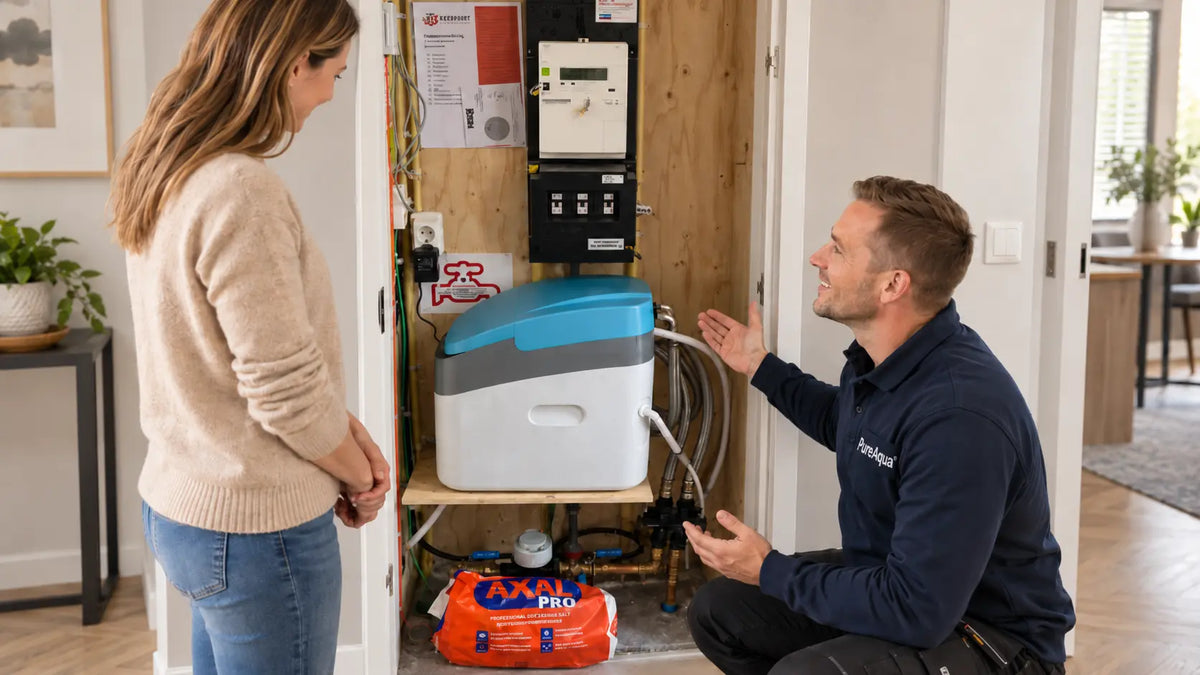
Free advice
We will work together to see which water softener best suits your needs.
Choosing a water softener
AquaCell by Joep, tailored to your hardness and water consumption.
Quote or order
You will receive a clear quote or can order directly online.
Installation appointment
We will schedule a time that works for you.
Installation by technician
Our technician will professionally connect the water softener to your water supply.
Explanation and usage
You will receive instructions on refilling salt and maintenance, ensuring you have soft water worry-free.
Shall I include clean drinking water as well?
A water softener makes your water soft and limescale-free, but it does not filter PFAS, medication residues, or microplastics from your drinking water. Do you want pure drinking water in addition to soft water?
Combine your water softener with a pure water tap based on reverse osmosis. This way, you have soft water throughout the entire house and pure water at your kitchen tap.
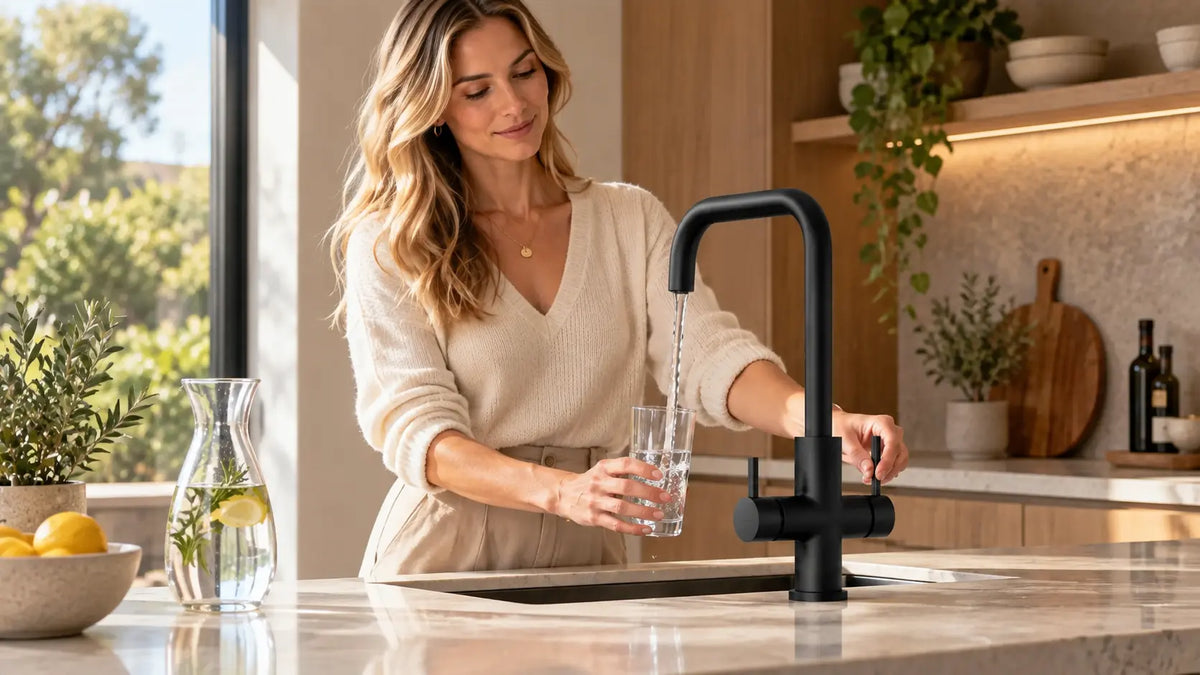
No-obligation advice, we are happy to think along with you.
Frequently asked questions about water softeners
How exactly does a water softener work?
Via ion exchange: lime (calcium/magnesium) is exchanged for sodium in a resin bed, giving you soft water. Periodically, the resin regenerates with brine.
What does a water softener do to your water?
It removes hardness minerals, which reduces limescale and makes appliances last longer. The composition only changes regarding lime; it remains safe tap water.
How much salt does a water softener use?
An average four-person household uses approximately 50 to 100 kg of regeneration salt per year. The exact consumption depends on your water hardness and water usage: the harder the water, the more salt is needed for regeneration. The Joep cleverly adjusts to your consumption, making it salt-efficient.
Is soft water healthy to drink?
Yes. During softening, sodium is added to the water: approximately 8 mg per liter for every degree of German hardness (°dH) removed. For the complete softening of average Dutch water at 8 °dH, this amounts to approximately 65 mg per liter, well below the standard of 150 mg of sodium per liter from the Drinking Water Decree (RIVM). Softened water is therefore safe to drink. Please note: softened water is not the same as filtered drinking water (reverse osmosis).
What is the difference between a water softener and reverse osmosis?
A water softener makes the water throughout your entire home soft (limescale-free). Reverse osmosis purifies your drinking water (PFAS, heavy metals). Read how reverse osmosis works.
What is the water hardness in the Netherlands?
Water is soft below 7 °dH, average between 7 and 14 °dH, and hard above 14 °dH. In the Netherlands, the average hardness is around 8 °dH, but this varies significantly by region. You can find the exact value for your address on your water company's website (e.g., Vitens or Brabant Water) using your postal code.
Does a water softener work without electricity?
Yes. The AquaCell works 100% without electricity (hydraulically) and uses a double cylinder, so you have soft water 24/7. The Joep uses little electricity and intelligently adapts to your consumption. However, a water softener does not work without salt: true softening requires regeneration with brine.
How long does a water softener last?
A high-quality water softener typically lasts 15 to 20 years or longer. At PureAqua, you receive a 20-year warranty on the resin of the Joep and 30 years on the resin of the AquaCell.
Does a water softener fit in the meter cupboard?
Both PureAqua water softeners are compact enough for a standard meter cupboard or utility room, close to the main water pipe. The Joep is approximately 27 cm wide, 48.5 cm deep and 48 cm high; the AquaCell is approximately 20.5 cm wide, 44 cm deep and 49 cm high. Not sure if it will fit? Send us a photo of your meter cupboard without obligation, and we will help you measure.
What is the annual cost of a water softener?
After purchase (Joep from €1,699, AquaCell from €2,348, excl. installation) the operating costs are low. The biggest expense is regeneration salt (approximately 50 to 100 kg per year for a family) plus an occasional check-up. Unlike reverse osmosis, no expensive replacement filters are required.
What are the disadvantages of a water softener?
The main drawbacks are the purchase costs and the need to periodically refill the salt (approximately 50 to 100 kg per year for a family of four). In addition, softening adds a small amount of sodium to the water, about 8 mg per liter per degree of German hardness (°dH) removed, which remains well below the 150 mg per liter standard set by the Drinking Water Decree. Finally, the device consumes some rinse water during regeneration.
How much does it cost to maintain a water softener?
Maintenance is limited: you periodically top up the salt and occasionally check the settings. A professional service is not always necessary and costs on average 60 to 100 euros. Unlike reverse osmosis, there are no expensive replacement filters required.
What is the payback period of a water softener?
A water softener generally pays for itself within 7 to 10 years, depending on your water hardness and consumption. The savings come from using less descaler, detergent, and soap, a longer lifespan for appliances, and a more efficient central heating boiler and water heater without limescale. The harder your water, the faster the payback period.
How much does it cost to install a water softener?
Expect to pay between 250 and 400 euros for installation by a technician, depending on your fuse box and connection. You can install it yourself using the included manual, but an incorrect connection risks leakage and sometimes your warranty. At PureAqua, you can have the installation taken care of by our technicians; ask for the exact rate for your situation.
How much water does a water softener use during regeneration?
During regeneration, the water softener flushes the resin bed with approximately 50 to 150 liters of water, depending on the model and settings. Modern, proportional softeners such as the Joep regenerate only when necessary and therefore use less flush water. On an annual basis, this amounts to a fraction of your total water consumption.
Do I still need to add salt to the dishwasher if I have a water softener?
That depends on your set residual hardness. If it is set to 4 °dH or lower, dishwasher salt is usually no longer necessary. At a residual hardness of 5 °dH or higher, it is better to continue using dishwasher salt.
To what residual hardness should a water softener be set?
For most households, a residual hardness between 4 and 8 °dH is ideal: soft enough to prevent limescale, with just enough minerals for a pleasant taste. A lower residual hardness uses more salt, so those looking to save choose not to go lower than necessary. At PureAqua, we set this up for you during installation.
Is softened water suitable for plants and the garden?
For houseplants and garden plants, it is better to use regular tap water or rainwater, as softened water contains slightly more sodium. That is why we usually leave the outdoor tap connected to hard water during installation, so that your garden and pond receive untreated water while you enjoy soft water indoors.
Does a water softener harm the environment?
During every regeneration, a small amount of sodium and rinse water ends up in the sewer. For a normal household, this effect is limited. You can keep consumption low by not setting the residual hardness lower than necessary and by choosing a proportional softener that only regenerates when required.
Everything about water softeners
What is hard water and water hardness?
Hard water contains a lot of dissolved lime: calcium and magnesium. The more of these in your tap water, the "harder" the water, expressed in °dH or mmol/l. In large parts of the Netherlands, the water is moderately hard to hard, which you notice through limescale, white spots, and dull laundry. Don't know your own water hardness? Take the water hardness check and discover if water softening is useful.
Why have a water softener in your home?
Why a water softener? Because hard water costs money every day: limescale on taps and glass, appliances (washing machine, dishwasher, boiler) that wear out faster, more soap and descaler, and dry skin and dull hair. A water softener tackles the cause, providing soft water throughout your entire home, so you clean less and your appliances last longer.
What does a water softener remove from your water?
A water softener only removes the hardness minerals calcium and magnesium, the lime that causes scale and clogged pipes. It does not filter PFAS, drug residues, heavy metals, or bacteria; reverse osmosis is needed for that. A water softener therefore makes your water soft and lime-free, not "pure". If you want both, combine it with a pure water tap.
What is the difference between a water softener and reverse osmosis?
A water softener treats the water in your entire home and only removes lime, so you have soft water everywhere. Reverse osmosis purifies your drinking water at one tap and removes up to ~99% of substances like PFAS and heavy metals. They complement each other: soft water through the house, pure water at the kitchen tap. Read how reverse osmosis works.
Is soft water healthy to drink?
Yes. During ion exchange, the lime is replaced by a small amount of sodium; at normal water hardness, this is negligible and safe. If you are on a strict low-salt diet, consult your doctor. Softened water remains safe tap water; it is just lime-free, not additionally filtered.
How much salt and water does a water softener use?
That depends on your water hardness and water consumption. During regeneration, the device uses salt (brine) and some flush water to clean the resin bed. Modern devices like the Joep are efficient in this.
What does a water softener cost?
You pay once for the device plus installation, and after that only for salt and periodic maintenance. At PureAqua, the Joep starts from €1,699, the AquaCell is higher. Weigh those costs against what you save: less lime damage to appliances, less soap and descaler, and a longer lifespan for the washing machine, boiler, and pipes. View the water softeners or read what does a water softener cost for the full cost breakdown.
How much maintenance does a water softener need?
Little. You periodically refill salt and occasionally check the settings; otherwise, the device regenerates itself. The AquaCell even works completely without electricity. A check once a year keeps everything in order.
What misconceptions exist about water softeners?
The biggest misconception is that a "salt-free water softener" (magnetic or electronic) does the same thing. Those devices do not actually change the water hardness; only ion exchange with salt truly removes the lime. Also, people think softened water tastes salty; that is not the case. And again: softened water is not the same as filtered drinking water.
Which water softener is right for you?
For most households, the economical Joep is our recommendation; if you want a device that works entirely without electricity, the AquaCell is ideal. Don't know your water hardness yet? Take the water hardness check or request no-obligation advice.
Now that you know how a water softener works, you can provide yourself with soft, lime-free water in your home. Are you unsure about the AquaCell or Joep? Request no-obligation advice; we are happy to think along with you.