NRC article puts drinking water quality back on the map
Clean drinking water from the tap feels like a given in the Netherlands. We turn the tap on, fill a glass, and barely give it a second thought. Yet, the quality and availability of our drinking water are increasingly coming under pressure.
A recent article by NRC titled “Drinking water quality? ‘We are in big trouble, the time for warnings is over’” makes it clear once again that concerns regarding drinking water quality must be taken seriously. The article addresses the mounting pressure on our drinking water sources and the challenges faced by drinking water companies, governments, and households.
And that raises an important question:
Following the NRC article “Drinking water quality? ‘We are in big trouble, the time for warnings is over’” from May 28, 2026.
What does this mean for the water you drink at home every day?
At PureAqua, we notice that more and more people are looking into their tap water. Not because tap water will suddenly be undrinkable tomorrow, but because many people want extra certainty. Especially when it comes to water used daily for coffee, tea, cooking, baby formula, and your family.
Is tap water in the Netherlands still safe?
Let's start with the honest truth: tap water in the Netherlands is still among the most strictly controlled drinking water systems in the world. The RIVM (National Institute for Public Health and the Environment) states that Dutch drinking water is of high quality and must comply with many regulations. At the same time, the RIVM also points out that water utility companies are facing increasingly significant challenges due to contamination in groundwater and surface water, and a growing demand for water.
That is exactly the nuance that is important.
The problem, therefore, is not that you cannot drink tap water today. The problem is that the sources from which our drinking water is produced are being burdened more heavily.
Think of:
- PFAS
- drug residues
- pesticides
- microplastics
- industrial substances
- drought
- salinization
- growing demand for drinking water
The Human Environment and Transport Inspectorate previously warned that groundwater and surface water contain too many fertilizers, pesticides, PFAS, drug residues, microplastics, and other harmful substances. According to the inspectorate, this is putting pressure on, among other things, the drinking water supply.
See how our under-sink water filter system helps to further reduce unwanted substances such as PFAS, drug residues, and microplastics.
Why is drinking water quality under pressure?
1. Our drinking water sources are becoming increasingly polluted
Drinking water doesn't just come out of the tap. It is produced from groundwater, surface water, or a combination of both. Before it reaches your tap at home, it undergoes extensive purification and testing.
But the more pollution in the source, the more difficult and expensive it becomes to turn it into clean drinking water.
Substances like PFAS and drug residues do not simply disappear from the environment. PFAS are also known as “forever chemicals” because they hardly break down. The RIVM states that PFAS usually occur as a mixture and that multiple PFAS compounds together contribute to total exposure.
2. PFAS remains a growing point of concern
PFAS is a collective term for thousands of chemical substances used in products such as coatings, packaging, firefighting foam, textiles, and industrial applications. A portion of these substances eventually ends up in soil, rivers, and groundwater.
The RIVM previously indicated that people in the Netherlands can ingest too much PFAS through food and drinking water. At the same time, the RIVM continues to state that drinking tap water is responsible. That may seem contradictory, but it primarily means: tap water is controlled, but total exposure to PFAS must be reduced.
For consumers, that is precisely the reason why the demand for water filter systems is increasing. Not out of panic, but out of a desire for control.
3. Drug residues are increasingly ending up in water
Medication used by people partly ends up in the sewage system via urine and feces. Sewage treatment plants remove a lot from the water, but not always everything. As a result, drug residues can eventually end up in surface water.
The national government notes that drug residues in water are a point of concern and that measures are needed to reduce these substances. At the same time, the official stance remains that Dutch drinking water is clean and safe to drink.
For households, this means: the tap water is checked, but the pressure on the system is increasing.
4. Climate change creates additional pressure
Drought, lower river levels, and salinization make it more difficult to keep sufficient clean freshwater available. The Council for the Environment and Infrastructure (RLI) warned in April 2026 that the Netherlands must intervene now to ensure sufficient, clean, and affordable drinking water in the future. According to the RLI, climate change, water pollution, and population growth play a major role in this.
This makes the topic much bigger than just “is there something in my tap water?” It is about the question of how much of a given clean drinking water will be in the future.
What does this mean for your tap water at home?
For most households, this does not mean you should immediately stop drinking tap water. It does mean that more and more people are becoming more conscious of the quality of their drinking water.
You can compare it to air quality. The air is not immediately dangerous everywhere, but many people still choose ventilation, air purification, or more conscious living. Not because they live in fear, but because they want to improve their living environment.
The same is now happening with drinking water.
More and more people are asking questions like:
What is actually in my tap water?
Tap water is clear, but clear water does not automatically mean that it contains no unwanted substances. Substances such as PFAS, drug residues, and microplastics are often impossible to see, smell, or taste.
Does it matter where I live?
Yes, that can matter. Drinking water can come from different sources depending on the region. In some parts of the Netherlands, more use is made of groundwater, in other parts more of surface water or river water. The RIVM previously indicated that tap water made from surface water generally can contain more PFAS than tap water made from groundwater.
Can I do anything about it at home?
Yes. You can opt for an extra layer of filtration at home. You are not replacing the work of the water utility company, but adding an extra step immediately before you drink the water.

Why more and more households are choosing extra water filtration
More control over your drinking water
A water filter system gives you more control over the water you drink daily. Especially when you are concerned about substances you cannot see, smell, or taste.
Better taste of water, coffee, and tea
Many people choose filtration not just because of potential contaminants, but also because of taste. Filtered water often tastes softer and more neutral. You notice this particularly with tea, coffee, and cooking.
Less dependent on bottled water
Those who have doubts about tap water quickly reach for bottled water. But bottled water is more expensive, less practical, and causes extra plastic waste. The RIVM even states that bottled water can be 150 to 500 times more expensive than tap water.
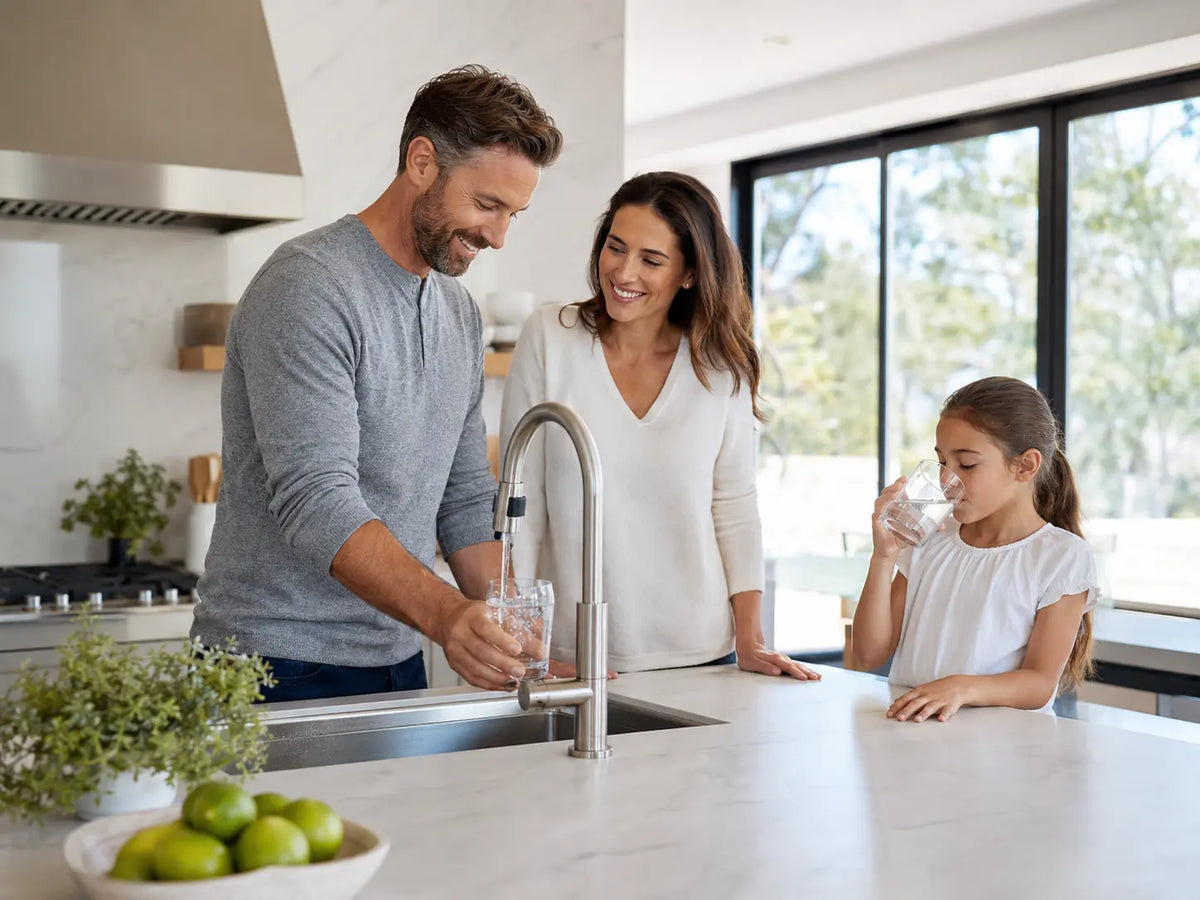
An under-sink water filter system can therefore be a logical alternative: the convenience of tap water, with extra in-home filtration.
Curious how much you can save on bottled water?
With a fixed water filter system, you drink filtered water from your own tap and reduce the use of plastic bottles, Take the savings check.
Certainty for the whole family
You use water every day. Not just for drinking, but also for coffee, tea, cooking, baby formula, and pets. Precisely because water is such a basic product, many households want to know what they are consuming.
What unwanted substances can be found in drinking water sources?
PFAS
PFAS are chemical substances that hardly break down in the environment. They can end up in soil and water via industry, consumer products, and discharges.
Drug residues
Drug residues can end up in surface water through the sewer system. Drinking water companies purify extensively, but the presence of drug residues in water remains an important point of concern.
Microplastics
Microplastics are created by the wear and tear of plastic products, synthetic clothing, packaging, and other sources. The long-term effects are still being researched, but many people want to limit their exposure as much as possible.
Pesticides
Pesticides and agricultural chemicals can end up in groundwater and surface water via soil and water flows.
Limescale and taste-altering substances
Besides health questions, comfort also plays a role. Limescale affects the taste of water, tea, and coffee and can damage appliances. A water filter is not a complete water softener for the entire home, but it can improve the drinking water experience.
How does a PureAqua water filter system help?
A PureAqua water filter system is placed under the sink and filters the water immediately before you drink it. This way, you add an extra layer of filtration to your tap water at home.
Depending on the chosen system, filtration can help reduce, among other things:
- PFAS
- drug residues
- microplastics
- chlorine-like flavors
- heavy metals
- unwanted odors and tastes
- other common contaminants
PureAqua The Source: powerful filtration with reverse osmosis
For households that want maximum filtration, a reverse osmosis system is a strong choice.
The Source from PureAqua works with advanced filtration and reverse osmosis. In this process, water is pressed through a very fine membrane, which significantly reduces many unwanted substances.
Suitable for people who:
- want the purest possible drinking water
- are concerned about PFAS, drug residues, and microplastics
- want to be less dependent on bottled water
- are looking for a permanent solution under the sink
- want filtered water daily for drinking, cooking, coffee, and tea

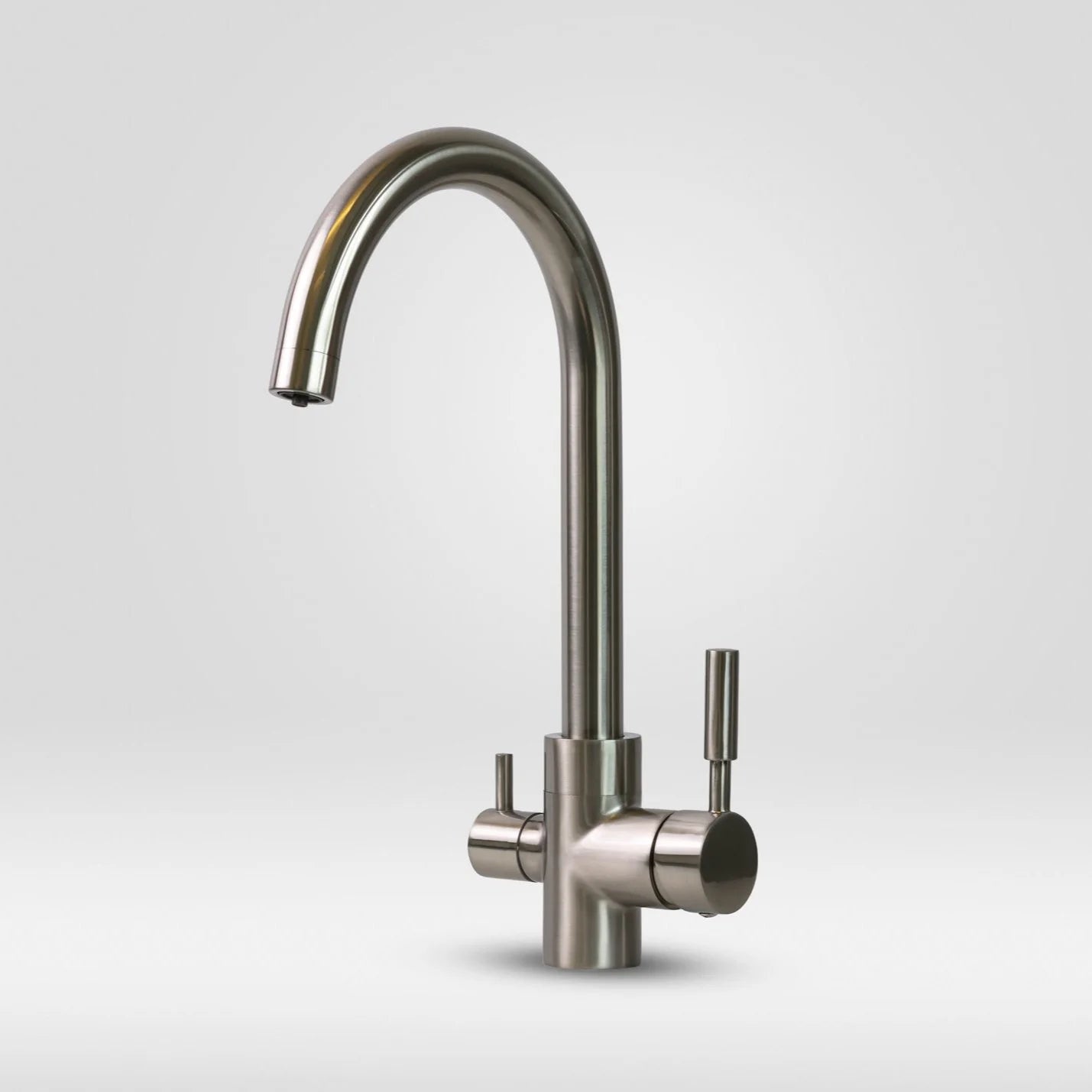
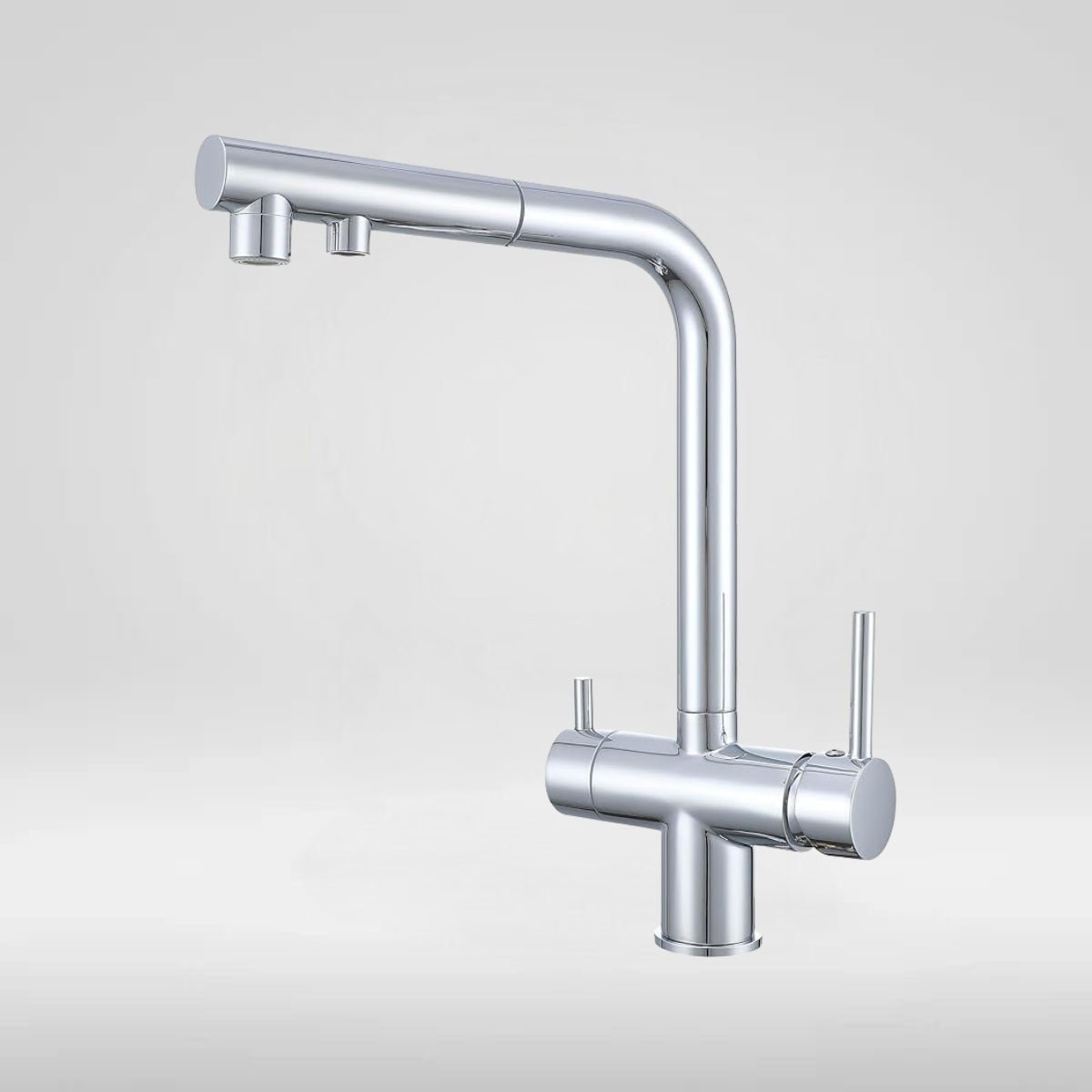
View the PureAqua pure water taps
4-in-1 tap: filtered, chilled, and hot water from one tap
Do you want to combine convenience with filtration? Then a 4-in-1 tap is interesting. This allows you to combine multiple functions in one tap, such as normal hot and cold water, filtered water, and boiling water.
Suitable for people who:
- want one luxury tap solution
- want filtered water directly from the tap
- want fewer loose appliances on the counter
- find comfort and design important
View our 4-in-1 boiling water taps.
Water filter for Quooker users
Do you already have a Quooker? Not every filter system is suitable. A reverse osmosis system can affect water pressure, meaning it doesn't always work well with a Quooker.
For Quooker users, a compact under-sink filter without reverse osmosis may be a better choice. This allows you to add extra filtration without having to replace your existing Quooker immediately.

View the PureFilter Mineral+ water filter for Quooker users here.
Should everyone go out and buy a water filter now?
No. And that would not be the right message.
Tap water in the Netherlands is monitored and officially safe to drink. But the discussion is shifting. Where it used to be mainly about “is tap water safe?”, it is now increasingly about:
How do we keep drinking water clean in a time of increasing pollution, drought, and demand?
For many households, a water filter is therefore not a panic buy, but a conscious choice. Just like choosing better food, an air purifier, solar panels, or a water softener.
Not because it is mandatory, but because you want more control over your living environment.
Frequently asked questions about drinking water quality and water filters
Is tap water in the Netherlands safe to drink?
Yes, Dutch tap water is strictly monitored and meets legal requirements. At the same time, organizations such as the RIVM and the Rli indicate that drinking water companies are facing increasingly greater challenges due to pollution, climate change, and the growing demand for water.
Does a water filter remove PFAS from tap water?
That depends on the type of filter. Not every water filter is suitable for PFAS. High-quality filtration systems, such as reverse osmosis, are designed to significantly reduce many undesirable substances. Always check carefully which system you choose and which substances the filter is capable of reducing.
Is reverse osmosis better than a standard water filter?
Reverse osmosis is a very fine filtration technique and is often chosen when maximum filtration is desired. A standard water filter may be suitable for improving taste and reducing certain substances, but it generally removes less from the water than an RO system.
Can a water filter be used with a Quooker?
Not every system can simply be used with a Quooker. A reverse osmosis system can affect water pressure. That is why, if you have an existing Quooker, we often recommend a special filter that is suitable for combining with a Quooker. See a Quooker water filter here.
Is bottled water a better alternative?
Not necessarily. Bottled water is more expensive, less practical, and creates more plastic waste. Furthermore, bottled water is not automatically free of all undesirable substances. For many households, a fixed water filtration system is therefore a more sustainable and practical alternative.
Conclusion: clean drinking water is valuable, but no longer a given
The NRC article shows that drinking water quality is a topic we can no longer afford to be careless about. The Netherlands has good tap water, but the pressure on our drinking water sources is increasing.
PFAS, drug residues, microplastics, pesticides, drought, and a growing demand make clean drinking water increasingly less of a given.
For households, this does not mean you should panic. It does mean that awareness is becoming more important.
With a PureAqua water filtration system, you choose extra peace of mind at your own tap. You add an extra layer of filtration to the water you drink daily, without being dependent on bottled water.
Would you like to know which system best suits your home, family, or existing tap?
View our pure water tap collection or request no-obligation advice. We are happy to help you think through your options.