Reading time: about 14 minutes
Short answer
A cheap water softener exists, but the word covers three technologies that do not do the same thing. Under €200 you almost always buy a clamp-on or magnetic device that does not lower your measured hardness and falls under no performance standard. A unit that really lowers your hardness works by ion exchange and starts at around €1,000 in the Netherlands. If you want to pay less without giving anything up, there are three honest routes: a simpler unit, spreading the cost, or buying together with your neighbours or owners’ association.
Table of contents
- What does a cheap water softener really cost?
- Three technologies, one word: that is where the price difference comes from
- What you give up at the cheap end
- The four price levels side by side
- First this: do you need one in your postcode at all?
- Three ways to pay less without giving anything up
- Calculate in annual costs, not purchase price
- Six questions before you click order
- Frequently asked questions
- Conclusion
Cheap water softener
Not a product category but a price class, and in the Dutch search results that price class runs from €42.95 to €1,161.60 within one and the same product carousel. That difference of almost 27 times does not exist because one unit is better finished than another, but because three different technologies are sold under the same name. Only ion exchange lowers the hardness that your water company measures.
What does a cheap water softener really cost?
On 3 October 2026 we went through the Dutch search results for cheap water softener. The first thing you see is not an explanation but a product carousel, above even the first organic result. In it are a VONROC softener at €42.95, the same VONROC at €48.95, an RF softener at €109.00, an Alpine magnet at €109.00, an 8-litre EMGA at €111.08, a 12-litre EMGA at €130.86, an Alpine All-in-one at €218.00, a 20-litre EMGA at €212.03, a UNIPRODO at €323.00, a Wiltec at €328.99, a Hendi at €341.28, an Aqmos R2D2-32 at €449.00, a Water2Buy W2B500 at €609.84, an AquaStar 800 SHE at €829.00, an AquaZacht at €1,115.00 and an AquaStar PL800 including 120 kilos of salt at €1,161.60.
Sixteen units, all found on the same keyword, with a lowest price of €42.95 and a highest of €1,161.60. That is not a difference in price class. Those are different products.
The search demand behind it is substantial and commercial. On 1 October 2026 we measured 320 searches a month for the Netherlands on cheap water softener, with a competition index of 100 and a cost per click of €4.13. Around it there is another 90 a month on water softener offer, with a cost per click of as much as €7.08, plus smaller terms around promotions, discounts and buying together. Together well over 450 searches a month from people who are close to a purchase and searching on price.
And what do those people get to see? Of the ten organic results, seven are a shop or product page. The three pages that really explain something run to 2,379, 781 and 246 words, an average of 1,135. There is no AI Overview on the main results and no featured answer, but there are six questions in the People also ask block, all six with an AI summary behind them. We answer those six questions below, one by one.
Honest upfront: PureAqua sells water softeners itself, and not at the cheap end of the market. That is exactly why we set out below what you really give up at that cheap end, and when the answer to the question of which softener you need is simply: none.
Want to know first whether softening would do anything for you?
We look at your postcode, your household size and your appliances and honestly tell you whether it is worth it. Free, without obligation.
Get free advice View the water softenersThree technologies, one word: that is where the price difference comes from
In the Netherlands the word water softener is used for three things that have little to do with each other technically. As soon as you pull them apart, the mystery of the price spread disappears.
The ion exchanger: the only one with a performance standard
This is what an installer means by water softener. The water flows through a vessel of resin beads that hold on to calcium and magnesium and give sodium back in return. When the resin is full, the unit flushes itself clean with brine from the salt tank. How that process works step by step is set out in detail on our page about how a water softener works.
It is also the only one of the three with an international performance standard. NSF/ANSI 44 describes household softeners that work with cation exchangers, regenerate with sodium or potassium chloride and lower hardness caused by calcium and magnesium. The standard sets requirements for capacity, efficiency and the materials that come into contact with drinking water. For magnetic and clamp-on devices there is no equivalent performance standard. That is not an opinion but a gap in the standards themselves.
The clamp-on or magnetic device: from around €30
A magnet or an electronic coil around the pipe is supposed to change the limescale crystals so that they stick less well. Nothing is removed from the water. The calcium and the magnesium stay in it, and that is why your measured hardness shows exactly the same number after installation as before. In the carousel we measured, these are the units from €42.95 to €218.00. We have looked into the claims around this kind of device before and show what is left of the magnet claims when you test them.
The limescale filter or polyphosphate cartridge: from around €100
A cartridge that protects a single tap point or a single appliance, for example a coffee machine or a combi boiler. It has a fixed capacity, is replaced as soon as that is reached and leaves the rest of the house alone. Which of these three you actually need, we worked out separately in our piece on what each of the three does and doesn’t change about your hardness.
Rule of thumb for the price lists you come across online: anything under roughly €200 is almost certainly a clamp-on or cartridge solution. The comparison site waterontharder-expert.nl, which also ranks on this keyword, uses the same lower limits: magnetic from €30, polyphosphate from €100, mechanical ion exchange from €1,000 and electronic ion exchange from €1,600, each time excluding installation.
What you give up at the cheap end
Suppose you deliberately choose a real ion exchanger, but the cheapest one you can find. Then you are still buying the right technology. This is what stands against that in practice.
1. No soft water during regeneration
A unit with a single cylinder has to flush now and then, and during that cycle it delivers no softened water. Manufacturers therefore schedule that in the middle of the night. If you shower at six o’clock, or the washing machine runs on a timer, the two can coincide. Units with two cylinders switch between them and always deliver soft water, but you won’t find those at the bottom of the market.
2. No recognised quality certificate
A Vitens water quality adviser states that you should only buy a unit with a quality certificate recognised by the Dutch state, with the right backflow protection, and that any change to your drinking water installation must comply with the principles of NEN 1006. Asking for that certificate costs nothing and takes one email. With many imported units from the lowest price class it simply isn’t there.
3. Unknown maintenance costs
Vitens also points out that poorly maintained softeners can cause bacterial growth, with smell and taste complaints as a result. A unit that costs €449 but for which no Dutch service party exists is a discarded appliance at the first valve fault. Which wear parts need attention when, we explain in the piece on the lifespan of such a unit.
4. Pressure loss you need to know about in advance
Softening costs pressure. Evides calculates for a softening installation including the required protection about 70 kilopascals of pressure loss, roughly 0.7 bar. In a home that already has low pressure, or on a third floor, that is a point to check in advance and not a detail you find on the product page of a budget unit.
5. A warranty period that doesn’t cover the whole unit
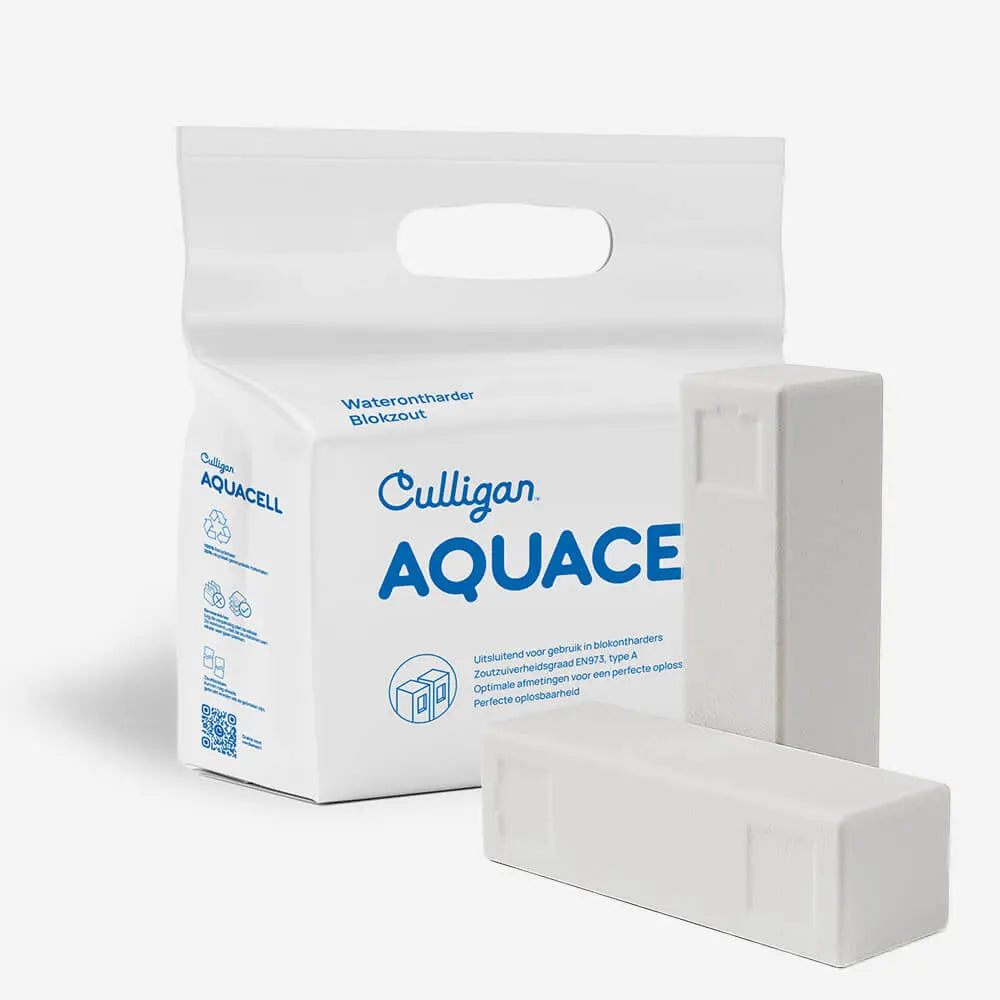
With the cheap units, pay attention to the difference between the warranty on the pressure vessel and the warranty on the control valve. The valve is the moving part and is what breaks first in practice. For comparison: the AquaCell that we sell comes with 5 years of all-in service, and that covers the whole unit.
The four price levels side by side
| Price level | What you buy | Lowers hardness in dH? | Performance standard | Reach |
|---|---|---|---|---|
| €30 to €220 | Magnet or electronic coil around the pipe | No | No equivalent performance standard | From the point of installation, with no measurable effect on your hardness |
| €100 to €350 | Cartridge filter with polyphosphate or crystallisation | No | No standard covering hardness reduction | One tap point or one appliance |
| €320 to €1,160 | Entry-level ion exchanger, usually a single cylinder | Yes, measurably | Sometimes NSF/ANSI 44, often not stated | Whole home, with an interruption during regeneration |
| €1,699 to €2,348 | Full ion exchanger with Dutch service | Yes, measurably | Yes, plus a recognised quality certificate | Whole home from the water meter |
The bottom row is our own pricing: the Joep starts at €1,699 and the AquaCell costs €2,348. We include it not to show that expensive is better, but to make clear which columns you are really comparing when you put two prices side by side. A full cost breakdown over the lifespan, including salt, water and electricity, is in our article on what a water softener really costs over the years.
First this: do you need one in your postcode at all?
This is the question that comes before all price comparisons, and that not a single page in the top ten asks. A cheap water softener is still money thrown away if your hardness is not the problem.
The Dutch range is limited by law. According to WMD, the Drinking Water Decree prescribes a total hardness of between 1 and 2.5 millimoles per litre, or roughly 5.6 to 14 degrees of German hardness. So your tap water here is never extremely hard and never completely free of limescale.
On top of that comes a boundary where manufacturers and water companies part ways. Waternet states that the Netherlands averages around 8 dH, that water between 8 and 12 dH is called medium and that water is only called hard above 12 dH. In the same breath Waternet adds that the websites of water softener manufacturers often say that water above 4 dH is already hard, and calls that, literally, incorrect. That is no detail: the whole target group at which the cheap end of the market aims lies precisely between those 4 and 12 dH.
Dunea uses the full scale: 0 to 4 dH very soft, 4 to 8 soft, 8 to 12 medium, 12 to 18 fairly hard and 18 to 30 hard, and itself supplies 1.42 millimoles per litre, or 7.9 dH. It sounds the same across the border: the Flemish Environment Agency opens its page on water softeners by stating that such a unit is usually not needed and that you should first check whether your tap water is really too hard.
You can request your hardness free of charge from your own water company, usually by postcode, and it is also on your water bill. That takes five minutes and is the cheapest step in this whole article. If you are under 8 dH, the gain from softening is small and you will get more result from cleaning and descaling than from a €449 unit.
Have your hardness and your situation worked out
Postcode, household size and your appliances: with those we calculate whether softening would do anything for you and which unit fits. We will also tell you if the answer is no.
Get free advice Compare the unitsThree ways to pay less without giving anything up
Suppose your hardness is above 12 dH, you have a boiler, a dishwasher and a washing machine, and softening therefore really does pay off for you. Then the question is not whether a cheaper unit exists, but how to pay less without giving up the technology. There are three routes, and none of them comes down to less unit.
Route 1: a simpler unit instead of a cheaper brand
Within the category that does work, there are large differences in equipment that not everyone needs. The Joep starts at €1,699, the AquaCell at €2,348, and that difference of €649 lies in capacity, width and service package, not in whether your hardness goes down. Which equipment suits which household, we go through in the buying guide based on criteria instead of price. A unit that is too big for your household costs you money at purchase and again at every regeneration.
Route 2: spreading instead of haggling
Some of the people who search for cheap are not really looking for a lower amount but for a lower threshold. A €1,699 unit in one go is something different from the same unit spread out. That hardly changes the total sum, but it does change whether you can decide now or are still hesitating two years from now while your limescale piles up.
Route 3: buying together with your neighbourhood, owners’ association or park
This is the only route that really lowers the price without taking anything away from the unit. If a street, an owners’ association or a holiday park orders and installs at the same time, the purchasing and call-out costs per home go down. We have a separate desk for that: PureAqua Collectief, where a group signs up and everyone receives an invitation for the same purchasing moment. How such a process runs in practice, from the first neighbourhood app message to installation day, we describe in the account of a neighbourhood purchase from start to finish.
Strikingly, this route hardly exists online as a search query. When we had fifteen combinations around collective and water measured on 1 October 2026, not one returned a usable volume, and in the top 100 keyword suggestions around water softener the word collective appears zero times. That says nothing about whether it works, only that almost nobody knows it is possible.
Calculate in annual costs, not purchase price
The purchase price is the easiest number to compare and the worst one to decide on. An ion exchanger has recurring costs: salt, rinse water and, with electric units, electricity. A clamp-on device doesn’t have those, but it also delivers no hardness reduction, so the comparison doesn’t hold.
Within the category that does work, the difference between a cheap and an expensive unit over ten years is often smaller than the purchase price suggests, and sometimes it even reverses. A unit that regenerates more generously than needed uses more salt and more rinse water every year. A unit without a Dutch service party is a new unit at the first valve fault. The full calculation, including what salt and water cost per year, is on our page about what a water softener costs.
Two more figures that appear in no price comparison. Ion exchange swaps limescale for sodium, and the Drinking Water Decree uses a standard value of 150 milligrams per litre for sodium, with taste complaints generally arising from around 200 milligrams per litre. Many installers therefore deliberately leave one cold-water tap in the kitchen untreated. And soft water is not yet pure drinking water: a softener removes limescale, not PFAS, not microplastics and not heavy metals. If you want both, you combine a softener with a device that purifies the drinking water itself.
Six questions before you click order
Go through these six points before you click order. Together they take less than half an hour and remove most wrong purchases.
- Request your hardness. Free, by postcode, from your water company. Under 8 dH the gain is small, above 12 dH it gets serious.
- Check whether the unit uses ion exchange. If it says magnet, coil, electronic field or crystallisation, it does not lower your measured hardness.
- Ask for the quality certificate. A certificate recognised by the Dutch state, plus the right backflow protection in line with NEN 1006. No answer is also an answer.
- Measure up your meter cupboard. Width, height, a drain within reach and, for electric units, a socket. At 20.5 cm wide the AquaCell is made for tight cupboards; far from every unit is.
- Ask what the warranty covers. The whole unit or only the pressure vessel, and who pays for the call-out.
- Calculate the annual costs. Salt, rinse water and possibly electricity, times ten years, on top of the purchase price.
Torn between two units?
Send us a photo of your meter cupboard and your postcode. We will tell you which unit fits, what it costs per year and whether a collective in your street is feasible.
Get free advice Compare the unitsFrequently asked questions
What is the best water softener for home use?
That depends on three things that differ per home: your measured hardness in dH, the number of people in the house and the space in your meter cupboard. So there is no fixed winner. There is, however, a hard lower limit: choose a unit that works with ion exchange, because only that technology falls under the international performance standard NSF/ANSI 44 and actually lowers your measured hardness. Also always ask for a quality certificate recognised by the Dutch state and check that the unit fits in your cupboard; the AquaCell, for example, is 20.5 cm wide and works without electricity.
What does a water softener cost including installation?
For a unit that really lowers your hardness, it starts at around €1,000 in the Netherlands excluding installation. At PureAqua the Joep starts at €1,699 and the AquaCell costs €2,348. In the Dutch search results of 3 October 2026 you find entry-level units from €323 and an AquaStar PL800 including 120 kilos of salt for €1,161.60. On top of the purchase, count on installation by a certified installer, because according to Vitens any change to your drinking water installation must comply with the principles of NEN 1006, with the right backflow protection.
Can you get a subsidy for a water softener?
No. The national scheme for homeowners is the ISDE, and according to RVO it reimburses only a (hybrid) heat pump, a solar boiler, a connection to a heat network, electric cooking equipment, insulation and glazing measures and, from 2026, ventilation in combination with at least one insulation measure. A water softener is not on that list and therefore does not qualify. If you come across a provider who does promise a subsidy, ask for the scheme and the registration code number; in practice it will then be their own discount, not government money.
Is a water softener really necessary?
Often not. The Flemish Environment Agency opens its page on water softeners by stating that such a unit is usually not needed and that you should first check whether your tap water is really too hard. In the Netherlands the Drinking Water Decree keeps hardness between 1 and 2.5 millimoles per litre according to WMD, or roughly 5.6 to 14 dH, and according to Waternet the national average is around 8 dH. Water is only called hard above 12 dH. If you are below that, you can keep limescale in check perfectly well with cleaning and descaling and a unit adds little.
What is the downside of a water softener?
There are four you need to know about in advance. The unit needs maintenance, and Vitens points out that poorly maintained softeners can cause bacterial growth with smell and taste complaints as a result. It costs pressure: Evides calculates about 70 kilopascals of pressure loss for a softening installation including the required protection, roughly 0.7 bar. It swaps limescale for sodium, for which the Drinking Water Decree uses a standard value of 150 milligrams per litre. And it costs recurring money for salt and rinse water. With single-cylinder units there is also no softened water from the tap during regeneration.
Has the Consumentenbond recommended a water softener?
We cannot view or verify a Consumentenbond test and therefore do not name a result that we have not been able to check ourselves. Many pages that rank on this keyword do, but they are in fact comparison sites with a revenue model. Two independent benchmarks exist that you can check yourself free of charge: the international performance standard NSF/ANSI 44 for softeners with ion exchange, and the quality certificate recognised by the Dutch state that Vitens explicitly refers to. For clamp-on and magnetic devices, neither exists.
Conclusion
Cheap water softener is not a product category but a price class in which three different technologies are mixed together. The €42.95 and the €1,161.60 that we found in the same product carousel on 3 October 2026 do not stand for a bad and a good version of the same thing. Only ion exchange lowers your measured hardness and falls under NSF/ANSI 44; a clamp-on or magnetic device changes nothing about your dH value and has no equivalent performance standard.
That is why the decision doesn’t start with an amount but with a number you haven’t requested yet: your water hardness. If you are under 8 dH, the cheapest thing you can do is buy nothing at all. If you are above 12 dH, the question is not which unit is cheapest but via which route you pay less without giving anything up: a simpler unit, spreading the cost, or buying together with your neighbours or owners’ association. That third route is the only one that lowers the price without taking anything away from the unit.
And remember the difference the whole market confuses: soft water is not yet pure drinking water. A softener removes limescale. What else is in your water is a different question and a different device.
Want to know what makes the most sense for you?
We work out your situation by postcode, household size and appliances, and honestly tell you whether softening pays off. Drink different.
Get free advice View the water softeners