Short answer
Descale a coffee maker with the product that belongs to the type of machine, not with whatever happens to be in the cupboard. With a simple filter coffee maker without a pump, diluted white vinegar is fine, as long as you rinse generously afterwards. With a pad machine, a cup machine or a bean-to-cup machine it is not: those contain rubber seals, a pump and a flow-through boiler that acetic acid attacks, and the smell of vinegar soaks into the plastic and you taste it afterwards. Use a descaler based on citric acid or lactic acid there, or the manufacturer’s own product, and follow the descaling programme in the manual for your model. How often? With daily use every 6 to 8 weeks, with less use every 2 to 3 months, and less often in an area with soft water.
Table of contents
- The sources contradict each other, and nobody explains why
- Acetic acid, citric acid and lactic acid: what they do in your machine
- Descaling a filter coffee maker
- Descaling a pad machine
- Descaling a cup machine
- Descaling a bean-to-cup and espresso machine
- The four machine types side by side
- How often should you descale?
- Descaling treats the symptom
- Frequently asked questions
- Conclusion
Descaling a coffee maker
Dissolving and rinsing away calcium carbonate, commonly known as limescale, which settles on the heating element and in the water lines of a coffee machine as soon as heated tap water releases its dissolved calcium and magnesium. The term covers four different appliances with four different interiors, and for that very reason it also covers four different answers to the question of which product you may use.
The sources contradict each other, and nobody explains why
On 6 October 2026 we went through the Dutch search results for descaling a coffee maker, and then checked every source listed there separately. The keyword gets 3,600 searches a month with high competition. At the top of the page is an AI summary, and below it four questions in the People also ask block, each with its own AI summary behind it. One of them reads, literally: why not descale with vinegar?
That Google asks that question is no coincidence. The pages ranking above it give opposite advice.
Albert Heijn holds the first organic spot and is unambiguous: household remedies such as vinegar seem handy but can damage your appliance, the smell of vinegar often lingers for a long time and you taste it in your coffee. The conclusion is just as firm: do not use vinegar to descale your coffee maker, but a special descaling liquid or tablets suitable for your type of appliance. That is in the Albert Heijn step-by-step guide.
The second spot is held by a water softener seller who writes exactly the opposite: a simple coffee maker can be descaled with diluted white vinegar, and without a water softener you have to repeat that monthly. In fifth place is a kitchen shop with a complete step-by-step guide to cleaning with vinegar, prescribing 50 percent water and 50 percent white vinegar.
The Consumentenbond takes the middle ground and is honest about it: the use of cleaning vinegar is sometimes strongly discouraged, writes the page on descaling espresso machines, updated on 15 July 2026. The only hard ban stated there is attributed to the manufacturer: Nespresso advises against using vinegar, because according to the company it can damage the machine.
And then there is Vitens, the largest drinking water company in the Netherlands, which on its own page on water hardness actually advises cleaning appliances regularly with, for example, cleaning vinegar, with the single proviso that you first read the cleaning instructions of the appliance. Vitens names the coffee maker specifically, alongside the boiler, the geyser and the washing machine.
Four sources, four pieces of advice, and not one explains why the other three say something different. Yet it can be explained, and the answer is not that one of the four is wrong. The answer is that they are talking about different appliances.
The three content pages in the top 3 for this search query run to 485, 779 and 1,075 words, an average of 780. None of those three contains the distinction that resolves the whole contradiction: what is inside your machine. That is exactly what follows below, per type, with the brands as examples within each type.
Would you rather have no limescale in your coffee machine at all?
We look at your postcode, your household and your appliances and honestly tell you whether softening or filtering would do anything for you. Free and without obligation.
Get free advice View the water softenersAcetic acid, citric acid and lactic acid: what they do in your machine
Limescale is calcium carbonate. Any weak acid dissolves it, and on that one task the three acids barely differ. The difference lies not in what they do to the limescale, but in what they do to the rest of the machine.
Acetic acid
This is the acid in white vinegar and in cleaning vinegar. It dissolves limescale perfectly well, but it is also the only one of the three with two side effects that matter in a coffee machine. The first is damage to materials: acetic acid attacks rubber seals, gaskets and some aluminium parts, and those are precisely what sit in the pump and the flow-through boiler of a modern machine. The second is smell: vinegar soaks into plastic and stays there. Albert Heijn mentions both explicitly. Cleaning vinegar and white vinegar are chemically the same acid in water; cleaning vinegar is the more concentrated of the two and so dissolves limescale faster. That is exactly why it does more damage in a machine with a pump.
Citric acid
The acid most ready-made descalers are based on. It dissolves limescale without the rubber damage and without the lingering smell. In the product strip for this search query on 6 October 2026 you find, among others, an HG descaler based on citric acid at €5.66 to €8.00 for half a litre and an Eccellente quick descaler from €2.25. A half-litre bottle is good for several rounds.
Lactic acid
The third acid you come across on packaging, often a little more expensive: the same HG range carries a lactic acid variant at €6.92 to €13.99. Lactic acid works a little more slowly than citric acid but is gentler on metal, and is therefore widely prescribed for espresso and pad machines.
Add the brand descalers and the picture is complete. In the same measurement the Philips descaler for Senseo costs €6.95 to €7.95 for 250 millilitres, the DeLonghi EcoDecalk Mini €7.94 to €10.49 and a Melitta Anti Calc €8.77 to €14.49. That is a few euros a year more than a bottle of store brand. So it is rarely the price that decides the choice.
Descaling a filter coffee maker
The classic jug with a filter holder on top. This is the appliance that the keyword descaling a coffee maker, with its 3,600 searches a month, is mostly about, and it is also the only type for which the vinegar advice from the second search position is defensible.
There is hardly anything inside. Water runs by gravity from the reservoir past a heating tube and comes out boiling above the filter. No pump, no pressure chamber, hardly any rubber on the hot path. The heating element is where the limescale collects, and that is metal.
This is how you go about it with this type:
- Empty the appliance completely: no coffee, no filter paper, jug clean and empty back on the plate.
- Fill the reservoir with the descaling solution. Choose a ready-made descaler and stick to the dosage on the packaging. If you do use vinegar, take white vinegar and dilute it with an equal part of water, as the kitchen shop in the search results prescribes.
- Let half run through, switch the appliance off for 15 to 20 minutes so the acid can work, and then let the rest run through.
- Rinse with at least two full jugs of clean water. With vinegar preferably three, because that is the step where most people stop too early and where the aftertaste comes from.
It is the same logic as with a kettle, where only a metal element and a plastic jug are involved. If you want to go through that job separately, we have worked out which acid dissolves limescale fastest and how long you should leave it.
Descaling a pad machine
Here the answer changes, and it changes for a technical reason. A pad machine forces water through the pad under pressure. That requires a pump, a flow-through boiler that brings the water up to temperature in seconds, and a pad holder that seals watertight with rubber gaskets. Three parts that a filter coffee maker does not have, and all three sensitive to acetic acid.
The search demand here is also considerably larger than for the main keyword. Descaling a Senseo gets 8,100 searches a month, and descaling a Senseo with vinegar another 720. That is more than twice the volume of the general keyword, and it shows how many people stand at exactly this crossroads.
The advice for this type is short: no vinegar. Use a descaler based on citric acid or lactic acid, or the manufacturer’s own liquid. Philips sells its own descaler for Senseo that in our price check of 6 October 2026 costs between €6.95 and €7.95. Which buttons you press in which order differs per model, and that is no detail: on many pad machines the descaling mode is a separate setting that you start with a button combination. Get the manual for your model for that, because a step-by-step guide from a blog does not replace it.
Striking for this search query: of the eight organic results for descaling a Senseo, only two come from the manufacturer itself, and they sit at the bottom. The top 3 consists of a parts webshop, a blog about water softeners and consumer journalism. So the official manual does not rank at the top for the people asking this question, and that explains to a large extent why the vinegar advice keeps circulating so stubbornly.
Descaling a cup machine
A cup machine works at higher pressure than a pad machine and has a narrower passage: the needle that pierces the cup and the channel behind it are narrow enough to actually clog up with limescale. The cluster around this type is the largest of all. Descaling a Nespresso gets 8,100 searches a month, descaling a Nespresso appliance 1,900, descaling a Nespresso machine 720 and descaling a Nespresso with vinegar another 590. Together well over 11,300 a month.
Here the vinegar advice is not just unwise but explicitly off limits according to the manufacturer. The Consumentenbond notes it without ceremony: Nespresso advises against using vinegar, because according to the company it can damage the machine. That same page points out that the manufacturer states in the manual when you need to descale, sometimes via a light, sometimes after a number of cups and sometimes after a number of months, and that this differs per appliance.
There is another reason to stick to the manual here and not to a random step-by-step guide. On the keyword descaling a Nespresso, all eight organic results come from nespresso.com itself, all of them pages from the support section. So Google hands this question over entirely to the manufacturer. Only the AI summary at the top also cites third parties. For you as a user that mainly means something practical: the right instruction for your model is two clicks away, and it takes precedence over anything you read elsewhere.
What applies to every cup machine: descale with the prescribed product, let the entire reservoir run through according to the programme, and then run at least one full reservoir of clean water through before you make coffee again.
Descaling a bean-to-cup and espresso machine
The bean-to-cup machine with its own grinder, brew group and milk system is the machine where vinegar does the most harm and at the same time the machine you have to work out the least yourself. Descaling a DeLonghi gets 1,000 searches a month, descaling a Jura 880 and descaling an espresso machine 140.
Almost every appliance in this class has a built-in descaling programme. The Consumentenbond writes that most espresso machines tell you themselves when to remove limescale, and that on some appliances you cannot ignore that signal: you can only make coffee again after you have descaled. That is not spite but a safeguard, because a clogged boiler under pressure is a more expensive repair than any descaler.
Two points that are often overlooked with this type. The first is the warranty: the Consumentenbond warns that not descaling can affect the warranty, because a technician can sometimes tell that you waited too long. The second is that descaling and cleaning are two different jobs. Descaling removes limescale from the water path, cleaning removes coffee oils from the brew group. Different products belong to each, and a cleaning tablet at €2.29 to €9.75 does nothing against limescale.
The four machine types side by side
This is the overview that appears on none of the pages in the search results, and it is the only thing that resolves the contradiction from the first paragraph.
| Machine type | What is inside | Vinegar acceptable? | What to use instead | Search volume per month |
|---|---|---|---|---|
| Filter coffee maker | Gravity, heating tube, hardly any rubber on the hot path | Diluted white vinegar is fine, as long as you rinse generously | A ready-made descaler remains the safest choice | 3,600 on the general keyword |
| Pad machine | Pump, flow-through boiler, rubber gaskets in the pad holder | No | Citric acid, lactic acid or the brand descaler, plus the button combination from the manual | 8,820 around Senseo |
| Cup machine | High pressure, piercing needle and a narrow channel that can clog | No, the manufacturer explicitly advises against it | The prescribed product and the programme from the manual | Over 11,300 around Nespresso |
| Bean-to-cup machine | Grinder, brew group, milk system and a boiler under pressure | No | The built-in descaling programme with the product the manufacturer specifies | 2,020 around the brands combined |
Read the Vinegar acceptable column from top to bottom and the whole discussion falls into place. Vitens is right about appliances in general, the seller in second place is right about the simple filter machine, and Albert Heijn and Nespresso are right about anything with a pump. The only thing missing was the column next to it.
How often should you descale?
Albert Heijn gives the only concrete interval found in these search results: with daily use every 6 to 8 weeks, and if you use the appliance less often, every 2 to 3 months is enough. If your machine has its own descaling alert, that alert takes precedence, because it counts cups or litres instead of weeks.
Two things shift that interval.
The hardness of your tap water. The more calcium and magnesium it contains, the faster your element clogs up. Vitens explains that those minerals occur naturally in groundwater and that hardness therefore differs per town, and names the coffee maker specifically as a place where scale forms as soon as hard water is heated. The same water company adds that truly hard water hardly occurs in the Netherlands any more, because water companies soften the water where necessary. If you want to know where limescale comes from and what else you can do about it around the house, you will find that worked out in our piece on the places where limescale clings most stubbornly.
A water filter in or in front of the machine. The Consumentenbond is clear about this: on some espresso machines you can fit a water filter, and then you need to descale less often, because a water filter softens the water and so causes less scale. You do have to replace those filters regularly. Which filter suits which machine and what it costs per year, we set out in our article on what a filter in your coffee machine actually delivers.
A sum that is rarely done: if you descale every 7 weeks with daily use, that is well over 7 rounds a year. With a bottle of descaler of around €6 that covers four to five rounds, that costs roughly €9 to €11 a year in product, plus a half-hour job each time. Over ten years that is some 75 rounds and well over 35 hours of work.
Descaling treats the symptom
To be fair: everything above is about clearing limescale that is already there. The limescale comes from your tap water, and as long as that water stays the same, it comes back. That is not a sales pitch but exactly what Vitens writes: because of scale on the heating elements, more energy is needed to heat the water. Your coffee machine is the smallest victim here. The washing machine, the dishwasher and the combi boiler are in the same row and are a lot more expensive.
If you want to tackle it at the source, there are two different routes, and they solve different things.
A whole-house water softener
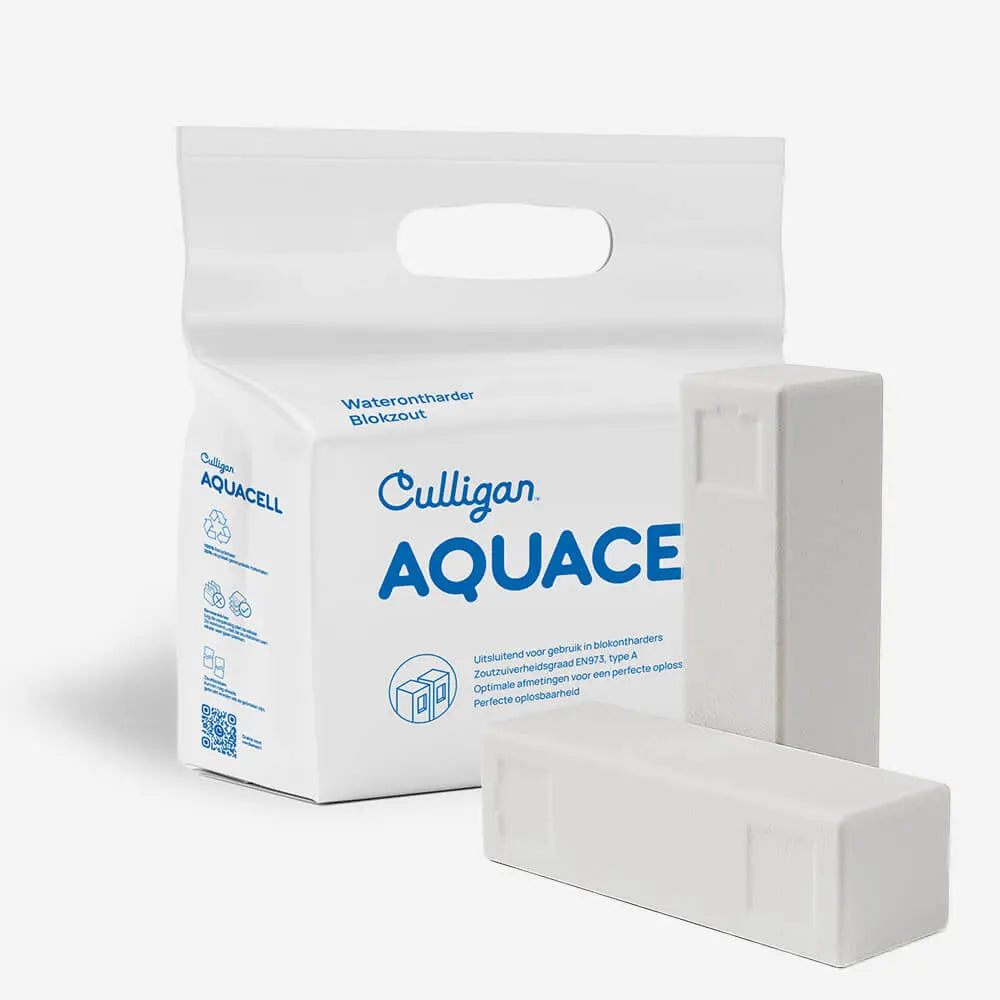
An ion exchanger removes calcium and magnesium from the water before it goes into your pipes. It is the only one of the limescale solutions with an international performance standard: NSF/ANSI 44 sets requirements for capacity, efficiency and the materials that come into contact with drinking water. How that process works step by step is on our page about how a water softener works. At PureAqua that starts with the Joep from €1,799 and the AquaCell at €2,348. That is an investment you don’t make for your coffee maker alone: you make it when your whole house suffers from limescale.
Purified water for what you drink
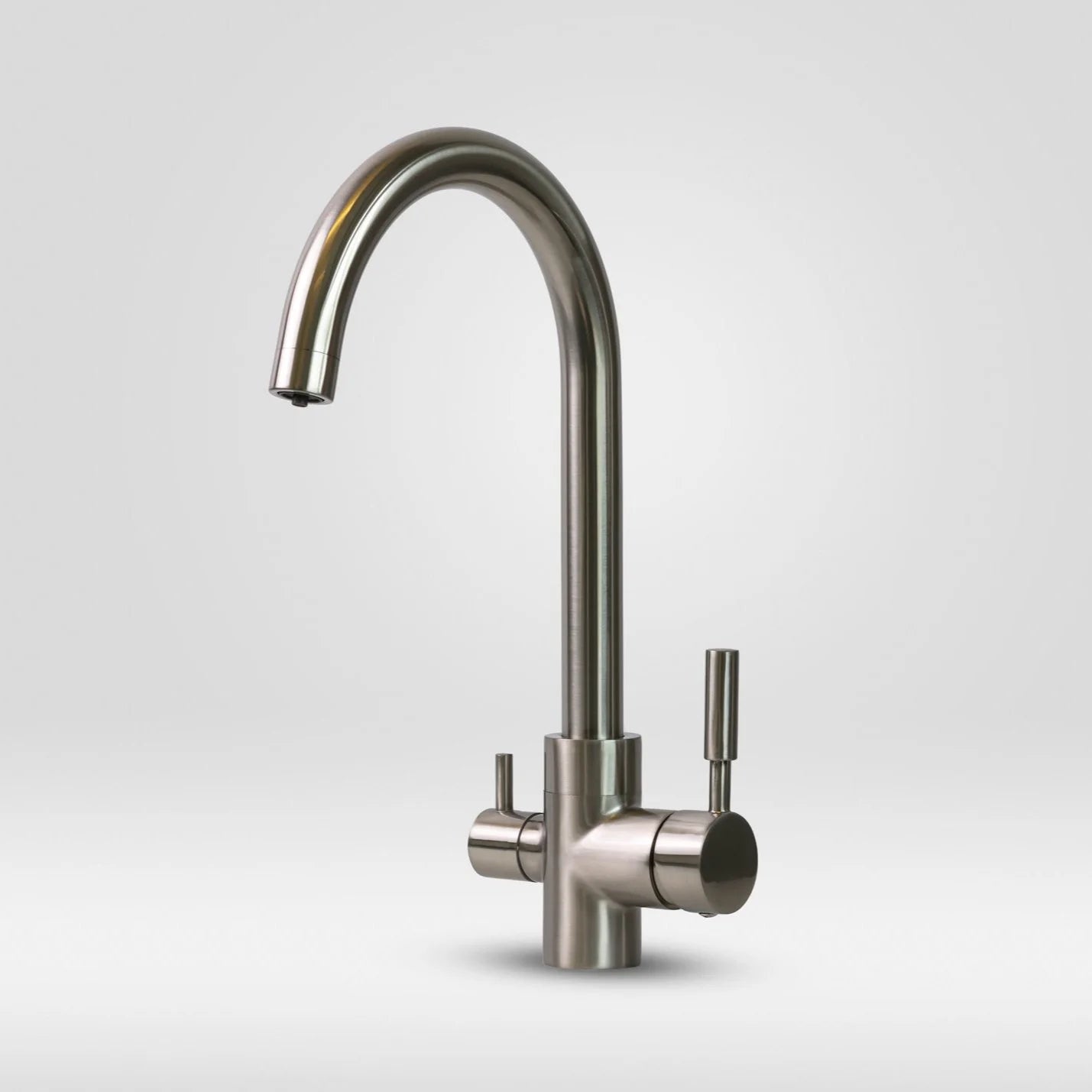
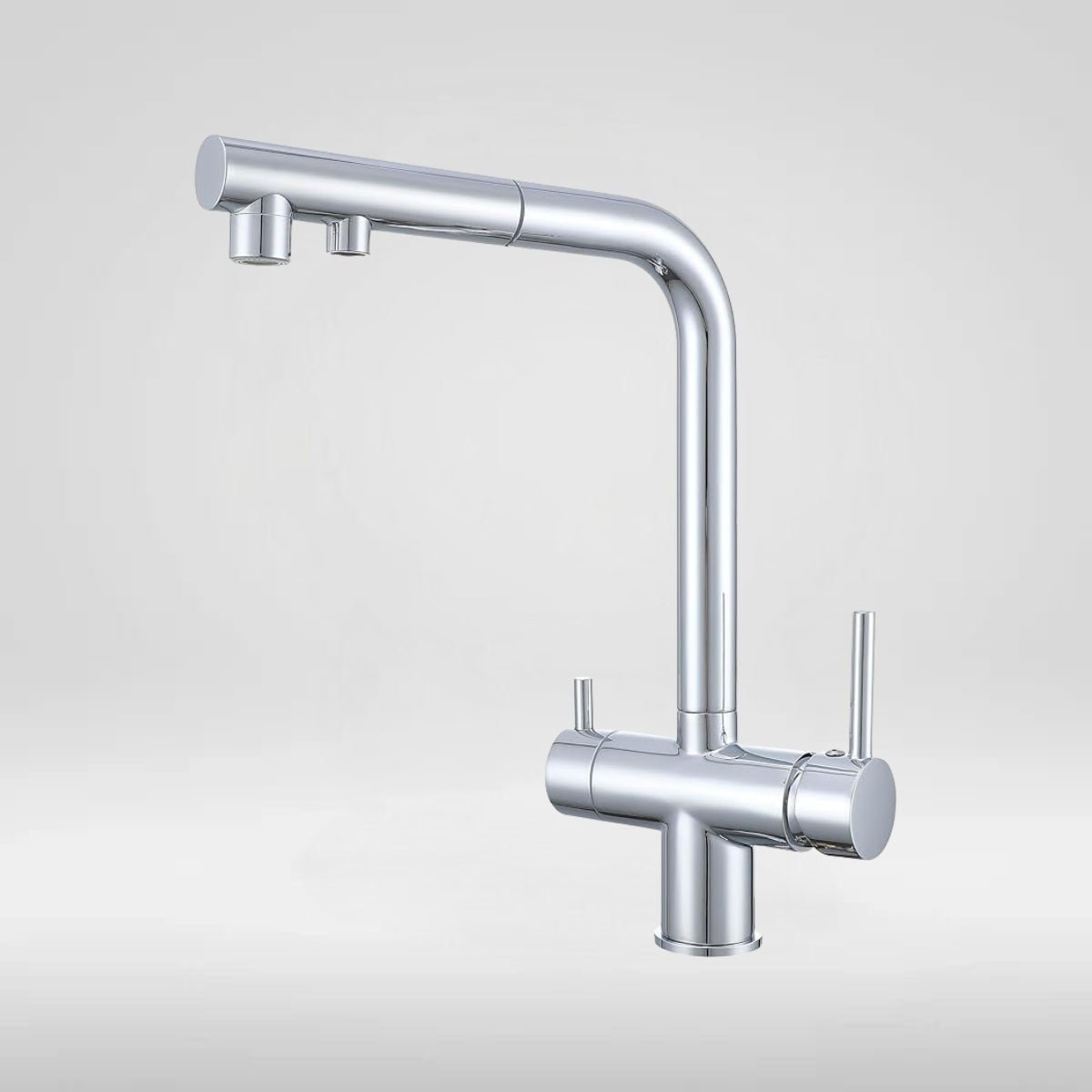
For the taste of your coffee and tea there is a second route: reverse osmosis at the tap point in the kitchen. That produces water that contains virtually no dissolved minerals, and therefore virtually no limescale that can precipitate. What else that water is suited for, from coffee to your iron, we explain in the overview of the uses for which osmosis water makes the difference. At PureAqua that system comes as standard with a pure water tap, or you take the Zorgeloos Zuiver Water subscription at €29 a month with €299 start-up costs, which includes the tap, the filter system, a year of filters and the installation.
And if neither suits you: just descale on time, with the right product for your type of machine. That is a perfectly good answer, and it is cheaper than both alternatives.
Frequently asked questions
What is the best way to descale a coffee maker?
With the product that belongs to your type of machine. With a filter coffee maker you fill the reservoir with a descaling solution, let half run through, switch the appliance off for 15 to 20 minutes and let the rest run through, after which you rinse with at least two full jugs of clean water. With a pad machine, a cup machine or a bean-to-cup machine you start the descaling programme from the manual for your model and use a descaler based on citric acid or lactic acid, or the manufacturer’s liquid. Descale every 6 to 8 weeks with daily use and every 2 to 3 months with less use, unless your machine gives its own alert; that alert takes precedence.
Can I descale my coffee maker with vinegar or cleaning vinegar?
Only with a simple filter coffee maker, and then with diluted white vinegar and generous rinsing. With anything that has a pump it is not possible. Albert Heijn advises against vinegar because household remedies such as vinegar can damage your appliance and because the smell of vinegar often lingers for a long time, which you taste again in your coffee. A pad machine, a cup machine and a bean-to-cup machine have rubber seals, a pump and a flow-through boiler that acetic acid attacks. Use a descaler based on citric acid or lactic acid there.
Can you descale a coffee machine with cleaning vinegar?
Better not. Cleaning vinegar and white vinegar are chemically the same acid in water, but cleaning vinegar is the more concentrated of the two and so attacks rubber and aluminium faster. With a coffee machine that has a pump, such as a pad machine, a cup machine or a bean-to-cup machine, that is exactly the wrong property. Vitens does advise cleaning vinegar for household appliances in general, but adds the proviso that you should always read the cleaning instructions of the appliance first. For coffee machines with a pump, that instruction almost always comes down to a descaler based on citric acid or lactic acid.
Why not descale with vinegar?
For two reasons that both have nothing to do with the limescale. Acetic acid dissolves limescale perfectly well, but it also attacks rubber seals, gaskets and some aluminium parts, and those are precisely what sit in the pump and the flow-through boiler of a modern coffee machine. In addition, the smell of vinegar soaks into plastic and lingers, so you taste it again in your coffee. Nespresso explicitly advises against vinegar because it can damage the machine. With a simple filter coffee maker without a pump both objections matter much less, and there diluted white vinegar with generous rinsing is fine.
How can I descale my coffee maker following grandma’s advice?
The household remedy handed down from generation to generation is vinegar, usually half water and half white vinegar through the reservoir. On the appliance grandma used it on, a filter coffee maker without a pump, that still works, as long as you then rinse with at least two to three full jugs of clean water. The second household remedy, lemon juice, also dissolves limescale but contains sugars and pulp that can be left behind; a ready-made descaler based on citric acid does the same job without that drawback. On a pad machine, a cup machine or a bean-to-cup machine, grandma’s advice does not carry over, because those machines didn’t exist back then.
Is cleaning vinegar or white vinegar better for descaling?
For dissolving limescale, cleaning vinegar is faster, because it is the more concentrated of the two; chemically it is the same acetic acid in water. For your coffee maker, white vinegar is therefore the wiser choice of the two, because the milder concentration pulls less hard on rubber and aluminium. But the real choice comes a step earlier: do you want to use vinegar at all on this type of machine? With a filter coffee maker you can, diluted and with generous rinsing. With a machine with a pump the answer to both variants is no.
Conclusion
The question of which product you may use has no single answer, and that is exactly why the Dutch search results on this subject have been contradicting each other for years. Albert Heijn, the Consumentenbond, Vitens and the sellers in second and fifth place are all right, but about different appliances. The distinction none of them makes is whether there is a pump inside.
If there isn’t, as with a classic filter coffee maker, diluted white vinegar is fine, as long as you rinse with two to three full jugs. If there is, as in every pad machine, every cup machine and every bean-to-cup machine, acetic acid goes after the rubber seals and the smell soaks into the plastic. That calls for a descaler based on citric acid or lactic acid, or the manufacturer’s liquid, and the programme from the manual for your model. Count on every 6 to 8 weeks with daily use, and follow your machine’s alert if it has one.
And the limescale itself? It keeps coming as long as it is in your tap water. Whether that is worth a softener or a purification system depends on your hardness, your household and your appliances. We are happy to work it out with you, even if the outcome is that a €6 bottle of descaler a year is the wisest answer for you. Drink different, but with a clean machine.
Want to know if limescale costs you more than a bottle of descaler?
We look at your hardness, your household and your appliances and honestly tell you what would do anything for you. Free, without obligation and without a sales pitch.
Get free advice View the taps