




Is water from a Quooker filtered?
Partly. The Quooker tank contains a HiTAC filter made of activated carbon, and the CUBE has its own filter for chilled and sparkling water. If you also want to filter your water before it reaches the Quooker, you fit an inline filter on the cold water pipe to your Quooker. The PureFilter Mineral+ lowered PFOA and PFOS by 83 to 85% in the lab test by Equinox Labs (2026). See the Quooker taps.
More and more people with a Quooker ask us the same question: "Can I also filter my tap water?" The short answer is yes. The full answer requires a bit more explanation, as not every filter technology works well in combination with a boiling water tap.
In this blog, we explain which type of water filter is suitable for a Quooker, why that is the case, and which solution best suits your situation. No sales pitch, just honest advice.
Why people want a water filter, even with a Quooker
A Quooker is a great tap for instant boiling water, but it is not a full-fledged water purification system. The tank contains a HiTAC filter made of activated carbon for the boiling water. If you want to be sure what happens to substances like PFAS, add a filter that has been lab tested.
That is why many Quooker owners choose an additional water filter under the sink. The idea is simple: the water is filtered first and only then enters the Quooker. This way, you get filtered water from both your cold tap and your boiling water tap, perfect for tea, coffee, cooking, and just a glass of water.
The golden rule: always filter before the Quooker
Before we discuss the right solution, first this: you should always place an additional water filter before the Quooker, on the cold water line leading to your system. Not after it, not on the hot side, and not on the tank itself.
The logic is clear: you want to purify the water first and only then let it into your Quooker. This way, you protect not only what you drink, but also the tank, the pipes, and the lifespan of your tap.
Which filter types are there, and what works with a Quooker?
There are three main types of water filters that people consider: pitcher filters, reverse osmosis, and inline filters. Not all three are suitable for combination with a Quooker; let's look at them one by one.
Pitcher filters (Brita and similar)
Pitcher filters are separate from your tap and filter water in a jug. They are not connected to your pipes and therefore work entirely independently of your Quooker. Practical for individual glasses of water, but not a solution for people who want their boiling water filtered as well. For Quooker owners, this is not a comprehensive option.
Reverse osmosis (RO)
Reverse osmosis is the most thorough filter technology that exists. Water is pressed under pressure through a membrane with microscopically small pores, which holds back almost everything—contaminants, but also minerals.
Important for Quooker owners: an RO system works with a storage tank and a separate filter tap on the sink. The system itself is not designed to be connected to a Quooker and is not suitable for it. An RO system is therefore a separate solution—a second tap next to your Quooker—and not an addition to your existing tap.
An RO system is an excellent choice for those who want very thorough filtration and accept having a separate filter tap on the sink. For those who specifically want to filter the water before it reaches the Quooker, it is not the right solution.
Inline filters under the sink
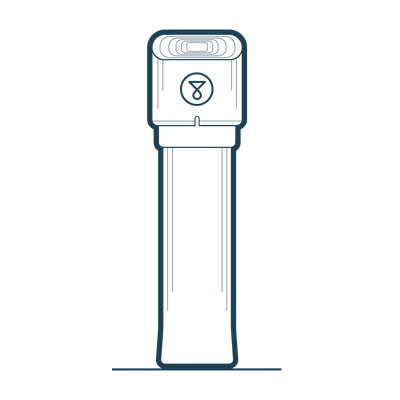
An inline water filter is a compact cartridge that is mounted directly onto the cold water line. The water flows through it and is filtered in a single pass—without a storage tank, without wastewater, and without loss of pressure or power.
This is the only type of filter that is suitable for placement before a Quooker. The filter operates at normal water pressure, provides filtered water instantly without delay, and fits between the cold water line and your Quooker system without any issues.
More information about the inline filter

Why an inline filter is the solution for Quooker owners
For the average Quooker owner, an inline filter is the most practical and most effective addition. The reasons summarized:
- It filters directly on the pipe to your Quooker, so your boiling water starts as filtered water
- You connect it yourself or have it installed
- It works at normal water pressure, from 1.5 to 8.5 bar
- The PureFilter Mineral+ lowered PFOA and PFOS by 83 to 85% in the lab test by Equinox Labs (2026)
- It is compact and fits in almost any kitchen cabinet
- The filter lasts up to 12 months and is easy to replace yourself
The only point of attention: not every inline filter works the same way. Some filters also remove natural minerals from the water, which makes it taste "flat." The better inline filters actually add minerals during the filtration process.

An interesting addition: inline filter with natural minerals
There is a specific category of inline filters that not only removes contaminants but also adds natural minerals to the water during the filtration process. This occurs via a layer of mineral rock in the filter—a technology that originally comes from Sweden and is known as Swedish Mineral Rock™.
The water flows through this layer and is naturally enriched with calcium, magnesium, and potassium. This gives the water the characteristic, fresh taste profile you recognize from high-quality spring water, while all contaminants are removed at the same time.
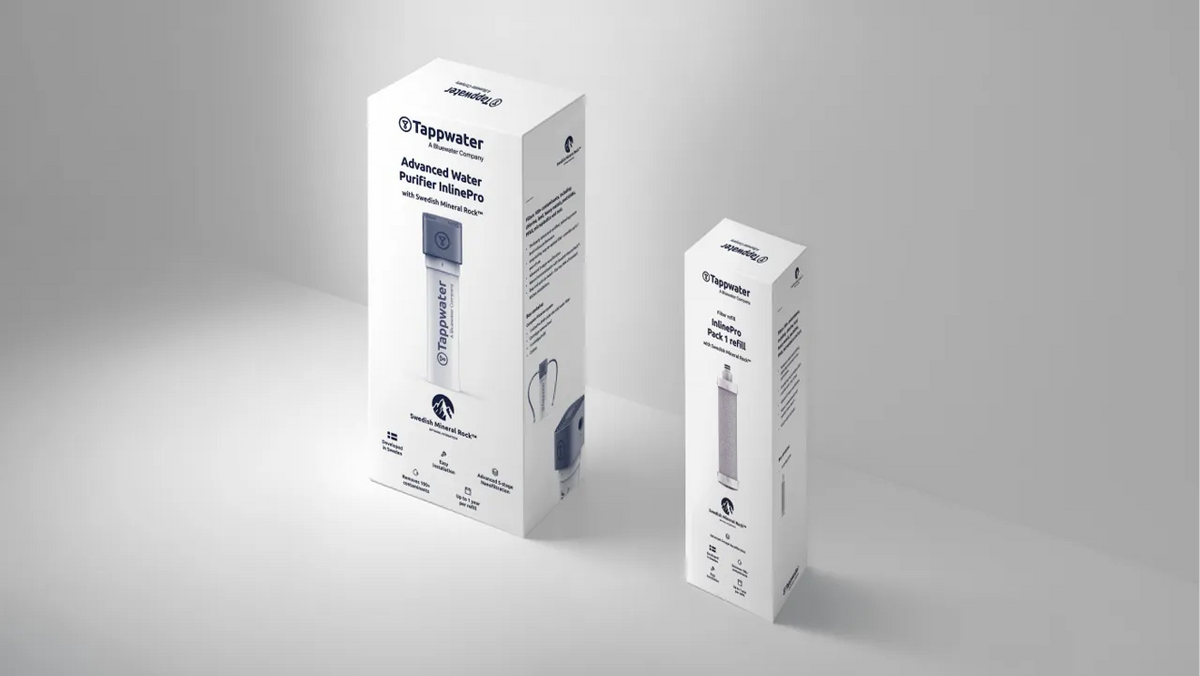
This technology is featured in products like the PureFilter Mineral+, a Dutch inline water filter specifically designed to be mounted directly under the sink and perfectly combined with a Quooker. The filter fits on the cold water line before your Quooker, provides pure and mineral-rich water for up to 12 months, and can be installed yourself in 5-10 minutes without a plumber.
For Quooker owners who want to get the best out of their tap water while maintaining minerals and protecting against modern contaminants, this is the most practical solution.
Read more about the PureFilter Mineral+
Which choice suits you? Three scenarios
Scenario 1: You have a Quooker and want all your water (cold and boiling) filtered
An inline filter under the sink is the smartest choice. Compact, retains minerals, removes PFAS, microplastics, and chlorine. And it works seamlessly with your Quooker.
Scenario 2: You want a thoroughly purified, separate filter tap next to your Quooker
Then a reverse osmosis system with a separate filter tap on the sink is the right option. This is separate from your Quooker and provides the highest level of filtration specifically for drinking water.
Scenario 3: You are unsure if you even need a filter
Ask yourself what your goal is. Are you mainly looking for better taste, protection against modern contaminants (PFAS, microplastics), and mineral retention—for both your cold and boiling water? Then an inline filter is the logical choice. Do you want a separate, thoroughly purified drinking water tap next to your regular tap? Then you end up with RO.
Frequently asked questions
Does an inline filter fit every Quooker?
Yes. An inline filter is mounted on the cold water line before your Quooker and is therefore compatible with all Quooker models—including in combination with the CUBE.
Will my boiling water also be filtered?
Yes. Because the filter is before the Quooker, all the water that goes to your boiling water tap first flows through the filter. The water in your tank is therefore already purified before it is heated.
Does an inline filter affect the water pressure of my Quooker?
With a quality filter, you will not notice any significant difference. The pressure is maintained because the filter is designed for flow-through without storage.
How often do I have to replace the filter?
For an inline filter, that is usually once every 12 months for a household of 1-3 people, or every 6 months for larger households.
Is an inline filter cheaper than reverse osmosis?
Yes, both in terms of purchase and maintenance. An inline system costs around €150 with an annual replacement filter of around €50. An RO system is generally a larger investment with multiple filters that need to be replaced annually.
Tip: do you also want pure drinking water from the same tap alongside boiling water? Check out the PureAqua 4-in-1 tap—boiling, hot, cold, and filtered water in one.
Finally
For most Quooker owners who want to improve their tap water, an inline filter under the sink is the most logical solution. It filters all your water—cold and boiling—without you having to change anything about your existing tap.
For those who are specifically looking for a separate filter tap with the most thorough purification, reverse osmosis remains the standard. At PureAqua.nl, we have been selling high-quality RO systems for that exact purpose for years.
For those looking for a compact, mineral-retaining inline filter that fits perfectly with a Quooker, we recommend the PureFilter Mineral+.







 Filtered drinking water
 Boiling water from the tap
 Less limescale at home
 Water for my business


