Reading time: approximately 9 minutes
Short answer
Yes, you can filter PFAS from your tap water. The most reliable method is reverse osmosis, which forces the water through a membrane and blocks up to about 99 percent of PFAS, along with heavy metals, nitrate, and limescale, according to the NSF/ANSI 58 standard. A good activated carbon filter binds some of the PFAS, but results vary. A filter pitcher or water softener does not address PFAS reliably.
In this article
- Can you filter PFAS from tap water?
- Which water filters remove PFAS and which do not?
- Why reverse osmosis is the most reliable choice
- PFAS filters compared
- Filtering PFAS from your tap water with PureAqua
- What should you look out for?
- What does this mean for Dutch tap water?
- Frequently asked questions
- Conclusion
Can you filter PFAS from tap water?
Yes, you can. PFAS are extremely small and hardly break down, which earned them the nickname "forever chemicals," but with the right technology, you can remove them from your drinking water. According to the Drinkwaterplatform, PFAS particles are present in Dutch drinking water, and a large number of PFAS are known to be potentially harmful to health and the environment. The RIVM (National Institute for Public Health and the Environment) monitors levels closely and is urging for reductions in the coming years.
Important to know: Dutch tap water meets legal standards and is safe to drink according to the RIVM. Those who still wish to further reduce their exposure to PFAS can purify the water additionally at the kitchen tap. This is not a necessity, but a conscious choice to go beyond the standard. If you first want to know where PFAS in the home comes from, read our article on reducing PFAS in the rest of your home. In this article, we focus on the solution: which water filter actually removes PFAS.
Which water filters remove PFAS and which do not?
Not every filter that has "PFAS" on the packaging actually addresses these substances. The difference lies in the technology, and that is precisely where many product descriptions remain vague.
Definition
A PFAS water filter is a water filter that removes per- and polyfluoroalkyl substances from your drinking water. Only techniques with a fine membrane or suitable, fresh activated carbon demonstrably reduce PFAS. A simple sieve or a saturated filter does not.
What does address PFAS
- Reverse osmosis: pushes water through a semi-permeable membrane and blocks up to about 99 percent of PFAS, plus heavy metals, nitrate, microplastics, and limescale. The most complete method for your drinking water.
- Good quality activated carbon: binds a portion of the PFAS through adsorption. The exact amount depends on the type of PFAS, the type of carbon, and how fresh the filter still is. Less complete and less predictable than a membrane.
What does not reliably address PFAS
- Filter pitcher with carbon cartridge: handy for chlorine taste, but limited for PFAS and highly dependent on timely replacement. We compare the filter pitcher and reverse osmosis in the same calculation.
- Water softener: makes water soft and lime-free via ion exchange, but does not remove PFAS. Softening and purifying are two different things; read how a water softener works if you are in doubt.
The difference between carbon and membrane goes deeper than the level of PFAS removal. We fully explained it in our article on what activated carbon does and does not remove from water.
Why reverse osmosis is the most reliable choice
Reverse osmosis does not bind anything but separates at a molecular level. Water is pressed under pressure through a membrane that is so fine that water molecules pass through while many larger and charged particles do not. Precisely because it does not depend on whether a substance adheres to carbon, the list of contaminants that a membrane blocks is much longer, and PFAS is reliably among them.
The performance of such systems is laid down in NSF/ANSI 58, the international standard for household reverse osmosis systems. At PureAqua, The Source removes up to about 99 percent of, among other things, PFAS, microplastics, heavy metals, and limescale from your tap water in this way. How that process works exactly can be read on our page about how reverse osmosis works.
There is also a downside, and we do not hide it. A membrane removes the good minerals just as well as the rest, and there is rinse water involved. We list those disadvantages in our article on what osmosis costs in terms of minerals and rinse water. An optional mineral filter after the membrane adds calcium and magnesium back in.
PFAS filters compared
| Filter type | PFAS removal | Note |
|---|---|---|
| Reverse osmosis | Up to approx. 99 percent | Most complete, also heavy metals, nitrate, and limescale |
| Activated carbon (good quality) | Partial and variable | Depends on carbon type, PFAS type, and saturation |
| Filter pitcher with carbon cartridge | Limited | Mainly chlorine and taste, timely replacement is key |
| Water softener | No | Removes limescale via ion exchange, no PFAS |
At PureAqua, we see that customers who start with this question almost never care only about taste. They mention PFAS, heavy metals, or their newborn child. For those concerns, a membrane is the technology that actually makes a difference.
Pure water without PFAS from your own tap
Tell us what you want to remove from your water, and we will think along with you without any obligation. No sales pitch, just honest advice.
Request free advice View the pure water tapsFiltering PFAS from your tap water with PureAqua
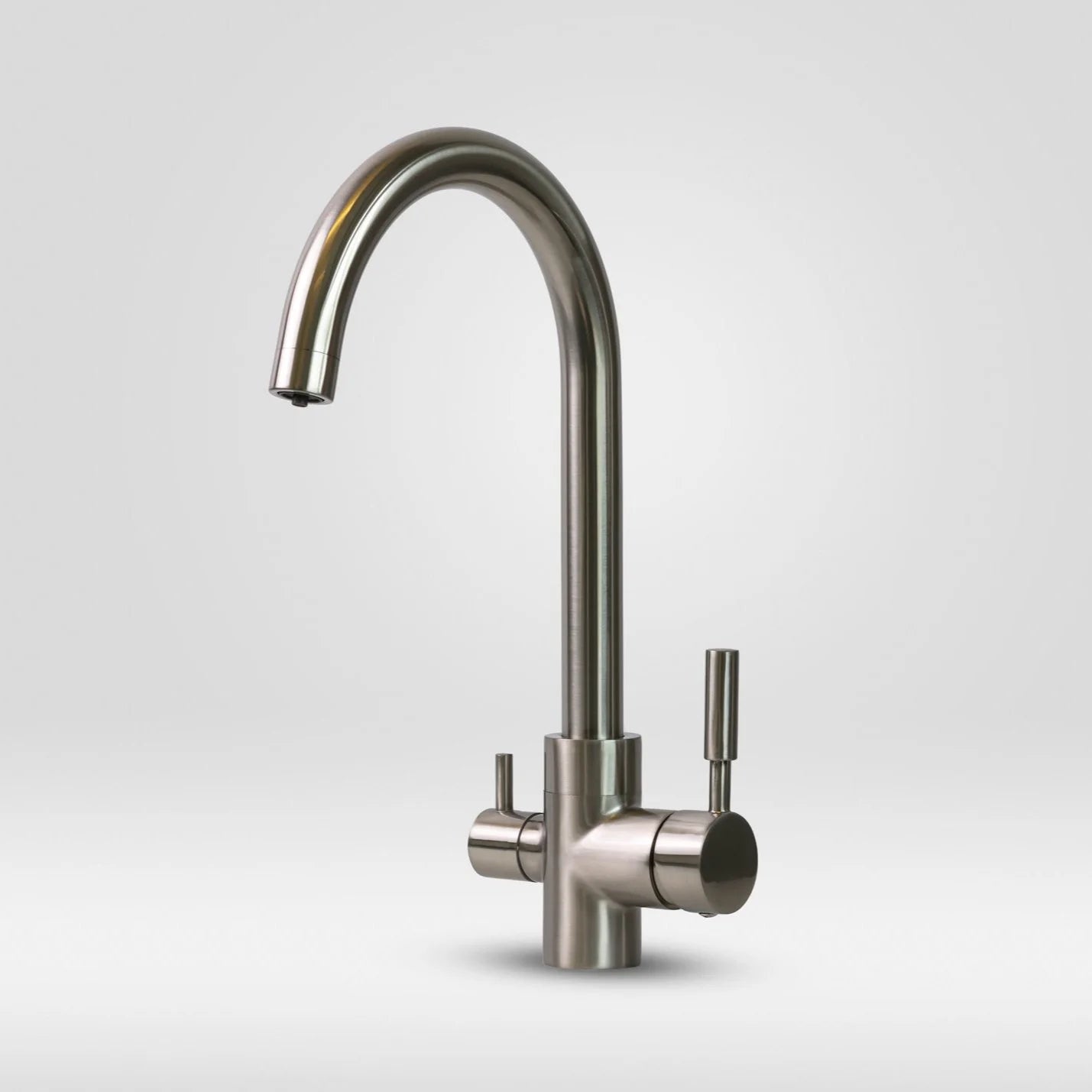
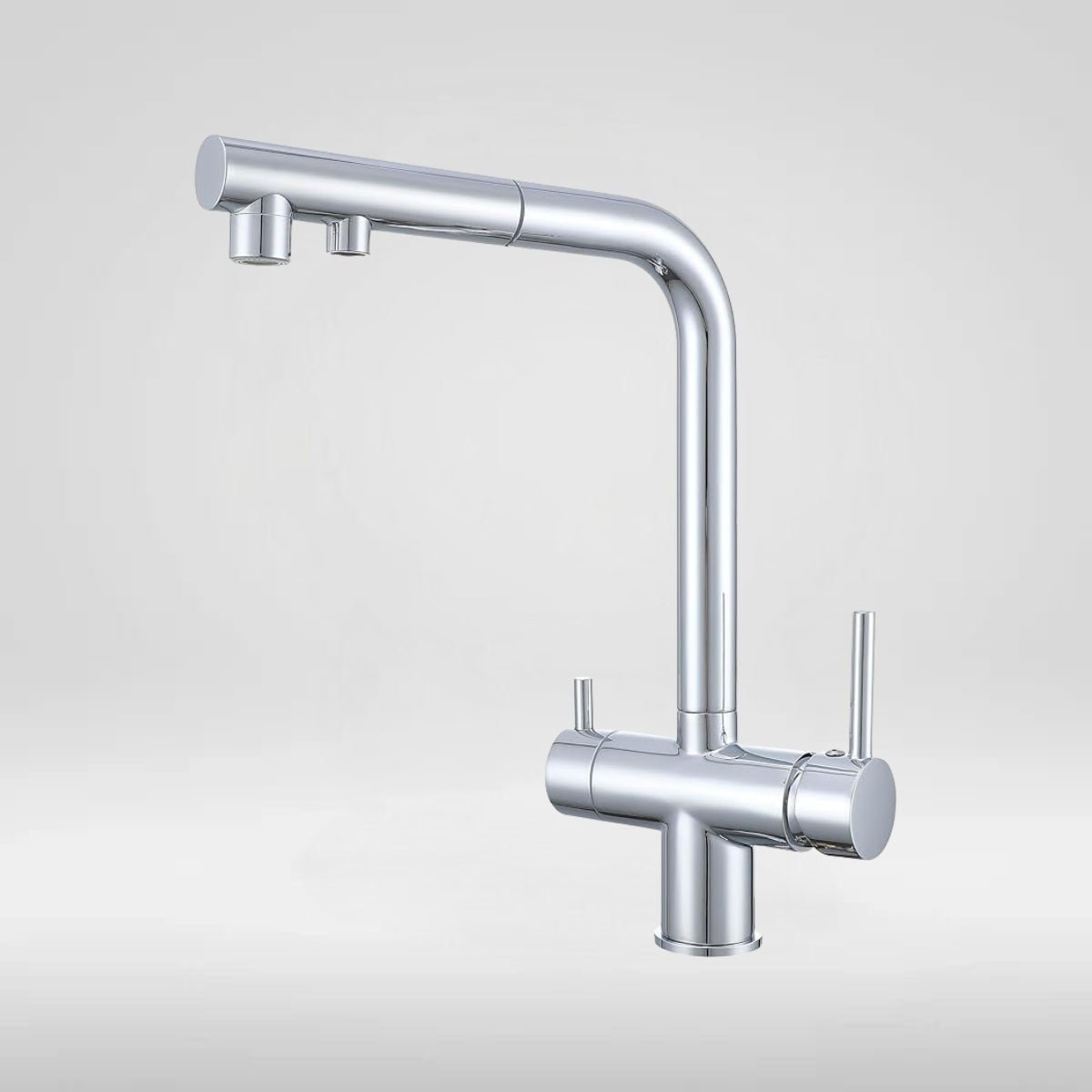
At PureAqua, you have several ways to get PFAS-free water, all based on reverse osmosis. The pure water taps have the osmosis system included and purify your drinking water directly at the tap. If you want purified, boiling, and chilled water from one tap, the PureAqua 4-in-1 tap is a complete solution.
Prefer not to have an installation under the sink? Then the water purification device offers plug-and-play purification: place it on the countertop, plug it in, and enjoy immediately purified water. And those who don't want to worry about it can choose the Carefree Pure Water subscription for 29 euros per month with 299 euros in startup costs, including a tap of your choice, system, filters for twelve months, and installation by a specialist.
What should you look out for in a PFAS water filter?
A filter works only as well as its maintenance. If a filter becomes saturated and is not replaced, its effectiveness decreases and it can itself become a breeding ground for bacteria. Vitens explicitly warns about this for filters that are left in for too long. Therefore, pay attention to these three points:
- Technology: choose reverse osmosis for the most complete and predictable PFAS removal, not just a separate carbon step.
- Certification: look for a standard like NSF/ANSI 58 for the osmosis system, so that performance has been independently tested.
- Maintenance: replace the filters on time. With a service appointment or the subscription, you don't have to think about that yourself.
What does this mean for Dutch tap water?
A fair nuance is appropriate, including from us as a supplier. Dutch tap water is safe and healthy according to the RIVM, and both Vewin and Milieu Centraal describe how extensively the quality is already monitored. So, you are not filtering out of necessity in the Netherlands.
What you do with an osmosis system is go further than the standard: reducing PFAS as much as possible, no more limescale in your drinking water, and a neutral taste. If you want to know exactly how strictly tap water is checked, read our article on how safe and healthy Dutch tap water is.
Frequently asked questions
Can you filter PFAS from water?
Yes. With reverse osmosis, you remove up to about 99 percent of PFAS from your tap water because the membrane holds back the substances at a molecular level. A good activated carbon filter binds some of the PFAS, but results vary. A filter pitcher or water softener does not address PFAS reliably.
What is the best water filter against PFAS?
A system based on reverse osmosis is the best choice because the membrane blocks PFAS while simultaneously removing heavy metals, nitrate, and limescale. Look for a certification such as NSF/ANSI 58. A mineral filter after the membrane returns calcium and magnesium for taste.
How can I filter PFAS from my tap water?
Install a reverse osmosis system on your kitchen tap. With PureAqua, that system is included with the pure water tap, so you tap purified drinking water directly. If you don't want to drill, it can also be done with a separate device on the countertop. It is important that you replace the filters on time.
Does a Brita or other filter pitcher remove PFAS?
Limited. A filter pitcher with a carbon cartridge is mainly good for chlorine taste and odor, and PFAS removal depends heavily on how fresh the cartridge is. For reliable, complete PFAS removal, reverse osmosis is a much more certain solution than a pitcher.
Does a water softener remove PFAS?
No. A water softener makes your water soft and lime-free via ion exchange, but it does not filter PFAS. If you want soft and pure water, combine a whole-house water softener with an osmosis tap for your drinking water.
How often should I replace the filter?
That varies by system and water consumption. Timely replacement is important, as a saturated filter works less well and can become a breeding ground for bacteria. With the PureAqua subscription or a service appointment, this is arranged for you, including the filters.
Conclusion
Filtering PFAS from your tap water is possible, and the most reliable way is reverse osmosis, which removes up to about 99 percent of PFAS while also removing heavy metals, nitrate, and limescale. A good carbon filter binds some, but results vary; a filter pitcher or water softener does not offer that certainty. Dutch tap water is already safe, so you filter here out of a conscious choice to go beyond the standard.
If you are not sure what applies to your situation, please feel free to call or WhatsApp us. We prefer to honestly calculate that a simpler step suffices than to sell you a system you don't need. Drink different.
Ready for water without PFAS?
A pure water tap with an osmosis system included, or everything worry-free via the 29 euros per month subscription. We advise, install, and maintain.
View the pure water taps View the subscription