Reading time: approximately 9 minutes
Quick answer
A 3-in-1 tap provides cold, hot, and boiling water from a single tap. A 4-in-1 tap adds a fourth function. For most brands, this is filtered water; for others, it is chilled or sparkling water. Always check which fourth function you are getting, as it varies by brand.
In this article
- What is a 3-in-1 tap?
- What is a 4-in-1 tap?
- The difference at a glance
- Why 4-in-1 means something different for every brand
- What does that fourth channel really filter?
- Energy consumption and annual costs
- 3-in-1 or 4-in-1: what suits you?
- Points to consider before choosing
- PureAqua compared to the alternatives
- Frequently asked questions
- Conclusion
What is a 3-in-1 tap?
Definition
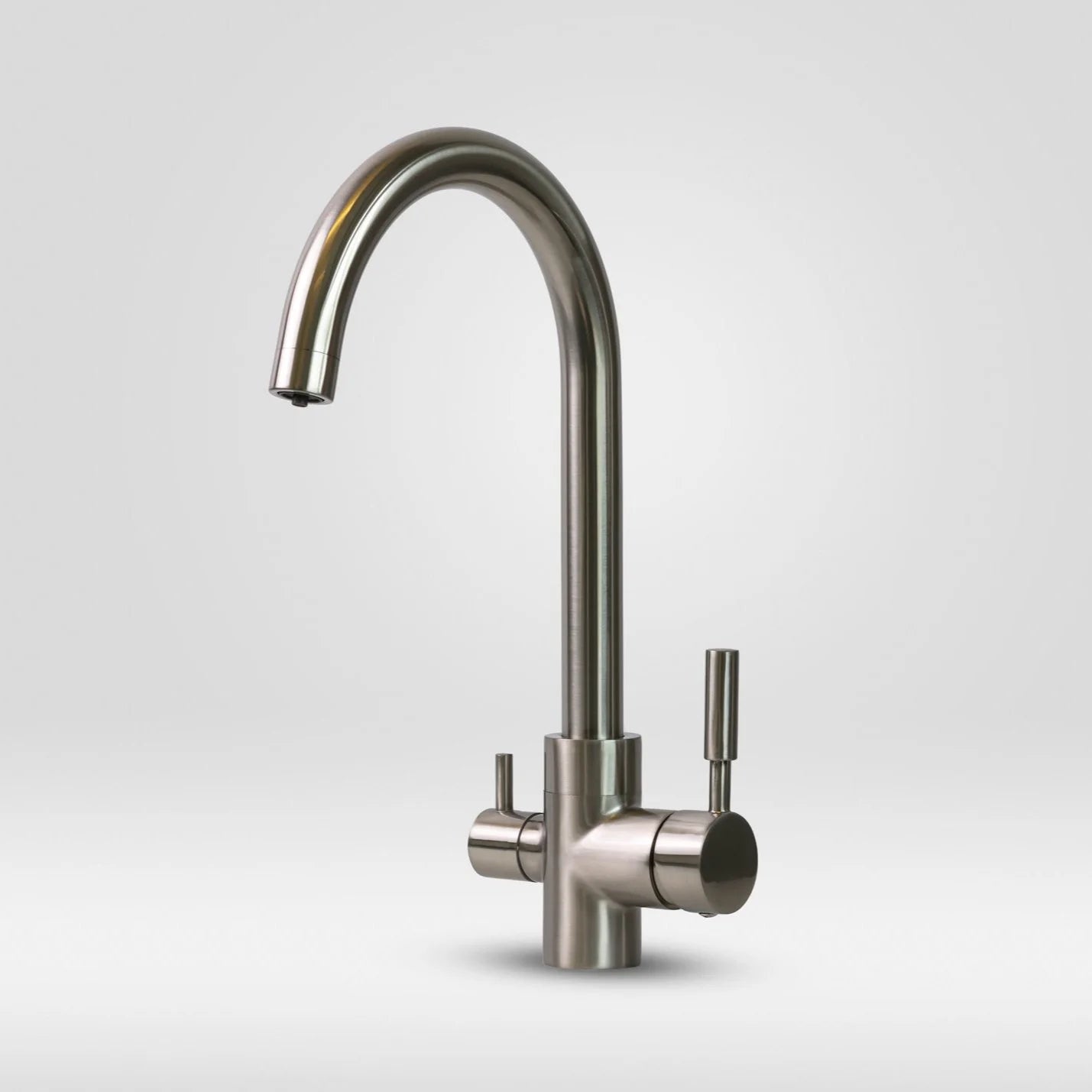
A 3-in-1 tap is a kitchen faucet with three functions from a single spout: cold water, hot water, and boiling water at approximately 100 degrees Celsius. The boiling water comes from a small reservoir under the sink that keeps the water at a constant temperature.
The 3-in-1 tap is the most well-known type of boiling water tap and effectively replaces your kettle. You dispense boiling water instantly for tea, coffee, pasta, or blanching vegetables, and you no longer need an extra appliance on your countertop. The reservoir under the sink is the heart of the system: it determines how much boiling water you can draw at once and how much power the tap consumes.
Important to know: a 3-in-1 tap is a temperature solution, not a water quality solution. The water that comes out is just your regular tap water, only boiling. Such a tap does not remove limescale, PFAS, or drug residues. If you want that, you automatically end up with the fourth function.
What is a 4-in-1 tap?
A 4-in-1 tap does everything a 3-in-1 tap does, plus one extra function. And therein lies the confusion: that fourth function is not the same for every brand. In practice, you see three variants.
- 4-in-1 with filtered water: cold, hot, boiling, and filtered water. This is the most common version, found in brands like HOWAT, FlexTap, and the Itho Daalderop Close-In More, which combines a 10-liter boiler with a tap that dispenses cold, hot, boiling, and purified water.
- 4-in-1 with chilled or sparkling water: cold, hot, chilled, and sparkling water, such as the Selsiuz Cool 4-in-1. Here, the fourth function is an experience, not purification.
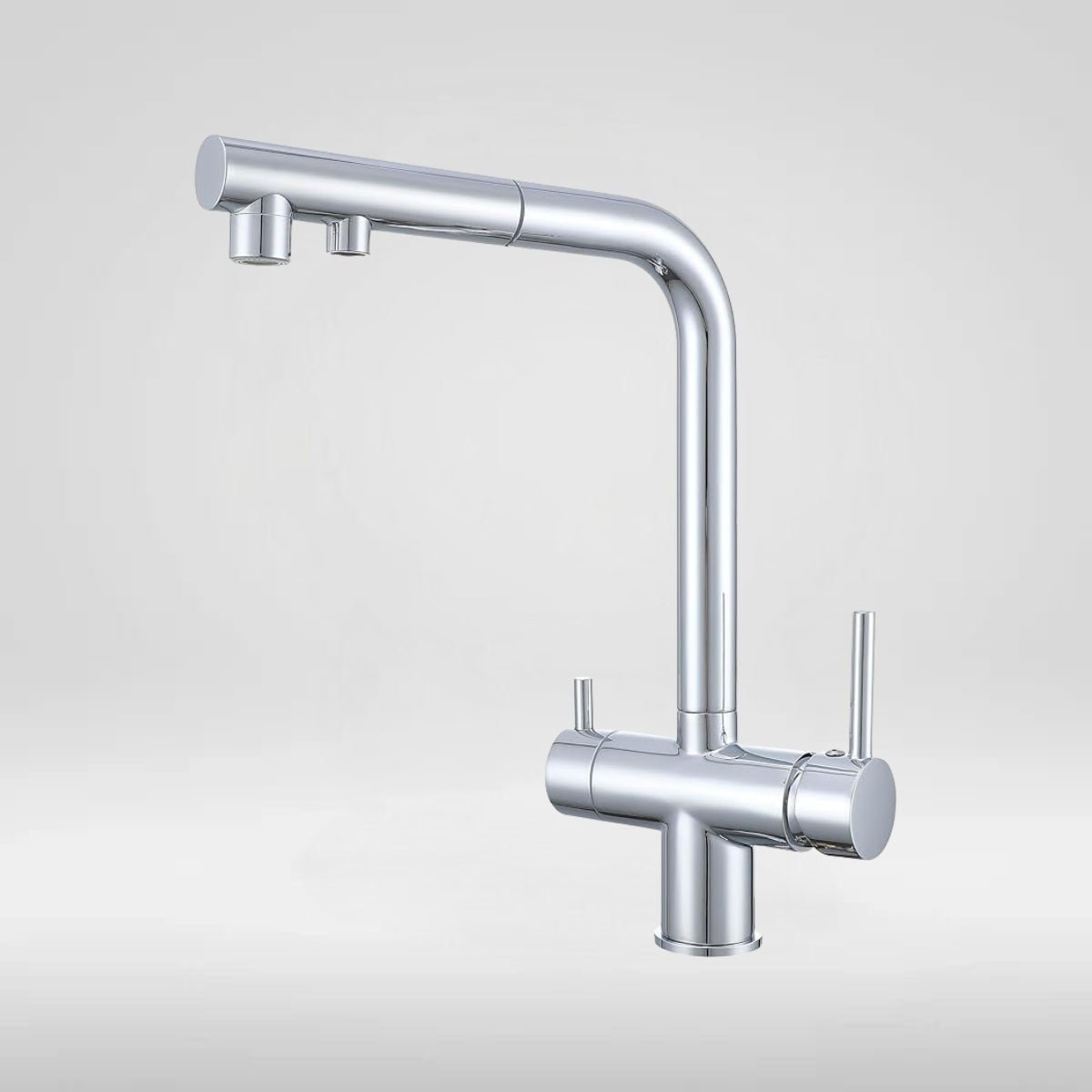
- 4-in-1 with reverse osmosis: cold and hot water plus filtered, filtered boiling, and filtered chilled water. This is the version of the PureAqua 4-in-1 tap, where the water first passes through a reverse osmosis system.
The latter is a fundamental difference. With most 4-in-1 taps, only the cold dispensing point passes through a filter, and the boiling water still comes out of the boiler unfiltered. With a tap based on reverse osmosis, every drinkable dispensing point is filtered, including your tea and your pasta. At PureAqua, we see that customers specifically drop out of cheaper models for this reason: they thought they were buying filtered boiling water and only received a filtered cold tap.
The difference at a glance
| Tap type | Functions | Purifies the water? | Typical for |
|---|---|---|---|
| 3-in-1 | Cold, hot, boiling | No, only temperature | Those who want to replace the kettle |
| 4-in-1 with filter | Cold, hot, boiling, filtered cold | Partially, usually a carbon filter on the cold tap | Those who want to tackle limescale and taste |
| 4-in-1 with sparkling or cooling | Cold, hot, chilled, sparkling | No, this is an experience | Lovers of sparkling water |
| 4-in-1 with reverse osmosis | Cold, hot, filtered, filtered boiling, filtered chilled | Yes, up to approx. 99% of PFAS, microplastics, heavy metals, and limescale | Those whose primary goal is pure drinking water |
| 5-in-1 | Cold, hot, boiling, chilled, sparkling | No, unless it comes with a separate filter system | Those who want everything in one tap |
In short: the difference between 3-in-1 and 4-in-1 is not about "more luxury," but about what the tap does to your water rather than just its temperature.
Why 4-in-1 means something different for every brand
"4-in-1" is not a protected term or a standard. Every brand decides for themselves which functions count, which explains why prices vary so widely. In a spot check of the Dutch market on August 11, 2026, 4-in-1 taps ranged from approximately 295 euros for an entry-level FlexTap model and 495 euros for a Watura to 1,829 euros for a Selsiuz Cool 4-in-1. A Quooker COMBI+ Flex was priced at about 1,396 euros, and a Quooker Flex with CUBE reservoir as a 5-in-1 at about 2,138 euros.
That price difference of more than a factor of six says more about what happens under your sink. An inexpensive 4-in-1 tap typically has a small boiler and a simple carbon filter cartridge. An expensive tap has a better-insulated reservoir, a carbonation module, or a full-fledged filtration system. The question you should ask every provider is about the technology under your sink: we explain in detail how a filter tap filters your tap water. If you want to evaluate the system yourself, use the criteria from our guide on choosing a reverse osmosis system.
The question you should ask every provider is therefore not "is this a 4-in-1 tap," but: which fourth function do I get, and does the boiling water pass through it too?
What does that fourth channel really filter?
Dutch tap water is of high quality, but there are points of attention. The RIVM advises lowering the PFAS standard for drinking water from 100 nanograms per liter to 4.4 nanograms per liter, expressed as PFOA equivalents, and reports that in more than half of the measurements in drinking water made from river water, the concentration is higher than the 20 percent of the health-based limit recommended by the WHO. This is no reason for panic, but it is a reason to know what your filter is capable of.
Carbon filter: taste, chlorine, and particles
The filter in most 4-in-1 taps is an activated carbon cartridge. This improves taste, captures chlorine and suspended particles, and blocks coarser dirt. It is fine for taste, but it is not a purification technology for dissolved substances like PFAS, nitrates, or heavy metals. We extensively compare the distinction between those two worlds in water filter vs. water purifier vs. reverse osmosis compared.
Reverse osmosis: the finest mesh
Reverse osmosis forces water under pressure through a membrane that stops up to about 99 percent of contaminants, including PFAS, microplastics, heavy metals, and limescale. For this type of system, there is a separate American standard, NSF/ANSI 58, with fixed test procedures for, among other things, the removal of total dissolved solids (TDS); the lead limit in that standard has recently been tightened to 5 micrograms per liter. If you want to know exactly how the technology works, read how reverse osmosis works.
One nuance: reverse osmosis also removes minerals from the water. That is why there is an optional mineral filter that adds minerals back, for a fuller taste. We are honest about that in our article on the disadvantages of reverse osmosis and how to solve them. And because a membrane requires time and pressure, pure water in a 4-in-1 tap is dispensed from a small storage tank instead of directly from the pipe.
Are you doubting between 3-in-1 and 4-in-1?
Tell us what your kitchen and sink look like, and we will calculate together which tap fits. Advice is free and without obligation.
View the pure water tapsAsk for free adviceEnergy consumption and annual costs
A boiling water tap keeps water at a constant temperature, so the power consumption is a real expense. According to Milieu Centraal, a combi-boiling water tap with good insulation consumes an average of 290 kWh per year, while a comparable tap with poor insulation reaches about 480 kWh per year. That is almost double for the same function.
| Kitchen solution | Consumption per year |
|---|---|
| Combi-boiling water tap with good insulation | Average 290 kWh |
| Combi-boiling water tap with poor insulation | About 480 kWh |
| Close-in boiler plus kettle | About 370 kWh |
| Electric flow heater plus kettle | Average 220 kWh |
Milieu Centraal also discourages a tap that only provides boiling water, because you would still need another appliance for regular hot water. If you choose boiling water from the tap, choose a combi-version with good insulation. In addition to electricity, filters are part of the operating costs: include the replacement interval of each filter in your comparison, not just the purchase price.
3-in-1 or 4-in-1: what suits you?
Choose a 3-in-1 tap if
- You mainly want to get rid of your kettle and save time.
- The quality of your drinking water is not a purchase reason for you.
- Your budget and the space under the sink are limited.
Choose a 4-in-1 tap if
- You want pure drinking water without hauling bottles.
- You live in an area with hard water and see limescale in your kettle and appliances.
- You want to remove PFAS, microplastics, and heavy metals from your drinking water, and are therefore looking for a version with reverse osmosis.
- You want one tap that combines boiling, chilled, and filtered water instead of three separate appliances.
Do you already have a boiling water tap and want to keep it? Then a separate solution for drinking water is smarter than a new tap; we list which appliances exist for that and what they cost in which pure water appliance fits you. If you want pure water without messing with your tap or piping, the Countertop RO is a plug-and-play alternative that simply sits on the countertop: read how instant osmosis water without renovation works.
Points to consider before choosing
- Space under the sink: the reservoir, filter housing, and possibly a carbonation cylinder all need to fit. Measure the height and available width before you order.
- Reservoir size: this varies significantly by brand. For example, the Itho Daalderop Close-In More combines a 10-liter boiler with a 4-in-1 tap; smaller models provide less boiling water in succession.
- Faucet size and spout: you can choose between a round spout, an angular U-spout, or a C-spout, often rotatable 360 degrees and sometimes featuring a pull-out hand shower. Consider the height above your sink: the higher the spout, the easier it is to fill a tall pitcher.
- Filter maintenance: every filter has a replacement interval. Include these costs in your comparison, not just the purchase price.
- Installation: a boiling water tap requires a power outlet under the sink, and a reverse osmosis system also requires a drain connection. At PureAqua, a specialist handles the installation, or you can use the DIY installation kit.
- Water hardness: in areas with hard water, filters and boilers clog up faster. Consider a water softener as well: we compare the options in a water softener with or without salt.
PureAqua compared to the alternatives
| Option | What you get | Filtered boiling water? | Point of attention |
|---|---|---|---|
| Standard 3-in-1 boiling water tap | Cold, warm, boiling tap water | No | Does not resolve taste and contaminants |
| 4-in-1 tap with carbon filter | Extra filtered cold water tap | No, only the cold water tap | No purification of dissolved substances like PFAS |
| 4-in-1 tap with sparkling or cooling | Chilled and sparkling water | No | Fourth function is an experience, not purification |
| PureAqua 4-in-1 tap with reverse osmosis | Warm, cold, filtered, filtered boiling, and filtered chilled water | Yes | Requires space and a drain connection under the sink |
| PureAqua pure water tap next to your existing tap | Separate tap for osmosis water | No, but fully pure cold water | Requires a second hole in the countertop |
| Countertop RO from PureAqua | Osmosis water without installation | No | Sits on the countertop instead of underneath |
At PureAqua, the filter system is included as standard with a pure water tap; you don't have to purchase separate parts. If you prefer to spread the cost, the Carefree Pure Water subscription is available for 29 euros per month with 299 euros in startup costs, including a tap of your choice, filter system, filters for twelve months, and installation by a specialist.
Frequently asked questions
What is the difference between a 3-in-1 and a 4-in-1 tap?
A 3-in-1 tap provides cold, warm, and boiling water. A 4-in-1 tap adds a fourth function: with most brands, this is filtered water, while some brands offer chilled or sparkling water. With a 4-in-1 tap with reverse osmosis, the boiling and chilled water are also filtered.
What is the difference between a 3-in-1 and 4-in-1 tap from brands like HOWAT or FlexTap?
With HOWAT and FlexTap, the fourth function is filtered water: in addition to cold, warm, and boiling water, you draw filtered drinking water through a filter cartridge. That filter is on the cold water line, so the boiling water from the boiler is not filtered. Check with each brand which taps run through the filter.
What is the best alternative to a Quooker?
That depends on your goal. If you only want boiling water, brands like Unito, HOWAT, FlexTap, or Grohe Red are common alternatives. If you want both boiling water and pure drinking water, a 4-in-1 tap with reverse osmosis is the strongest choice, as it replaces the Quooker and provides filtered, filtered boiling, and filtered chilled water.
What is the disadvantage of a boiling water tap like a Quooker?
Three points come up repeatedly: the reservoir keeps water at temperature continuously, which, according to Milieu Centraal, costs 290 to 480 kWh per year depending on the insulation; the reservoir takes up space under the sink; and the water is not purified, so limescale, PFAS, and microplastics remain in it. Filter maintenance and, in the case of sparkling versions, carbon dioxide cylinders are also part of the operating costs.
What sizes and spout shapes are available for a 4-in-1 tap?
You typically choose between a round spout, an angular U-spout, and a curved C-spout, usually rotatable 360 degrees and sometimes with a pull-out hand shower. The most important dimension is the height between the spout and the sink: ensure there is enough room to fill a tall pitcher or pot. Under the sink, the height of the reservoir determines whether it will fit.
Is the filtered water from a 4-in-1 tap truly pure?
That depends entirely on the filter technology. An activated carbon filter improves taste and captures chlorine and particles, but does not remove dissolved substances like PFAS or heavy metals. Reverse osmosis blocks up to approximately 99 percent of these substances; for this type of system, the NSF/ANSI 58 standard with fixed test procedures exists.
What does a 4-in-1 tap cost?
The market is broad: in a spot check on August 11, 2026, 4-in-1 taps ranged from approximately 295 euros for an entry-level model to 1,829 euros for a designer version with cooling and sparkling functions, with 5-in-1 models reaching over 2,400 euros. At PureAqua, you can also pay in installments via the subscription plan of 29 euros per month with 299 euros in startup costs, including installation and filters for the first year.
Conclusion
The difference between a 3-in-1 and a 4-in-1 tap is quickly summarized: a 3-in-1 regulates temperature, a 4-in-1 promises something extra. But that extra can be filtered water, or it can simply be sparkling or cooling. Therefore, always ask for details regarding the fourth function and whether the boiling water also passes through it.
If your goal is pure drinking water, then a reverse osmosis version is the only one that truly delivers: up to approximately 99 percent of substances including PFAS, microplastics, heavy metals, and limescale are removed, and with an optional mineral filter, it also tastes great. If you are only looking to save time making tea, a well-insulated 3-in-1 tap is an excellent and more economical choice. Still in doubt? Take a look at our frequently asked questions or simply give us a call. Drink different.
Boiling, chilled, and pure water from a single tap
The PureAqua 4-in-1 tap filters via reverse osmosis, so your tea and pasta water are purified too. We handle the advice and installation.
View the 4-in-1 tapRequest free advice