Reading time: approximately 9 minutes
Short answer
Yes, a slight metallic taste is usually harmless. It almost always comes from your own pipes: iron, copper, or manganese dissolves in standing water. You can taste iron from about 100 to 200 micrograms per liter, well below the threshold for it to be unhealthy. Only in a home built before 1960 with lead pipes is the taste a signal that you should have it tested.
In this article
Is a metallic taste normal?
In most cases, yes. You taste metal in water at concentrations that are far below health standards, and that is precisely why the taste is more of a warning light than an alarm bell. Your tongue is simply more sensitive to it than your body.
The pattern almost always reveals the cause. If you only taste it in the morning, after a weekend away, or in the first glass from a tap that is rarely used, it is coming from the pipes in your own home. If the taste remains even after thorough flushing, something more is going on.
Definition
A metallic taste in tap water is a taste deviation that occurs because metal ions dissolve into the water from the pipe material. This almost always involves iron, copper, zinc, or manganese. The taste says something about the concentration, not automatically about the safety: for most metals, the taste threshold is lower than the legal standard.
Does the taste keep coming back after flushing?
Tell us your situation and your postal code, and we will look into what is going on in your home. Free and without obligation.
Request free advice View pure water tapsWhere does that taste come from?
Iron: the most common suspect
Iron gives that classic taste that people describe as blood or rust. According to Dunea, iron gives drinking water a metallic taste with a taste threshold around 100 to 200 micrograms per liter; above 300 micrograms per liter, the taste is unacceptable to most people. Iron occurs naturally in groundwater and is largely filtered out during purification, but a small portion deposits in the distribution network.
Copper: bitter and sharp
Copper pipes release copper into standing water, especially in the first years after installation and with soft or slightly acidic water. The taste is more bitter and sharper than that of iron. The standard in the Drinking Water Decree is 2 milligrams per liter; according to Dunea, irritation of the digestive organs can only occur above 3 milligrams per liter.
Manganese: black and earthy
You are more likely to taste manganese as earthy or musty, and it sometimes results in black particles or dark residue in a kettle. The standard is 50 micrograms per liter, significantly lower than that of iron.
Zinc from galvanized pipes
In older installations with galvanized steel, zinc can dissolve into the water. This provides a slightly metallic, somewhat astringent taste. It is rarely a health issue, but it is a sign that the pipe is aging.
Besides the metal itself, temperature plays a role. Warm water dissolves metals faster, which is exactly why you should never use warm tap water for cooking or making tea. The same principle applies to the question how long water stays good in a jug or bottle: stagnation changes the taste.
What is legally allowed in your water?
The Drinking Water Decree sets a standard for each substance. For iron and manganese, that standard is aesthetic, meaning it is based on color, odor, and taste. For copper and lead, it is health-related.
| Substance | Drinking Water Decree Standard | Basis | When tasteable |
|---|---|---|---|
| Iron | 200 micrograms per liter | Aesthetic | Approx. 100 to 200 micrograms per liter |
| Manganese | 50 micrograms per liter | Aesthetic and operational | Often visible before it is tasteable |
| Copper | 2 milligrams per liter | Health-related | Bitter at higher levels |
| Lead | 5 micrograms per liter | Health-related | Cannot be tasted |
Note that last line, as that is the most important nuance of this entire article. The Netherlands applies a stricter lead standard than the WHO: 5 micrograms per liter versus a WHO guideline value of 10 micrograms per liter. And you cannot taste lead. Therefore, the absence of a metallic taste tells you nothing about lead.
Is it dangerous to your health?
For iron, manganese, and zinc: no. These are substances for which the standard was chosen because people otherwise find them unpleasant, not because a health risk arises at those levels. You taste them long before there is anything wrong.
For copper, it is slightly different, but even then the margin is wide: the standard is 2 milligrams per liter, and according to Dunea, symptoms only appear above 3 milligrams per liter. If you want to be on the safe side, let the tap run for half a minute before drawing water to drink or cook.
Dutch tap water is strictly regulated and continuously monitored; we previously wrote extensively about how safe tap water in the Netherlands actually is. A metallic taste is almost never a sign that the water itself is poor; it is a sign that something is happening between the water meter and your tap.
When should you be careful?
There is one situation where you should not wait. According to the RIVM, lead pipes may still be present in buildings from before 1960, which release lead into tap water. The RIVM is clear about this: consuming it is unhealthy, and if young children ingest too much lead, it can lead to lower intelligence.
Dunea illustrates how much that can be: with supply through lead service lines or a lead indoor installation, a lead concentration of 35 micrograms per liter is representative of tap water at the consumer's home. That is seven times the Dutch standard of 5 micrograms per liter.
Do you live in a building from before 1960? Do not rely on the taste. Ask your housing association or landlord about the pipe material, or have the water tested. Replacing lead pipes is the only real solution; filtering is an intermediate step, not a final destination.
How do you test your tap water?
Start with the cheapest test available: the flush test. Vitens advises in the event of an unusual odor or taste to open several taps in the building for a few minutes at the same time so that the installation is flushed.
- Step 1: draw a glass of water first thing in the morning, before anyone has used a tap. Taste and smell it.
- Step 2: then let the tap run vigorously for a few minutes and taste again.
- Step 3: if the taste is gone, it came from your own pipe, and flushing or a filter at the tap point is sufficient.
- Step 4: if the taste is still there, check if the neighbors are experiencing the same thing and report it to your drinking water company.
- Step 5: if you want numbers instead of impressions, request a laboratory analysis for iron, copper, manganese, and lead.
A TDS meter, the well-known pen from the webshop, measures the total dissolved solids and says nothing about which metal is in your water. Useful for spotting a change, unsuitable for ruling out lead. The same applies to the acidity of your tap water: it does influence how quickly metals dissolve, but it does not tell you which ones.
How to get rid of the metallic taste
| Approach | What it does | Works for lead | Effort |
|---|---|---|---|
| Flushing before use | Drains standing water with dissolved metals | Limited | None, just costs water |
| Draw cold instead of warm | Warm water dissolves metals faster | Limited | None |
| Filter jug with carbon cartridge | Improves taste, catches chlorine and some of the metals | Partially, depends on the cartridge | Replace cartridge every month |
| Reverse osmosis | Membrane stops dissolved metals, plus PFAS and nitrate | Yes, up to about 99 percent | One-time installation |
| Replace pipe | Removes the cause | Yes, permanently | Intervention by a plumber |
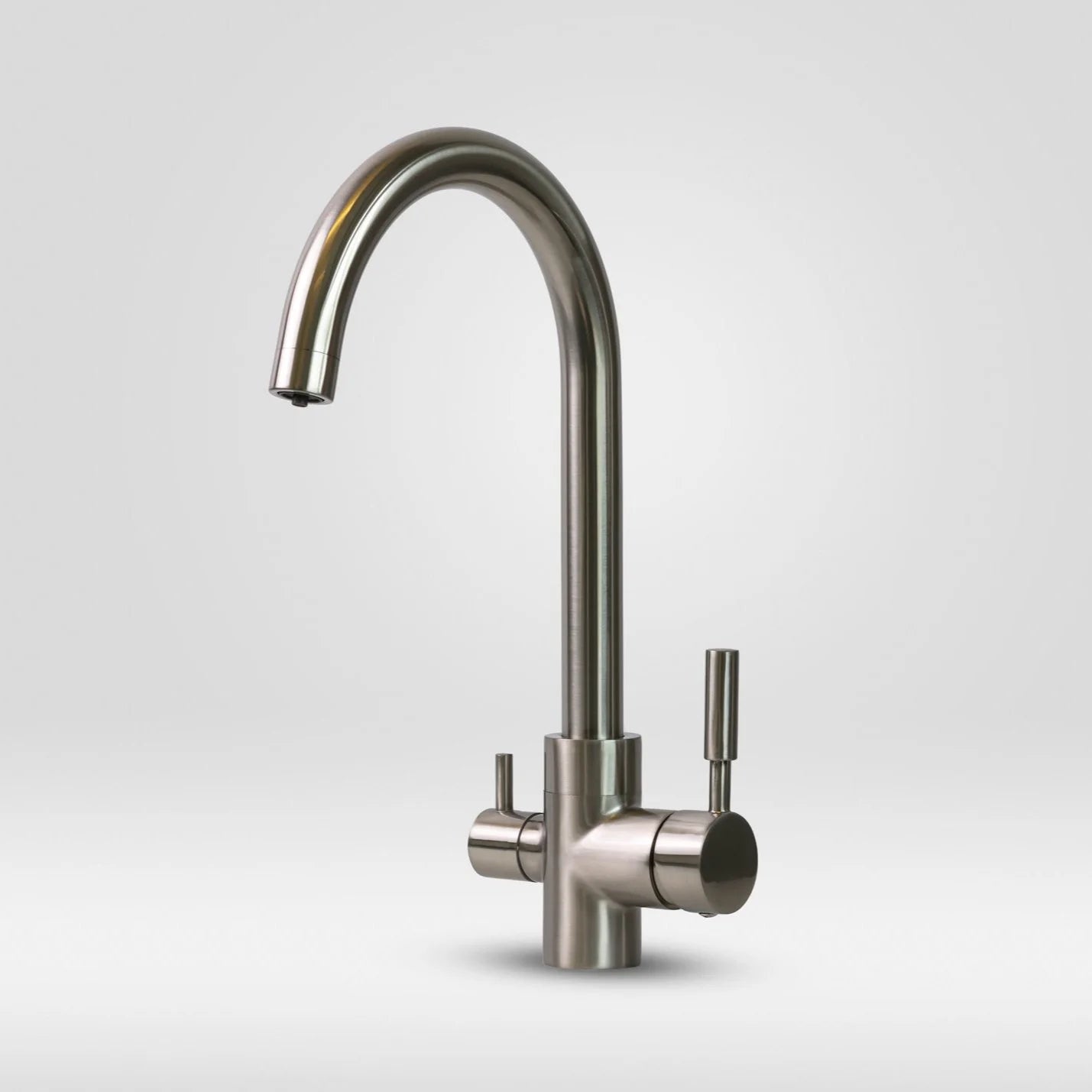
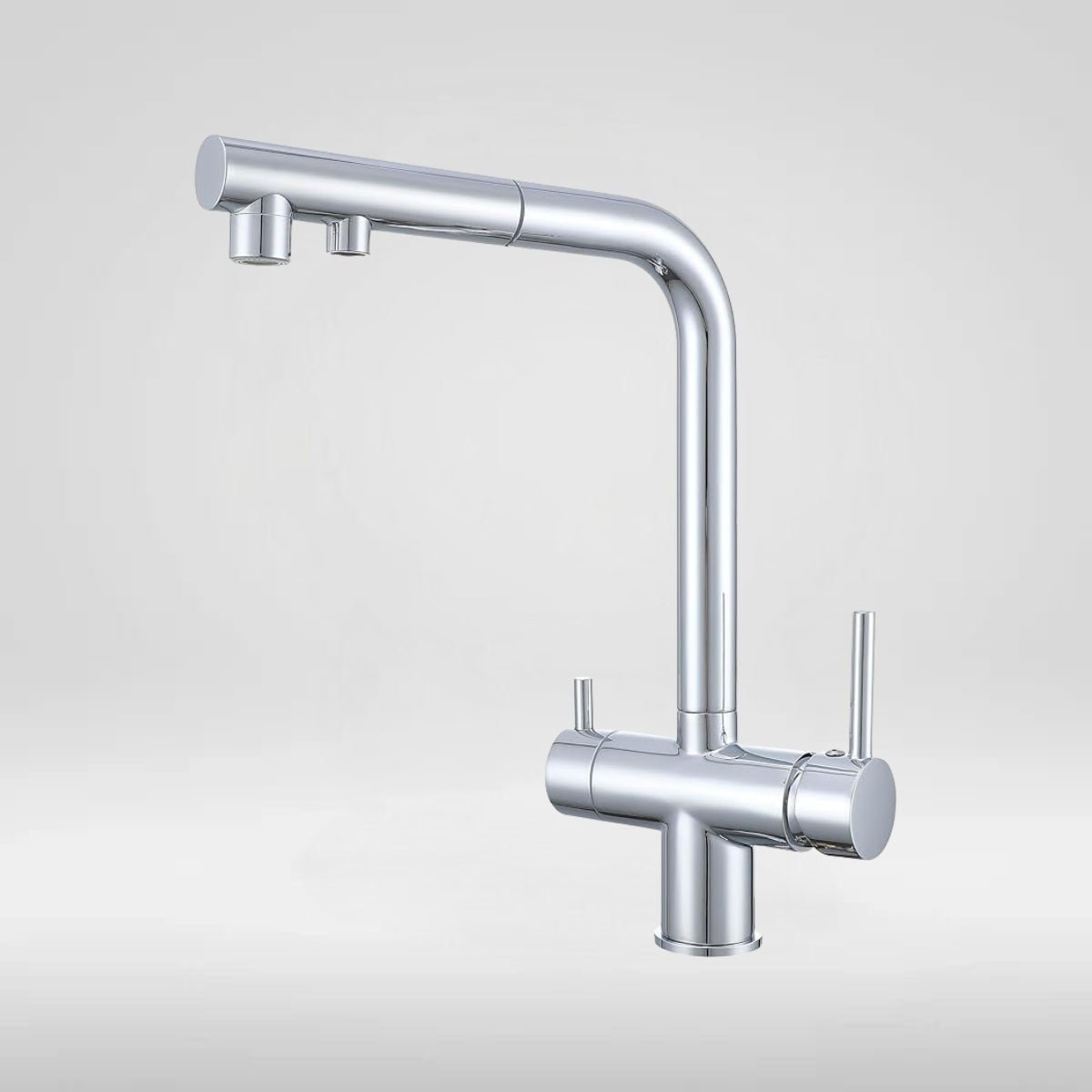
Reverse osmosis is the technology that works most broadly, because the membrane holds back dissolved substances instead of just binding them. That is also the standard addressed by NSF/ANSI 58. At PureAqua, that system, The Source, is included as standard with a pure water tap; you are therefore not buying an appliance but a tap from which pure water comes. If you would rather not have anything installed, the water purification device does the same thing on your countertop.
If you are doubting between a jug, a filter tap, and an osmosis system, our overview of the different ways to purify tap water compares them side by side regarding what they do and do not remove.
Water that tastes like water
Reverse osmosis removes dissolved metals from your drinking water, including lead. System included with every pure water tap. Drink different.
View pure water taps How reverse osmosis worksFrequently asked questions
What does it mean if you taste metal?
With tap water, it usually means that metal ions have dissolved from your pipes, almost always iron, copper, zinc, or manganese. That taste occurs even at concentrations far below health standards. If you taste metal without drinking anything, i.e., as a constant taste in your mouth, that has a different cause than your water, and it is wise to discuss it with your GP.
Why does my tap water taste weird?
The three most common causes are stagnation in the pipe, chlorine after work on the network, and metals from the pipe material. Vitens advises in the event of an unusual odor or taste to open several taps for a few minutes at the same time so that the installation is flushed. If the taste disappears with that, it was your own installation. If it persists, report it to your drinking water company.
Why does water have an iron-like taste?
Because it contains dissolved iron. Iron occurs naturally in groundwater and is largely removed during purification, but a small portion deposits in the distribution network and can become loose. Dunea indicates that the taste threshold for iron is around 100 to 200 micrograms per liter and that the taste becomes unacceptable to most people above 300 micrograms per liter.
Why does my tap water have a bad taste?
Look at the timing first. Only the first glass of the day points to stagnation; a taste that persists all day points to the installation or the supplied water. A chlorine smell usually comes after work and disappears by itself. An earthy or musty taste fits manganese. A bitter taste fits copper from copper pipes.
What are the symptoms of contaminated drinking water?
In the Netherlands, that is rare because drinking water is continuously monitored. If something is wrong, your drinking water company will actively warn you, and a boiling advisory will follow. Therefore, do not rely on symptoms as a signal, but on the notifications from your water company.
Is bottled water better than tap water?
Not in terms of safety. Dutch tap water complies with the Drinking Water Decree and is tested more frequently than bottled water. The difference lies in taste and mineral composition, which is a matter of personal preference. However, tap water is many times cheaper and plastic-free.
Conclusion
A metallic taste in your tap water is usually harmless and almost always comes from your own pipes. You can taste iron at levels as low as 100 to 200 micrograms per liter, well below any health limit, and manganese and zinc fall into the same category. In most homes, flushing the pipes solves the issue.
The exception is lead. You cannot taste it, the Dutch standard is strict at 5 micrograms per liter, and in homes built before 1960, the actual value can be far above that. Therefore, never rely on taste; rely on the year of construction and the piping material.
If you want to get rid of the taste and have certainty about what is in your glass, reverse osmosis is the only approach that broadly blocks dissolved metals. At PureAqua, that system comes standard with a pure water tap. If you are unsure what is happening in your situation, call or message us; we will also tell you if filtering is not necessary in your case.