Short answer
No, under normal circumstances there is no chlorine in Dutch tap water. The Netherlands is an exception in Europe: our water companies disinfect with UV light, ozone and filtration instead of chlorine. Two companies, PWN and Evides, add a tiny amount of chlorine dioxide as a precaution, which according to the RIVM (the Dutch National Institute for Public Health and the Environment) is already no longer measurable once the water enters the pipe network. If you do taste or smell chlorine, you are usually dealing with temporary disinfection after works or a pipe burst, with water from abroad, or with a smell that has nothing to do with chlorine. Flush the tap for a few minutes first and call your water company if in doubt.
Contents
- Is there chlorine in Dutch tap water?
- Why the Netherlands manages without chlorine
- The three exceptions to that rule
- Chlorine smell, or something else?
- Why you do taste it on holiday
- Is chlorine in drinking water harmful?
- What removes chlorine taste and what doesn’t
- What you can do yourself today
- When a filter does make sense
- Frequently asked questions
- Conclusion
Chlorination of drinking water
Adding a chlorine compound, usually sodium hypochlorite (chlorine bleach) or chlorine dioxide, to purified water to kill bacteria and viruses and to keep the water protected on its way through the pipe network. It is the most widely used disinfection method in the world. The Netherlands belongs to the small group of countries that does not do this as standard, because the purification and the pipe network here are set up in such a way that it is not needed.
Is there chlorine in Dutch tap water?
No. Under normal circumstances Dutch water companies do not add chlorine to drinking water. Waterbedrijf Groningen puts it briefly and clearly in its answer to exactly this question: under normal circumstances no chlorine, and good alternatives for disinfection have since been found. Other water companies say the same.
That surprises many people, because the idea of chlorine in tap water is firmly rooted. And that idea is correct, just not for the Netherlands. Worldwide, chlorination is the standard. Waternet puts it in so many words: in the Netherlands we want to use as little chlorine and other chemicals as possible to purify water, whereas chlorine is used as standard in many European countries.
There is something striking going on here. Anyone searching online for this question gets two opposing stories. The drinking water sector and the RIVM say the same thing: no chlorine. Alongside that sits a whole series of pages from filter sellers that suggest there is chlorine in your glass after all and that you need to buy something against it. We sell water purification ourselves and still just say it: you do not need to buy a filter for chlorine in the Netherlands. There are other reasons to filter, and we cover them further down.
The figures behind that confidence can be checked. Vitens says it takes around 200,000 samples a year from source to tap, about 750 a day, and between production and delivery there is usually 24 to 48 hours. The RIVM explains in its own piece how we know that Dutch tap water is safe and healthy. In our own explanation of how strictly that supervision is actually organised we go into this in more depth.
Why the Netherlands manages without chlorine
In most countries chlorine does two things at once. It kills pathogens during purification, and it leaves a small residue that protects the water on its way against contamination that still gets into the pipe network. That second point is the real reason so much of it is used: it is an insurance policy against a leaking or poorly maintained network.
The Netherlands does not need that insurance. The Drinkwaterplatform, the joint knowledge platform of the drinking water sector, explains in its article on chlorine in tap water that our distribution network is maintained better than in many other countries and has hardly any leaks. Bacteria and viruses are already rendered harmless during purification, with UV light or ozone. The conclusion there: thanks to our good pipe network, no disinfectant such as chlorine is needed.
The six alternatives used instead of chlorine
Waterbedrijf Groningen names six that are used alongside or instead of chlorine:
- Chlorine dioxide, a related substance that does not form trihalomethanes and that breaks down so quickly it is no longer measurable.
- Ozone, a gas that breaks down organic material and pathogens and then decomposes.
- Ultraviolet radiation, which disables the DNA of micro-organisms without adding anything to the water.
- Slow sand filtration, the classic biological final step of many Dutch purification plants.
- Membrane filtration, in which particles and micro-organisms are held back mechanically.
- Activated carbon filtration, which captures organic substances and taste components.
There is a second advantage to that choice, and it is the reason the sector is not going back. Chlorine bleach can react in water in all kinds of ways that create harmful substances, such as trihalomethanes. The Drinkwaterplatform explicitly names that as a drawback of chlorination. According to the RIVM, chlorine dioxide does not produce those substances. Less chlorine therefore also means fewer by-products in this case.
What this means for you: if you smell chlorine at your tap in the Netherlands, that is not a normal situation but a signal. It is worth finding out where it comes from instead of filtering it away.
Doubts about the taste of your water?
Call or message us and describe what you taste. We will tell you honestly whether a filter solves anything for you, and when you are better off calling your water company first. Free and without obligation.
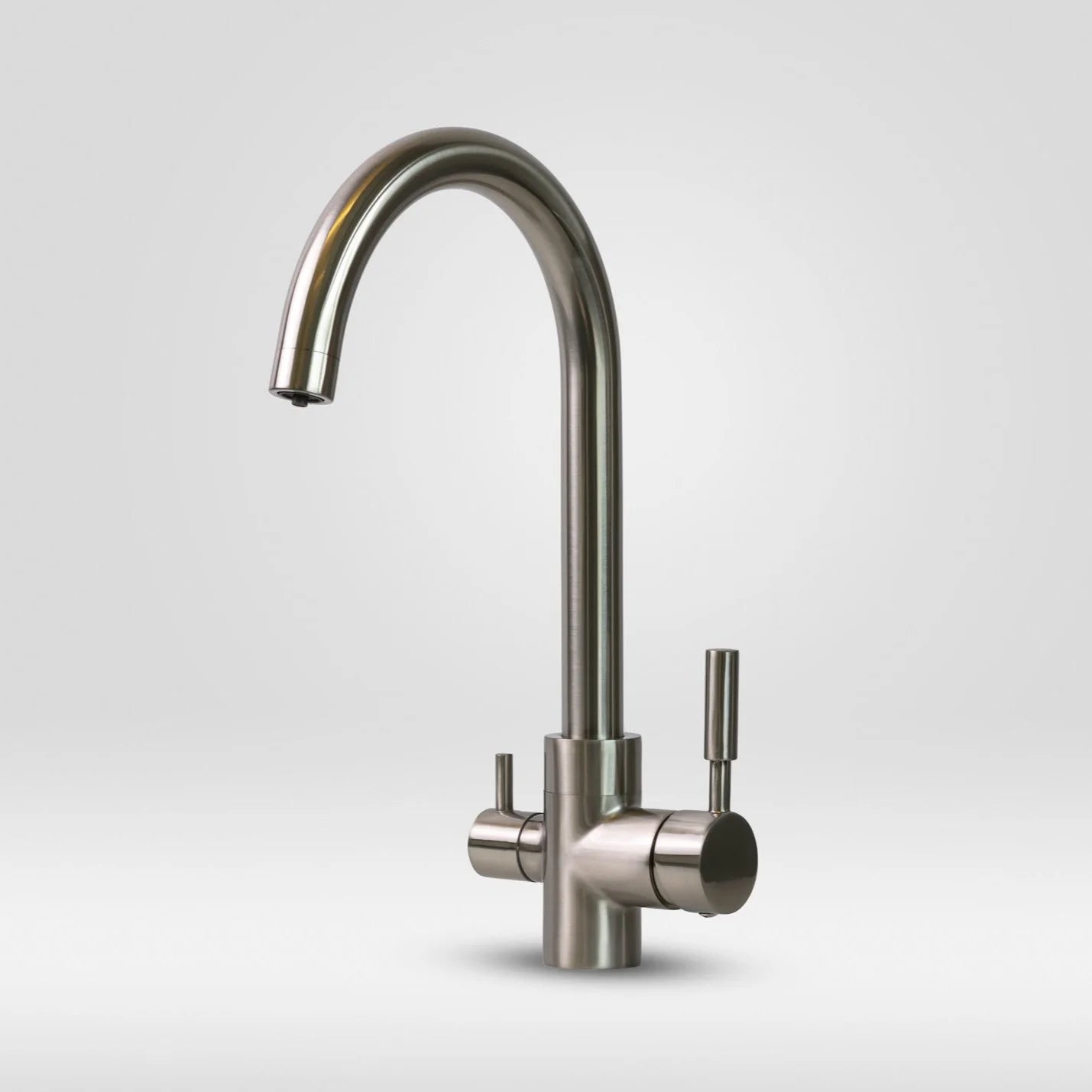
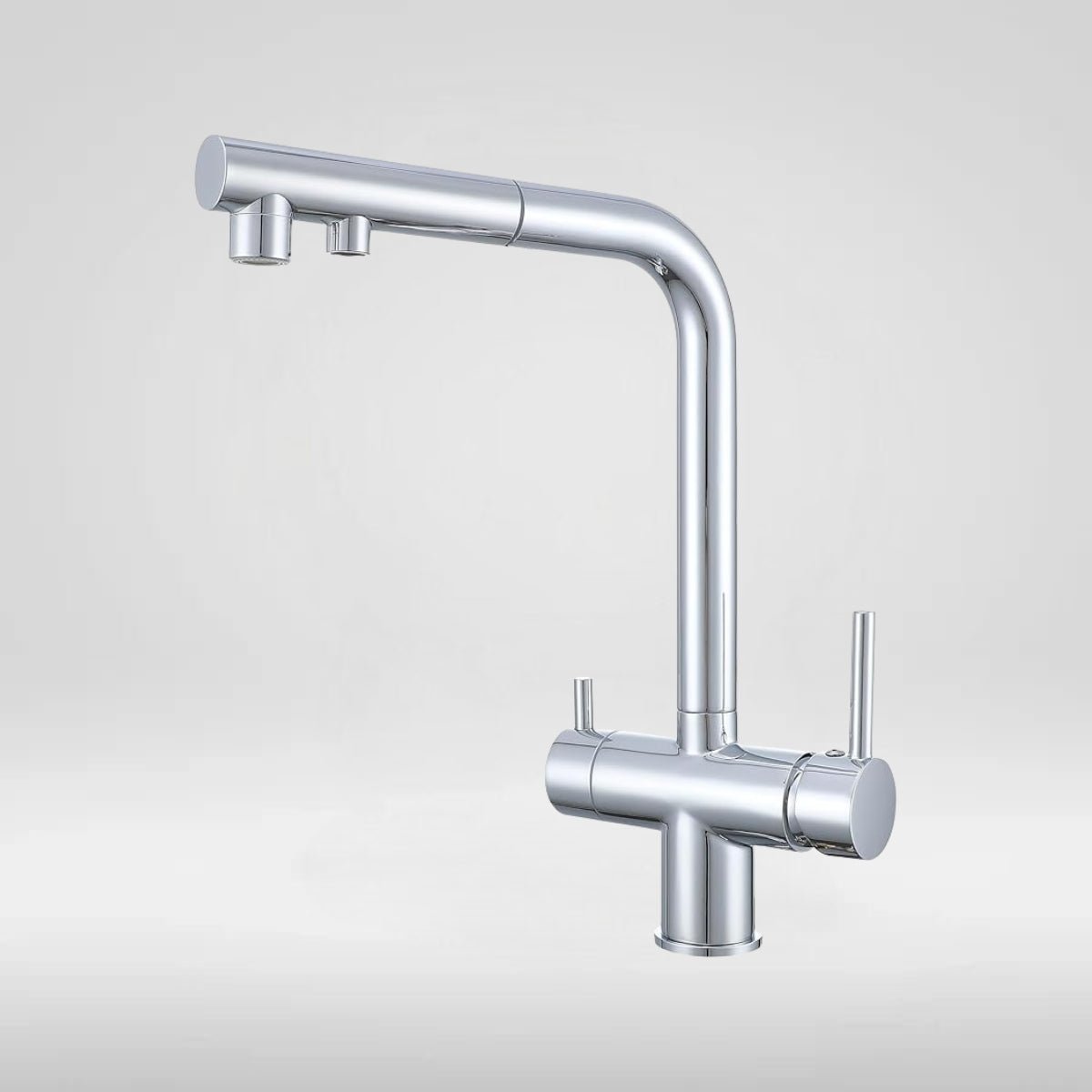
Ask for free advice View the pure water tapsThe three exceptions to that rule
“No chlorine” is the main rule, not an absolute truth. There are three situations in which a chlorine compound is involved, and they differ greatly from one another.
1. Two water companies with chlorine dioxide as a precaution
According to the Drinkwaterplatform, PWN and Evides add a tiny amount of chlorine dioxide as a precaution. That is not chlorine bleach, and the amounts are so small that, according to the RIVM, the substance has already decayed and is no longer measurable by the time the water enters the distribution network. You taste nothing of it, and it does not explain a chlorine smell at your tap.
2. Temporary disinfection after works or a pipe burst
This is by far the most common reason a Dutch person suddenly smells chlorine. If works or a pipe burst let a bacterial contamination into the network, the water company can temporarily flush the pipe section concerned with chlorine to kill disease-causing bacteria. Waterbedrijf Groningen speaks of very small doses that are not harmful to health.
Such an action is local and usually lasts days to a few weeks at most. The water company generally announces it to the streets concerned in advance or during the works. If you smell chlorine and have not had a notice, just call: that is exactly the signal the fault service exists for.
3. Water that does not come from the Dutch tap
Swimming pool water, water from your own spring or well, water from a campsite connection abroad and water from a boat tank are all something different from Dutch tap water. Chlorine belongs in swimming pool water, and that is also the smell most people have in their heads as a reference. Do not confuse the two.
Chlorine smell, or something else?
Taste and smell are poor witnesses. People almost always describe an odd water smell as chlorine, even when there is no chlorine around, simply because it is the only word they have for “chemical”. Four mix-ups come up most often.
- The smell comes from your own pipe, not from the network. Water that has stood still in a pipe for a night or a holiday takes on the taste of that pipe. This applies especially to plastic pipes and to a newly laid or newly connected installation.
- It is a hot water problem. If you only smell it at the hot tap, it is in the boiler or the heater and not in the drinking water.
- It is a metallic rather than a chemical taste. Iron gives drinking water a metallic taste, with a taste threshold of around 100 to 200 micrograms per litre. If you also see discolouration, then discoloured water from the tap is a story of its own with its own solution.
- It only happens at one tap. Then the cause almost certainly lies in your home’s internal installation, not with the water company.
Vitens gives, on its page about unusual smell or taste a working order built precisely on this distinction: open several taps at the same time for a few minutes, see whether the problem also occurs at other taps, temporarily switch off any water softener, and call the fault service on 0800 0359 for persistent complaints, reachable 24 hours a day. That last number applies to Vitens customers; other water companies have their own fault number on their site.
Why you do taste it on holiday
In many places around the world chlorine in tap water is completely normal, and in Southern Europe you taste it straight away, according to toxicologist Merijn Schriks of the Drinkwaterplatform. That is therefore no sign that the water there is unsafe. It is a different design choice: a country with an older or leakier network opts for a little chlorine that keeps working along the way, and accepts the taste that comes with it.
For you as a traveller that means three things. A chlorine smell in a French or Spanish hotel says nothing about whether the water is drinkable. A lukewarm, flat chlorine taste largely disappears if you put the water in an open jug in the fridge for an hour. And the real question on holiday is not whether there is chlorine in it, but whether the water meets local standards. We have worked out per country where you can safely drink from the tap and where you had better not.
Back in the Netherlands the comparison is sometimes confronting. Many people notice after a holiday that their own tap water “tastes of nothing”. That is exactly the point: no chlorine, no aftertaste, only the minerals the water picked up along the way. With an average hardness of around 8 dH, Dutch tap water is moreover soft to medium hard, and that also makes a difference to the taste.
Is chlorine in drinking water harmful?
For Dutch tap water this is a question with no subject: under normal circumstances nothing is added, so there is nothing to ingest. If water is temporarily disinfected after a disruption, Waterbedrijf Groningen says the doses are very small and not harmful to health. The water remains drinkable during that period.
The discussion that does take place internationally is not about chlorine itself but about what chlorine can form in water. Chlorine bleach can react with organic material and form by-products, including trihalomethanes. That is one of the reasons the Netherlands and most Dutch water companies have chosen the route without chlorine bleach, and that PWN and Evides specifically use chlorine dioxide, which according to the RIVM does not produce those substances.
What we are not going to do here is scare you. The RIVM keeps up to date on its drinking water topic page the legal requirements and the current points of attention, and chlorine is not among the concerns for the Dutch consumer there. The topics that do call for attention are different: lead pipes in buildings from before 1960, traces of PFAS, and the hardness that damages your appliances. Technology can do something about those; not about a problem that does not exist.
What removes chlorine taste and what doesn’t
Suppose you do have to deal with chlorine, for example during temporary disinfection in your street or in a holiday home. The methods then differ enormously in effect, price and effort. This table puts them side by side.
| Method | Removes chlorine taste | What else it does | Point of attention |
|---|---|---|---|
| Flushing for a few minutes | Only if the taste comes from standing water in your own pipe | Refreshes the internal installation | Costs nothing, does not solve a network problem |
| Open jug, one hour in the fridge | Largely, chlorine evaporates | Nothing else | Does not work on chlorine dioxide by-products or on metallic taste |
| Filter jug with activated carbon | Yes, this is what activated carbon is good at | Taste and smell, partly organic substances | Replace the cartridge on time, otherwise something starts growing in it |
| Carbon filter on the tap | Yes, and without having to refill | Taste, smell, partly chlorine and organic substances | No effect on limescale, nitrate or salts |
| Reverse osmosis | Yes, with a carbon pre-filter ahead of the membrane | Also holds back dissolved salts, heavy metals and PFAS | Requires installation and filter replacement |
| Shower filter | That is literally what the standard for shower filters is about | Only the shower, not your drinking water | A cartridge in a shower head is used up quickly |
| Water softener | No | Lowers calcium and magnesium, so limescale | Does nothing to taste compounds or chlorine |
| Magnet or clamp-on device | No | Does not change the measured composition | There is no performance standard for it |
Two rules stand out. Activated carbon is the technology that deals with chlorine; that is so self-evident in water technology that the international standard for shower filters, NSF/ANSI 177, is exclusively about chlorine reduction, and is formally titled “Shower Filtration Systems, Aesthetic Effects”. Aesthetic, so: taste and smell. If you want to know what a filter on your shower head can and cannot do beyond that, read our calculation of what such a cartridge really delivers.
The second rule: a water softener does nothing here. Softening lowers calcium and magnesium, and that is a different problem from taste. Do not confuse the two when buying.
What you can do yourself today
If you smell or taste something that resembles chlorine, work through these four steps before you buy anything. Together they take less than ten minutes.
- Flush for two to five minutes. Open several cold water taps at the same time. If the smell disappears, it came from standing water in your own pipe and there is nothing wrong.
- Compare cold and hot, and compare taps. Only hot water means the boiler or heater. Only one tap means that tap or that pipe. All cold water taps at once means it is coming from outside.
- Temporarily switch off a water softener and let the water run for a moment, as Vitens advises. A poorly maintained unit can itself cause smell and taste complaints.
- Call your water company. That is no bother, that is their job. Within a minute they know whether flushing is taking place in your postcode area or whether works are under way.
If the complaint remains afterwards and comes from outside your home, you will hear that from the water company. If it is in your own installation, an installer is the right person, not a filter.
When a filter does make sense
Chlorine is no reason for us to filter. But that does not mean filtering is pointless. The reasons that do hold up are these.
- Taste you do notice every day. Not chlorine, but the minerals, the hardness and the residues the water picks up on its way. Anyone who drinks pure water from their own tap point notices the difference most in coffee and tea.
- Substances the discussion is about. Traces of PFAS, medicine residues and microplastics are on the RIVM’s agenda, chlorine is not. Reverse osmosis is the technology that holds back dissolved substances at molecular level, and NSF/ANSI 58 is the category standard that goes with it.
- Lead pipes in older homes. For buildings from before 1960 there is a point of attention of its own, with a legal limit of 5 micrograms of lead per litre.
- No more lugging bottles. The most practical reason of all, and the reason most of our customers end up calling.
Which technology fits which reason depends mostly on how far you want to go. A carbon filter deals with taste and smell; a membrane goes further. In our comparison you can read what activated carbon is good at and where it stops, and on the page about how reverse osmosis works you can see step by step what happens in the system.
At PureAqua the filter system comes as standard with a pure water tap, so there is no device on your counter. If you want to try it without installation, there is a separate plug-and-play version for the countertop. And if you do not want to think about it at all, the subscription with tap, system and maintenance in one handles the whole process for 29 euros a month with 299 euros start-up costs, including installation by a specialist. You have 100 days to try whether it suits you, and a 2-year all-in warranty.
Frequently asked questions
Does Dutch tap water contain chlorine?
No, not under normal circumstances. Dutch water companies disinfect with UV light, ozone, chlorine dioxide, slow sand filtration, membrane filtration or activated carbon filtration instead of chlorine bleach. The Netherlands is thereby an exception in Europe, where chlorination is the standard in many countries. Two companies, PWN and Evides, add a tiny amount of chlorine dioxide as a precaution, but according to the RIVM that amount is so small and the substance decays so quickly that it is no longer measurable once the water enters the distribution network.
Is there chlorine in drinking water?
That depends on the country. Worldwide, chlorine is the most widely used disinfectant for drinking water, because a little residual chlorine also protects the water on its way through the pipe network. In the Netherlands that is not needed, because the pipe network is well maintained and has hardly any leaks, and because pathogens are already rendered harmless during purification. Dutch drinking water therefore normally contains no chlorine; foreign tap water often does.
How much chlorine is in tap water?
In Dutch tap water, nothing under normal circumstances. At PWN and Evides it is a tiny amount of chlorine dioxide that, according to the RIVM, is already no longer measurable by the time the water enters the distribution network. If water is temporarily disinfected after works or a pipe burst, Waterbedrijf Groningen speaks of very small doses that are not harmful to health. In countries that chlorinate structurally, the residual levels are higher and can usually also be tasted.
What does chlorine do to your body?
For Dutch tap water that question does not arise, because nothing is added. Where temporary disinfection does take place, the doses are, according to the water company, not harmful to health, and the water remains drinkable. What is discussed internationally is not chlorine itself but what chlorine bleach can form in water: by-products such as trihalomethanes. That is one of the reasons the Netherlands does not take that route and that PWN and Evides use chlorine dioxide, which according to the RIVM does not produce those substances.
What harmful substances are in tap water?
Dutch drinking water meets the legal requirements of the Drinkwaterwet (Drinking Water Act) and the Drinkwaterbesluit (Drinking Water Decree) and is strictly monitored for them; Vitens, for example, takes around 200,000 samples a year, about 750 a day. The topics the RIVM does name are traces of PFAS and medicine residues, and lead from lead pipes in buildings from before 1960, with a limit of 5 micrograms per litre. Chlorine is not among them in the Netherlands. Limescale is not a harmful substance but is a practical problem for your appliances.
Is it sensible to drink tap water?
Yes. The RIVM and the water companies are unanimous on this: Dutch tap water is safe and healthy, and it is also the most sustainable and cheapest drink you can choose. You do not buy a filter in the Netherlands because the water would be unsafe, but because you want to improve the taste, reduce dissolved substances further, or simply no longer want to lug bottles. If you have doubts about your own situation, for example because of old pipes, call your water company first.
Conclusion
Is there chlorine in tap water? Not in the Netherlands, and that is a deliberate choice by the entire drinking water sector. A well-maintained pipe network, UV light, ozone and filtration make a little residual chlorine unnecessary, and with it the by-products that chlorine bleach can form disappear as well. Only PWN and Evides use a trace of chlorine dioxide as a precaution that you do not taste, and only after works or a pipe burst can there be temporary, local chlorination.
If you do smell it, do not start with a filter but with four minutes of flushing and a phone call to your water company. In nine out of ten cases the answer lies there, and it costs you nothing. And if you still want to filter afterwards, do it for the right reason: taste, dissolved substances, or simply never lugging bottles again. Drink different, but on the basis of what is really in your glass.
Pure water from your own tap
No bottles, no refilling jugs, no device on your counter. We advise, install and maintain. Ask for free advice or see what fits your kitchen.
Ask for free advice View the subscription