Quick answer
Filtering tap water means providing the water with an extra purification step after it passes the meter, usually at or under your kitchen tap. A filter tap directs the water through a cartridge at the moment you dispense it—often using activated carbon or a reverse osmosis membrane—thereby blocking chlorine taste, particles, and contaminants. A reverse osmosis system is the most thorough method, removing up to 99% of unwanted substances. At PureAqua, we help you choose the filter method that best suits your water.
Table of contents
- What is tap water filtering?
- How exactly does a filter tap work?
- What filtration techniques are there?
- Why should you filter tap water?
- Benefits of a filter tap
- Points of attention and drawbacks
- Comparison table: filter methods side by side
- Buying advice: which filter suits you?
- Frequently asked questions
- Conclusion
What is tap water filtering?
Filtering tap water involves adding an extra purification step to the water you dispense from your tap at home. Dutch tap water meets strict standards and is tested hundreds of times a year according to the industry organization Vewin, but the water still travels for kilometers through pipes between the treatment plant and your glass. Along the way, it may come into contact with traces of particles, chlorine, or substances from older plumbing.
Those who want to filter tap water usually do so at a single point: the kitchen tap. This can be done with a small attachment on the tap, with a filter pitcher, or with a system hidden in the kitchen cabinet and connected to a separate tap. The choice mainly determines how much the filter catches and how much convenience you get.
Definition
Filtering tap water: giving your tap water an extra treatment that removes unwanted substances, particles, or tastes. A filter tap is a dispensing point where the water is guided through a filter or membrane during dispensing, so you have filtered water instantly without the need for a pitcher or bottle.
How exactly does a filter tap work?
A filter tap filters the water at the moment you turn it on. Driven by your household water pressure, the water flows through one or more filter stages, each with its own task, and emerges purified on the other side. No electricity is involved: the water pressure does the work.
In practice, there are two main types. A simple filter tap contains a single cartridge with activated carbon that catches chlorine, off-tastes, and some organic substances. In a more thorough system, the water goes through multiple stages, including a sediment filter, activated carbon, and finally a reverse osmosis membrane. That membrane has pores of approximately 0.0001 microns, small enough to stop even dissolved substances like PFAS and heavy metals.
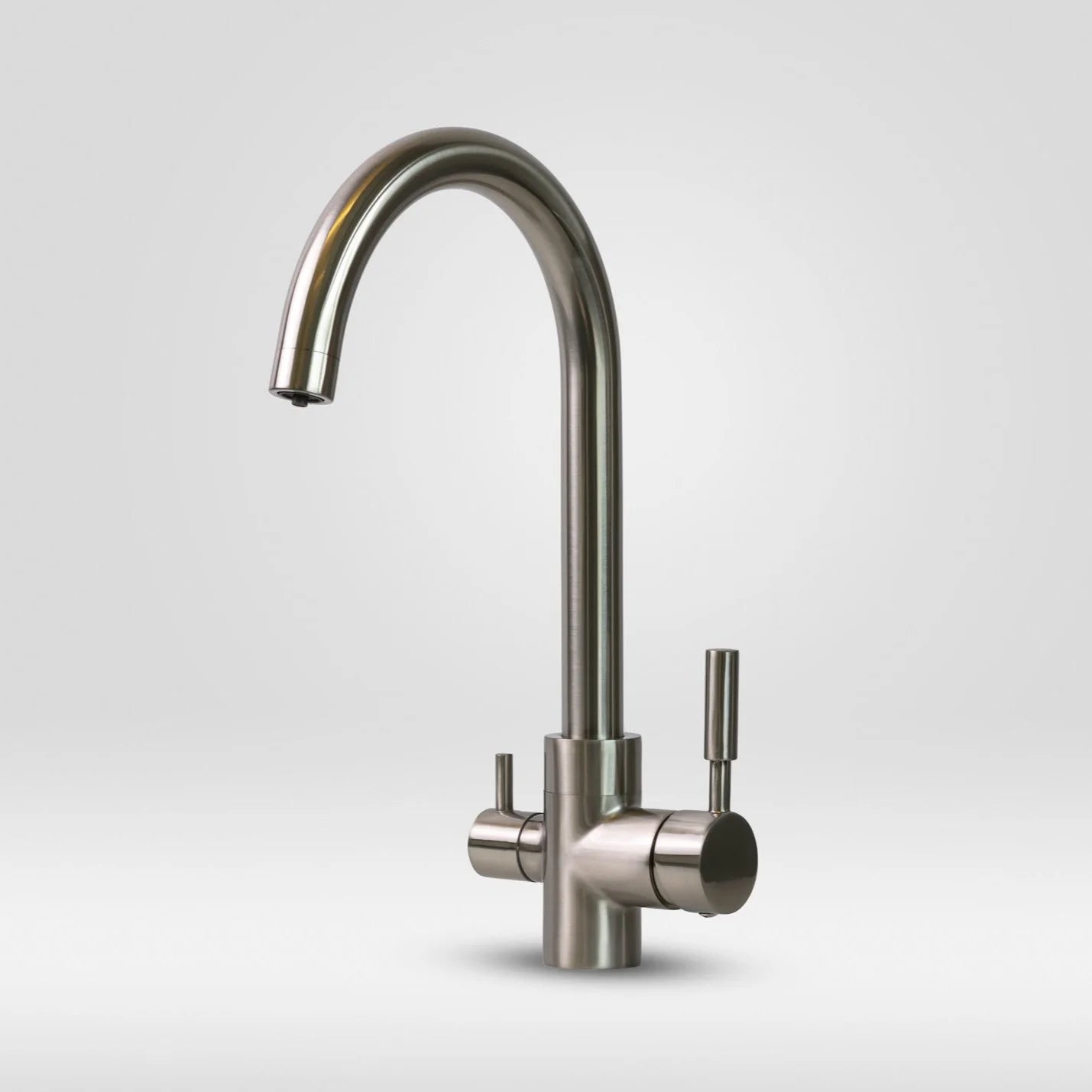
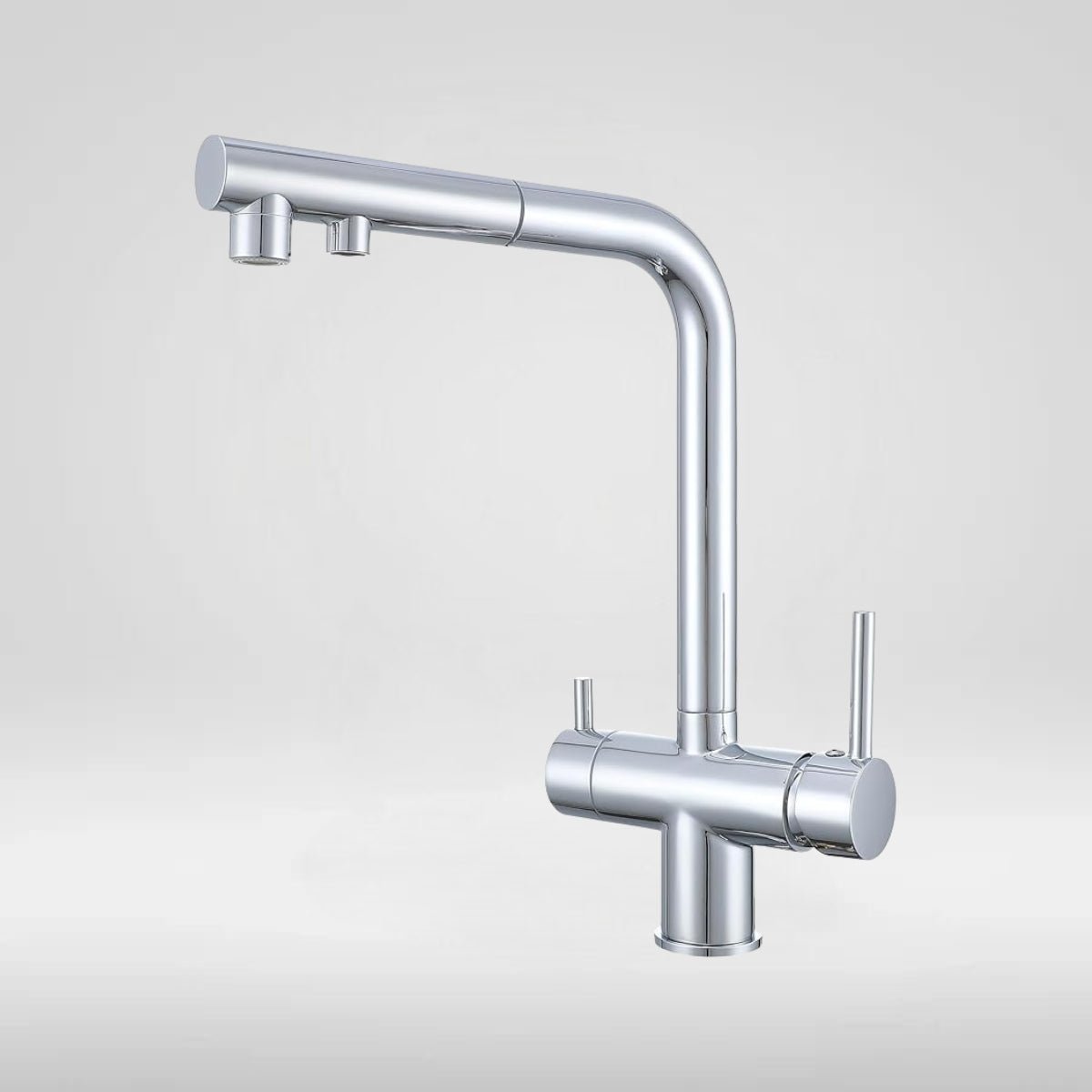
At PureAqua, the core system works based on reverse osmosis. The filter device, The Source, is hidden in the kitchen cabinet and provides purified water through a separate pure-water tap. This allows you to draw filtered water from a stylish dispensing point, while the actual filtering happens out of sight and works completely without electricity.
The Source and the pure-water tap: two components
It is useful to know the difference. The Source is the device that filters the water, located inside the cabinet. The pure-water tap is the dispensing point on your countertop with an additional function for filtered water. Together they form a single system, but they are two separate parts connected to each other. A mineral filter then adds calcium and magnesium back, ensuring the water retains a natural, full flavor.
What filtration techniques are there?
Various techniques fall under the heading of "filtering tap water." They differ significantly in what they stop, the maintenance they require, and how thorough the result is. If you first want to know what is and isn't in Dutch tap water, read that overview first.
Activated carbon
Activated carbon acts like a sponge that attracts and holds substances. It is highly effective at improving odor and taste and catches chlorine, some pesticides, and medication residues. It is the most commonly used technique in filter pitchers and simple filter taps, but it does not remove limescale and only partially blocks dissolved salts or nitrates.
Sediment and ceramic filters
These filters have very small openings and catch solid particles: sand, rust, silt, and a large portion of microplastics. They are often used as pre-filters so that the finer filters downstream last longer. They barely change the taste and do not remove dissolved substances.
Reverse osmosis (RO)
Reverse osmosis is the most thorough household technique. Water is forced through a membrane with extremely small pores that blocks up to 99% of unwanted substances, including PFAS, microplastics, medication residues, pesticides, and heavy metals. Because the membrane also removes minerals, a mineral filter adds calcium and magnesium back afterward. This is the technology behind the PureAqua system, The Source. We have separately listed the considerations associated with this filtration technique.
UV and water softeners
UV light renders bacteria and viruses harmless, but it does not change the water's composition, and therefore has no effect on the impact of filtering on pH levels. A water softener focuses specifically on limescale and makes water softer for the entire house, but it does not filter contaminants. Whether you choose a softener with or without regeneration salt makes a big difference in the result. Both are supplementary and not a replacement for a drinking water filter.
Why should you filter tap water?
The main reason is having control over taste and purity. Even though tap water is safe, many people want to manage that final step themselves. According to the RIVM, PFAS, medication residues, and microplastics are substances present in the environment in low concentrations, and exposure should be kept as low as possible. A thorough filter helps reduce that exposure via drinking water. If you travel often, that question also arises on the road: we researched whether you can drink tap water while on vacation and what to look out for.
In addition, there is the aspect of taste and convenience. Filtered water has no chlorine odor, tea and coffee become clearer, and you no longer need to carry bottles or refill pitchers. This also saves hassle with storing water in a pitcher or bottle, as you always dispense it fresh. At PureAqua, we find that customers mainly choose a solution that combines pure water with convenience: hidden from view and straight from the tap.
Benefits of a filter tap
A filter tap has several clear advantages over a pitcher or bottle:
- Instantly filtered water: you dispense pure water right away, with no waiting or refilling.
- Better taste: chlorine and off-tastes disappear, which you will notice especially in tea and coffee.
- More purity: a reverse osmosis system removes up to 99% of unwanted substances like PFAS and microplastics.
- Space-saving: no more pitchers or crates of bottles; the filter is hidden in the cabinet.
- Works without electricity: the PureAqua system uses only water pressure, so no power outlet is required.
Points of attention and drawbacks
Balanced against these benefits are a few things to consider beforehand:
- Not every filter does the same: a simple attachment filter mainly improves taste, whereas only reverse osmosis thoroughly tackles substances like PFAS.
- Maintenance: filters must be replaced periodically; at PureAqua, this is generally once a year with a filter set starting at 75 euros for a 2-pack.
- Tap-mounted filters: these can look obstructive and reduce flow rate; a built-in system does not have this issue.
- Filter pitchers: water quality can actually deteriorate due to stagnant water in the pitcher if you don't replace the cartridge in time.
- No limescale solution: a drinking water filter does not soften water; you need a water softener for that.
Do you want both pure drinking water and limescale-free water in your home? Then many customers combine a reverse osmosis system on the kitchen tap with a water softener for the entire house. This way, you tackle taste, purity, and limescale all at once.
Comparison table: filter methods side by side
| Method | What it removes | PFAS and microplastics? | Maintenance | Best for |
|---|---|---|---|---|
| Filter pitcher (Brita-type) | Chlorine, taste, some limescale | Hardly | Cartridge every month | Small budget, taste only |
| Tap attachment filter | Chlorine, particles, taste | Limited | Cartridge every few months | Quick, temporary solution |
| Under-counter activated carbon | Chlorine, pesticides, some drug residues | Partially | Filter annually | Better taste, low hassle |
| Reverse osmosis (The Source) | Up to 99% of unwanted substances | Yes, up to 99% | Filter set annually from 75 euros | Pure drinking water at the tap |
| Bottled water | Depends on the source | Variable | Continuous buying and carrying | On the road, not for home |
Buying advice: which filter suits you?
The choice depends on what you want to achieve. If it's mainly about a better-tasting glass without a chlorine flavor, then a filter pitcher or an activated carbon filter may suffice. If you want to specifically remove substances like PFAS, microplastics, and medication residues from your drinking water, then reverse osmosis is the most complete choice. A comparison of all household filter types will help you refine that choice.
If you are looking for convenience and a clean result, a built-in system with a separate pure-water tap is the most pleasant: the filter is out of sight and you dispense pure water from a beautiful tap. Compare the options in the pure-water taps collection or view all pure-water taps. Are you unsure about your water quality?
Curious which filter fits your tap water?
View the PureAqua pure-water taps or go for the complete The Source system. More than 950 customers have already preceded you, with a rating of 9 or higher. Prefer personal advice first? That is free and non-binding.
View pure-water taps Request free adviceFrequently asked questions
How does a filter tap work?
A filter tap guides water through one or more filter stages during dispensing, powered by your pipe pressure. In a simple model, this is a cartridge with activated carbon; in a more thorough system, the water also passes through a reverse osmosis membrane that blocks up to 99% of unwanted substances. No electricity is required.
Isn't Dutch tap water already clean enough?
Yes, Dutch tap water meets strict standards and is tightly regulated. Nevertheless, it can pick up traces of substances while traveling through pipes, and compounds like PFAS, medication residues, and microplastics can occur in low concentrations. A filter makes the water taste softer and further reduces exposure to these substances.
Which filter removes PFAS and microplastics?
For a thorough approach to PFAS and microplastics, reverse osmosis is the most effective choice; it removes up to 99% of unwanted substances. Activated carbon tackles some of the PFAS, but less completely. The PureAqua The Source system operates on the basis of reverse osmosis and adds minerals back via a mineral filter.
Does a filter tap also remove limescale from the water?
No, a drinking water filter does not change the hardness of your water. You tackle limescale with a water softener, which removes calcium and magnesium or changes the crystal structure. If you want both pure drinking water and less limescale, you can combine a tap filter with a water softener for the whole house.
How often do I need to replace the filter?
That depends on the system and your water consumption. With a PureAqua reverse osmosis system, you typically replace the filters once a year, with a filter set starting from 75 euros for a 2-pack or 149 euros for a 3-pack. A filter pitcher requires a new cartridge monthly and consequently provides less pure water.
Do minerals remain in the filtered water?
With activated carbon, the minerals are largely retained. Reverse osmosis also removes minerals, but PureAqua adds them back via a 45-euro mineral filter, so that calcium and magnesium return and the water retains a natural, full taste.
Can I have a filter installed myself?
You can use a clip-on filter or filter pitcher immediately. A built-in system like The Source is connected under the kitchen cabinet to the water pipe and the pure-water tap; PureAqua handles installation in the Netherlands and Belgium. You also get a 100-day trial and a 2-year all-in warranty, so you can calmly experience whether it suits you.
Conclusion
Filtering tap water gives you control over taste and purity, and a filter tap makes that most convenient: the water is filtered the moment you dispense it, without a pitcher or bottle. For purely better taste, activated carbon is sufficient, but if you want to thoroughly tackle substances like PFAS, microplastics, and medication residues, then reverse osmosis is the most complete choice.
With the PureAqua The Source system, you combine that purity with convenience: the filter sits invisibly in the cabinet, you dispense from a stylish pure-water tap, it works without electricity, and a mineral filter keeps the taste on point. This way, you consciously choose the filtering method that fits your water and household.
Ready for pure water straight from the tap?
Discover the PureAqua pure-water taps with The Source. 100-day trial, 2-year all-in warranty, 950+ customers with a 9+ rating, and free shipping in NL and BE. Not sure which system fits? Request free and no-obligation advice.
View pure-water taps Request free advice