Reading time: approximately 10 minutes
Short answer
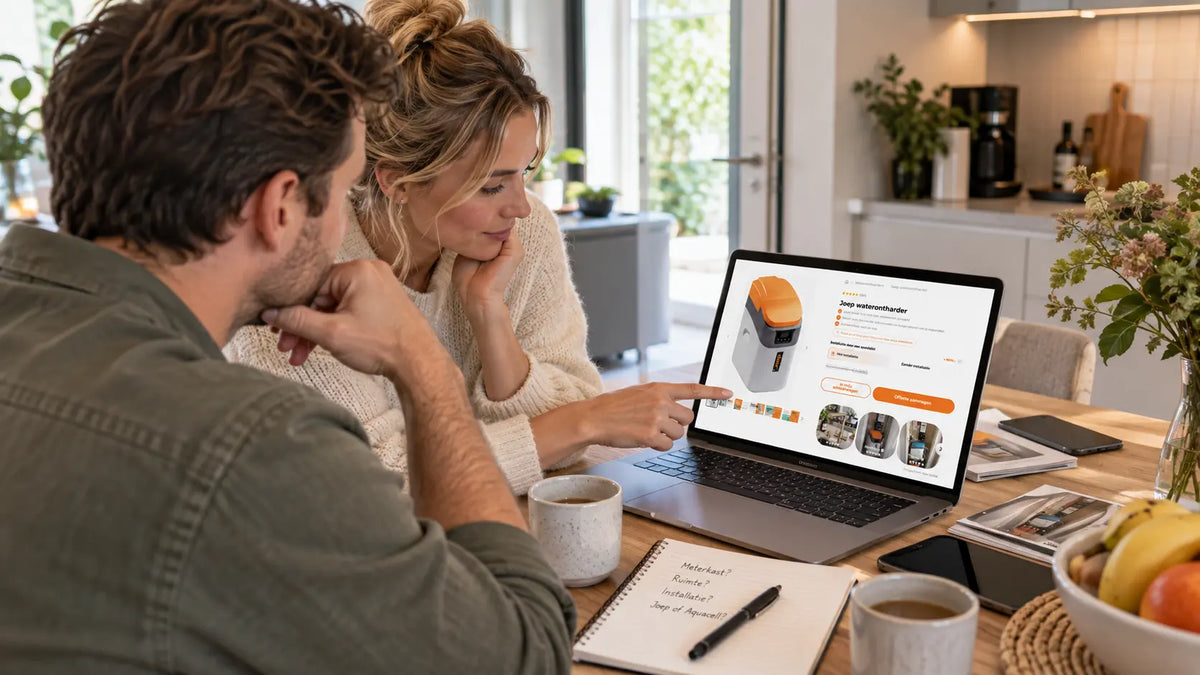
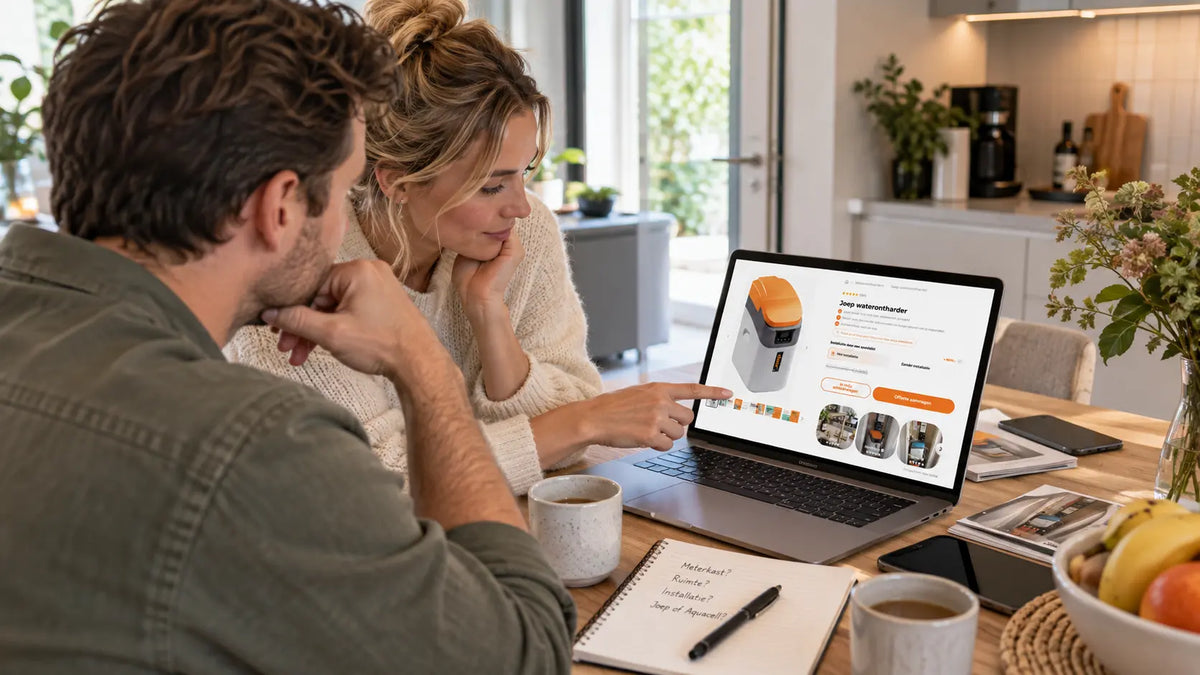
The best water softener is not one specific model, but the one that fits your water hardness, household size, and the space near your water meter. Compare based on the softening system, capacity, salt and water consumption, control method, warranty, and service. At PureAqua, the choice almost always falls on the AquaCell or the Joep.
In this article
- What exactly is a water softener?
- How hard is your water, actually?
- The 7 criteria to use for comparison
- Comparison: which type suits you?
- Which capacity for which household?
- Softened water is not filtered drinking water
- Five pitfalls when choosing
- Buying advice in five minutes
- Frequently asked questions
- Conclusion
What exactly is a water softener?
Definition
A water softener is a device installed directly after your water meter that removes calcium and magnesium from the tap water. This is done through ion exchange: the water flows through a tank filled with resin beads that trap the limescale-forming ions and replace them with sodium. The result is soft water throughout your entire home, including your bathroom, washing machine, and central heating system.
Soft water is not a luxury detail. Limescale deposits on heating elements, in pipes, and on glass, which costs you energy, soap, and the lifespan of your appliances. Still, the question of "the best water softener" cannot be answered with a single brand name, because the right choice depends on measurable factors: how hard your water is, how much water you use daily, and how much space you have.
Important to clarify upfront: softening and filtering are two different things. A water softener tackles limescale, not PFAS or medication residues. If you want to know which technology addresses which substance, our overview of the different filter technologies for home use compares them side-by-side. At PureAqua, we see that customers often want both: soft water in the house and pure water at the tap.
How hard is your water, actually?
Before comparing models, you need to know one figure: the hardness of your tap water, expressed in German degrees of hardness (dH) or millimoles per liter. One millimole per liter is equivalent to 5.6 dH. Your water utility publishes this figure by zip code, for example, via the water hardness check by Vitens or the water quality overview from Evides.
The differences within the Netherlands are significant. In the supply area of Brabant Water, the hardness in Eindhoven is between 5.71 and 6.16 dH, while in the rest of the province, it ranges from 5.0 to 11.2 dH. In practice, a difference of 5 dH means almost twice as much limescale flowing through your pipes. From about 8 dH, most people really notice the limescale: white spots on taps, a gray haze on glassware, and a kettle that heats up faster.
If your measurement is below 6 dH, the benefits of a softener are minimal and your money is better spent on other maintenance. If you are above that, the question is not if, but which one. For the sake of completeness, drinking water companies like Vitens emphasize that softening or filtering is not necessary for health. You do it for comfort, for your appliances, and for the taste, not because tap water would be unsafe.
Are you unsure which softener fits your hardness?
Check out the two water softeners we still recommend after hundreds of installations, or let us take a look at your situation.
View the water softeners Request free adviceThe 7 criteria to use for comparison
These are the seven points we use to compare devices. Go through them in this order, because the first two already determine if a model is even feasible.
1. Softening system: salt-based, salt-free, or magnetic
Only an ion exchanger with salt truly reduces hardness. Salt-free systems, whether catalytic beads or a magnet around the pipe, at most change the form in which limescale precipitates; the calcium remains in the water. For those who want to understand that difference precisely, the difference between softening with and without salt is explained in detail. Advice: if you want measurably soft water, choose salt.
2. Control: electronic, time-based, or hydraulic
A time-based device regenerates according to a clock, even if you were on vacation. A volume-based device regenerates based on liters used, which saves salt and water. A hydraulic device works entirely on the pressure in your pipes and requires no power outlet, which is a unique feature we have detailed in softening without an electrical connection. The AquaCell works hydraulically and delivers soft water 24 hours a day at up to 3,000 liters per hour.
3. Capacity: tailored to your household
Capacity is the amount of limescale the device can remove between two regenerations. Choosing one that is too small means more frequent regeneration, more salt, and sometimes hard water at the wrong moment. Choosing one that is too large means the resin sits idle for too long. Calculate approximately 120 liters of water per person per day: a family of four will use around 480 liters per day, a two-person household around 240 liters.
4. Consumption: salt, water, and power
Every regeneration costs salt and rinse water. That rinse water is simply drinking water and therefore not a free resource: according to Vewin, you will pay an average of 2.71 euros per cubic meter including taxes in 2026. If a device uses 100 liters of rinse water per regeneration, that is 0.27 euros per time, or about 8 euros per year if regenerating once a month. A 25 kg bag of salt is the second fixed cost. Always ask about consumption per regeneration, because that is where the biggest differences between models lie.
5. Installation and space
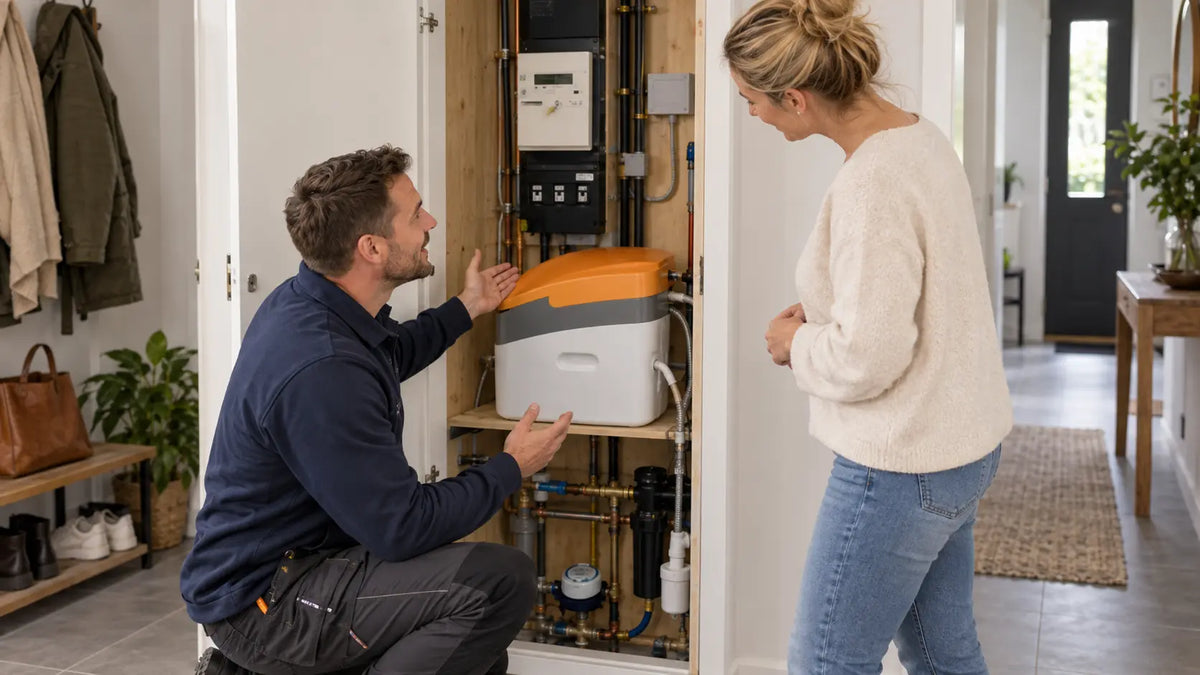
A softener must be installed after the water meter, above a drain, and preferably in a place where you can reach it with a bag of salt. In many Dutch homes, that is the utility cupboard, and then the question is whether the device fits in terms of width and height and if the connection is permitted. We have set out the requirements for installation in a utility cupboard separately, including the role of the installer.
6. Maintenance, warranty, and service
A water softener lasts fifteen years or longer, so the question of who will look at it in five years is just as important as the purchase price. Pay attention to the warranty period, who installs the device, and whether maintenance is covered under the warranty. PureAqua offers a 2-year all-in warranty and a 100-day trial period, and our own specialist handles the installation. Vitens rightly points out that every device in your drinking water system must have a quality declaration and be connected according to NEN 1006; so, do not leave that to a handyman.
7. Price and payback period
Do not calculate based on the purchase price alone, but on the price over ten years: purchase plus installation plus salt plus rinse water. At PureAqua, the AquaCell costs 2,348 euros and the Joep costs 1,699 euros. We have calculated what you earn back in terms of soap, descaler, energy, and longer-lasting appliances in our article on the total costs of a water softener.
Comparison: which type suits you?
| Type | Reduces hardness? | Requires power | Consumption | Price indication | Suits |
|---|---|---|---|---|---|
| AquaCell (hydraulic ion exchanger) | Yes, measurable | No | Salt and rinse water | 2,348 euros | Families wanting soft water without a power outlet, up to 3,000 liters per hour |
| Joep (ion exchanger) | Yes, measurable | No | Salt and rinse water | 1,699 euros | Smaller households and those seeking a lower entry point |
| Salt-free or catalytic | No, only less buildup | Sometimes | Filter cartridge | A few hundred euros | Those without a drain or space who only want to limit limescale buildup |
| Magnet around the pipe | No | No | None | A few tens of euros | Rarely a sensible choice, effect is not measurable in dH |
| Reverse osmosis at the tap | Only at that tap point | Yes for countertop | Filter set | Starting from a tap with system | Those wanting pure drinking water, alongside or instead of softening |
Be careful with "top lists" regarding the source. If you search for "best water softener consumer association" (Consumentenbond), you will mainly end up on commercial comparison sites that just use that name, not a publication from the Consumers' Association itself. We do not cite any test score that we cannot verify, and we advise you to do the same: compare based on the seven measurable criteria above.
Which capacity for which household?
The indication below assumes 120 liters of water per person per day and an average hardness of 8 to 10 dH. If you live in an area with 11 dH, move up one category.
| Household | Water consumption per day | What to look for |
|---|---|---|
| 1 to 2 people | approx. 120 to 240 liters | Compact device, small salt stock, ensure the resin does not sit idle for too long |
| 3 to 4 people | approx. 360 to 480 liters | The standard size; look especially at salt and water consumption per regeneration |
| 5 people or more | more than 600 liters | Larger capacity and a flow rate that can handle a second bathroom |
| Vacation home or second house | variable | Volume-based or hydraulic, so there is no unnecessary regeneration |
Softened water is not filtered drinking water
This is the confusion we encounter most often. A water softener trades calcium and magnesium for sodium. This removes the limescale, but not the substances people worry about: PFAS, medication residues, nitrate, and microplastics remain in the water. The RIVM describes these substances under drinking water quality, and Milieu Centraal explains that Dutch tap water meets strict requirements.
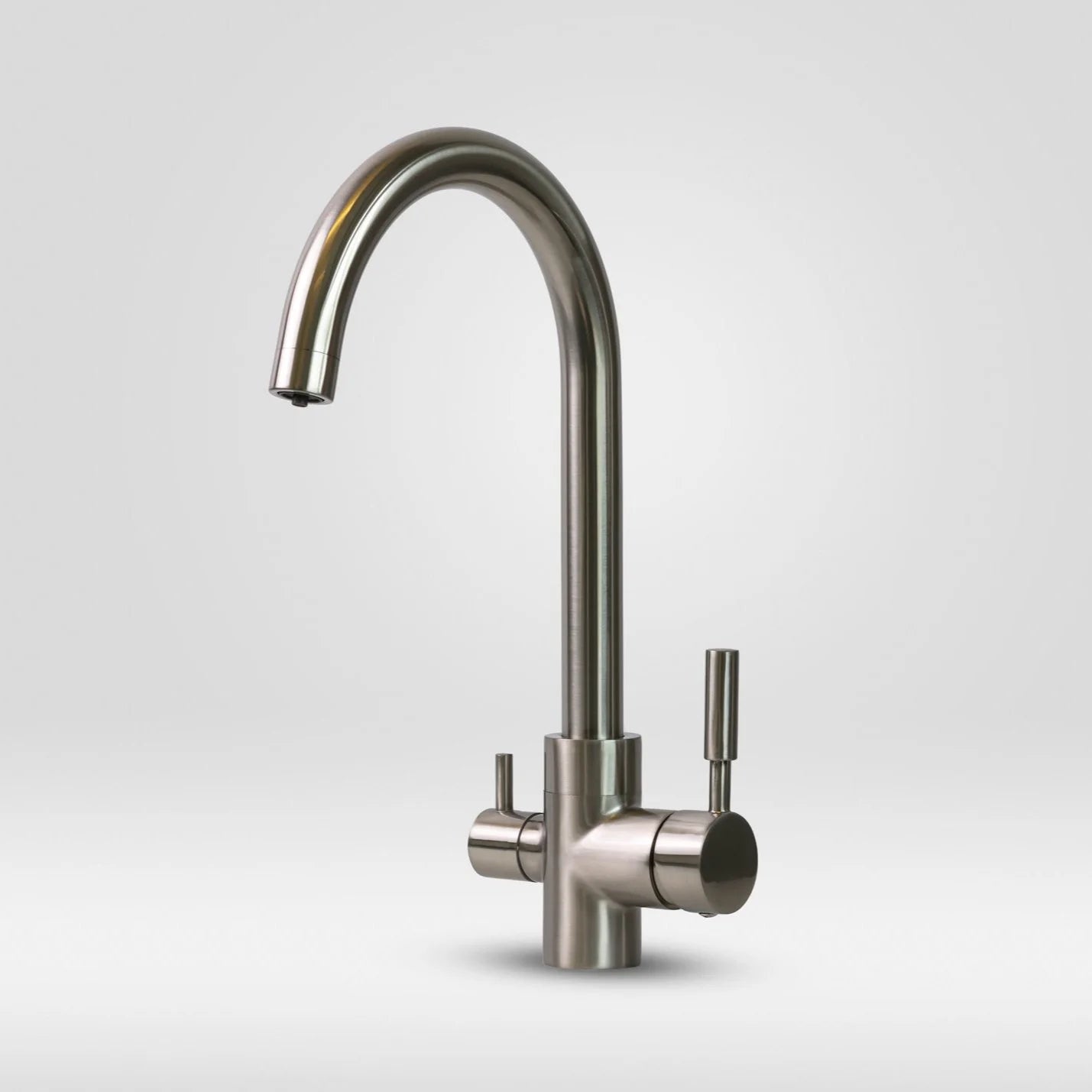
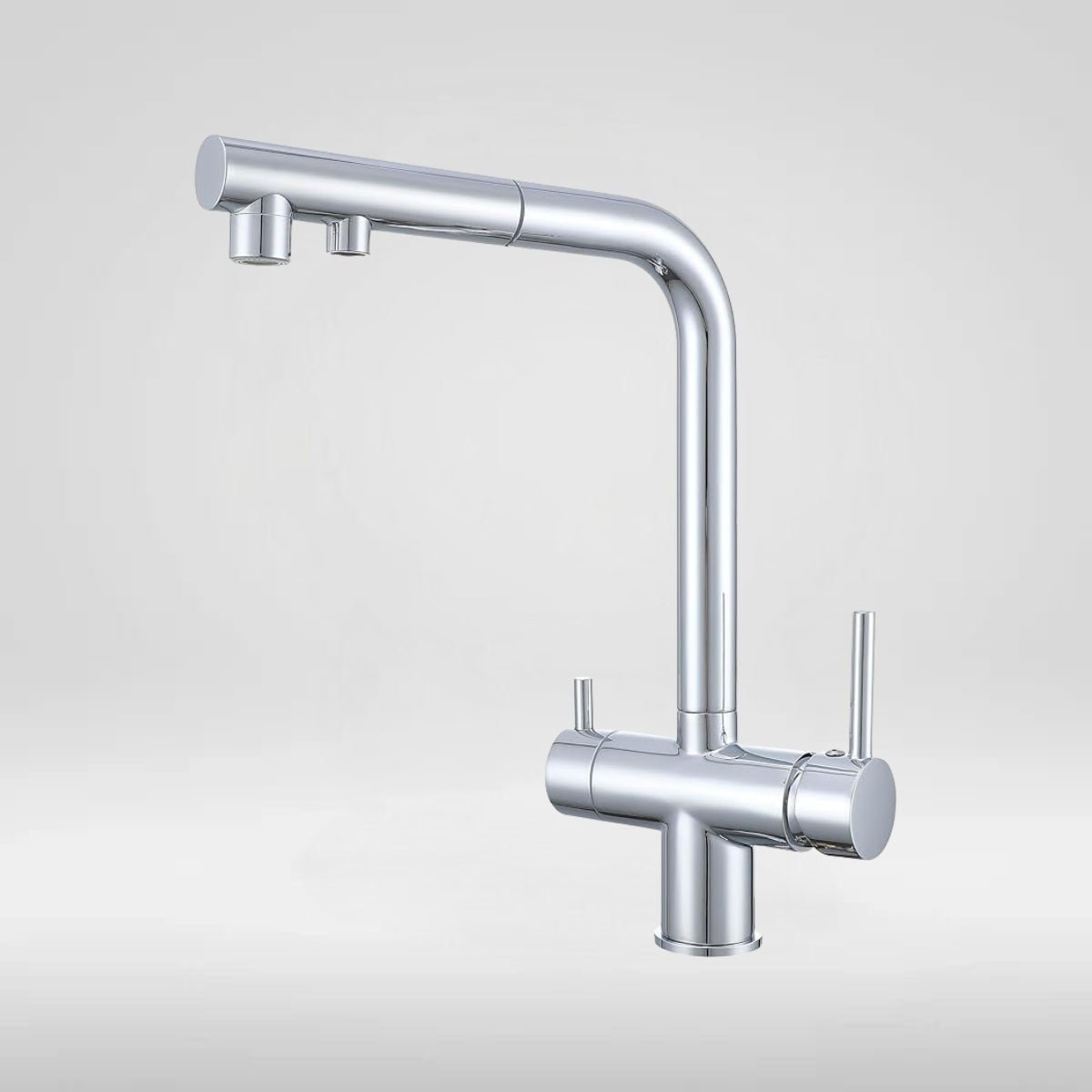
If, in addition to soft water, you also want pure drinking water, that requires a different technology: reverse osmosis. The membrane blocks up to approximately 99 percent of dissolved substances, including PFAS, heavy metals, and microplastics, and this technology is enshrined in the NSF/ANSI 58 standard. At PureAqua, this water flows via a pure water tap with the filter system included as standard, or via the subscription of 29 euros per month with a 299 euro start-up fee. What that looks like on a daily basis is covered in our article on filtering tap water via a filter tap.
In short: a softener protects your home and your appliances, an osmosis system improves what you drink. Many customers combine both, and that is precisely why we include them in one piece of advice.
Five pitfalls when choosing
- Choosing based on purchase price: a 500 euro device that uses double the amount of salt and water per regeneration is no bargain over ten years.
- Not requesting water hardness: without your dH value, any capacity calculation is a guess.
- Expecting salt-free to do what salt does: less scale is not the same as soft water, and the difference is measurable.
- Underestimating installation: a connection to the drinking water system falls under NEN 1006 and should be handled by a professional.
- Thinking that softening also filters: for PFAS and medicine residues, you need reverse osmosis, not an ion exchanger.
Buying advice in five minutes
Go through these four steps and you will have a clear choice, without spending an afternoon scrolling through reviews.
- Request your water hardness from your water company and write down the number in dH.
- Count your household size and calculate using 120 liters per person per day.
- Measure the available space near your water meter, including height and the proximity of a drain.
- Only then choose the device: for hardness above 8 dH and a family, a hydraulic ion exchanger like the AquaCell; for a smaller household or a lower entry point, the Joep.
If you are still hesitating between the two, the decision is usually made quickly as soon as someone takes a look at your meter cupboard and your hardness. We don't charge anything for that.
Let us make the choice for you
Provide your postal code and household size, and we will tell you which device fits and what the installation entails.
Request free advice View the AquaCellFrequently asked questions
According to the Consumers' Association, what is the best water softener?
There is no public model score from the Consumers' Association that we can cite here. The pages that appear at the top for that search term are almost all commercial comparison sites with a name that resembles the Consumers' Association. What is sustainable: choose based on seven measurable criteria, namely softening system, control, capacity, salt and water consumption, installation, warranty, and total costs over ten years. A device with salt measurably lowers hardness; a magnet does not.
Which is the best water softener?
The best water softener is an ion exchanger with salt that matches your hardness and household size. For a family with water above 8 dH, a hydraulic device like the AquaCell is the safest choice, because it works without electricity and delivers soft water 24 hours a day up to 3,000 liters per hour. For a smaller household or a lower entry point, the Joep at 1,699 euros is more logical. Salt-free and magnetic systems do not lower hardness.
Which water softener is best to buy?
Buy the device for which the salt and water consumption per regeneration is known, that fits in your meter cupboard, and that is connected by an installer according to NEN 1006. Calculate the costs over ten years instead of the purchase price: at 100 liters of rinse water per regeneration, that is 0.27 euros per time based on the Vewin rate of 2.71 euros per cubic meter, plus a 25-kilo bag of salt. At PureAqua, the AquaCell costs 2,348 euros and the Joep 1,699 euros, including installation by our own specialist.
Which water softener is best according to the test?
Here too: we do not refer to a test result that cannot be publicly verified. However, the pattern in all serious comparisons is the same. Ion exchange systems with salt score on softening results, while salt-free and magnetic systems only limit scale. Therefore, ask every provider for the hardness reduction in dH, plus the consumption per regeneration and the warranty period. Those three figures say more than any ranking.
What is the most sold water softener in the Netherlands?
The AquaCell is presented by the manufacturer itself as the most sold water softener in the Netherlands, with a claimed base of more than 350,000 households. That is a claim from the supplier and not an independent measurement, but the device is the model we install most often. The reason is practical: it works hydraulically, so no power outlet in the meter cupboard is needed, and it is compact enough for most Dutch homes.
Does a water softener really make sense?
With water above approximately 8 dH, yes, because then you see limescale on taps, glassware, and heating elements. Below 6 dH, the benefit is small. Drinking water companies like Vitens rightly say that softening is not necessary for health: you do it for comfort, less soap, and a longer lifespan for appliances. If you specifically want healthier or tastier drinking water, then reverse osmosis is the technology intended for that.
Conclusion
The best water softener is the device that fits your dH value, your household, and your meter cupboard, not the model at the top of a list. First, request your hardness, calculate using 120 liters per person per day, measure the space, and then choose. If you want measurably soft water, choose an ion exchanger with salt: at PureAqua, the AquaCell for 2,348 euros or the Joep for 1,699 euros, with a 2-year all-in warranty and a 100-day trial period.
And keep the distinction sharp: soft water protects your home, pure water improves what you drink. The latter requires reverse osmosis. Drink different.
Soft water at home, pure water at the tap
View the water softeners, or jump straight to a pure water tap with reverse osmosis.
To the water softeners View the pure water taps