Reading time: approximately 13 minutes
Short answer
It is impossible to avoid PFAS completely: they are already present in the soil, the air, our food, and in small amounts in tap water. You can, however, reduce your exposure. The biggest source is food, from which, according to the RIVM, people in the Netherlands ingest more than three times as much PFAS as from drinking water. Buy fewer products containing PFAS, eat a varied diet, and purify your drinking water using reverse osmosis.
In this article
- What are PFAS and why are they a problem?
- Where is PFAS found in the home? Room by room
- Fixed or loose PFAS: this distinction determines what you should do
- PFAS-free pans: what to look for?
- How much PFAS do you ingest through food and drink?
- Is there PFAS in Dutch tap water?
- What helps and by how much? Measures compared
- Step-by-step plan: reducing PFAS in 7 steps
- Frequently asked questions
- Conclusion
What are PFAS and why are they a problem?
Definition
PFAS stands for per- and polyfluoroalkyl substances: a group of man-made chemical substances that repel water, grease, dirt, and dust. They do not occur naturally in the environment, barely break down, and accumulate in plants, animals, and humans. That is why they are often called "forever chemicals".
According to the Voedingscentrum (Netherlands Nutrition Centre), there are more than 4,700 different PFAS. Well-known names include PFOA, PFOS, PFNA, PFHxS, and GenX. The very trait that makes them useful in a pan or a raincoat—namely that they are nearly inert—also makes them problematic: they do not disappear from the environment and only leave your body slowly.
According to the RIVM (Dutch National Institute for Public Health and the Environment), health risks from the normal use of products containing PFAS are small. The problem lies in accumulation: RIVM research on PFAS in blood shows that almost everyone in the Netherlands has higher levels of PFAS in their blood than the health-based limit. A number of PFAS are known to be able to affect the immune system, and at higher concentrations, also liver function, cholesterol levels, and birth weight.
Regulations are becoming stricter. PFOS was banned in many products in 2008 and PFOA in 2020. Since July 1, 2022, PFAS may no longer be used in paper and cardboard that comes into contact with food, such as baking paper and pizza boxes, with one evaluated exception. Five countries have jointly proposed a European ban on all PFAS, and the Dutch government has placed all varieties on the list of Substances of Very High Concern.
Start with the source you can control yourself
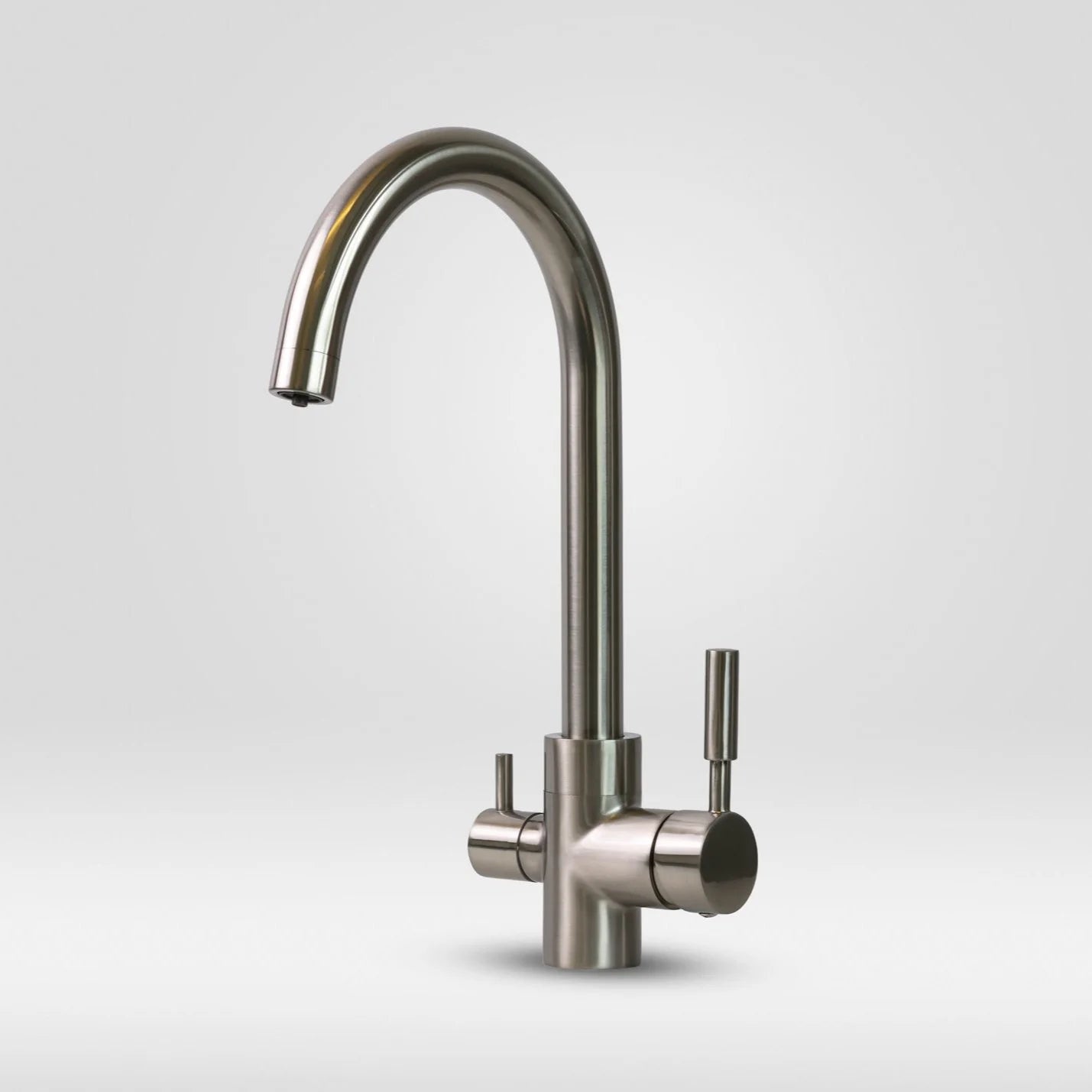
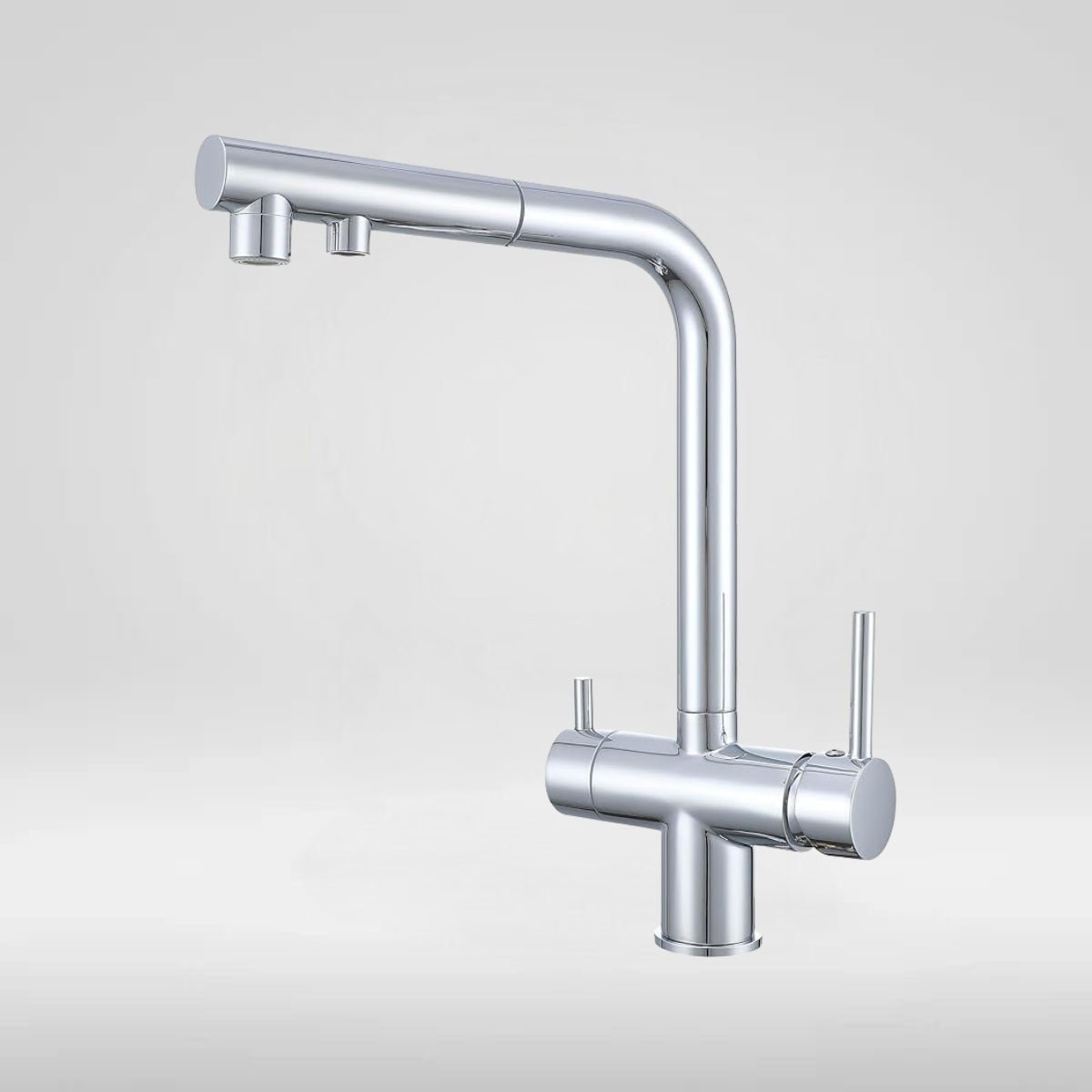
Reverse osmosis removes up to approximately 99 percent of dissolved substances, including PFAS. This system is standard with every pure water tap.
View our pure water tapsWhere is PFAS found in the home? Room by room
Most articles mention "pans and rainwear" and leave it at that. The product list from Milieu Centraal is quite a bit longer. Take a walk through your home.
Kitchen
- Non-stick pans: the classic Teflon coating, in which the PFAS are "fixed".
- Paper and cardboard food packaging: largely banned since July 2022, but older stock and products from outside the EU may still contain them.
- Kitchen aprons and tablecloths with a dirt- and grease-repellent coating.
- Coatings for tabletops, whiteboards, and sinks.
Living room and bedroom
- Upholstery: sofas, chairs, curtains, carpet.
- Electronics: smartphones, fitness trackers, cables, and data networks.
- Pressed wood and certain floor coatings.
Bathroom and personal care
- Cosmetics: mascara, lipstick, nail polish. In these, PFAS are "loose", so they are released during use.
- Dental floss and period underwear.
- Certain bandages, sports tape, and medical devices.
Hallway, wardrobe, and shed
- Rain and outdoor sports clothing with a breathable, water- and dirt-repellent layer, tents, and umbrellas.
- Impregnating agents for leather and textiles, paint, varnish, and maintenance products for floors and window frames.
- Lubricants such as chain spray and ski wax, plus fire extinguishers and carpet cleaner.
This seems overwhelming, but not every product is equally relevant to your exposure. That depends on whether the PFAS in the product are "fixed" or "loose".
Fixed or loose PFAS: this distinction determines what you should do
Milieu Centraal makes a distinction that is most practical and rarely seen in buying guides.
Fixed PFAS: use the product until it's worn out
If the PFAS are contained within a layer of the material, such as with a pan or a raincoat, they generally do not release during normal use. They only do so slowly due to wear and tear or improper use. If you already have such a product at home and it is not yet worn out, throwing it away is illogical: it does little for your health and is worse for the environment. Use it up and dispose of it properly at the end of its life.
Loose PFAS: this is where your gain lies
With ski wax, fire-extinguishing foam, impregnating spray, chain lube, paint, and cosmetics, the PFAS are loose. They are released during use, into your home and the environment. If there is a PFAS-free alternative that works well, switch to it and avoid using the old product. This is the category where you can truly make a difference with a single purchasing decision.
Rule of thumb: if a product is simultaneously grease-, dirt-, and water-repellent, the chances are higher that it contains PFAS. Manufacturers are not required to list it on the label, but you can ask: by law, a seller must give you an answer within 45 days at no cost.
PFAS-free pans: what to look for?
For many people, the pan is the first thing that comes to mind, and search figures show it: about 6,600 people in the Netherlands search for "PFAS-free pans" every month. Yet the pan is not your biggest source of exposure. The EFSA concluded in 2020 that very small amounts of PFAS end up in food via a non-stick pan and that they enter your body in very limited quantities that way. The Voedingscentrum therefore says that you can safely use an undamaged non-stick pan.
If you still want to choose PFAS-free when buying a new one, these are the reliable routes:
- No coating: stainless steel and cast iron have no non-stick coating and are therefore always PFAS-free. They can withstand high heat and last a long time, but you need more oil or butter.
- Ceramic coating: a layer based on mineral particles. Good for cooking, but avoid high flames, metal spatulas, and the dishwasher.
- The right label: "PFAS-free" and "PFC-free" mean that they do not contain PFAS. Be careful with "PFOA-free" or "PFOS-free", because that only excludes those specific substances while thousands of other PFAS exist.
- Be careful with purchases outside the EU: webshops outside the EU may supply products with PFAS that are banned here.
In short: replacing your pan is a sensible choice at your next purchase moment, but it is not an emergency measure. The largest amount of PFAS does not come from your frying pan.
How much PFAS do you ingest through food and drink?
This is the heart of the story. Food makes the most significant contribution to the PFAS in your body, the RIVM concluded based on research in 2023. According to the institute's calculations, people in the Netherlands ingest more than 3 times as much PFAS through food as through drinking water.
A health-based limit applies to total intake: the tolerable weekly intake, set by the European Food Safety Authority (EFSA) and adopted by the RIVM. The math works out as follows: for drinking water alone, intake stays below that limit, but for food and drinking water combined, the Netherlands exceeds it. That does not mean you will get sick, but it does mean that the chance of adverse effects increases with years of exposure.
Where is it in your food? Fish, in particular, can contain a lot of PFAS. Additionally, the RIVM and Voedingscentrum mention eggs, fruits and vegetables, dairy, meat and game, and even coffee and tea. Three specific tips come up repeatedly:
- Eat a varied diet. That is the best advice for ingesting less of any unwanted substance.
- Do not eat eggs from backyard chickens. Chickens that roam freely eat earthworms, which, according to RIVM research, are a significant source of PFAS. You can safely eat store-bought eggs.
- Limit consumption of self-caught freshwater fish such as eel, perch, and trout. The advice remains to eat store-bought fish once a week, because the health benefits of fish outweigh the disadvantages.
That PFAS are widespread is also evident from RIVM research from 2026 into breast milk: among 1,629 participants, PFAS was found in all samples tested. In 82 percent of cases, the amount was below the risk limit, and in 18 percent it was above. The advice to breastfeed still stands, because breast milk also contains antibodies and immune cells that protect babies.
Not sure which solution fits your kitchen?
Tell us what fits under your sink and how much water you drink per day. We will calculate it for you, with no strings attached.
Request free advice View the Countertop ROIs there PFAS in Dutch tap water?
Yes, in small amounts. And at the same time: Dutch tap water is safe to drink and meets legal standards. Both are true, which makes this subject prone to exaggeration in both directions.
The hard numbers: The Drinking Water Decree sets a legal maximum of 100 nanograms per liter for 20 different PFAS combined, and Dutch drinking water complies with this. Because there is new knowledge regarding effects on the immune system at very small quantities, the RIVM advises a stricter guideline of 4.4 nanograms per liter, expressed in PFOA equivalents. That is a factor of 23 stricter than the legal standard and shows the direction in which things are heading.
Furthermore, the source plays a role: drinking water from groundwater generally contains less PFAS than drinking water from surface water. Drinking water companies purify as well as they can, but the Voedingscentrum itself says that completely purifying PFAS out of water is difficult. If you want to know exactly how the safety of our tap water is structured, read how strictly Dutch drinking water is controlled.
What can you do about the water yourself? Filter it at the point of use. The technology is decisive. A charcoal filter or filter pitcher primarily improves taste and odor, and a small filter cartridge has too little contact time to demonstrably block PFAS. Reverse osmosis presses the water through a membrane and retains up to approximately 99 percent of dissolved substances, including PFAS, nitrate, heavy metals, and microplastics. The international standard for this is NSF/ANSI 58. In our explanation of how reverse osmosis works, you can see step-by-step what happens in the filter stages.
At PureAqua, we see that customers who start out of concern for PFAS often stay for the taste. It is also not an either-or situation: according to Milieu Centraal, tap water remains the most sustainable drink choice, and a filter on your own tap makes that water purer without the need to lug around bottles. The fact that Dutch drinking water quality is high remains the starting point.
What helps how much? Measures compared
Not every tip carries the same weight. This table lists common measures by effect and effort, so you know where to start.
| Measure | What it does | Effect on your intake | Points of attention |
|---|---|---|---|
| Varied diet | Spreads exposure across many products | High, as food is the biggest source | Costs nothing, healthy for other reasons too |
| No eggs from hobby chickens | Eliminates a source with sometimes elevated levels | High for those with their own chickens | Store-bought eggs are safe |
| Limit wild-caught freshwater fish | Avoids fish with higher PFAS levels | Medium to high for anglers | Store-bought fish once a week is still recommended |
| Replace products with loose PFAS | Prevents PFAS from being released during use | Medium, and reduces environmental emissions | Think of waterproofing sprays, ski wax, and cosmetics |
| PFAS-free pan when buying new | Less PFAS in the chain and in your pan | Low for your own intake | Using up an old pan is more environmentally friendly |
| Filter pitcher or carbon filter | Improves taste, odor, and some limescale | Not significant for PFAS | Change filter on time, otherwise bacterial growth |
| Reverse osmosis on the tap | Membrane blocks dissolved substances | High for water source: up to approx. 99 percent | Requires space, connection, and filter changes |
| Switch to bottled water | Different source, no guarantee of PFAS-free | Uncertain | Expensive, heavy, and a lot of plastic |
The ranking is therefore somewhat counterintuitive: food and drink have the most impact, while the pan everyone is looking for contributes relatively little. And of the things you can do to your water, only reverse osmosis is a technique that demonstrably addresses PFAS. Anyone who wants to see the downsides of osmosis fairly weighed can find them listed in a separate article.
Action plan: Reducing PFAS in 7 steps
- Start with your plate. Eat a varied diet and alternate between types of fish, meat, dairy, fruits, and vegetables. This is the cheapest measure with the greatest effect.
- Cut out the two outliers. No eggs from your own chickens and not too much wild-caught freshwater fish.
- Clean up the loose PFAS. Check your shed and bathroom cabinet for waterproofing spray, ski wax, chain lubricant, and cosmetics with "fluoro" or "PTFE" in the ingredients.
- Keep using fixed PFAS until they are worn out. Throwing away your pan or raincoat while it is still in good condition does not help your health or the environment.
- Choose the PFAS-free alternative for every new purchase. Ask if it is not on the label, as you are entitled to a free answer within 45 days.
- Address your drinking water with the right technique. For PFAS, this means reverse osmosis, not a carbon filter or pitcher.
- Schedule the maintenance. A forgotten filter is worse than no filter. Put the filter change in your calendar or arrange it through a subscription that includes filters and service, at PureAqua for 29 euros per month with 299 euros in start-up costs.
Frequently asked questions
Where is most of the PFAS found?
In food. In 2023, the RIVM concluded that food is the primary contributor to PFAS in our bodies: more than 3 times as much as via drinking water. Within food, fish is the largest source, followed by eggs, dairy, meat, vegetables, and fruit. Of consumer products, non-stick pans and rainwear are the best-known sources, but they contribute far less to your intake.
Which products contain a lot of PFAS?
Products that are simultaneously water, grease, and dirt repellent. Think of non-stick pans, rain and outdoor clothing, tents, umbrellas, upholstery, carpet, cosmetics, dental floss, waterproofing agents, ski wax, chain lubricant, paint, fire-fighting foam, artificial grass, and electronics. Since July 1, 2022, paper food packaging may no longer contain PFAS, with the exception of one assessed type.
What does PFAS do to your body?
PFAS leave your body slowly and accumulate. Consuming too much over many years can negatively affect the functioning of the immune system, which can make you ill more often or make vaccinations less effective. At higher concentrations, effects on liver function, cholesterol levels, and birth weight have also been observed. Some PFAS have been linked to kidney and testicular cancer in cases of long-term, high exposure.
What can you do to reduce PFAS?
Living completely PFAS-free is impossible, but reducing it is. Eat a varied diet, skip eggs from hobby chickens and too much wild-caught freshwater fish, replace products that contain loose PFAS such as waterproofing spray and cosmetics, choose the PFAS-free or PFC-free label for new purchases, and purify your drinking water with reverse osmosis. You should simply continue to use products that contain fixed PFAS, such as a whole pan.
How do you know if a pan is PFAS-free?
Look for the "PFAS-free" or "PFC-free" label. Claims like "PFOA-free" or "PFOS-free" only say something about that one specific substance, while there are over 4,700 types of PFAS. Stainless steel and cast-iron pans do not have a coating and are therefore always PFAS-free. If there is nothing on the packaging, ask the seller: by law, they must provide a free answer within 45 days.
Is bottled water PFAS-free?
That is not guaranteed. Spring water and mineral water also come from the ground, and PFAS are now widespread in groundwater and surface water. There is no general guarantee that bottled water contains less PFAS than tap water, while it is more expensive and generates a lot of plastic waste. According to Milieu Centraal, tap water is the most sustainable drink choice; if you want it purer, you can filter it at your own tap.
Does a water filter remove PFAS from tap water?
That depends entirely on the technology. A filter pitcher or small carbon filter improves taste and smell but has too little contact time to demonstrably stop PFAS. Reverse osmosis presses water through a membrane and blocks up to approximately 99 percent of dissolved substances, including PFAS, nitrate, heavy metals, and microplastics. The standard for these systems is NSF/ANSI 58.
Conclusion
Avoiding PFAS entirely is impossible, but reducing it is. That is not resignation, but a list of priorities. Food is the largest source, with more than 3 times the intake compared to drinking water, so a varied diet and cutting out hobby chicken eggs and a lot of wild-caught fish yields the most results. Next are the products containing loose PFAS, such as waterproofing sprays and cosmetics. The pan everyone is looking for is further down that list, and you shouldn't just throw away a perfectly functional pan.
Regarding your drinking water: Dutch tap water is safe and meets the legal limit of 100 nanograms per liter for 20 PFAS, while the RIVM simultaneously advises a stricter guideline of 4.4 nanograms per liter. If you want to increase that margin yourself, reverse osmosis is the only technique that demonstrably does so, by up to approximately 99 percent. At PureAqua, that system comes standard with a pure water tap, or you can choose the Countertop RO, which requires no installation. Pure water from your own tap, without bottles: Drink different.
Pure water from your own tap
Choose a pure water tap with the osmosis system included, or start worry-free with the subscription.
View the taps View the subscription