Reading time: about 12 minutes
Short answer
Reverse osmosis removes up to around 99 percent of the dissolved substances from your water, and calcium and magnesium are among them. There are two ways to bring them back: with a passive mineral cartridge behind the membrane, or with a pump that doses minerals per litre. The difference is consistency. A cartridge gives off a lot at first and steadily less as it wears out; a dosing system holds the same level. This is about taste, not health: you get your minerals mainly from food.
In this article
Definition
Remineralisation is putting minerals back into water after a treatment step has taken them out. With reverse osmosis that happens after the membrane, with a cartridge the water flows through or with a pump that doses a mineral solution. The aim is taste and a balanced water profile, not making up a deficiency.
Why osmosis takes the minerals with it
A reverse osmosis membrane makes no distinction between substances you do not want and substances you do. It holds back whatever is too big to pass through, and that means PFAS, heavy metals and nitrate just as much as calcium and magnesium. The performance of domestic systems is assessed against the standard NSF/ANSI 58, and that is about removal, not about selectivity.
That is immediately the most frequently raised objection to this technique, and it is a fair one. So how much do you take out? Vitens explains that the hardness of your tap water is determined by the amount of calcium and magnesium dissolved in it. With water at 8 degrees of German hardness, which according to Waternet is roughly the Dutch average, there is around 143 milligrams of lime in a litre. After the membrane, virtually none of that is left.
For your kitchen that is good news: no limescale in your kettle, no white spots on glassware. For your taste buds it is more nuanced, and that is what the rest of this article is about. If you would first like to know how the technique itself works, we explain that on our page about how reverse osmosis works.
Not sure whether remineralisation adds anything for you?
Tell us what you drink now and what you find missing in the taste. We will think along free of charge, even if the conclusion is that you do not need it. PureAqua is an official Bluewater dealer, so we know both sides of this story.
Ask for free advice View the pure water tapsWhat minerals in drinking water actually do
Here we have to be straight with you, even though we sell filter systems ourselves: the minerals in your drinking water mainly do something for the taste, and hardly anything for your mineral intake. You get calcium and magnesium primarily from food.
That does not mean it makes no difference. The World Health Organization background document on dissolved solids in drinking water is strikingly concrete about this. It describes a taste panel that classified water by the total amount of dissolved solids, the TDS value: excellent below 300 milligrams per litre, good between 300 and 600, fair between 600 and 900, poor between 900 and 1,200 and unacceptable above that. And then the sentence that counts for this article: water with an extremely low TDS can taste flat. That same document also establishes that there is no health-based guideline value for TDS.
The whole question sits there in two lines. There is no health reason to bring minerals back, and there is a taste reason. If you want to know exactly what that TDS value means and what is normal, you will find it in our article on what the ppm value on a meter tells you.
At PureAqua we hear this in practice mainly from people who have just switched. The water is cleaner than what they were used to, but the first cup of tea tastes different from what they expected. That is exactly the moment remineralisation comes up.
Water with electrolytes: do you need it?
Electrolytes sounds technical, but it is an ordinary word for salts and minerals dissolved in water: sodium, potassium, calcium and magnesium. Once they dissolve, they become charged particles. So every glass of tap water already contains them.
In recent years a whole market of powders, tablets and bottles has grown up around this. The Netherlands Nutrition Centre is clear about it where sports drinks are concerned: for most people who exercise they are simply unnecessary extra calories, and only with very intensive sport can they be useful. So for anyone who just gets through the day and goes to the gym now and then, water is water.
That is immediately the difference with what this article is about. A water filter with mineralisation is not a sports drink and not a supplement. It adds no sugars or high doses; it brings the water back to a mineral level comparable to good tap water or spring water, so that it does not taste flat. Anyone who suspects a deficiency or has symptoms should see a doctor, not buy a water filter.
So why bother at all? Because with filtered water you can determine yourself what is in it, and that is not the case with tap water. The hardness varies by region and by season. A dosed system delivers the same profile every day. For tea, coffee and simply a glass of water, that is the difference between variable and predictable.
Two ways to bring minerals back
1. The mineral cartridge
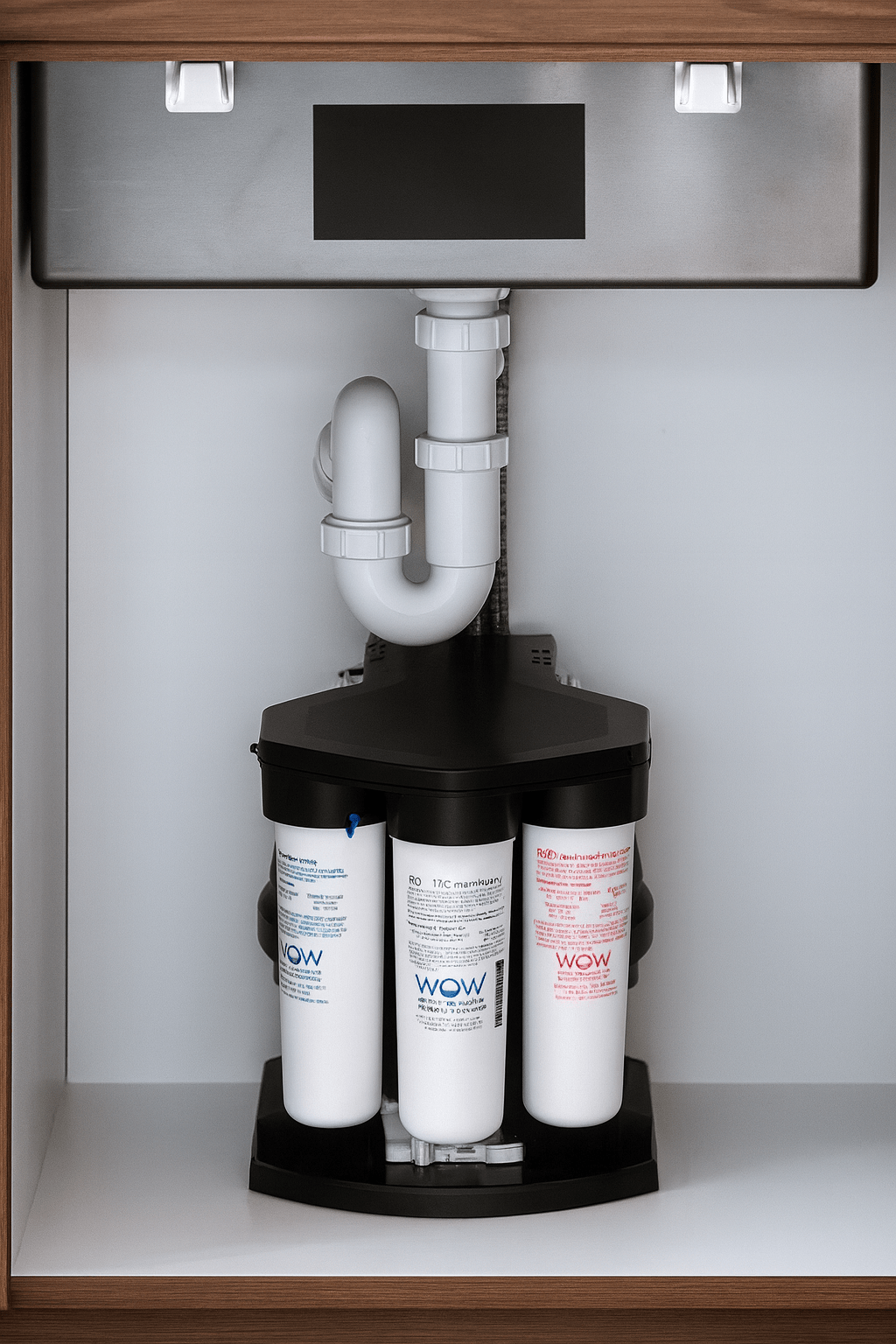
The classic solution and by far the most common. Behind the membrane sits a cartridge filled with mineral granules. The purified water flows through it and dissolves part of those granules on the way. Simple, no power needed, no electronics, and on most systems replaceable for ten to forty euros.
The drawback lies in the physics of it. A fresh cartridge gives off a lot, a half-used cartridge less, and an almost empty cartridge virtually nothing. So your mineral content slowly declines between two replacements, and you only notice once the taste changes. At PureAqua the mineral filter works this way; it is a perfectly good solution for anyone who simply wants a rounder glass of water.
2. Dosed mineralisation with a pump
The second route comes from the professional world and works the other way round. The water is first fully purified and then a pump adds a fixed dose of mineral solution per volume of water. No granule wears down and gives off less and less; it is dosed to a set level.
The brand supplying this for households is Bluewater, and PureAqua is an official dealer for it. Their mineral mix is called Liquid Rock and consists of Swedish minerals. Bluewater measures in its own research that its system delivers 6 milligrams of magnesium per litre consistently, against 0.46 milligrams per litre with a standard mineral cartridge whose calcium and magnesium decline as it wears out. That is a factor of thirteen difference, and more importantly: it is the same every day.
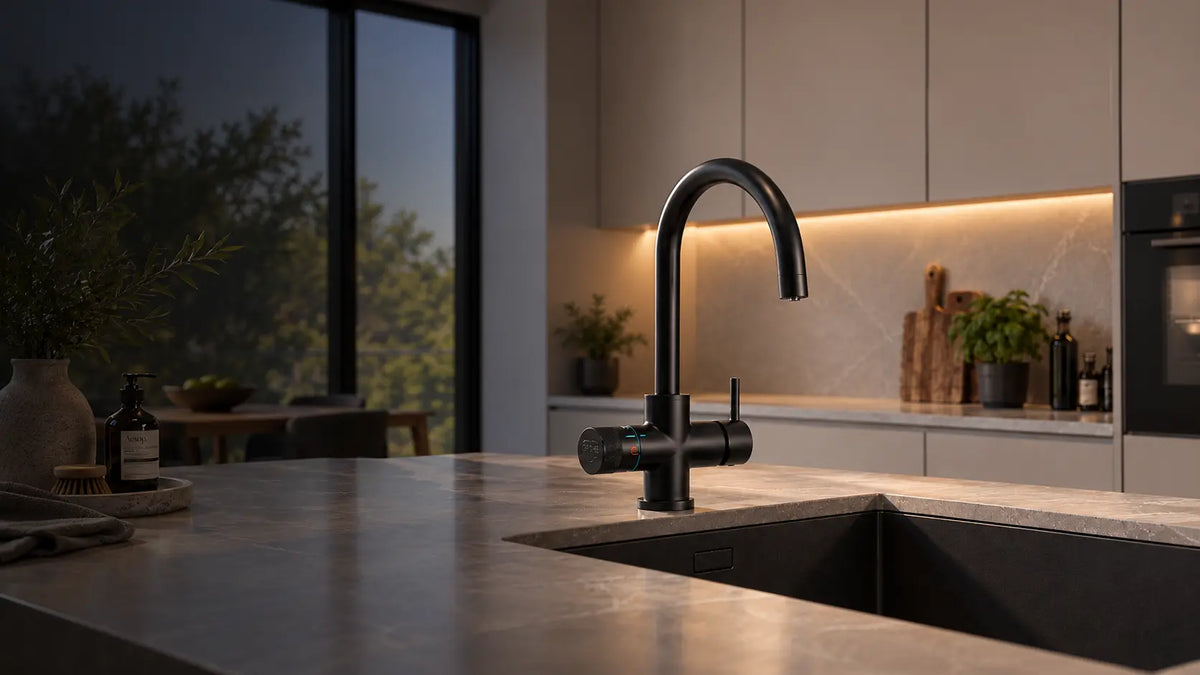
It comes with an app offering three profiles, light, original and strong, and a control button with three settings: water with electrolytes, pure water without any addition for cooking and brewing, and ordinary tap water for cleaning. That last one is more practical than it sounds, because you do not want to run a whole bucket of mopping water through a reverse osmosis membrane.
Curious what dosed mineralisation does in practice?
As an official Bluewater dealer we can tell you exactly what the Kitchen Station 1 would mean in your kitchen, which purifier goes with it and what the maintenance involves. Your enquiry comes straight to us.
Request the Kitchen Station Ask for free adviceCartridge versus dosed mineralisation
The two routes side by side, with the honest caveats included.
| Feature | Mineral cartridge | Dosed mineralisation |
|---|---|---|
| How it works | Water dissolves granules as it passes | Pump doses a fixed amount per litre |
| Consistency | Declines as the cartridge wears out | Stays at the set level |
| Measured magnesium | 0.46 mg per litre (Bluewater measurement) | 6 mg per litre consistently (Bluewater measurement) |
| Adjustable | No, one fixed mix | Yes, three profiles via an app |
| Power needed | No | Yes, plus a control unit |
| Maintenance | Replace the cartridge, usually annually | Top up mineral liquid plus a filter pack |
| Cost | A few tens of euros per replacement | Considerably higher, see the cost section below |
| Suits | By far most households | Anyone wanting the maximum or using it professionally |
The magnesium figures come from Bluewater’s own research and are therefore not independently verified. That does not make them worthless, but read them for what they are: the manufacturer setting its own technique beside the standard. The underlying principle, that a wearing cartridge gives off less than a pump that doses, is correct in any case.
What it costs and what you get for it
This is where the two worlds part ways, and we would rather simply put the amounts on the table. All prices were recorded on 15 September 2026.
The accessible route
At PureAqua a pure water tap with the filter system included starts at 465 euros, and the countertop appliance costs 495 euros. Prefer to spread the cost? Then there is the Pure Water Subscription at 29 euros a month with 299 euros in start-up costs, including tap, system, filters and installation. The mineral filter is a separate module at 45 euros. For the vast majority of households this is exactly enough.
The premium route
The Bluewater Kitchen Station 1 starts at 3,649 euros with the Cleone purifier, costs 5,699 euros with the Spirit and 7,999 euros with the Pro. On top of that comes the mineral liquid: 90.95 euros each time, or 81.86 euros through a subscription with 10 percent discount. An annual filter pack costs 135.95 euros, or 122.35 euros on subscription.
Note one technical detail that is not immediately obvious on the website. The entry-level Cleone purifier works with reverse osmosis and removes up to 99 percent of dissolved substances at a water recovery of 50 percent. The pricier Spirit and Pro use Bluewater’s own SuperiorOsmosis and reach up to 99.7 percent with a recovery of up to 80 percent. That is not a marketing nuance but a real difference, and it explains the jump of more than 2,000 euros between the configurations.
With both routes, also count what you stop buying. Anyone replacing bottled water with water from their own tap earns part of the investment back in groceries and lugging. How that calculation works out over several years is set out in our article on weighing an outright purchase against a fixed monthly amount.
Which solution suits you
We sell both, so we have no interest in steering you towards the most expensive one. This is how we divide it up honestly.
A mineral cartridge is enough if
- You mainly want pure water and would like it to taste rounder than plain osmosis water.
- You do not need exactly the same taste every day.
- You would rather have a system without power and without an app.
- Your budget is in the first route. That is not a compromise, that is the normal choice.
Dosed mineralisation is worth considering if
- You brew coffee at home at a level where the water measurably plays a part. Water is the largest component of a cup of coffee, and minerals steer the extraction.
- You want to be able to switch between profiles, for instance lighter for tea and fuller for a glass of water.
- You value a fixed, repeatable taste rather than a level that slowly drops away.
- Budget is not a decisive factor. At 3,649 euros and up, this is a kitchen investment, not a filter purchase.
What you should not do in either case is buy remineralisation because you think osmosis water without minerals would be unhealthy. It is not, and we have written that discussion out separately in the drawbacks that come with reverse osmosis. If you want to know how osmosis water compares with demineralised and distilled water, you will find that in the difference between demineralised, demi and osmosis water.
Let us look with you before you choose
We know the hardness in your region, we know what fits under your sink and we sell both levels. One conversation often saves an expensive wrong choice. 100 days on trial and 2 years of warranty on our own systems.
Ask for free advice View the countertop applianceFrequently asked questions
Why drink water with electrolytes?
In everyday life there is no need for it: ordinary tap water already contains dissolved minerals and you get calcium and magnesium mainly from food. With filtered water it is different, because reverse osmosis takes those minerals out. Then it is about taste: the World Health Organization establishes that water with an extremely low amount of dissolved solids can taste flat. Remineralisation brings that back to the level of good tap water.
Can you drink electrolytes every day?
You can drink mineralised water daily without any concern; the level is comparable to tap water or spring water. That is something different from using electrolyte powders or sports drinks every day. The Netherlands Nutrition Centre calls sports drinks unnecessary extra calories for most people who exercise, useful only with very intensive sport. If you have doubts about supplements, discuss them with your doctor.
How do you notice an electrolyte deficiency?
This is a medical question and not a water question, so we are not going to speculate about it here. With a varied diet and normal circumstances, a deficiency is unusual in the Netherlands. If you have symptoms or are worried, see your doctor. A water filter is not a remedy for a deficiency and we do not present it as one.
Which drinks are high in electrolytes?
Mineral water, stock, milk, coconut water and sports drinks contain relatively high levels of dissolved minerals. Tap water sits well below that but does contain them: at the Dutch average of about 8 degrees of German hardness there is around 143 milligrams of lime in a litre. Plain osmosis water sits far below that, and that is precisely why a mineralisation step is added behind it.
What are the drawbacks of electrolyte drinks?
Ready-made electrolyte drinks often contain sugars and therefore calories you do not need in normal use, they cost many times more per litre than tap water and they produce bottle waste. For intensive endurance sport they can be useful. For everyday hydration, filtered water at a normal mineral level is cheaper, more neutral and packaging-free.
Does reverse osmosis remove all the minerals from your water?
Virtually all of them, yes. A membrane holds back up to around 99 percent of dissolved substances and makes no distinction between PFAS, heavy metals and lime on the one hand and calcium and magnesium on the other. That is immediately the reason a mineralisation step exists. The water is safe either way; the standard NSF/ANSI 58 assesses the removal performance of this kind of system.
Do you need a mineral filter with reverse osmosis?
Necessary it is not, pleasant it often is. Osmosis water without minerals is safe to drink, but some people find it tastes flat. A mineral cartridge costing a few tens of euros solves that for most households. If you want a fixed, adjustable taste instead of a level that drops away as the cartridge wears out, you end up with dosed mineralisation, and that is a different price bracket.
Conclusion
A water filter that adds minerals solves a taste problem, not a health problem. Reverse osmosis removes up to around 99 percent of dissolved substances and takes calcium and magnesium with it; the World Health Organization itself establishes that water with an extremely low amount of dissolved solids can taste flat, and that there is no health-based guideline value for it. So the question is not whether you need minerals, but whether you taste the difference and whether you think it is worth it.
The choice then comes down to two principles. A mineral cartridge is cheap, simple and more than sufficient for by far most households, with the drawback that the level drops away as the cartridge wears out. Dosed mineralisation holds the level and lets you set it, but starts at an entirely different amount: 3,649 euros for a Bluewater Kitchen Station 1 against 465 euros for a PureAqua pure water tap with the system included.
Our advice is unspectacular but it holds: start with the question of what you are missing now. If you taste nothing unpleasant in your filtered water, you need neither. If it tastes too flat to you, try a mineral cartridge first. If you really want to steer on taste, for instance because you make coffee seriously, dosed mineralisation is the only route that does that reliably. As an official Bluewater dealer we can help you with both, and we will say so honestly if the cheapest solution is the right one. Drink different, but on the right grounds.
Taste first, choose afterwards
Tell us what you drink and what you find missing. We will line up the options, from a mineral cartridge costing a few tens of euros to the Bluewater Kitchen Station. Free and without obligation.
Ask for free advice Request the Kitchen Station