Reading time: approximately 13 minutes
Short answer
Buying an osmosis unit for drinking water in the Netherlands costs roughly 200 to 700 euros, depending on capacity and whether a faucet is included. Renting essentially does not exist in this market, but a subscription does: at PureAqua, you pay 29 euros per month with a 299 euro start fee, including faucet, filter system, filters, and installation. Purely in terms of costs, buying is cheaper in the long run. You buy a subscription for the service, not for the price.
In this article
- Buying or renting an osmosis unit: what are the actual options?
- Note: an osmosis unit means two very different things
- What does it cost to buy an osmosis unit?
- What exactly is included in a subscription?
- The calculation over 1, 3, and 5 years
- When buying pays off, and when a subscription does
- What to look for before you buy
- And what does the water itself actually cost?
- Frequently asked questions
- Conclusion
Buying or renting an osmosis unit: what are the actual options?
You can buy everywhere. Renting in the traditional sense, where you temporarily take a device and return it, virtually does not exist for household osmosis in the Netherlands. What does exist is a subscription: you pay a fixed amount per month and the supplier manages the system, the installation, the filters, and the service. In practice, that is the answer to the question "can I rent an osmosis unit".
The difference is therefore not between ownership and use, but where the risk and the labor lie. If you buy, you pay once and are then responsible for replacing filters, leaks, and replacement yourself. If you take out a subscription, you spread the costs and shift the maintenance to the supplier. The latter is more expensive, and that is as it should be.
At PureAqua, we see that people almost always ask this question when they see the price of a complete system for the first time. That is a logical moment, and it is exactly why this article makes the full calculation, including the years when the subscription is the more expensive route.
Are you doubting between buying and a subscription?
Tell us how many people live in your home and what your kitchen looks like. We will calculate both routes for free, even if the outcome is that buying is cheaper for you.
Ask for free advice View the subscriptionNote: an osmosis unit means two very different things
This is the pitfall that almost no one mentions, and it costs people money. If you search for "osmosis unit", you get two totally different worlds mixed together. In the measured search results of September 14, 2026, besides drinking water, window cleaners, telescopic poles, aquarium stores, and car washing also appear. That is no coincidence: the related searches are dominated by "osmosis unit window cleaner" and "osmosis unit aquarium".
Definition
An osmosis unit is an installation that forces tap water under pressure through a semi-permeable membrane, leaving dissolved substances behind. For drinking water, this means a system with a pre-filter, membrane, post-filter, and usually its own tap point. For window cleaning or an aquarium, it means a bare device without drinking water finishing, which only needs to make low-mineral water.
The technical principle is the same, the requirements are not. A device for window cleaning only needs to deliver streak-free water: no taste finishing, no mineral module, no materials that need to be suitable for drinking water, and no controlled connection to your home installation. That is exactly why those devices are on the shelves from about 40 euros, while a drinking water system costs many times more.
Anyone comparing by price without this distinction is therefore comparing two different products. If you want to understand what is inside a drinking water system and why those steps are in it, our article on the filter stages that make up an osmosis system explains that step by step. The operation of the membrane itself is on our page about how reverse osmosis works.
For drinking water, there is also a benchmark that the cheap devices lack. The performance of household osmosis systems is assessed internationally against NSF/ANSI 58, the standard for reverse osmosis in drinking water applications. A device intended for a window cleaner has not been assessed against this and does not need to be.
What does it cost to buy an osmosis unit?
We measured the Dutch prices on September 14, 2026, in the product results of Google Shopping. The spread is large: the cheapest device was at 39.95 euros and the most expensive at 1,269 euros. That seems unusable as a guideline until you separate the two worlds from the previous paragraph.
Below 100 euros, you will find almost exclusively bare devices for aquariums and window cleaning. The mid-segment between about 200 and 700 euros is where the household drinking water systems are, with and without a pressure tank, with and without a mineral module. Above that, the semi-professional segment starts with high flow and dispensers. For a family that wants pure drinking water from the kitchen faucet, that band of 200 to 700 euros is the realistic range.
What is almost never in that price, but does end up coming out of your wallet:
- Installation: connection to the cold water pipe, a drain for the flush water, and drilling for an extra tap hole. Everything involved is in our article about what happens under the sink with an osmosis installation.
- A second faucet: osmosis water does not run through your regular mixer tap unless you choose a faucet that has a separate channel for it.
- Filters: a recurring item, not a one-off. At PureAqua, the three main filters last twelve months and the mineral module six months.
- Sufficient water pressure: if it is disappointing, you need a pressure booster pump. How much pressure a membrane requires as a minimum can be read in our piece on the water pressure an osmosis system needs.
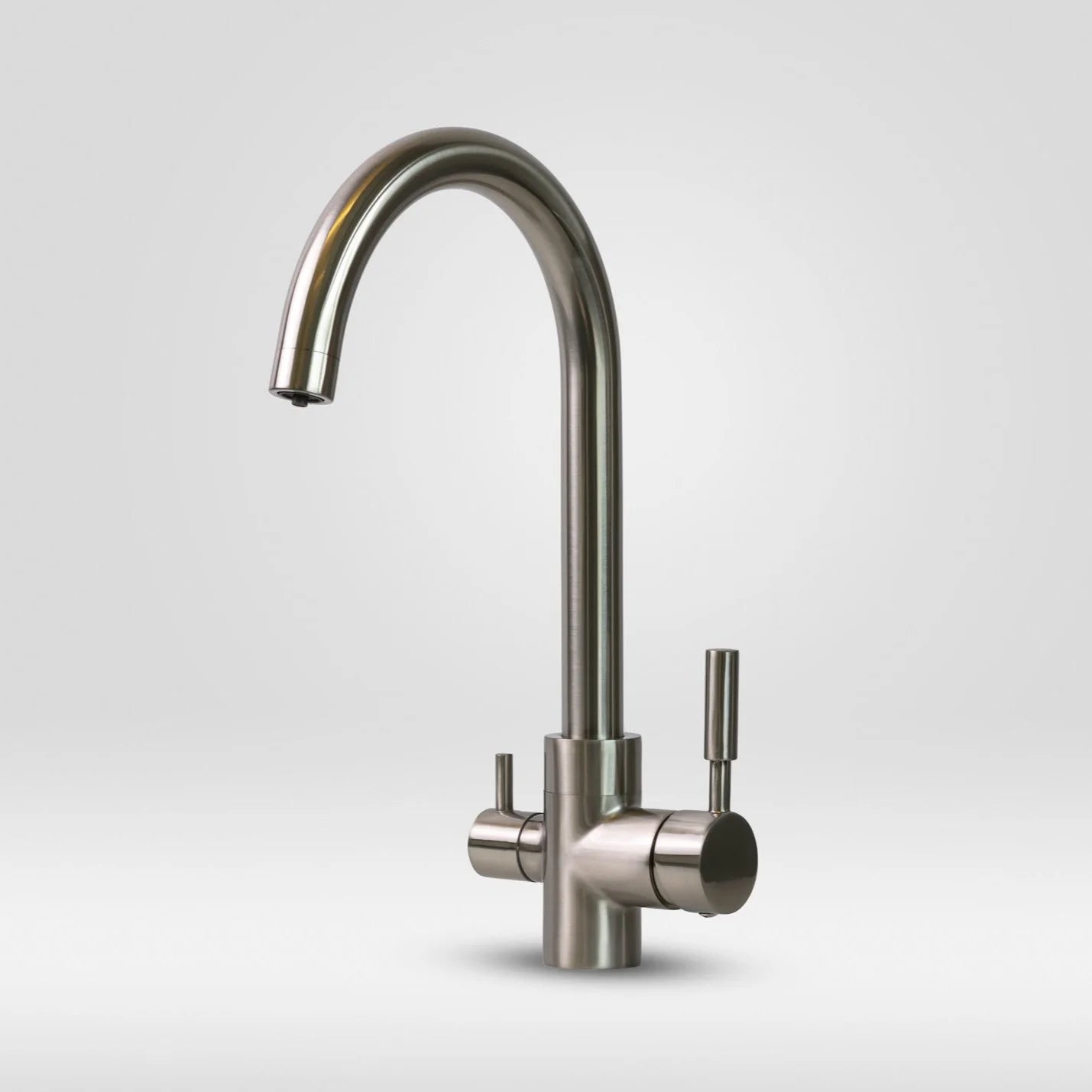
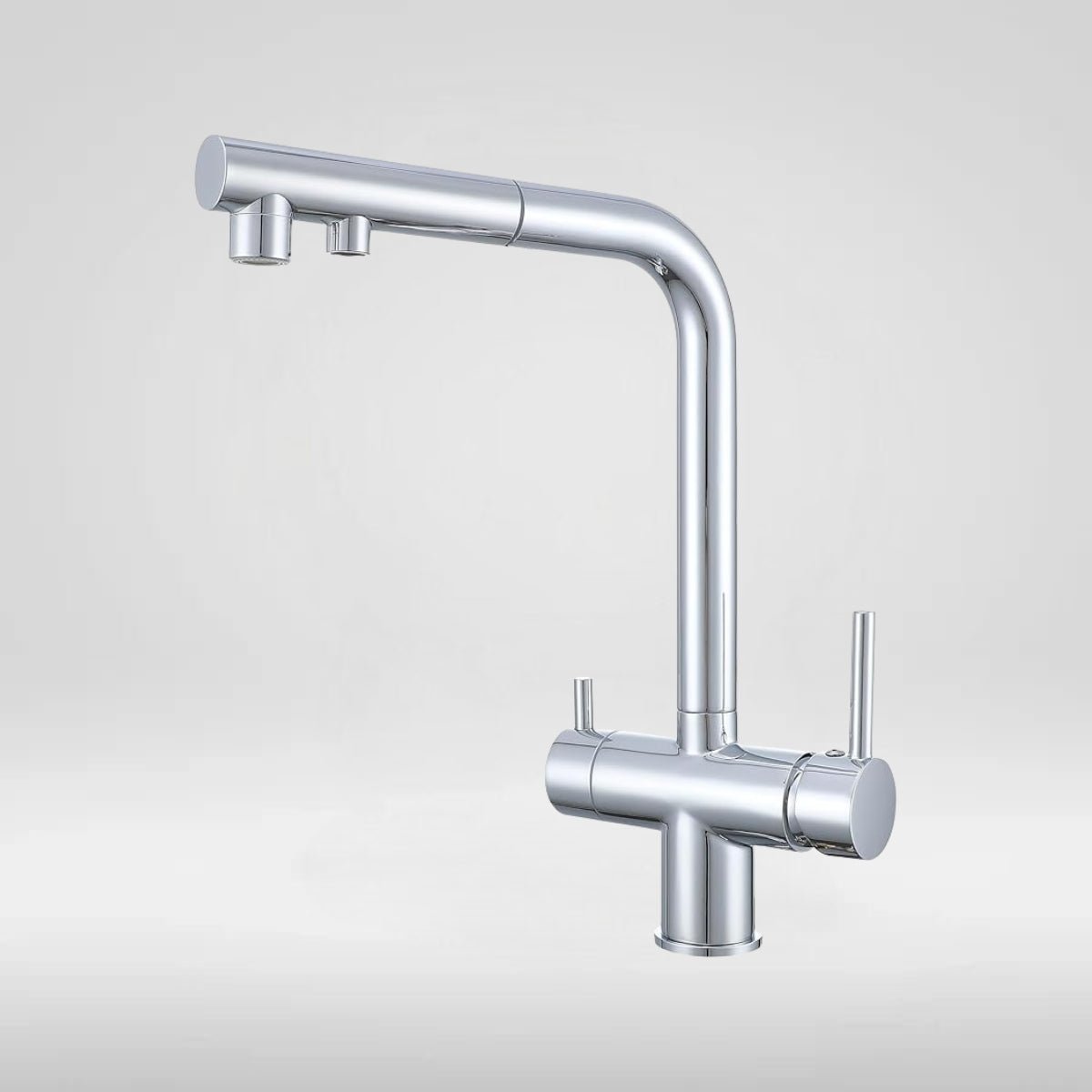
At PureAqua, things work slightly differently than with a separate device, and frankly, that is the most important difference in this comparison. The filter system "The Source" is not sold separately: you choose a pure water faucet and the system is standard included. A pure water faucet starts at 465 euros for the AquaPure. If you would rather not change your piping, there is the pure water device on the countertop for 495 euros, which works plug and play without installation.
For those who are handy themselves: the DIY installation kit with John Guest hoses and couplings costs 49 euros. If you would rather have a specialist come, you will get a separate price for that. A new filter set costs 149 euros for the triple pack, 75 euros for the double pack of the Source 50, and 45 euros for the separate mineral module.
What exactly is included in a subscription?
The Carefree Pure Water subscription costs 29 euros per month with a 299 euro start fee. This includes the pure water faucet of your choice, the filter system, the filter set for twelve months, and the installation by a specialist. The minimum term is twelve months, after which it can be canceled monthly with one month's notice.
What you get in return is planning that you don't have to do yourself. The filters come automatically, the installation is arranged, and in case of a malfunction, you call a number instead of looking for a plumber. Furthermore, there is a 100-day trial period and a 2-year warranty on all systems.
There is also an honest caveat, because a subscription is not free money. You are tied to the term for twelve months, you pay for use and service instead of ownership, and the exact ownership arrangement is in the terms and conditions on the subscription page instead of in a sales pitch. Anyone who is certain that they will live in the same house for ten years and dares to change a filter themselves pays more with a subscription than necessary.
Pay attention to the start costs. With a subscription of 29 euros per month with a 299 euro start fee, you pay 647 euros in the first year. That is more than many people expect when they only look at the monthly amount. Therefore, always calculate the first year before you sign, not the month.
The calculation over 1, 3, and 5 years
Below are both routes side by side, with the PureAqua prices as they stood on September 14, 2026. The purchase column assumes the AquaPure of 465 euros with the filter system included, the DIY installation kit of 49 euros, and from the second year onwards, a filter set of 149 euros every year. The subscription column assumes 299 euros in start costs plus 29 euros per month, with filters and installation included.
| Period | Buying, self-installing | Subscription, everything included | Difference |
|---|---|---|---|
| After 1 year | 514 euros | 647 euros | subscription 133 euros more expensive |
| After 3 years | 812 euros | 1,343 euros | subscription 531 euros more expensive |
| After 5 years | 1,110 euros | 2,039 euros | subscription 929 euros more expensive |
| One-off upfront | 514 euros | 299 euros | buying requires 215 euros more upfront |
| Installation | do it yourself, or specialist at an extra cost | by a specialist, included | saves a job or an invoice |
| Replace filters | order and place yourself | arrive automatically | mainly saves remembering |
| Malfunction or defect | within 2-year warranty, then yourself | service continues with the subscription | the real difference after year 3 |
The conclusion from this table is not subtle: purely in terms of money, buying is cheaper from the first year, and the difference grows to approximately 929 euros after five years. We prefer to tell you this ourselves rather than you calculating it later. The subscription does not pay for itself in euros; it pays for itself in time, certainty, and the absence of a large one-off purchase amount.
Two nuances are included. First, the purchase column assumes self-installation. If you have a specialist come, that amount shifts towards the subscription and the difference in year 1 becomes small or even negative. Second, the purchase column assumes that nothing breaks outside the warranty in five years. If that does happen, you pay for that repair yourself.
Prefer to buy all at once?
The pure water faucets have the filter system standard included. Choose a model that fits your kitchen, with a 100-day trial period and a 2-year warranty.
View the pure water faucets View the pure water deviceWhen buying pays off, and when a subscription does
The pattern that we see at PureAqua divides quite sharply into two groups. They do not choose based on price; they choose based on how much they want to manage themselves.
Buying suits you if
- You are in your own home and will be staying there for the coming years. Over five years, buying saves approximately 929 euros in this calculation example.
- You dare to change a filter and will actually follow through on a twelve-month calendar reminder.
- You can and want to put down the amount at once, or you start with the device on the countertop for 495 euros without installation costs.
- You do not want fixed monthly expenses. A subscription is comfortable, but it is on your account every month.
A subscription suits you if
- You prefer to spread the purchase amount and want to start with 299 euros upfront instead of 514 euros.
- You don't want to think about filters. Filters that you forget to replace are the most common reason for a system to start underperforming.
- You want a specialist to connect it, with backflow prevention and according to the rules that apply to an intervention in your home plumbing.
- You value service more than ownership, for example because you have little desire to go looking for the source yourself in the event of a small leak.
There is a third route that people often overlook. If you want to know first whether you like osmosis water without remodeling your kitchen, a countertop device is the cheapest test. We describe how that works in practice in our article about osmosis water without installation on the countertop.
What to look for before you buy
Whether you buy or subscribe, these are the points that matter most in the long run. They are rarely on a product page.
Connection to your home plumbing
An osmosis system is an intervention in your water pipes, not a plug into a wall socket. In their explanation of water filters and softeners, Vitens points out that you should only buy devices with a quality declaration recognized by the Dutch government, that proper backflow prevention is necessary, and that any modification to the installation must comply with the principles of NEN 1006. This applies to both cheap and expensive devices.
Costs after purchase
Ask for the price of a filter set and the replacement interval before you buy, not after. A 200 euro device with 120 euro annual filters is more expensive over five years than a 500 euro device with 149 euro annual filters. Simply calculate it over the period you intend to use it.
Space and rinse water
It's crowded under an average sink. A system with a large pressure tank takes up more room than a tankless system, and there must be a drain for the rinse water. That rinse water is one of the honest disadvantages of this technology. We have listed what the others are and how much they weigh in our overview of the disadvantages associated with reverse osmosis.
Adding minerals back to the water
Reverse osmosis removes up to approximately 99 percent of dissolved solids, including minerals. A mineral module adds them back in, primarily for taste. At PureAqua, that module costs 45 euros and lasts six months. With a subscription, this is included in the monthly fee.
What exactly you want to solve
Osmosis is the solution for your drinking water, not for limescale in your entire house. Anyone primarily suffering from limescale on taps, in the boiler, or in the washing machine needs a different appliance: look at our water softeners. These two are often seen as alternatives, while they solve different problems.
And what does the water itself cost?
This is the cost that everyone forgets and that is surprisingly small. According to Vewin, the average drinking water rate in 2026 is 2.05 euros per cubic meter excluding taxes, and 2.71 euros per cubic meter including taxes. A cubic meter is one thousand liters. The raw material for your osmosis water therefore costs less than three-tenths of a cent per liter.
The costs are therefore almost entirely in the device and the filters, not in the water. That makes the calculation simple: divide your annual costs by the number of liters you drink, and you have your price per liter. Those who want to compare that result with buying ready-made osmosis water from a tap point or in the store will find the complete comparison in our article on what a liter of osmosis water costs when you buy it.
Also consider that the water you make at home is a strictly controlled raw material. On its own page about water quality, Vitens reports approximately 200,000 samples per year, or about 750 samples per day in the laboratory. A filter at home is therefore not a repair of poor water, it is a final step for those who want more than the standard. The RIVM describes the frameworks within which that tap water is supplied.
Finally, a sustainability argument that holds water. Milieu Centraal calls tap water the most sustainable beverage choice. Anyone replacing bottled water with water from their own tap not only buys taste and convenience, but also saves a substantial pile of plastic per year.
Frequently asked questions
What does an osmosis device cost?
In the measured Dutch product results of September 14, 2026, the price ranged from 39.95 euros to 1,269 euros. Devices under 100 euros are intended for aquariums and window cleaning. A household drinking water system realistically costs 200 to 700 euros. At PureAqua, a pure water tap with filter system included starts at 465 euros, and the countertop device costs 495 euros.
Can you rent an osmosis device instead of buying it?
Renting in the classic sense virtually does not exist for household osmosis in the Netherlands. What does exist is a subscription with a fixed monthly fee that includes the system, installation, filters, and service. At PureAqua, that is 29 euros per month with 299 euros in start-up costs, with a minimum term of twelve months and thereafter cancellable monthly with one month's notice.
Can you make osmosis water yourself?
Yes. An osmosis system on your own piping makes osmosis water as soon as you turn on the tap, without you having to haul anything. You need sufficient water pressure, a connection to the cold water line, and a drain for the rinse water. It can also be done on the countertop: a plug-and-play device makes osmosis water without changing any of your plumbing.
Can I purify water at home with osmosis?
Yes, and that is exactly what these systems are made for. Reverse osmosis forces tap water through a membrane and blocks up to approximately 99 percent of dissolved substances, including PFAS, heavy metals, nitrate, and limescale. The performance of household systems is evaluated against the NSF/ANSI 58 standard. For raw well or borehole water, an osmosis system is only the final step, never the only one.
What are the disadvantages of osmosis water filtration?
There are three that really count. The system produces rinse water, as a portion of the water cleans the membrane. It removes minerals in addition to contaminants, which you restore with a mineral module. And it requires space under the sink plus filter replacement according to a schedule. None of the three is a dealbreaker, but you want to know them in advance.
Can I wash glasses with osmosis water?
Yes, and that is one of the two major applications of osmosis in the Netherlands. Because there are virtually no dissolved solids in it, osmosis water dries streak-free. Note, however, that a window cleaning device is not a drinking water system: it has no post-filter, no mineral module, and has not been assessed for drinking water performance. Do not buy the cheap window cleaning device if you want to drink the water.
Is boiled water the same as osmosis water?
No. Boiling kills bacteria and drives off some of the chlorine, but changes nothing regarding limescale, nitrate, heavy metals, PFAS, or drug residues. These simply remain in the water and become even slightly more concentrated through evaporation. Reverse osmosis works via a membrane and effectively removes these substances, up to approximately 99 percent.
Conclusion
Buying or subscribing to an osmosis device is essentially a choice between paying once and being worry-free on a monthly basis. Renting barely exists, but a subscription does. On pure cost, buying wins: in our calculation example, 514 euros versus 647 euros after one year, and 1,110 euros versus 2,039 euros after five years. Anyone who only looks at the monthly amount misses the 299 euro start-up costs, and thus the entire first year.
The subscription is therefore not a worse deal; it is a different deal. You pay approximately 929 euros over five years for installation by a specialist, filters that arrive automatically, and service that does not end after the warranty period. For those who do not want to add filter replacement to their calendar, that is money well spent.
In any case, start with the right question. First, check whether the device you are comparing on price is actually intended for drinking water, because under 100 euros, you are generally buying a window cleaning device. Then calculate your own period, including filters. And if you are still unsure whether osmosis water suits you, start small with a 495 euro countertop device, without a single screw in your kitchen. Drink different, but run the numbers first.
Let us do the math for free
We will compare buying and a subscription for your situation, with an honest answer included. 100-day trial and 2-year warranty on all systems.
Request free advice View the subscription