Reading time: approximately 11 minutes
Short answer
No, a true water softener without a drain does not exist. An ion exchanger periodically flushes its resin beads with a salt solution and must discharge this rinse water into the sewer. What is sold as a water softener without a drain is almost always a lime descaler: it changes how limescale behaves, but it does not reduce your water hardness. If you do not have a drain in the meter cupboard, an extended drain, a small waste water pump, or a different location in the house is usually easier to arrange than you think.
In this article
- Can you have a water softener without a drain?
- Why does a softener need a drain?
- What rules apply to the connection?
- What are they selling as a water softener without a drain?
- Does salt-free softening really work?
- No drain in the meter cupboard: five solutions
- With a drain, without a drain, or pure water: the comparison
- Which choice suits your home?
- Frequently asked questions
- Conclusion
Can you have a water softener without a drain?
For a classic water softener, the answer is short: no. Any device that actually removes limescale from your water does so via ion exchange, and that process produces rinse water that needs to be disposed of. Nevertheless, this term is searched for about 480 times per month in the Netherlands, according to search volumes from August 2026. This is because many homes have a water meter in the meter cupboard, but no drain next to it.
Definition
A water softener without a drain is a collective term for devices placed between two pipe sections without a sewer connection. They work with carbonic acid, ceramic beads, polyphosphate, or a magnetic field. They do not lower water hardness but attempt to prevent limescale from depositing. Only an ion exchanger truly lowers hardness, and it always requires a drain.
That distinction is the entire article in one sentence. The question behind the search query is therefore rarely "does this exist," but rather "how do I get rid of limescale when my meter cupboard has no drain." There are certainly solutions for this, and the cheapest is often not the device, but the plumber. At PureAqua, we see that customers who look into this ultimately end up in two camps: making the meter cupboard suitable after all, or only treating their drinking water and accepting the limescale in the rest of the house.
Unsure if your meter cupboard is suitable?
Our specialists will check the space, connections, and drainage with you before you buy anything.
View water softeners Ask for free adviceWhy does a softener need a drain?
An ion exchanger is full of synthetic resin beads that hold calcium and magnesium and exchange them for sodium. After a few hundred liters, those beads are full. Then the device puts a salt solution over the resin, washes the limescale off, and flushes the whole thing away. That exact mixture of salt and limescale is the rinse water. If you want to see step by step why a softener must periodically rinse itself clean, we have detailed that process separately.
Therefore, there is no technical trick to make that rinse water disappear. Vitens is clear about this: the drain and the overflow of a water softener must be connected to the sewer. The overflow is just as important as the drain, because if the salt tank overflows or a valve gets stuck, you want the water to go to the sewer and not onto your floor.
There is also additional water consumption, but it is not significant in terms of cost. According to Vewin, the Dutch drinking water rate in 2026 was 2.71 euros per cubic meter, including taxes. A few hundred liters of rinse water per month will therefore cost you less than a euro. The real obstacle is never the bill, but the question of where that water should go.
Another detail that few sellers mention: a softener lowers your water pressure by approximately 70 kPa, or 0.7 bar. Vitens explicitly mentions this as a point of attention. In a house with a high-floor bathroom or a rain shower, this can be noticeable, and it is one of the reasons to have the device sized properly instead of choosing the smallest possible option.
What rules apply to the connection?
This is where things go wrong in practice more often than with the drain itself. Anyone who places a softener after the water meter changes the drinking water installation, and there are strict requirements for this. Vitens lists four that your installer must know.
The correct check valve
Backflow prevention: a check valve prevents softened water from flowing back into the public drinking water network. According to Vitens, a softener with automatic regeneration should have a CA check valve, and a device with replaceable filters an EA check valve. These are two different protection classes, so this is not something to choose based on intuition.
An air gap on the drain
Air gap: because the drain and the overflow are connected to the sewer, there must be an air gap between them. Without this interruption, sewage water can be sucked into the system in the event of negative pressure. This is exactly the point where a DIY drain hose in a siphon often fails to meet requirements.
An accredited declaration of quality
Kiwa Water Mark: the device must have a Kiwa Water Mark certificate or another government-recognized declaration of quality. Theo Hofman, senior water quality advisor at Vitens, explains why: a device that has not been officially tested for the release of substances could, over time, leach substances into your drinking water. That is a real reason to avoid cheap, undocumented softeners from online shops.
Compliance with NEN 1006
NEN 1006: as soon as you change anything in your installation, it must continue to comply with the principles of this standard for public health, safety, and efficiency. If you live in an apartment and the homeowners' association wants to provide central softening, you also need permission from the water utility company. If you supply softened water to third parties via a shared piping network, for example in a restaurant or gym, the hardness must not fall below the legal lower limit of 5.6 dH, and a monitoring program is mandatory.
For an ordinary single-family home, it is simpler: you may install a softener without having to have the water tested yourself. Vitens does recommend it, however, because you are altering the water quality. And the general terms and conditions of most water companies state that you must report a device installed after the water meter, which is something many people do not know.
What are they selling as a water softener without a drain?
The search results for this term include four technologies, and none of the four is a softener in the strict sense. They are officially called lime descalers or physical water treatment systems. The difference from ion exchange is fundamental: the calcium remains in your water; only the crystal structure changes so that the limescale adheres less easily to heating elements.
1. Carbonic acid or CO2 injection
A dosing unit introduces carbonic acid into the pipe, keeping the calcium in solution instead of precipitating it. No drain is needed, but a cylinder is required that you periodically replace. The hardness remains unchanged, so your water hardness in dH does not change.
2. Ceramic beads
The number one result in Google for this search term works with ceramic beads that supposedly bundle calcium into nanocrystals. No electricity, no salt, no drain. The same applies here: it is lime management, not softening. Anyone who uses a test strip or TDS meter to check the effect will measure the same result before and after.
3. Polyphosphate dosing
Small dosing cartridges that are often placed before a boiler or combination boiler. They bind limescale chemically so that it does not settle. It is intentionally a local solution for one device, not a treatment for your entire home.
4. Magnetic or electronic
A magnet or coil around the pipe, without any intervention in the water itself. This is the category with the largest gap between promise and measurable result, and at the same time the category where most providers are found. If you want to have a clear understanding of the difference between this approach and real softening, read what we wrote about softening with and without salt.
Does salt-free softening really work?
Honest answer: sometimes you notice something, but your hardness does not change. That is not an opinion but a matter of definition. Softening means removing calcium and magnesium. If that does not happen, your water remains just as hard as it is when it comes out of the pipe, even if your kettle looks cleaner.
The follow-up question is whether that is a problem. In the Netherlands, the hardness of tap water is around 8 dH according to Vitens, which amounts to soft to moderately hard, because water companies already soften the water themselves almost everywhere. Vitens refers to the Consumers' Association, which states that a water softener is not necessary in the Netherlands. The Flemish Environment Agency says the same about Flanders and advises checking first whether your water is truly too hard.
Regionally, it does differ. Brabant Water reports 5.71 to 6.16 dH in Eindhoven, while it ranges from 5.0 to 11.2 dH across their entire supply area. If you are at the top end of that range, then softening will make a noticeable difference on glassware, sanitary fixtures, and the lifespan of appliances. If you are around 6 dH, then with a lime descaler, you are mainly buying an expectation.
Important difference: softened water is not filtered drinking water. A softener exchanges calcium for sodium and leaves PFAS, nitrates, medication residues, and heavy metals unaffected. The Drinking Water Decree sets a standard value of 150 milligrams per liter for sodium. We have honestly listed what else does and does not offset the comfort of soft water.
No drain in the meter cupboard: five solutions
This is where the conversation is usually really about. Five routes, from cheap to radical, and the last two require no drain at all.
- Extend the drain: a hose from the meter cupboard to the nearest stack pipe, washing machine tap, or siphon in the bathroom or toilet. Often that pipe is only a few meters away. Pay attention to the mandatory air gap, as that makes the difference between a valid connection and a risk.
- A small waste water pump: if the existing drain is higher than the device, a small pump will lift the rinse water up. This is exactly why "water softener drain upwards" is one of the regular search queries in this cluster. It works, but you are adding an electrical component that can fail.
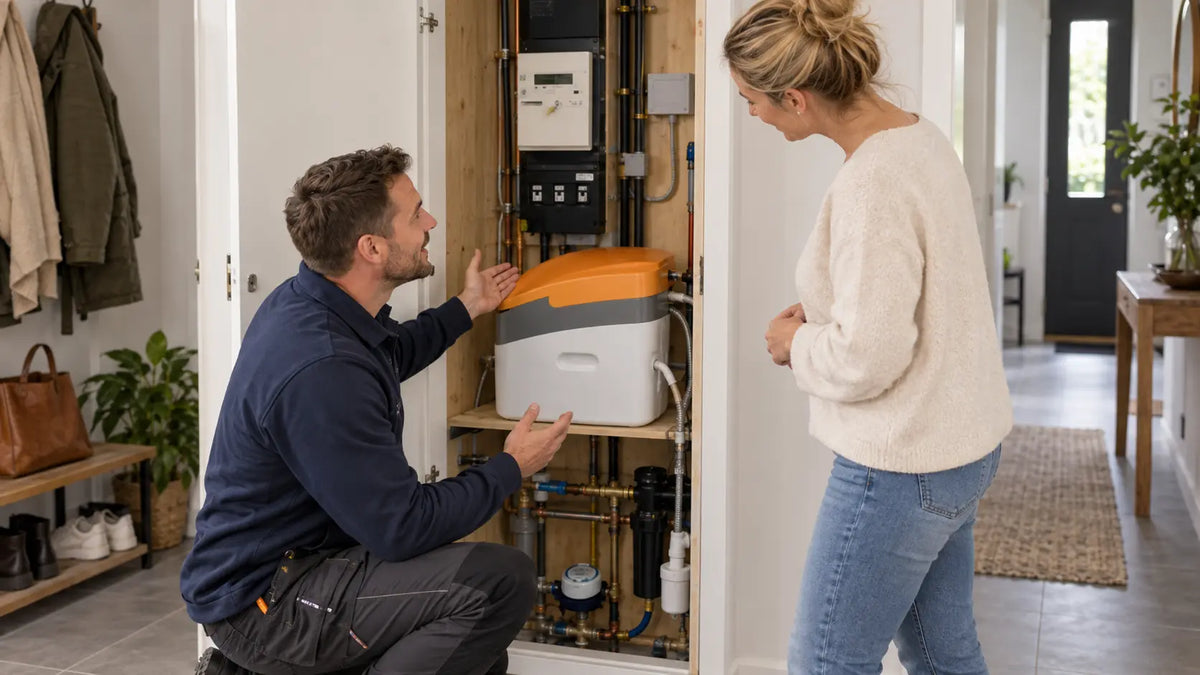
- Choose a different location: the utility room, the basement, a garage, or the cupboard under the stairs often do have a drain. The device does not have to be in the meter cupboard; it only needs to be installed before the branches you want to have softened. You can read what that means for space, ventilation, and access in our article on what a device needs in the meter cupboard.
- A compact dual-cylinder appliance: a water softener with two cylinders regenerates one half while the other continues to supply water, flushing in smaller portions. Our AquaCell operates this way and requires no power outlet. If you are specifically looking for a device that regenerates without electricity, that is a different story.
- Addressing only your drinking water: if you are mainly bothered by limescale in your kettle and the taste of your coffee, there is no need to soften the water for the entire home. A reverse osmosis system under the sink uses the drain already present there, and a countertop model on your kitchen counter requires no permanent connection at all.
At PureAqua, we see that the latter route is most often chosen for apartments. You solve the problem where you notice it daily, without plumbing work in a utility closet where there is no space.
No drain? Start with your drinking water
The water purification device from PureAqua sits on your countertop and filters up to approximately 99 percent, with no permanent connection required.
View the installation-free device View pure water tapsWith drain, without drain, or pure water: the comparison
The prices in this table are the PureAqua prices as they stood in our shop on August 26, 2026.
| Solution | Drain required | Reduces hardness | Range | PureAqua price |
|---|---|---|---|---|
| AquaCell water softener | Yes, sewer with air gap | Yes, ion exchange | Whole house | 2,348 euros |
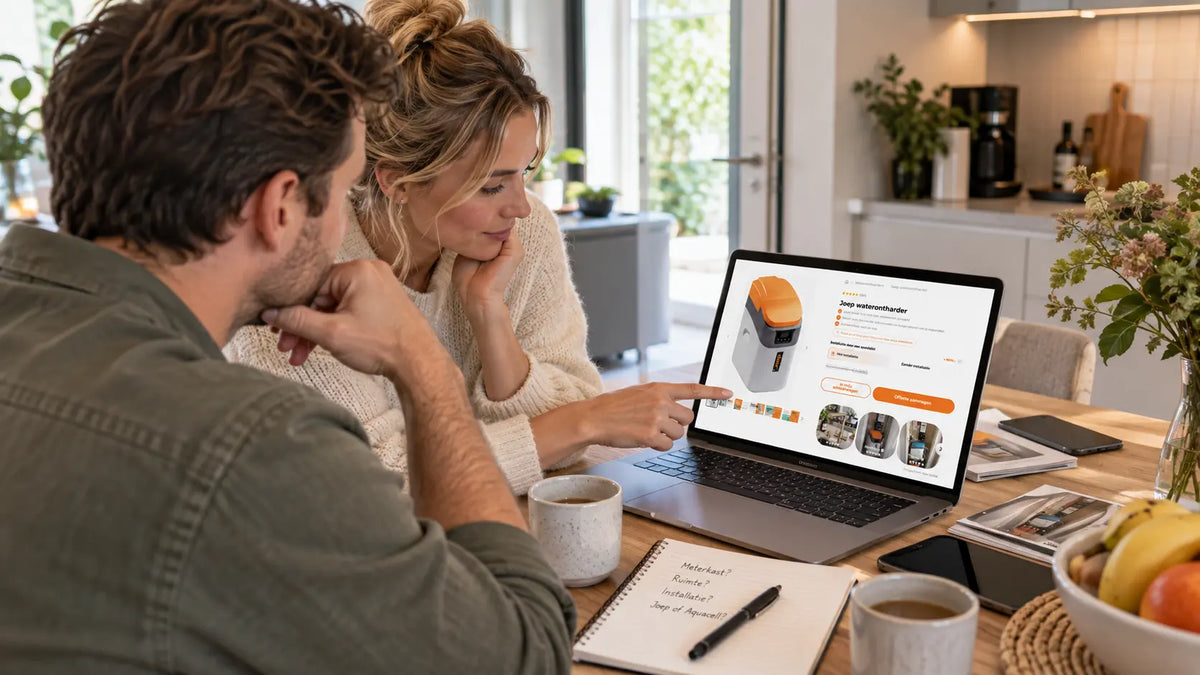
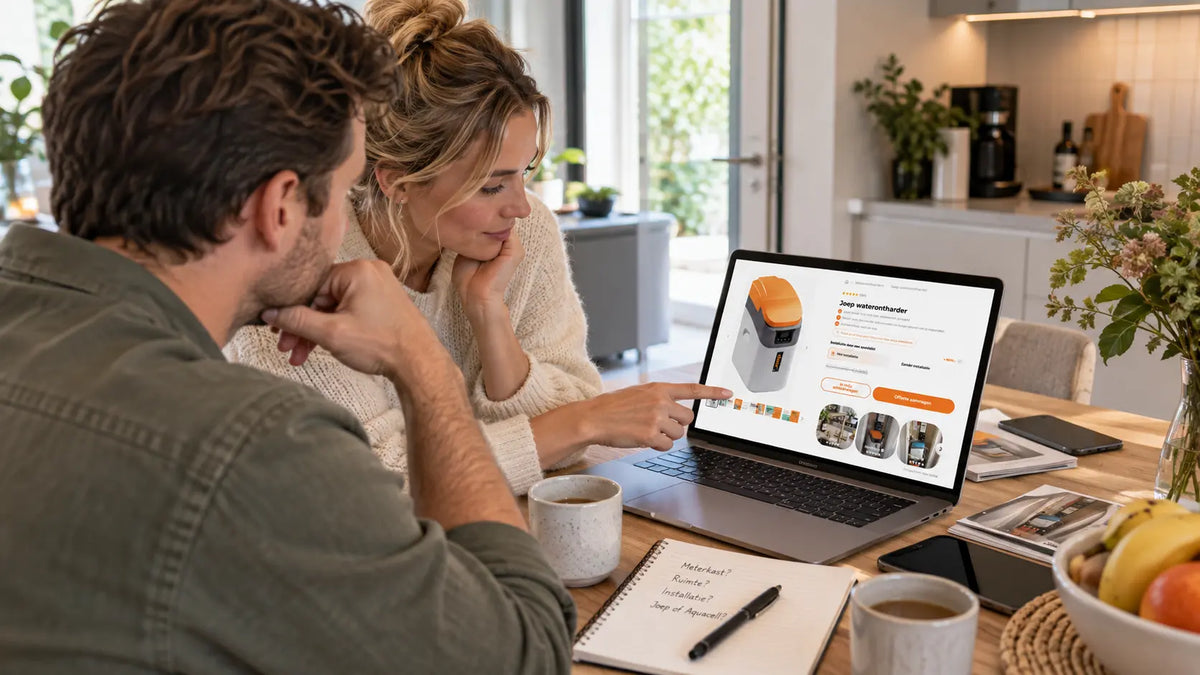
| Joep water softener | Yes, sewer with air gap | Yes, ion exchange | Whole house | 1,699 euros |
| Limescale converter, ceramic or magnetic | No | No, only the scaling behavior | Whole house | Not in our range |
| Water purification device for countertop | No, no permanent connection | Yes, for your drinking water | Single tap point | 495 euros |
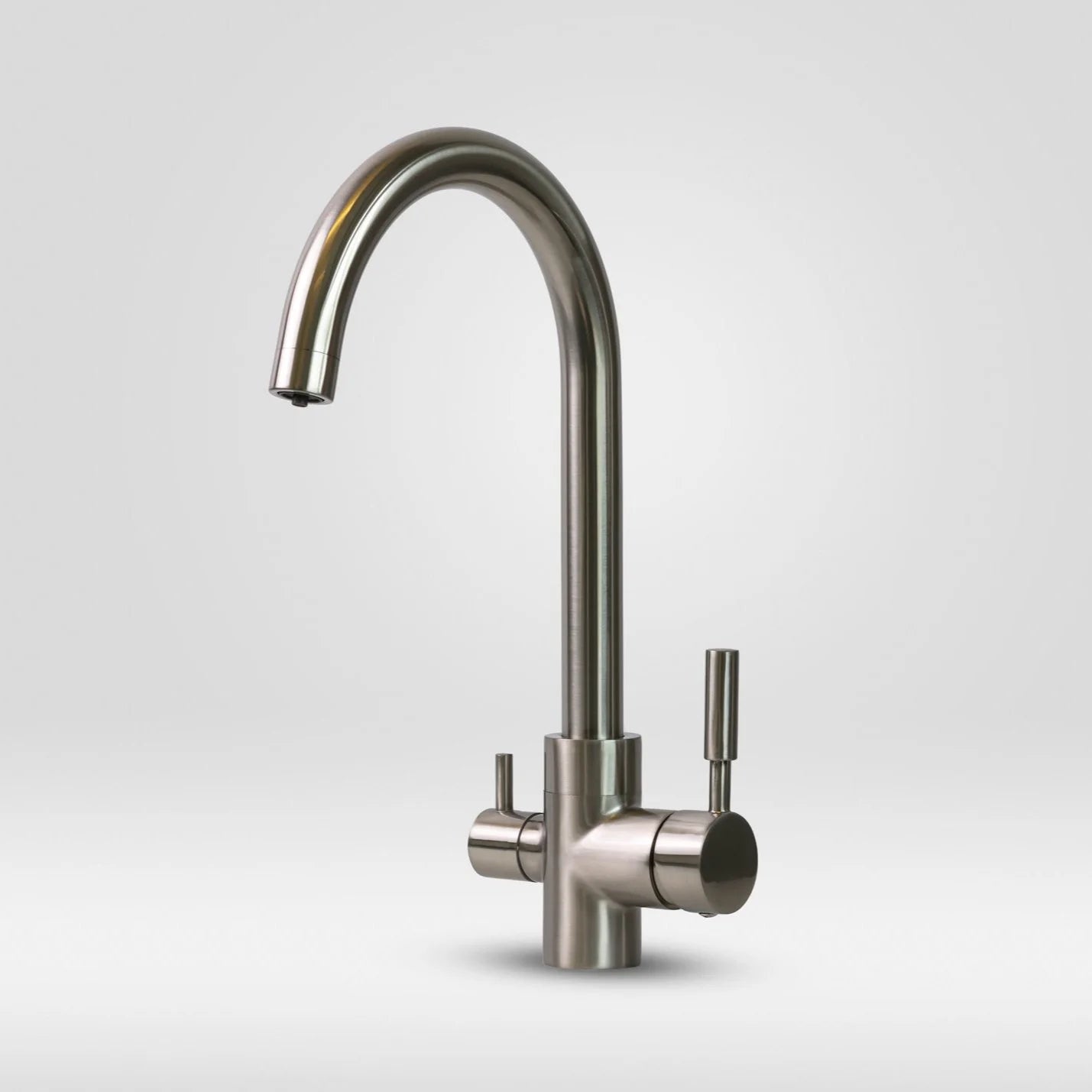
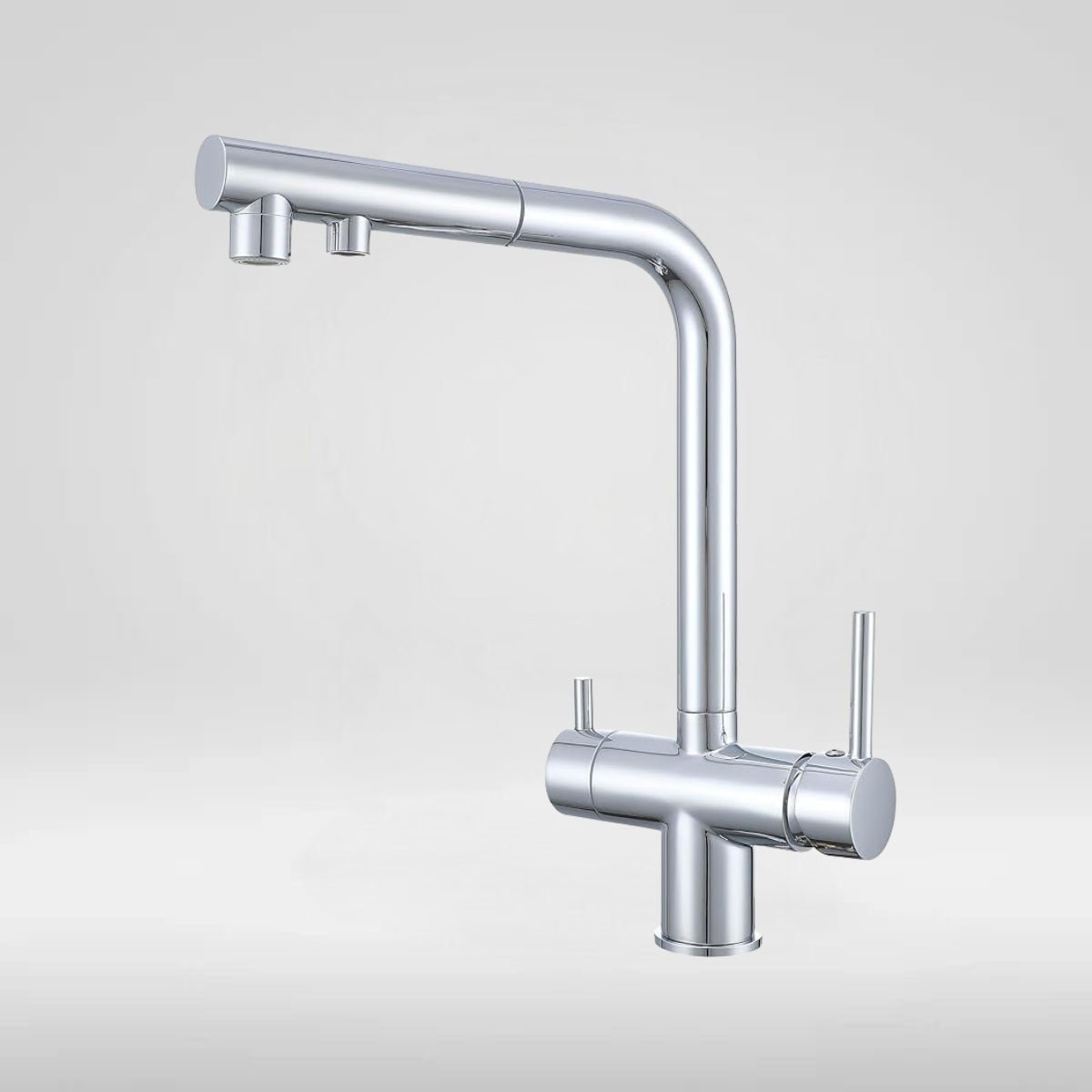
| Pure water tap with under-sink system | The drain under your sink is already there | Yes, for your drinking water | Kitchen tap | Subscription from 29 euros per month |
Read the "reduces hardness" column carefully. Only the top two rows do what the search term promises, and both require a drain. The bottom two solve a different problem: the quality and taste of the water you drink, which they achieve through reverse osmosis in accordance with the NSF/ANSI 58 standards for osmosis systems.
Which choice suits your home?
Three situations we encounter most often in practice, with the corresponding logical choice.
Single-family home with hard water above 10 dH
Here, softening pays for itself in glassware, taps, and the lifespan of your water heater. Ask your installer first where the nearest drain is located. A few meters of hose with the proper air gap is almost always cheaper than a limescale converter that does not lower the hardness anyway. The 2,348 euro AquaCell or the 1,699 euro Joep are the candidates, and which one fits your household depends on capacity and water consumption.
Apartment without a drain in the utility closet
Central softening here requires permission from the water company and involves responsibilities—as stated by Vitens—that a homeowners' association rarely wants. A small wastewater pump is technically possible, but in a shared shaft, that is often not an option. In this scenario, the 495 euro water purification device is the fastest solution: it sits on the countertop and requires no connection.
Soft water, but you don't trust the quality
If you are around 6 dH and are actually concerned about PFAS, microplastics, or the taste of chlorine, a water softener is the wrong device. A pure water tap with reverse osmosis under the sink uses the existing drain and removes up to 99 percent of those substances. At PureAqua, the filter system is included with the tap, and via the 29 euro-per-month subscription with 299 euros in startup costs, installation and filters are included.
Frequently Asked Questions
Do you need a drain for a water softener?
Yes. Every water softener that works with ion exchange flushes its resin beads with a salt solution and must dispose of that flush water. Vitens mandates that both the drain and the overflow must be connected to the sewer, with an air gap in between to prevent sewer water from entering the system. Only limescale converters without ion exchange work without a drain, and they do not lower your water hardness.
What is the disadvantage of a water softener?
There are four recurring disadvantages. You need salt and a sewer connection. Water pressure drops by approximately 70 kPa, or 0.7 bar. Sodium levels rise, which is problematic for a low-salt diet, while the Drinking Water Decree maintains a standard value for sodium of 150 milligrams per liter. And softened water is not filtered drinking water: PFAS, nitrates, and medication residues remain in it.
What is a good alternative to a water softener?
That depends on your goal. If you want less limescale in the entire home without a drain, only a limescale converter remains, and it does not lower hardness. If your goal is better drinking water, reverse osmosis is the better alternative: an under-sink system uses the existing drain, or a countertop model requires no connection at all. At PureAqua, the latter costs 495 euros.
Does a water softener really make sense?
That depends on your water hardness. In the Netherlands, hardness is around 8 dH—soft to moderately hard—because water companies already soften it themselves almost everywhere. At Brabant Water, it ranges from 5.0 to 11.2 dH. If you are above 10 dH, you will notice the effects of softening on glassware, sanitary fixtures, and appliances. If you are around 6 dH, the gains are minor, and filtering your drinking water is more meaningful than softening.
Has the Consumers' Association (Consumentenbond) recommended a water softener?
No. On its own page regarding water softeners, Vitens refers to the Dutch Consumers' Association, which concludes that a water softener is not necessary. The Flemish Environment Agency comes to the same advice, suggesting you first check if your tap water is actually too hard. This does not mean softening never has utility, but rather that in the Netherlands it is a matter of comfort choice, not a health necessity.
What are the most common problems with water softeners?
Vitens mentions four: bacterial growth if the device is not cleaned on time, resulting in a foul odor and taste; metals leaching from pipes due to changing water composition; higher sodium levels that, together with other substances, leave white deposits on sanitary fixtures; and a pressure drop of approximately 0.7 bar. Proper maintenance, suitable salt, and a clean, sealed salt container prevent most of these issues.
Conclusion
A water softener without a drain does not exist; that is not a sales pitch, but a matter of technology: ion exchange produces flush water. What does work without a drain is a limescale converter, and it does not lower your hardness from 8 dH to 4 dH. It only changes how limescale behaves.
If you do not have a drain in the utility closet, the most honest question is not which device to buy, but which problem you want to solve. If you want soft water throughout the house, a few meters of drain with a proper air gap is usually the cheapest path to a 2,348 euro AquaCell or a 1,699 euro Joep. If you primarily want better drinking water, you don't need to touch that utility closet: reverse osmosis at the tap point removes up to 99 percent of substances like PFAS and microplastics, which can be done with an under-sink system or a 495 euro countertop device.
Not sure which of the two fits your situation? Tell us your postal code and utility closet setup, and we will calculate it with you. Drink different.
Want to know what's possible in your home first?
Our specialists look at your water hardness, your utility closet, and your wishes, and will tell you plainly if you don't need anything at all.
Request free advice View the subscription