Reading time: approximately 10 minutes
Short answer
A water softener removes limescale from your tap water through ion exchange. The water flows through a cylinder containing resin beads that capture calcium and magnesium and release sodium in return. Once the resin is full, the device flushes itself clean with a saline solution, and the limescale is sent down the drain. This process is called regeneration and happens automatically.
In this article
- What exactly is a water softener?
- How does a water softener work step-by-step?
- What happens during regeneration?
- With salt, without salt, or magnetic: what really works?
- Hydraulic, time-controlled, or electronic?
- What do you notice at home with softened water?
- What should you look out for regarding installation and maintenance?
- Softened water is not filtered drinking water
- Which water softeners does PureAqua install?
- Frequently asked questions
- Conclusion
What exactly is a water softener?
Definition
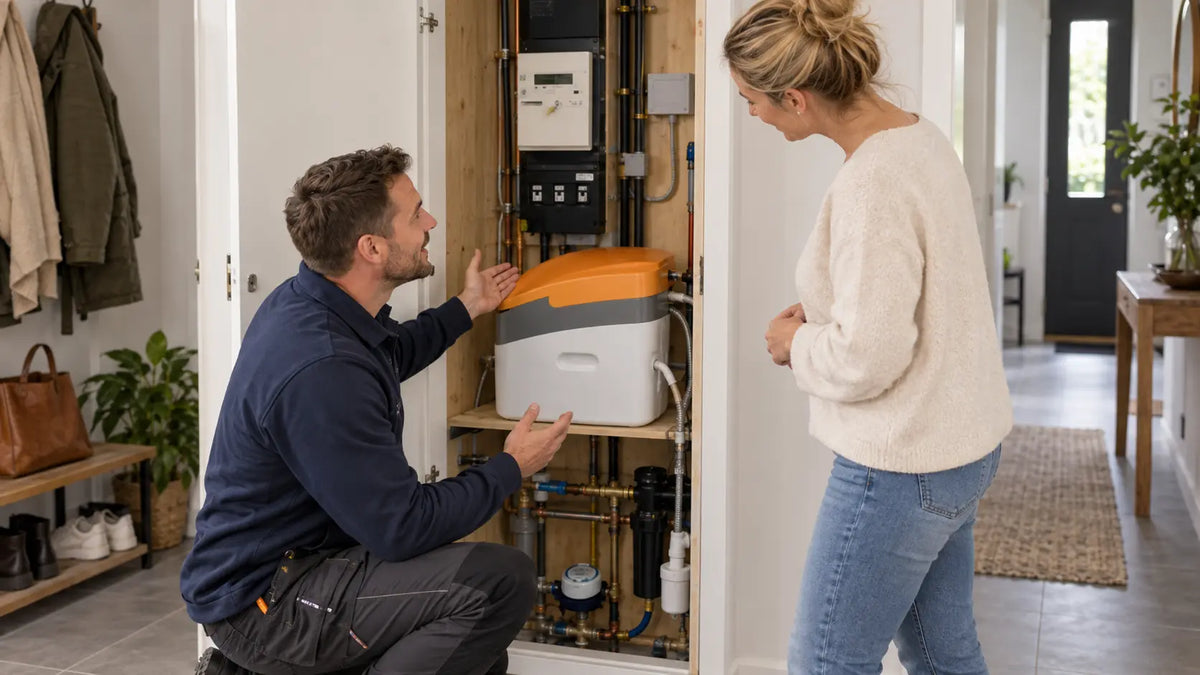
A water softener is a device installed directly after your water meter in the water supply line that removes calcium and magnesium from the water. Together, these two minerals determine the hardness of your water and form the limescale on your taps, in your pipes, and on heating elements. What remains is soft water throughout your entire home, including the shower, the washing machine, and the central heating system.
The hardness of Dutch tap water varies greatly by region. Water companies provide this value in German degrees of hardness (dH) or in millimoles per liter, where 1 mmol per liter corresponds to approximately 5.6 dH. In the supply area of Brabant Water, hardness ranges from 5.0 to 11.2 dH, while the water in Eindhoven itself is between 5.71 and 6.16 dH. For Vitens and Evides, you can look up the value by postal code. Above approximately 8 dH, you will really start to see limescale; below that, it is manageable.
Important to know: hard water is not unhealthy. All Dutch tap water meets the requirements of the Drinking Water Decree, which legally establishes what drinking water must comply with according to the RIVM. You soften water for comfort, to reduce limescale, and to extend the lifespan of your appliances, not because there is anything wrong with the water.
How does a water softener work step-by-step?
The operation of a classic water softener revolves around one principle: ion exchange. That sounds technical, but it is an exchange between two types of charged particles. It works in four steps.
Step 1: hard water enters the resin cylinder
After the water meter, the tap water first passes through the device before flowing into your home. The cylinder contains hundreds of thousands of small resin beads, each no larger than a grain of sand. Together, these beads have an enormous surface area, and that surface is negatively charged.
Step 2: calcium and magnesium are exchanged for sodium
Calcium and magnesium are double positively charged and are therefore more strongly attracted to the resin than sodium, which has only one positive charge. The resin releases the sodium and retains the limescale-forming minerals. That is the core of how it works: the limescale doesn't disappear into thin air; it is traded.
Step 3: soft water enters the house
What leaves the cylinder is water with a much lower hardness. Almost every device has a mixing valve or bypass that allows the installer to set the residual hardness. Completely zero dH is undesirable, partly because very soft water is more aggressive toward pipe materials. In practice, we usually set this to a residual value of about 4 to 8 dH.
Step 4: the resin gets full and flushes itself clean
After a certain number of liters, the resin is full of calcium and magnesium and cannot hold any more. The device then automatically starts a flush cycle with a strong saline solution from the salt tank. This cycle is called regeneration and ensures the resin is full of sodium again so it can absorb limescale once more. A softener is therefore not a filter that you replace, but a system that recovers itself time and time again.
Done with limescale on your taps and in your appliances?
View the water softeners we install, including installation by our own specialist.
View the water softenersWhat happens during regeneration?
Regeneration is the step most people aren't familiar with, even though it's where the salt, water, and drain come into play. The cycle follows three phases:
- Backwashing: water flows in reverse through the cylinder to loosen the resin bed and flush away dirt.
- Brining: a concentrated salt solution from the salt tank slowly draws through the resin. Due to the high sodium concentration, the exchange is reversed and the resin releases the captured calcium and magnesium.
- Rinsing: the device flushes the brine and the released limescale down the drain, after which the cylinder is ready for use again.
The limescale literally goes into the sewer, dissolved in the flush water. That flush water costs money, although the amount is small. According to Vewin, the drinking water rate in 2026 is 2.71 euros per cubic meter including taxes. A regeneration of approximately 100 liters therefore costs 0.27 euros. If your device regenerates on average once a month, you are looking at roughly 3 euros per year in flush water, plus the salt. If you want the complete calculation including purchase and maintenance, read on about the total costs of a water softener over several years.
Salt consumption depends on your hardness and your water usage. At PureAqua, we see that an average family uses somewhere between one and two 25-kilogram bags of softening salt every two months. The harder your water and the more you consume, the more often the device regenerates and the faster the salt tank empties.
With salt, without salt, or magnetic: what really works?
Everything stated above applies to an ion exchanger with salt. That is the only type that actually lowers the hardness of your water. There are also systems that claim to soften without salt, and these work in a fundamentally different way: they change the form in which the limescale is present in the water so that it adheres less easily. The calcium and magnesium remain in the water. If you measure the hardness afterwards, the meter will still show the same dH. Anyone who wants to know exactly where that boundary lies will find the complete trade-off in our overview of the difference between softening with and without salt.
| Type | How it works | Lowers hardness | Salt and drain needed |
|---|---|---|---|
| Ion exchanger with salt | Exchanges calcium and magnesium for sodium in a resin bed | Yes, demonstrable in dH | Yes, salt tank plus drain for flush water |
| Saltless limescale converter | Converts limescale into a crystal form that adheres less | No, hardness remains the same | No |
| Magnetic or electronic device | Influences limescale particles with a field around the pipe | No, hardness remains the same | No |
| Reverse osmosis | Presses water through a membrane and blocks almost everything | Yes, but only for drinking water at one tap | No salt, but requires a drain for flush water |
If you choose a saltless or magnetic system, know what you are buying: less limescale in the best case, but not soft water. If you are looking for guaranteed measurable softer water, you will always end up with ion exchange.
Hydraulic, time-controlled, or electronic?
Two devices can use the exact same ion exchange technology and yet function very differently. The difference lies in how the device determines when it needs to regenerate.
- Time-controlled: the device regenerates at fixed times, for example, every night. Simple, but it wastes salt and water if you haven't used much that week.
- Electronic and volume-controlled: a water meter in the device counts the liters and only starts when the resin is actually full. More economical, but it does require a power outlet in the meter cupboard.
- Hydraulic: the device uses the pressure of your own water line to control the valves and does not require electricity. With a dual cylinder, one cylinder regenerates while the other continues to supply water, so you are never without soft water.
The latter point is particularly practical in Dutch meter cupboards, as not every one has a spare power outlet. We explain exactly how such a power-free setup works in the article about a softener that runs entirely on water pressure.
What do you notice at home with softened water?
Operation is one thing, the result in the home is what you are ultimately buying. These are the effects that customers mention to us most often, usually within a few weeks of installation.
- Less limescale: on taps, shower screens, glassware, and in the kettle, white spots disappear.
- Less soap and detergent: soft water lathers more easily, so you need less product for the same result.
- Longer lifespan of appliances: limescale deposits on the heating elements of the washing machine, dishwasher, and central heating boiler, and that layer has an insulating effect.
- Softer-feeling water: on skin and hair, softened water feels smoother, which some people love and others find something to get used to.
What a water softener does not do is make your water taste better or purer for drinking. It simply wasn't built for that, and that difference is significant enough to explain separately.
What should you look out for regarding installation and maintenance?
A drain and enough space
Every device with salt must dispose of its flush water somewhere, so a drain within reach is not a luxury but a requirement. In addition, you need space around the water meter, including enough room to refill the salt tank. If you are struggling with this in your home, the overview on what fits in a meter cupboard and which connection is needed will help.
Connecting according to standards
A water softener intervenes in your drinking water installation, so the connection must comply with the NEN 1006 standard. Vitens therefore points out that a device should have a quality statement and must be installed professionally, partly to prevent backflow and bacterial growth. At PureAqua, our own specialist handles the installation so that the bypass, residual hardness, and drain are set correctly from the start.
Sodium in the soft water
Because calcium and magnesium are exchanged for sodium, softened water contains slightly more sodium than before. How much depends directly on how much hardness you remove. This is one of the reasons that installers set a residual hardness rather than removing everything, and that the kitchen tap used for drinking water is sometimes intentionally connected to softened water or specifically left out of the loop.
Maintenance you do yourself
Most maintenance is simple: refilling salt before the reservoir is empty, checking the settings occasionally, and having the unit serviced periodically. If you run out of salt, the unit will continue to let water pass through, but it will no longer soften it, and you won't notice that until the limescale returns.
Are you unsure if your utility cupboard is suitable?
Our advisors will check your hardness, space, and drainage with you free of charge.
Request free adviceSoftened water is not filtered drinking water
This is where most comparisons on the internet get stuck. An ion exchanger is built to remove two substances: calcium and magnesium. Everything else passes through unimpeded. PFAS, drug residues, microplastics, and heavy metals are not limescale, so a water softener does not remove them.
If you want to remove those substances from your drinking water, you need a different technology. Reverse osmosis forces water through a membrane with openings so small that almost everything is left behind. Systems rated according to the NSF/ANSI 58 standard remove up to approximately 99 percent of these types of contaminants. You can read about how that membrane works on our page about reverse osmosis. Anyone who wants to see both techniques side by side will find the differences per substance in our overview of filtering, purifying, and softening.
In practice, the two complement each other. The water softener provides comfort throughout your home, while a pure water tap or the standalone Countertop RO for 495 euros provides the water you drink and make coffee with. The drinking water itself then remains clean and delicious, without you having to change your entire installation. That is exactly where our slogan, Drink different, comes from.
Which water softeners does PureAqua install?
We intentionally work with two units that both run on ion exchange but excel in different areas. Below are the figures as they stand in our shop today.
| Feature | AquaCell | Joep |
|---|---|---|
| Price | 2,348 euros | 1,699 euros |
| Control | Hydraulic, works entirely without electricity | Automatically adjusts operation to your water usage |
| Dimensions | 49 cm high, 20.5 cm wide, 44 cm deep | Compact unit for placement near the water meter |
| Weight | 20 kg empty, 30 kg in use | Depending on version |
| Strongest point | No power outlet required, so flexible placement | Economical with salt and water due to smart control |
Customers usually choose the AquaCell for the flexibility in placement: no power outlet means the utility cupboard is rarely an obstacle. The Joep is the logical choice if you are primarily looking at consumption and entry price. If you are not yet sure which direction to take, our buying guide on the criteria for comparing units will help you further. If you would prefer pure drinking water without a large upfront purchase, you can use the pure water subscription for 29 euros per month with a 299 euro startup cost.
Frequently Asked Questions
What are the pros and cons of a water softener?
Pros: less limescale on taps, glass, and heating elements, less soap and detergent required, and appliances that last longer. Cons: purchase between 1,699 and 2,348 euros at PureAqua, recurring costs for softening salt, a drain for the flush water, and slightly more sodium in the water. Furthermore, a water softener does not improve drinking water quality, as PFAS, heavy metals, and drug residues simply pass through the resin.
How often does salt need to be added to a water softener?
That depends on your water hardness and consumption, not on a fixed schedule. At PureAqua, we see that an average family uses one to two 25-kilo bags every two months. Check the salt reservoir monthly and refill as soon as the salt level drops below half. If the reservoir runs empty, the unit will continue to pass water through but will stop softening it, and then you will see the limescale return within a few weeks.
Do you always need a drain for a water softener?
For every softener that regenerates with salt, yes, because the flush water with the dissolved limescale must go to the sewer. Count on about 100 liters per regeneration, which at the drinking water rate of 2.71 euros per cubic meter according to Vewin comes to 0.27 euros per time. If there is no drain near the water meter, a small pump or extending the drain is the usual solution. Saltless and magnetic devices do not require a drain, but they also do not lower the hardness.
Does a water softener actually make sense?
With hard water, yes. Above approximately 8 dH, you will see limescale on taps, glassware, and heating elements, and softening provides visible comfort. Below 6 dH, the benefit is small. Drinking water companies such as Vitens rightly point out that softening is not necessary for health: Dutch tap water meets the Drinking Water Decree in any case. You do it for your appliances, your cleaning, and your comfort, not for the safety of your water.
Has the Consumers' Association (Consumentenbond) recommended a water softener?
There is no publicly verifiable test result in which the Consumentenbond designates one model as the best, so we do not refer to any such ranking. What you can do is compare measurable points yourself: the hardness reduction in dH, the salt and water consumption per regeneration, the controls, the warranty period, and whether installation is included. These figures are available from any serious supplier and say more than a quality mark or a top five.
What are the most common problems with water softeners?
The four complaints we hear most often: the salt reservoir ran empty without anyone noticing, there is a salt bridge in the reservoir preventing brine from being created, the flush water drain is clogged or kinked, and the residual hardness is set too low or too high. All four can be prevented with an annual inspection. A fifth point is expectation: people sometimes think the unit purifies their drinking water, and it does not.
Conclusion
A water softener works via ion exchange: resin beads exchange calcium and magnesium for sodium, and as soon as they are full, the unit flushes itself clean with a salt solution. That is the entire technique, and it is also the reason why a softener requires salt, a drain, and a little maintenance. Only systems with ion exchange truly lower your hardness, measured in dH.
What a softener does not do is purify your drinking water. If you want limescale-free water throughout your home and pure water from the tap you drink from, you combine a softener with reverse osmosis. PureAqua supplies both, installs them with its own specialist, and thinks ahead with you about hardness, space, and drainage.
Soft water at home, pure water at the tap
Choose the softener that fits your hardness, or discover what a pure water tap with reverse osmosis does for your drinking water.
View water softeners View pure water taps