Reading time: about 14 minutes
Short answer
The Bluewater Kitchen Station 1 is a premium reverse-osmosis station for the kitchen that starts at 3,649 euro with the Cleone purifier, costs 5,699 euro with the Spirit and 7,999 euro with the PRO. For that price you get a membrane that removes up to 99 or 99.7 percent, a pump that doses minerals back in at a fixed rate, and an app with three taste profiles. PureAqua is an official Bluewater dealer and advises honestly: for most households, this is more station than needed.
Anyone seeing the Kitchen Station 1 for the first time on Bluewater's site is startled by two things at once: the price tag, and the fact that three prices appear on the same page. 3,649 euro, 5,699 euro and 7,999 euro, for what looks like the same device at a glance. That immediately raises the question of what you're actually buying, and whether the most expensive model is better or just more expensive.
This article breaks it down. What's in the box, where the price difference between the three configurations comes from, what it costs per year in minerals and filters, and, just as important, when this station doesn't make sense for you. PureAqua is an official Bluewater dealer, so we can supply, advise on and have it installed. That's exactly why we tell you honestly where you can stop investing. A nice detail: Bluewater Netherlands is based in Leeuwarden and PureAqua in Hallum, both in Friesland.
On this page
- What is the Bluewater Kitchen Station 1?
- What do you get for 3,649 euro?
- The three configurations side by side
- Cleone or SuperiorOsmosis: the difference nobody explains
- Liquid Rock: dosed minerals instead of a cartridge
- What does it cost per year?
- Who is this a good fit for, and who isn't it?
- What to check before you submit a request
- PureAqua or Bluewater: the honest comparison
- Frequently asked questions
- Conclusion
What is the Bluewater Kitchen Station 1?
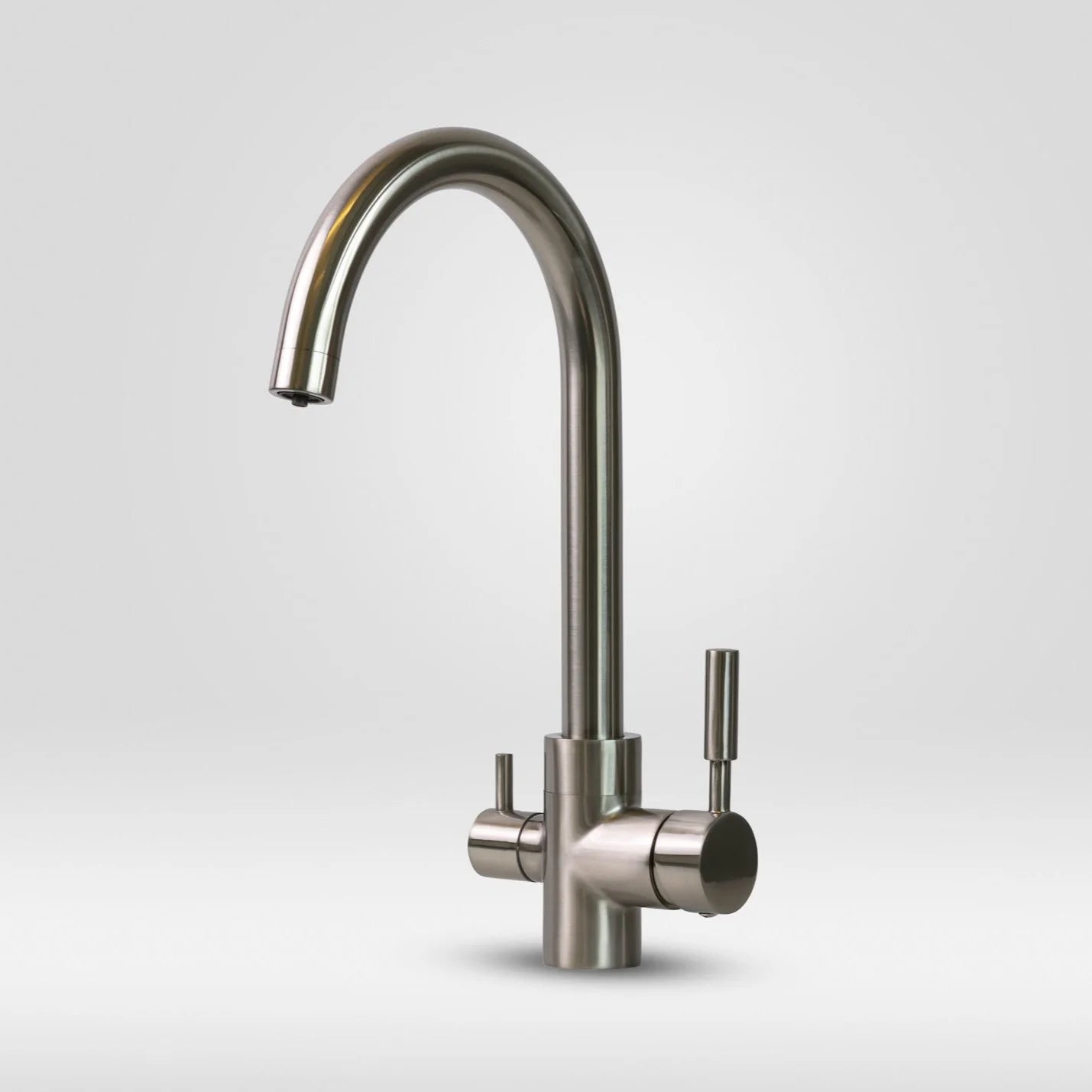
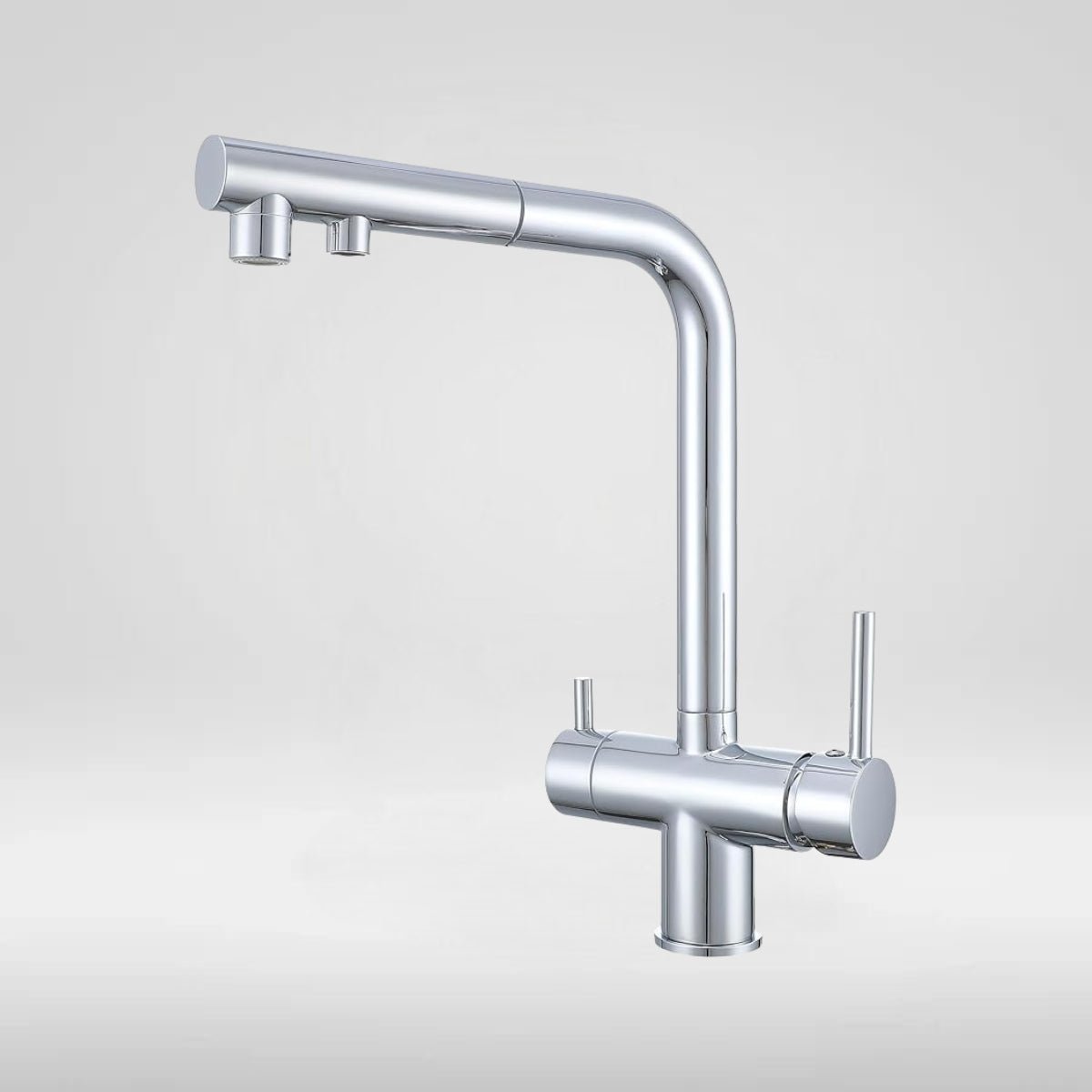
The Kitchen Station 1 isn't a standalone filter but a complete system for under and on the counter. It contains a reverse-osmosis purifier, its own dispensing point, a dosing pump for minerals, a control unit and an app. Sweden's Bluewater sells it as one package, where you choose which purifier goes into it. That choice determines the price, and thus also why three amounts appear on the same product page.
Definition
The Bluewater Kitchen Station 1 is a premium water purification station for the kitchen in which a reverse-osmosis purifier is combined with an RO tap, the Bluewater O, a control box, a Mineralizer with dosing pump and an app. The station purifies tap water to 99 or 99.7 percent, depending on the purifier chosen, and then doses a fixed amount of minerals back in.
The principle under the hood isn't new. It's the same technology we use at PureAqua, which we explain step by step on our page about how reverse osmosis works: water is pushed under pressure through a membrane that blocks most dissolved substances. What the Kitchen Station does differently is at the end of the process, with the minerals, and in the finishing.
Bluewater itself cites, for the Cleone purifier, water recovery of 50 percent versus roughly 25 percent for conventional reverse osmosis, a flow rate of 2.75 litres per minute from the tank, and production of up to 610 litres a day. The device measures 215 by 380 by 416 millimetres, has a 12-litre storage tank and a membrane that lasts 3 to 5 years. Those are the hard figures you can build a choice on.
Not sure whether this tier suits you?
Tell us what you want to get out of your water and how many people are drinking it. We'll tell you honestly whether this is the right place to be or a few steps down.
Ask for free advice View the pure water tapsWhat do you get for 3,649 euro?
For the entry-level amount of 3,649 euro, measured on Bluewater's Dutch webshop on 15 September 2026, you get the Cleone purifier plus the full station equipment. That equipment is precisely what you're paying the difference over a standalone purifier for. The Cleone costs 1,495 euro on its own, so the station adds 2,154 euro on top.
You're not buying that amount for thin air. It stands for five components:
- Bluewater O: the RO tap with three settings, for electrolyte water, pure water and plain tap water.
- Mineralizer with dosing pump: the component that adds the Swedish Liquid Rock minerals to the purified water at a fixed ratio.
- Control Box: the controller that drives and monitors the system.
- Bluewater App: three taste profiles, light, original and strong, plus maintenance notifications.
- Built-in leak protection: standard on the Cleone.
On the more expensive configurations, the markup for that difference is almost identical: 2,004 euro for both the Spirit and the PRO. In other words, the station equipment costs roughly the same regardless of which purifier you choose. The 2,050 euro price difference between the entry level and the mid-range model therefore comes almost entirely from the purifier itself, not from extras. That's exactly the kind of insight you need before submitting a request, and it's the same calculation method we use when working out when a subscription works out cheaper than buying.
The three configurations side by side
Prices are Bluewater's webshop prices from 15 September 2026. They can change, so check them with us before making a decision.
| Configuration | Station price | Purifier alone | Markup for the station |
|---|---|---|---|
| Kitchen Station 1 with Cleone Classic | 3,649 euro | 1,495 euro | 2,154 euro |
| Kitchen Station 1 with Spirit Purifier | 5,699 euro | 3,695 euro | 2,004 euro |
| Kitchen Station 1 with PRO Purifier | 7,999 euro | 5,995 euro | 2,004 euro |
What stands out in this table is how flat the markup is. Anyone looking only at the station prices might think the PRO version contains more luxury. It doesn't. You pay roughly 2,000 to 2,150 euro across all three for the same tap, the same pump, the same control unit and the same app. So the choice comes down to exactly one question: which purifier is attached.
Cleone or SuperiorOsmosis: the difference nobody explains
This is where almost every other page about this product goes wrong, by mixing up the figures for the two techniques. They aren't the same, and the difference is worth knowing.
The Cleone
The Cleone is a classic reverse-osmosis purifier with a storage tank. Bluewater states that it removes up to 99 percent of contaminants and recovers 50 percent of the feed water, versus roughly 25 percent for conventional systems. The 12-litre tank provides a flow rate of 2.75 litres per minute, and production runs up to 610 litres a day. For an average family, that's more than enough: with four people together drinking and cooking with 8 litres a day, you use less than 2 percent of that capacity.
SuperiorOsmosis, the Spirit and the PRO
The Spirit and the PRO run on SuperiorOsmosis, Bluewater's own membrane technique. It claims up to 99.7 percent removal and water recovery up to 80 percent, with a self-cleaning membrane. Bluewater also states that it's up to 10 times purer than traditional carbon filters and saves 3 times more water than other reverse-osmosis systems.
Work that difference through. Going from 99 to 99.7 percent sounds like a small step, and in absolute terms it is: out of 1,000 particles, 10 remain instead of 3. Water recovery is the argument that matters more in practice, since that goes from 50 to 80 percent. Anyone dispensing 8 litres of pure water a day flushes away about 8 litres with the Cleone and only 2 litres with SuperiorOsmosis. Over a year, that's a difference of more than 2,000 litres. Against the drinking water rate that Vewin cites for 2026, 2.71 euro per cubic metre including taxes, that's about 5.50 euro a year in water. Reject water is therefore more of a sustainability argument than a financial one.
The honest conclusion: the jump from Cleone to Spirit costs 2,050 euro extra in station form and delivers 0.7 percentage points more purification plus higher water recovery. For a two-person household that's rarely necessary. For anyone who wants the maximum, or uses the device professionally, it's defensible.
Also pay attention to what isn't stated. Bluewater cites the WQA and NSF/ANSI/CAN 372 certifications for the Cleone. That latter standard concerns the lead content of the components in drinking water systems, not how much the device removes. That's different from NSF/ANSI 58, the standard that describes the performance of reverse-osmosis systems. If you read that a system is NSF-certified, it's worth asking exactly which standard.
We are an official Bluewater dealer
Want to know which configuration suits your kitchen and household? Request the Kitchen Station, or run your situation past us free of charge first.
Request the Kitchen Station Run your situation past usLiquid Rock: dosed minerals instead of a cartridge
This is the brand's strongest technical argument, and it's also the part that explains most about why a station costs more than a purifier. Every reverse-osmosis system removes the minerals from the water alongside the pollutants. That's not a flaw but a consequence of the technique, and it can be fixed. The only question is how.
The usual solution is a mineral cartridge behind the membrane. That works, but the output fades as the cartridge wears out. Bluewater measures 0.46 milligrams of magnesium per litre for such a standard mineral filter, and 6 milligrams of magnesium per litre, constantly, for its own Mineralizer with dosing pump. That's over 13 times as much, and, more importantly, it stays the same until the mineral bottle is empty.
For taste, that makes a difference. Anyone who's ever drunk pure osmosis water knows it can taste flat; that's exactly why we offer a 45-euro mineral filter at PureAqua. How those two approaches compare to each other, we've laid out earlier in our piece about the difference between a mineral cartridge and dosed mineralisation.
Two more things, for completeness. First: in practice, you get minerals mainly from food, not from drinking water. This is about taste and consistency, not health. Second: the app gives you three taste profiles and the Bluewater O three settings, so you can choose per glass. That's comfort, and comfort is exactly what this price tier is about.
What does it cost per year?
With this type of system, the purchase price is only half the story. The recurring costs determine what you'll have spent over five years, and with the Kitchen Station those fall into two items.
| Item | One-off | Via subscription | Rhythm |
|---|---|---|---|
| Liquid Rock minerals | 90.95 euro | 81.86 euro (10 percent discount) | Per month, every 2 or every 3 months |
| Annual filter pack | 135.95 euro | 122.35 euro | Once a year |
| PureAqua filter set 2-pack, for comparison | 75 euro | Included in the subscription | Depends on usage |
| PureAqua filter set 3-pack, for comparison | 149 euro | Included in the subscription | Depends on usage |
Anyone who has the minerals delivered every 3 months and takes the annual pack via subscription ends up at roughly 450 euro a year in consumables. That's considerably more than the 75 to 149 euro per filter set our own system requires, and that difference belongs in your consideration. On the other hand: weigh it against bottled water and the sums tip quickly, since tap water itself costs about 0.0027 euro per litre under the same Vewin rate.
For anyone who wants to see the full cost comparison over several years, including the PureAqua routes, the comparison of buying versus subscribing comes closest to that. And if you first want to know which price level suits your reason in the first place, start there, and come back here once it's clear you're looking in the premium tier.
Who is this a good fit for, and who isn't it?
This is the part a dealer usually skips, which is exactly why it's here. At PureAqua we see that most households end up with a pure water tap with the filter system included, from 465 euro, or with the 29-euro-a-month subscription with 299 euro in start-up costs. That's a factor of 7 to 8 cheaper than the Kitchen Station's entry-level model, and it delivers the same principle: reverse osmosis from its own dispensing point, with an optional mineral filter.
The Kitchen Station makes sense if:
- You want constant, measurable mineralisation instead of a cartridge that fades, for example because you're serious about coffee or tea.
- You want to be able to choose a different taste profile per glass and are happy to use an app for it.
- You use the device professionally or semi-professionally, or draw a lot of water per day.
- Design and finishing weigh heavily and budget isn't the deciding factor.
The Kitchen Station doesn't make sense if:
- You mainly want PFAS, nitrate and limescale out of your drinking water. An ordinary reverse-osmosis system does that too, for a fraction of the price.
- You're renting or moving within a few years. Then a countertop device, such as the 495-euro pure water device, is more practical.
- You find the roughly 450-euro-a-year recurring cost too high.
- You're doubting whether you'll notice the difference between 99 and 99.7 percent. You won't notice that in your glass in practice.
That's not a sales pitch against our own range; it's the reason we carry the brand as a complement, not a replacement. Anyone who first wants to understand which criteria really matter for an osmosis system will find them in our buying guide about what to look for when choosing an osmosis system.
What to check before you submit a request
Space under the counter
The Cleone measures 215 by 380 by 416 millimetres and also needs room for the Mineralizer, the control box and the connections. Measure your cabinet before you order, including the space the trap and any drawers take up. This is, with every osmosis system, the point where plans go wrong, and it's solved with a tape measure in five minutes.
Power and connection
A station with a dosing pump, a control box and an app needs power. Make sure there's a power outlet in or near the cabinet. A drain is also needed for the reject water, as with any other reverse-osmosis system.
The minerals are a subscription in practice
Without Liquid Rock, the mineralisation doesn't work, and that's exactly the distinguishing part. So factor the 81.86 to 90.95 euro per delivery in as a fixed cost, not an option. Anyone who finds that too much should honestly acknowledge that the station then loses its main advantage.
Warranty and trying it out
Bluewater applies a 30-day money-back guarantee and states the brand is used by more than 50,000 households. On Bluewater's Dutch Kitchen Station product page, there were two reviews on 15 September 2026, averaging 5.0. Two reviews say little statistically; treat it as a signal, not as proof.
PureAqua or Bluewater: the honest comparison
| Point | PureAqua pure water tap | Bluewater Kitchen Station 1 |
|---|---|---|
| Investment | From 465 euro, or 29 euro a month with 299 euro start-up costs | From 3,649 euro |
| Technique | Reverse osmosis, system included with the tap | Reverse osmosis, Cleone or SuperiorOsmosis |
| Purification | Up to roughly 99 percent, including PFAS and nitrate | Up to 99 percent (Cleone) or 99.7 percent (SuperiorOsmosis) |
| Minerals | Optional 45-euro mineral filter | Dosed via pump, 6 mg magnesium per litre |
| Usage per year | Filter set 75 to 149 euro | Roughly 450 euro in minerals and filter pack |
| Operation | Tap with a separate channel | Tap with three settings plus app with taste profiles |
| Best for | Most households | Those who want the maximum or use it professionally |
Two tiers, two customers. We sell both and have no interest in pushing you towards the more expensive one. What we do is work out what you'll spend over five years and which of the two routes suits your usage. That conversation is free and takes a quarter of an hour.
Ready for the premium tier?
Read the full specifications on Bluewater's product page, or request a quote through us as official dealer.
View the Kitchen Station 1 Request a quoteFrequently asked questions
What does the Bluewater Kitchen Station 1 cost?
The Kitchen Station 1 starts at 3,649 euro with the Cleone purifier, costs 5,699 euro with the Spirit Purifier and 7,999 euro with the PRO Purifier. Those are Bluewater's webshop prices, measured on 15 September 2026. Also budget roughly 450 euro a year for Liquid Rock minerals and the annual filter pack.
What's the difference between the Cleone, the Spirit and the PRO?
The Cleone is a classic reverse-osmosis purifier with a 12-litre storage tank that removes up to 99 percent and recovers 50 percent of the water. The Spirit and the PRO run on SuperiorOsmosis: up to 99.7 percent removal and water recovery up to 80 percent, with a self-cleaning membrane. The station equipment around them is almost identical across all three and costs 2,004 to 2,154 euro.
Is Bluewater NSF-certified?
Bluewater cites the WQA and NSF/ANSI/CAN 372 certifications for the Cleone. That latter standard concerns the lead content of the components in drinking water systems and says nothing about how much the device removes. That's a different standard from NSF/ANSI 58, which describes the performance of reverse-osmosis systems. So ask for the standard number with any certification claim.
What exactly are Liquid Rock minerals?
Liquid Rock is Bluewater's Swedish mineral mix, added to the purified water with a pump. Bluewater measures 6 milligrams of magnesium per litre with it, constantly, versus 0.46 milligrams per litre for a standard mineral filter that decreases as the cartridge wears out. A delivery costs 90.95 euro one-off or 81.86 euro via subscription.
Can I buy the Kitchen Station through PureAqua?
PureAqua is an official Bluewater dealer and advises, supplies and arranges installation. The station is deliberately not in our own webshop: you submit the request via Bluewater's product page and we pick it up. Want to know first whether this tier suits you? Run your situation past us free of charge before you submit a request.
Do I need a 3,649-euro station for PFAS-free water?
No. Any decent reverse-osmosis system holds back PFAS, nitrate and heavy metals to roughly 99 percent. At PureAqua, that starts at 465 euro for a pure water tap with the system included, or 29 euro a month via the subscription. You buy the premium station for dosed mineralisation, taste profiles and finishing, not for better protection against PFAS.
How much water does the Kitchen Station waste?
The Cleone recovers 50 percent of the feed water, versus roughly 25 percent for conventional reverse osmosis. SuperiorOsmosis reaches up to 80 percent. At 8 litres of pure water a day, that means about 8 litres of reject water for the Cleone and roughly 2 litres for the Spirit or PRO. In money terms, that difference is small, since tap water costs about 0.0027 euro per litre.
Conclusion
The Bluewater Kitchen Station 1 is a well-built, nicely finished premium station that does one thing genuinely better than the rest of the market: bringing minerals back at a fixed dose of 6 milligrams of magnesium per litre instead of via a cartridge that fades to 0.46. For that you pay from 3,649 euro, plus roughly 450 euro a year in consumables.
The price difference between the three configurations lies almost entirely in the purifier and not in the equipment around it, so the only real choice is Cleone versus SuperiorOsmosis. And that difference, 99 versus 99.7 percent, you won't notice in your glass. What you will notice is the water recovery of 50 versus 80 percent, and that's mainly a sustainability argument.
For by far most households, our own answer remains the wisest: a pure water tap with the filter system included from 465 euro, or the 29-euro-a-month subscription. If you still want the maximum, we supply and install the Kitchen Station as official dealer. Drink different, but at the tier that suits you.
Advice first, then choose
For an investment ranging from 465 to 7,999 euro, one conversation is worth more than ten comparison sites. Tell us your situation, and we'll work out both routes for you.
Ask for free advice View the subscription