Reading time: about 13 minutes
Short answer
You do not choose a home water purification system by technology but by level. For taste and chlorine, a filter jug or carbon filter of a few dozen euros is enough. If you also want to remove PFAS, nitrate and heavy metals, you need reverse osmosis: at PureAqua from 465 euros for a pure water tap with the system included, or 29 euros a month through the subscription. The premium level above that starts at around 3,649 euros.
Anyone searching for a home water purification system is immediately offered five completely different things: a jug of twenty euros, a tap attachment, a unit on the worktop, an installation under the sink and a station of almost eight thousand euros. They are all called water purification, but they do not do the same thing and they are not meant for the same person.
This article lines up those levels, with prices, with what each level does and does not stop, and with honest buying advice. At PureAqua we see that most households end up halfway rather than at the top: the most expensive system is almost never the right answer. If you would rather understand the technology first, read how the filter technologies differ from one another. This article is about the price level and the choice.
On this page
- What is a home water purification system?
- Do you actually need water purification in the Netherlands?
- The five levels, from filter jug to station
- The levels side by side
- What does it cost per year?
- When does the premium level make sense?
- What to check before you choose
- Frequently asked questions
- Conclusion
What is a home water purification system?
A home water purification system is any installation that treats the water already coming out of your tap one more time. The water company has already purified and tested that water; what you do at home is an extra step on top of a product that already meets the standard.
Definition
A home water purification system is a filter or installation in the house that removes substances from the tap water that the water company is not required to remove, such as a chlorine taste, limescale, traces of lead from old pipes, nitrate, microplastics and PFAS. The levels run from a stand-alone filter jug to a reverse osmosis installation under the worktop with its own tap.
The word purifier suggests that something is wrong with your tap water. In the Netherlands that is not the case. The RIVM is explicit about this in its explanation that tap water in the Netherlands is safe and healthy. So you do not buy a purification system because you have to, but because you want something specific: better taste, less limescale in your appliances, or the certainty that traces of PFAS and nitrate are removed as well.
That distinction immediately determines your budget. Anyone who only wants to get rid of the chlorine taste is done with a carbon filter. Anyone who wants to filter at molecular level inevitably ends up at a membrane, and that is a different price class. The technology behind it is explained on our page about how reverse osmosis works.
Do you actually need water purification in the Netherlands?
No, not for your health. That is the honest answer, and it does not come from us. Senior water quality adviser Theo Hofman of Vitens says in the water company's explanation of water filters and softeners that filtering or softening is certainly not necessary for your health. Waternet explains the same in its piece on whether a water filter at home is necessary or superfluous, quoting professor of drinking water technology Jan Peter van der Hoek of TU Delft.
So why do people buy one anyway? For four reasons that have nothing to do with safety.
- Taste: chlorine, a metallic aftertaste or a high limescale content make water less pleasant to drink neat.
- Limescale: Dutch tap water averages around 8 dH, and you see that back in your kettle and your coffee machine.
- PFAS and traces: the RIVM writes on its page about PFAS in drinking water that the amount of PFAS in drinking water made from river water has to come down. The standard is met, but the margin is tight.
- Convenience and sustainability: no more hauling crates of bottles, and no plastic.
Those four reasons weigh differently for everyone. That is exactly why the question is not whether you need a water purification system, but which level suits your reason. Someone who only wants to lose the chlorine taste and someone who wants to filter out PFAS should be buying a very different appliance.
Not sure which level you need?
Tell us what is bothering you and what you want to achieve. We will say honestly where you can stop investing.
Ask for free advice View the pure water tapsThe five levels, from filter jug to station
The market is more manageable than it looks as soon as you divide it into five levels. Each level solves something the previous one leaves untouched, and costs roughly two to five times more.
Level 1: the filter jug
A jug with a carbon cartridge in the spout. It handles the chlorine taste and part of the odour compounds, and with some brands part of the limescale. What it does not do is remove nitrate, PFAS or heavy metals, because a carbon cartridge is not built for that. The cartridges last a few weeks and then have to go, otherwise bacteria grow on them. Our comparison of a filter jug and an osmosis system sets out the difference substance by substance.
Level 2: the carbon filter on or under the tap
The same principle, but permanently connected and with a larger cartridge. You no longer have to wait for the jug to run through, and the capacity is many times greater. The limit stays the same: what activated carbon does and does not remove from water is precisely why this level works excellently for taste and not for chemistry.
Level 3: reverse osmosis on the worktop
Here the step is made to a membrane. A countertop unit does the same as a built-in system, but stands loose on the worktop and needs no plumber. At PureAqua that is the pure water unit at 495 euros, measured August 2026. It is the cheapest way to bring real osmosis into your home, and the only one that also works in a rented home without permission.
Level 4: reverse osmosis under the worktop, with its own tap
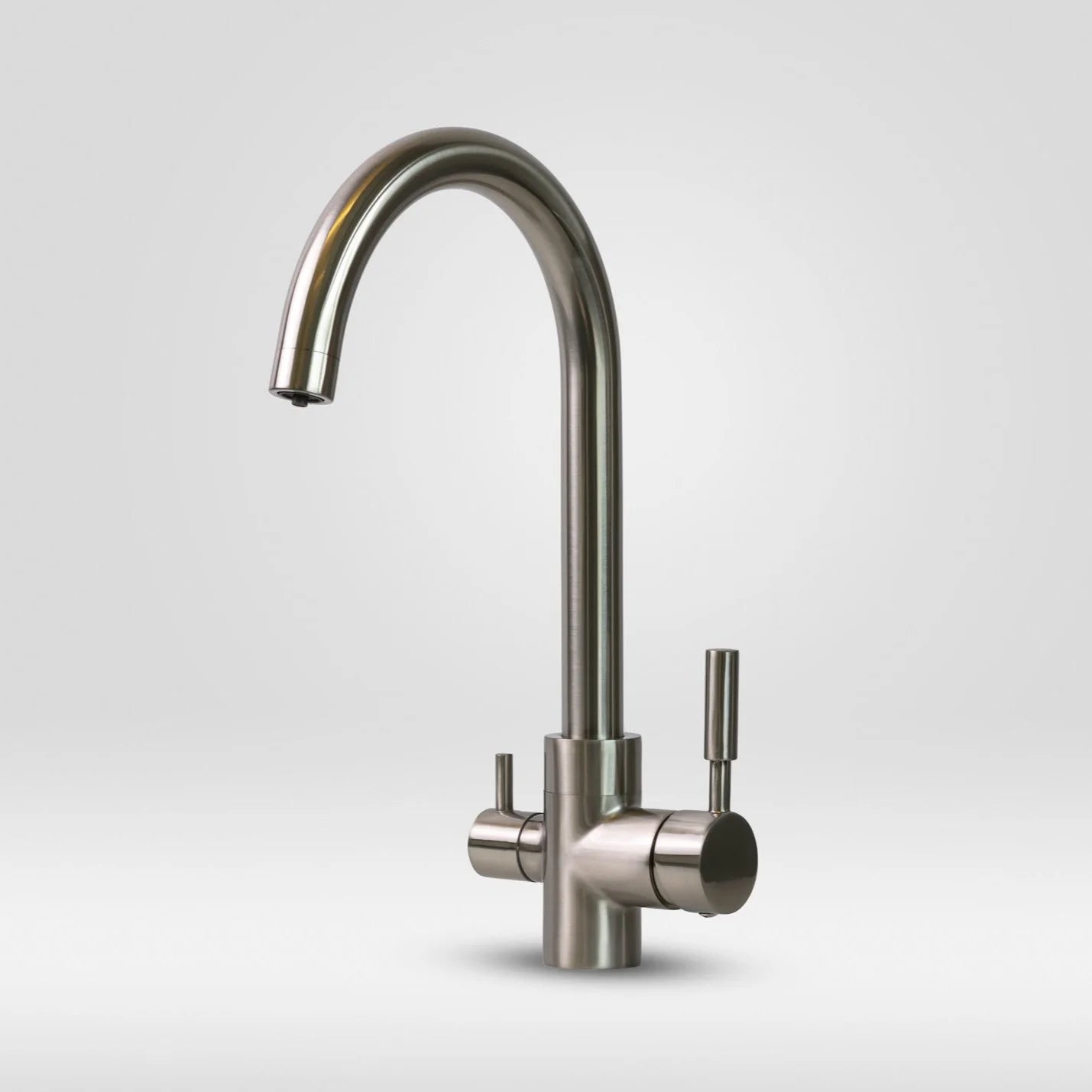
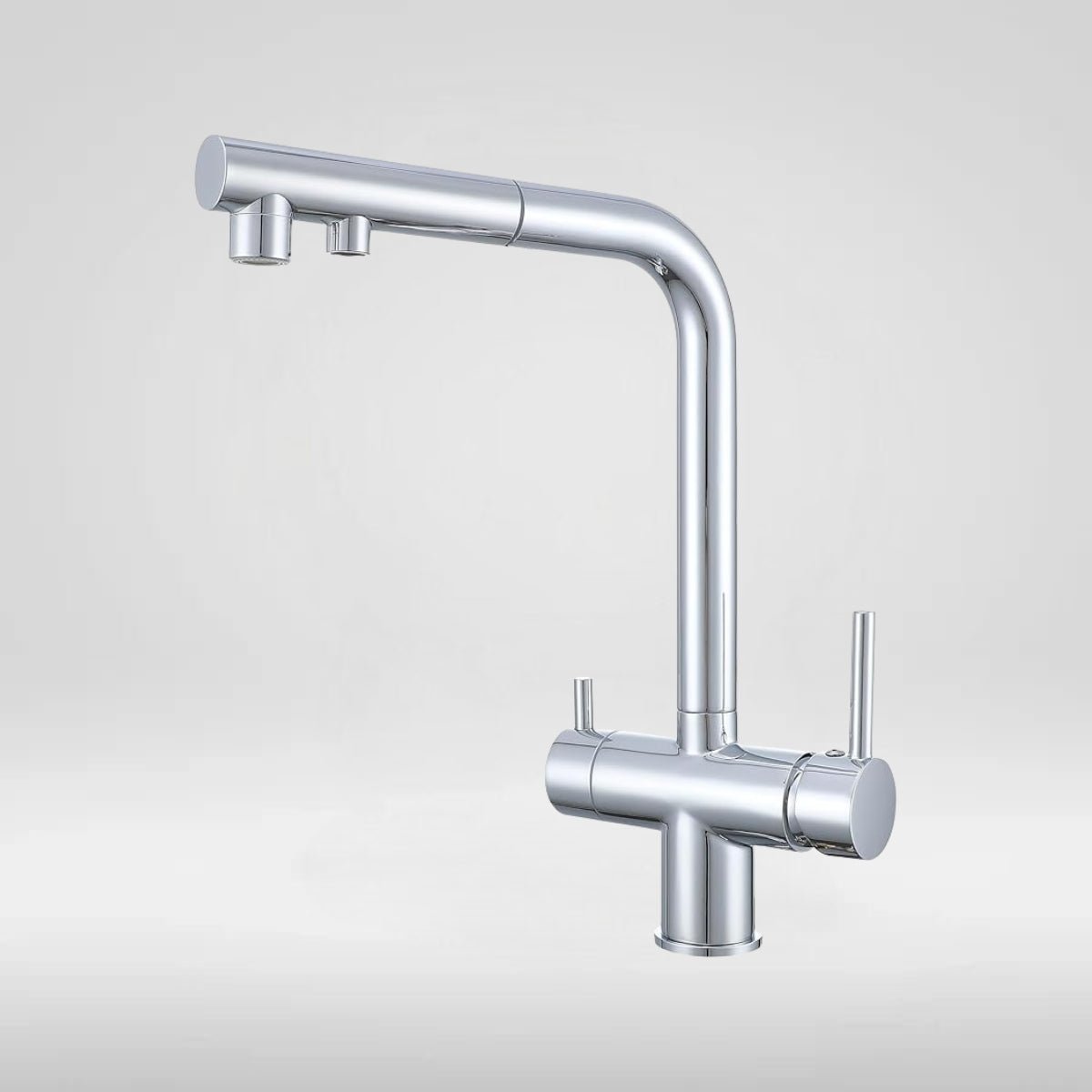
The system disappears into the cupboard and you get your own tapping point in your worktop. This is the level most households end up at, because it is invisible and you can draw from it without limit. At PureAqua you buy this as a tap with the filter system The Source included as standard, from 465 euros for the AquaPure. The system is deliberately not sold separately. The membranes work according to the same method described in NSF/ANSI 58, the international standard for reverse osmosis drinking water systems.
Level 5: the premium station with dosed mineralisation
Above the ordinary built-in system there is one more layer: stations that combine the membrane with a pump that returns minerals in a fixed dose, an app with taste profiles and a higher water recovery. PureAqua is an official dealer of Bluewater, which supplies this category in the Netherlands. The Kitchen Station 1 starts at 3,649 euros. A nice detail: Bluewater Netherlands is based in Leeuwarden and PureAqua in Hallum, both in Friesland.
The levels side by side
Prices are the PureAqua catalogue prices of September 2026 and the Bluewater web shop prices of 15 September 2026. Check them with us before you decide.
| Level | Investment | What it removes | Minerals | Who it is for |
|---|---|---|---|---|
| 1. Filter jug | A few dozen euros plus cartridges | Chlorine taste, odour, partly limescale | Stay in | Anyone who only wants to improve the taste |
| 2. Carbon filter at the tap | Around 100 to 300 euros | Chlorine, taste, odour, particles | Stay in | Anyone who wants the same, but without refilling a jug |
| 3. Countertop osmosis | 495 euros, no installation | Up to about 99 percent, including PFAS and nitrate | Removed, optional mineral filter | Renters, temporary homes, small kitchens |
| 4. Pure water tap with The Source | From 465 euros, or 29 euros a month | Up to about 99 percent, including PFAS and nitrate | Removed, optional mineral filter | Most households |
| 5. Premium station | From 3,649 euros | Up to 99 percent (Cleone) or 99.7 percent (SuperiorOsmosis) | Dosed back via a pump | Anyone who wants the maximum or uses it professionally |
The jump in this table that really matters sits between level 2 and 3. That is where purification moves from taste to chemistry. The jump from 4 to 5 is technically smaller than the price difference suggests, and we come back to that shortly.
For most kitchens, level 4 is the answer
A pure water tap with The Source included, from 465 euros. Or carefree for 29 euros a month, including installation and filters.
View the pure water taps View the subscriptionWhat does it cost per year?
The purchase price is only half the story. Every level has recurring costs, and those vary even more widely than the purchase price.
Start at the baseline. According to Vewin in the price of drinking water, tap water itself costs 2.05 euros per cubic metre excluding taxes and 2.71 euros per cubic metre including them. That is about 0.0027 euros per litre. Everything you add on top, you pay for taste, for extra purification or for convenience.
- Filter jug: cartridges you replace every four to eight weeks. With average use that is six to twelve cartridges a year.
- Carbon filter at the tap: usually one to two cartridges a year, each dearer than a jug cartridge but with far more capacity.
- Countertop and built-in osmosis at PureAqua: a filter set of 2 pieces costs 75 euros, a set of 3 pieces 149 euros. A mineral filter for the taste costs 45 euros.
- Premium station: Liquid Rock minerals cost 90.95 euros separately or 81.86 euros via subscription, and the annual filter package 135.95 euros separately or 122.35 euros via subscription.
The PureAqua subscription flattens that sum: 29 euros a month with 299 euros start-up costs, which includes the tap, the filter system, the filter set for twelve months and installation by a specialist. If you prefer to pay in one go, you will find the full comparison in our piece on when a subscription works out cheaper than buying.
One cost item is almost always forgotten: the replacement moment itself. A membrane left in place too long slowly delivers poorer water. Which part is due when is set out in our overview of when to replace which filter.
When does the premium level make sense?
An honest story belongs here, even though we are a dealer. For by far the most households, level 4 is the sensible choice: a pure water tap from 465 euros or the subscription of 29 euros a month gives you the same membrane, the same level of purification and the same invisibility in the kitchen. A station of 3,649 euros is not a better PureAqua, it is a different level for a different customer.
So where does the difference lie? In three things, and it is worth keeping them apart.
Dosed mineralisation instead of a cartridge
This is the strongest technical argument in the category. An ordinary mineral filter releases minerals as long as the cartridge is fresh and then drops off. Bluewater measures 6 milligrams of magnesium per litre constantly with its Liquid Rock dosing, against 0.46 milligrams per litre with a standard mineral cartridge that declines as it wears. If you want to understand why that is needed at all, read why a membrane removes the minerals and how you put them back.
Water recovery
Every osmosis system flushes away part of the water. According to Bluewater, the Cleone purifier achieves 50 percent recovery against around 25 percent for conventional systems; the heavier SuperiorOsmosis variants claim up to 80 percent. Note the distinction: the Cleone is rated at up to 99 percent removal, SuperiorOsmosis at 99.7 percent. Those are two different products and those figures do not belong on one pile.
Capacity and certification
The Cleone produces up to 610 litres a day, draws 2.75 litres a minute from a 12 litre tank and has a membrane that lasts 3 to 5 years, in a cabinet of 215 by 380 by 416 millimetres. The certification Bluewater names is WQA plus NSF/ANSI/CAN 372. That last standard is about the lead content of the parts, not about how much the appliance removes. That is something other than NSF/ANSI 58 and we deliberately do not stretch it.
In short: the premium level makes sense if you have a large household with heavy use, if you also use the water professionally or for coffee at a high level, or if constant mineralisation and taste profiles are decisive for you. If that is not the case, level 4 buys you the same clean water for a fraction.
Still curious about the premium level?
PureAqua is an official Bluewater dealer. We advise, supply and install. Request a quote or read the specifications first.
Request the Kitchen Station View the specificationsWhat to check before you choose
Five points that in practice make the difference between a system you enjoy for years and an appliance that disappears into a cupboard after six months.
- Quality declaration and NEN 1006: Vitens advises buying only equipment with a quality declaration recognised by the Dutch state, with the right backflow protection, and having every change to the installation comply with the principles of NEN 1006. That is not a formality: it protects the mains network.
- Space under the sink: a built-in system needs cupboard space and a drain connection. Measure that beforehand, because this is the most common reason to go for a countertop after all.
- Maintenance you will actually do: every filter left in place too long becomes a risk instead of a solution. A subscription or a fixed reminder is not a luxury.
- A boiling water tap in the house: a boiling water tap does not deliver osmosis water, and The Source does not combine with a Quooker. If you want both functions from one tap, look at the 4-in-1 tap, which gives hot, cold, filtered and filtered boiling water.
- Softened is not filtered: a water softener lowers your hardness and protects your appliances, but does not deliver purified drinking water. Those are two different solutions for two different problems.
If you are still torn between a countertop and a built-in system, our comparison of which pure water unit suits which kitchen will help. If you want to see what the whole thing looks like at our place, have a look at the page about our home water filter.
Frequently asked questions
What is the best water purification for the home?
For most households, reverse osmosis under the worktop with its own tapping point is the best choice. It removes up to about 99 percent of substances such as PFAS, nitrate, heavy metals and limescale, and you can draw from it without limit. If you only want to lose the chlorine taste, a carbon filter is enough and osmosis would be overkill.
How can I store drinking water for a long time?
Keep tap water in a clean, fully sealed bottle or jerrycan, cool and dark. Sealed and chilled it stays good for up to about seven days; an open jug for a day at most. Refresh an emergency supply every six months. The full explanation is in our article on how long tap water keeps.
How do you purify ditch water into drinking water?
Ditch water requires several steps one after another: first settling and coarse filtering, then a fine filter against bacteria and protozoa, and only after that a step against chemical contamination. One single filter is never enough. An ordinary household system is not built for this; for that you need a survival or emergency filter.
What are the drawbacks of filtered water?
The three real drawbacks are: a membrane also removes the useful minerals, every osmosis system flushes away part of the water, and every filter requires maintenance you have to keep up. The minerals can be solved with a mineral filter or dosed mineralisation. Besides, you get minerals mainly from food, not from water.
How can I purify water into drinking water myself?
At home you purify mains water by putting a filter on it: carbon for taste and chlorine, a membrane for chemistry. Making water from a well, a rain barrel or surface water drinkable yourself is a very different story and requires several steps plus a quality check. Do not underestimate that difference.
Is the water filter from the Action any good?
A cheap filter jug does what a carbon cartridge can do: soften the chlorine taste. For that purpose it works. What it does not do is remove PFAS, nitrate or heavy metals, and that is not claimed on the packaging either. Replace the cartridge on time, because a saturated cartridge in a warm kitchen is a breeding ground for bacteria.
What does a home water purification system cost?
From a few dozen euros for a filter jug to 3,649 euros and up for a premium station. At PureAqua, real reverse osmosis starts at 465 euros for a pure water tap with the system included, or 29 euros a month with 299 euros start-up costs via the subscription. The countertop unit costs 495 euros and needs no installation.
Conclusion
You choose a home water purification system by first naming your reason and then taking the lowest level that solves it. If it is about taste, you stop at a carbon filter. If it is about PFAS, nitrate and heavy metals, a membrane is unavoidable and you end up at level 3 or 4.
For by far the most Dutch households that is level 4: a pure water tap with The Source included from 465 euros, or the subscription of 29 euros a month in which installation and filters are already covered. The countertop unit of 495 euros is the fallback for rented and small kitchens. The premium station from 3,649 euros is a deliberate choice for anyone who needs constant mineralisation, higher recovery or professional use, and an obligation for no one else.
If after this overview you are still not sure, call or message us. At PureAqua we find that one ten-minute conversation about your kitchen, your household and your reason is almost always enough to settle the level. Drink different, but at the level that suits you.
Let us think along about your level
Free tailored advice, without a sales pitch. We will also say so if a cheaper solution is all you need.
Ask for free advice View the pure water unit