Reading time: approximately 12 minutes
Short answer
Fill your kettle half full with water and half full with cleaning vinegar or natural vinegar, bring to a boil, let it sit for 15 to 30 minutes, and then rinse twice with clean water. Citric acid works just as well and smells a lot more pleasant: 1 to 2 tablespoons per half liter of water. With Dutch tap water at an average of 8 °dH, repeat this every 4 to 8 weeks. The limescale keeps coming back because it is in the water itself, not in the appliance.
In this article
- Descaling a kettle with vinegar: the step-by-step plan
- Descaling with citric acid or lemon juice
- Soda, dishwasher tablets, and ready-made descaler
- Which method works best?
- How often should you descale a kettle?
- Why does the limescale keep coming back?
- Preventing limescale structurally
- Is limescale in your kettle harmful?
- Frequently asked questions
- Conclusion
Definition
Limescale is the white, granular layer of calcium carbonate that remains when hard water evaporates or is heated. The calcium and magnesium that make the water hard are left behind on the heating element and the bottom during boiling. Descaling is nothing more than dissolving these deposits with an acid, after which you rinse them away.
Descaling a kettle with vinegar: the step-by-step plan
Vinegar is the most popular household remedy and it works because acetic acid dissolves calcium carbonate. This is the sequence to follow.
- Empty and unplug: remove the kettle from its base and empty it.
- Make the mixture: fill it about halfway with a mixture of 50 percent water and 50 percent cleaning vinegar or natural vinegar. If there is a light layer of limescale, 1 part vinegar to 3 parts water is sufficient.
- Bring to a boil: turn the kettle on once. Never fill past the maximum line, as a boiling acidic mixture overflowing is no fun.
- Let it soak: let the mixture sit for 15 to 30 minutes. If there is a thick, hard layer, an hour is fine.
- Discard and remove loose residue: pour out the mixture and wipe away loosened flakes with a soft cloth. Never scrub with steel wool, as that damages the element.
- Rinse twice: rinse the pot, then boil a full pot of clean water once and discard it. If you still smell vinegar, repeat that one more time.
Two things often go wrong. First: people turn the kettle on two or three times in a row to "make the acid work harder." That doesn't help because the acid is already at temperature after boiling once, and the soaking time does the work. Second: the filter in the spout is forgotten. Take it out and let it soak separately in the same mixture, as that is often where the most limescale is.
If you have a kettle with a hidden heating element, you won't see the limescale, but it is there. In that case, don't go by sight, but by the calendar and the sound: a kettle that starts fizzing louder and takes longer to heat the same liter of water is due for a cleaning.
Don't know how hard your tap water is?
Tell us your zip code and how many people live in your home. We will look up the hardness in your region and tell you honestly whether a device will solve the problem in your situation. Even if the answer is no.
Ask for free advice View water softenersDescaling with citric acid or lemon juice
Citric acid is the gentler sibling of vinegar and is often the better choice in practice. It dissolves the same limescale, leaves no sharp odor behind, and is less aggressive toward rubber seals and plastic components.
With citric acid powder
Dissolve 1 to 2 tablespoons of citric acid powder in half a liter of water, bring to a boil, and let it sit for 15 to 20 minutes. Then pour out, rinse, and boil once with clean water. A 500-gram bag of citric acid costs a few euros at the supermarket or drugstore and is enough for dozens of cleanings, so this is the cheapest route per use.
With lemon juice or half lemons
The juice of 2 lemons in half a liter of water does the same work, just a bit slower. You can also place two cut lemons in the water. Fun detail: this is the version that smells the best, and precisely for that reason, it's the version where people skip the rinsing step. Don't do that, because sugars from the pulp will remain behind otherwise.
One warning that rarely appears anywhere: do not use citric acid in boiling hot water in an appliance with many aluminum parts, and never let it sit overnight. A long soaking time with a concentrated acid is not more effective, but it is harder on the material. At PureAqua, we regularly hear from customers that their kettle suddenly leaked at the water level indicator rubber after soaking overnight.
Soda, dishwasher tablets, and ready-made descaler
Besides vinegar and citric acid, three other methods circulate. They don't all work equally well, and for one of them, the advice is downright questionable.
Baking soda
A frequently mentioned tip is 200 to 250 grams of baking soda in the kettle, fill with water, and let sit for a few hours without boiling. The point: baking soda is a base, not an acid. It loosens the limescale mechanically and neutralizes odors, but it does not dissolve calcium carbonate the way vinegar or citric acid do. Fine as an additional cleaning, subpar as a descaler.
Dishwasher tablet
A dishwasher tablet in boiling water dissolves grease and residue and makes the pot look clean. However, it does not contain the acid you need for limescale, and it is not intended for an appliance you draw drinking water from. If you want to do this anyway, rinse at least three times. We do not recommend it.
Ready-made descaler
Liquid or powder descalers from the supermarket usually contain citric acid, amidosulfonic acid, or lactic acid in a fixed dosage. They work quickly, often within 10 to 15 minutes, and the packaging states exactly how much to use. Disadvantage: you easily pay 4 to 8 euros for a few uses, while citric acid powder does the same for a fraction of that. For coffee machines with pumps and lines, a brand-name descaler is wiser, because the dosage is more critical there. That also applies to espresso machines, about which we have written separately what limescale does to your coffee machine and which filter helps with that.
Which method works best?
The methods compared, with honest ratings included. Costs are per descaling of a 1.7-liter kettle.
| Method | Works on limescale? | Soaking time | Cost per use | Point of attention |
|---|---|---|---|---|
| Cleaning vinegar | Yes, strong | 15 to 30 minutes | Approx. 10 cents | Persistent odor, aggressive to rubber if soaked long |
| Natural vinegar | Yes, slightly milder | 20 to 45 minutes | Approx. 15 cents | Same odor, slightly weaker than cleaning vinegar |
| Citric acid powder | Yes, strong | 15 to 20 minutes | Approx. 10 cents | Fresh scent, best balance between performance and material |
| Lemon juice | Yes, moderate | 30 to 60 minutes | Approx. 60 cents | More expensive, rinse well to remove sugar residue |
| Baking soda | Hardly | Several hours | Approx. 50 cents | Base instead of acid, cleans rather than descales |
| Dishwasher tablet | No | 15 minutes | Approx. 20 cents | Not intended for drinking water equipment, rinse at least 3x |
| Ready-made descaler | Yes, strong | 10 to 15 minutes | 1 to 2 euros | Fast and pre-dosed, most expensive option per use |
In short: citric acid powder wins on the combination of performance, price, and scent. Vinegar is a fine second and everyone has it at home. Soda and dishwasher tablets are cleaning agents, not descalers, and ready-made descalers are especially useful if you don't want to measure.
How often should you descale a kettle?
That depends entirely on the hardness of your tap water and how much you boil. A useful schedule, assuming daily use:
- Soft water up to 8 °dH: every 2 to 3 months.
- Average water from 8 to 12 °dH: every 6 to 8 weeks.
- Quite hard water from 12 to 18 °dH: every 3 to 4 weeks.
- Very intensive use, for example in an office: every 2 weeks, regardless of hardness.
That scale comes from Dunea, which classifies hardness from 0 to 4 °dH as very soft, 4 to 8 as soft, 8 to 12 as average, 12 to 18 as quite hard, and 18 to 30 as hard. Dunea itself supplies water with 1.42 mmol per liter, or 7.9 °dH. The Dutch Drinking Water Decree prescribes a total hardness between 1 and 2.5 mmol per liter, which corresponds to 5.6 to 14 °dH.
The practical rule of thumb is simpler than any schedule: look at the bottom. If you see white flakes or the bottom feels rough, it is time. If you wait until there is a hard, gray crust, you will need two or three cleanings instead of one.
Why does the limescale keep coming back?
This is the question that remains structurally unanswered in the top 10 on Google, while it is the only question that matters in the long term. The answer: your kettle does not create limescale, it only makes it visible.
The hardness of your water is determined by the amount of calcium and magnesium dissolved in it, explains Vitens. As soon as you heat that water, some of that calcium precipitates as solid limescale. If water evaporates, the rest is left behind. Every liter you boil leaves something behind, even if you don't see it.
Calculate it yourself. One degree of German hardness is equal to about 17.8 milligrams of calcium carbonate per liter. With water at 8 °dH, which according to Waternet is about the Dutch average, there is around 143 milligrams of limescale in a liter. If you boil 1.5 liters per day, more than 75 grams of limescale goes through your kettle every year. Not all of it precipitates, but it explains why an appliance you descaled in January is already scratching again by March.
It is interesting what Waternet adds about the marketing surrounding this topic. According to them, water is only considered hard above 12 °dH, and websites of water softener manufacturers often state that water above 4 °dH is already hard. That is, in their own words, incorrect. The Flemish Environment Agency also states that a water softener is usually unnecessary and that you should first check if your tap water is really too hard. We think that is a fairer starting point than a sales pitch, even though we sell those devices ourselves.
Preventing limescale structurally
There are three levels, from free to far-reaching. Start with the first.
Level 1: habits that cost nothing
- Only boil what you need: every excess liter leaves limescale behind without you drinking tea from it.
- Don't leave water sitting: pour out leftovers instead of reboiling them tomorrow. Standing water that evaporates slowly is the biggest source of limescale in a kettle.
- Rinse the kettle after use: five seconds, and the first layer won't get a chance to bond.
- Descale on a schedule rather than by sight: a thin layer disappears in 15 minutes, while a crust takes three rounds.
Level 2: using different water in your kettle
If you fill your kettle with filtered water from a reverse osmosis system, the limescale is already removed from that water before it reaches your appliance. Reverse osmosis forces tap water through a membrane that blocks up to approximately 99 percent of dissolved substances, including calcium and magnesium. There is then virtually nothing left to precipitate, and you will notice this in the taste of your tea as well. The performance of such systems is evaluated against the NSF/ANSI 58 standard.
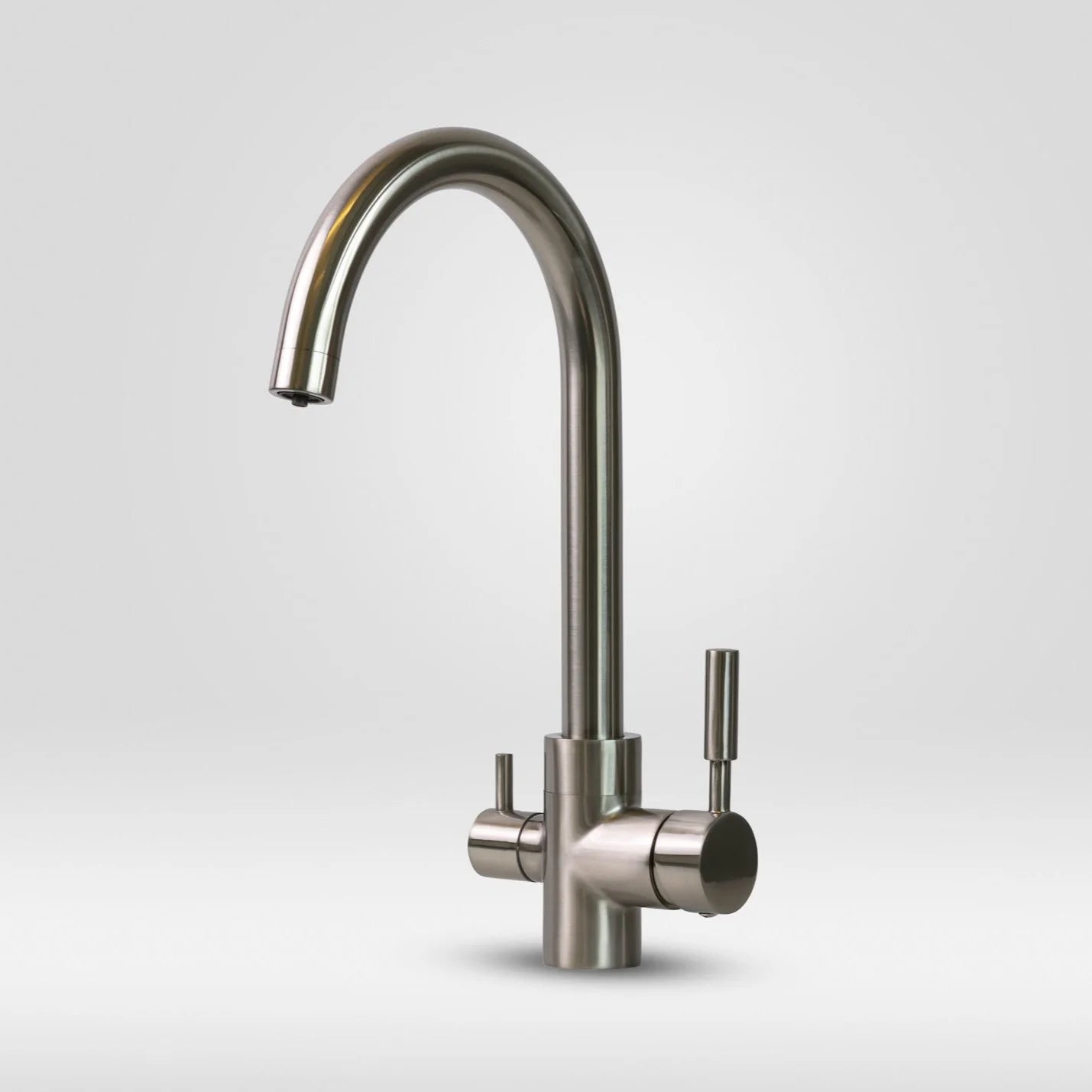
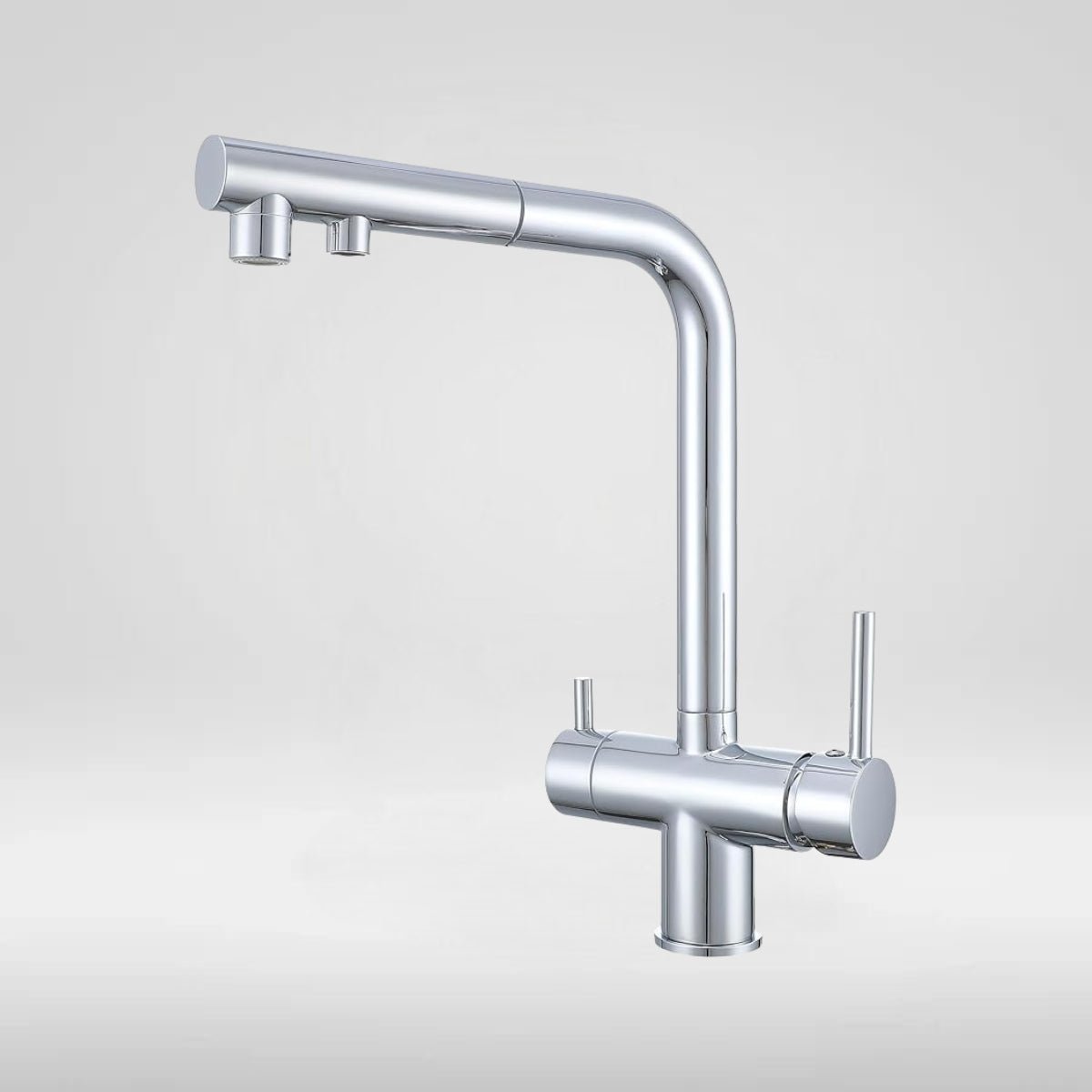
At PureAqua, that water runs through a dedicated pure water tap with the filter system included, or via a countertop device costing 495 euros that you can set up without installation. This solves your limescale problem in the kettle and coffee machine, but not in your shower, washing machine, or central heating boiler: it only covers your drinking water point.
Level 3: softening the water in your entire home
A water softener tackles hardness at the water meter, so for the entire house. It works via ion exchange: calcium and magnesium are exchanged for sodium, after which the resin periodically regenerates with salt. This is also exactly how the NSF/ANSI 44 standard describes household softeners. If you want to see that technology from the inside, we have written out exactly what happens during ion exchange and regeneration.
Two things should be mentioned honestly. Firstly, it costs money: the AquaCell is priced at 2,348 euros with us, and the Joep starts at 1,699 euros. For someone who just wants to get rid of a limescale ring in the kettle, that is a solution that is far too big for the problem. Secondly, such a device requires maintenance. Vitens points out that a poorly maintained softener can lead to bacterial growth with odor and taste complaints, and that you should only buy units with an recognized quality declaration, installed according to the principles of NEN 1006. The full list of caveats is in our piece on what you spend on salt, rinse water, and maintenance.
And then there is the category you can skip: magnets and electronic limescale converters that clip around your pipe. They do not lower the hardness because the calcium and magnesium simply remain in the water. There is also no performance standard that evaluates these devices as NSF/ANSI 44 does for ion exchangers. We have summarized the claims and measurements in our article on what a magnet around your water pipe really does.
No more limescale in your tea
With pure water from a PureAqua tap, you fill your kettle with water that is already free of limescale. 100-day trial and 2-year warranty, or worry-free from 29 euros per month.
View the pure water taps View the countertop deviceIs limescale in your kettle harmful?
No. Limescale consists of calcium and magnesium, two minerals that are also in your food, and hard water is perfectly safe drinking water in the Netherlands. Vitens takes approximately 200,000 samples annually from source to tap, about 750 per day in the laboratory, and calls tap water the best-monitored food product in the Netherlands. Flakes in your tea are therefore an aesthetic problem, not a health problem.
Where limescale does cost something is on the practical side. A layer on the heating element provides insulation, which means the element has to work longer for the same liter. The element itself is therefore subjected to higher heat, which does not benefit its lifespan. And loose flakes that end up in your cup are harmless but not appetizing. If you notice an unusual taste or smell in addition to limescale, Vitens provides a simple flushing recommendation: turn on multiple taps at once for a few minutes.
The water itself, by the way, is incredibly cheap. According to Vewin, the drinking water rate in 2026 will be an average of 2.05 euros per cubic meter excluding taxes and 2.71 euros including taxes. A cubic meter is one thousand liters, so that liter of tea costs you less than a third of a cent in water. The costs of limescale are in appliances that don't survive, not in the water bill.
Frequently asked questions
Can I use cleaning vinegar in the kettle?
Yes. Cleaning vinegar is the strongest household version and works well on limescale. Use a mixture of 50 percent water and 50 percent cleaning vinegar, bring it to a boil once, and let it sit for 15 to 30 minutes. Always use cleaning vinegar without added scent or perfume, do not let it sit for longer than an hour, and rinse twice afterwards with clean water.
Can you also descale with regular vinegar?
Yes. Regular natural vinegar from the kitchen contains around 4 to 5 percent acetic acid and dissolves limescale just fine, only slightly slower than cleaning vinegar with approximately 8 percent. Count on 20 to 45 minutes of soaking time instead of 15 to 30. Do not use balsamic or wine vinegar: they leave stains and contain sugars that burn on.
Why avoid descaling with vinegar?
There are two reasons to leave vinegar aside. The smell stubbornly permeates plastic and is sometimes only gone after three rinses, which you will taste in your first cup of tea. And acetic acid is more aggressive toward rubber seals, plastic components, and chrome parts than citric acid, especially with long soaking times. For occasional use, vinegar is fine; if you descale every month, choose citric acid.
How can I remove limescale from my kettle without vinegar?
Citric acid is the best alternative: 1 to 2 tablespoons of powder in half a liter of water, boil, and let stand for 15 to 20 minutes. The juice of 2 lemons also works, but more slowly. A ready-made descaler from the supermarket does the same in 10 to 15 minutes for 1 to 2 euros per round. Baking soda and dishwasher tablets clean the pot but do not dissolve limescale.
How can I descale my kettle according to old wives' tales?
The classic household remedies are vinegar, lemon, and soda, and two of those hold up. Vinegar and lemon both contain an acid that dissolves calcium carbonate, and that works demonstrably. Soda does not: it is a base and polishes rather than descales. The best bit of advice is not a product but a habit: pour out water leftovers instead of reboiling them tomorrow.
What is the best way to descale a kettle?
With citric acid powder: 1 to 2 tablespoons in half a liter of water, boil once, let sit for 15 to 20 minutes, pour out, and rinse twice. It dissolves limescale just as well as cleaning vinegar, costs about 10 cents per round, smells fresh, and is milder on rubber and plastic. Don't forget the little filter in the spout; place that separately in the same mixture.
How often should I descale my kettle?
With daily use and soft water up to 8 °dH, every 2 to 3 months; with average water of 8 to 12 °dH, every 6 to 8 weeks; and with fairly hard water of 12 to 18 °dH, every 3 to 4 weeks. Dutch tap water averages around 8 °dH. With a concealed heating element, don't go by eye but by the calendar, or by the sound: noisier bubbling and taking longer for the same liter are the signs.
Conclusion
Descaling a kettle can be done in ten minutes: put in an acid, boil once, wait fifteen minutes, and rinse twice. Citric acid powder is the best choice in terms of effect, price, and smell, with vinegar as a fine second. You can skip soda and dishwasher tablets, as they do not dissolve limescale.
The more interesting question is why you have to do it again every month. That is not due to your appliance but your water: at 8 °dH, there is around 143 milligrams of limescale in every liter, and that remains behind as soon as you boil it. Anyone who wants to solve that structurally has two paths. Pure water from a reverse osmosis system removes the limescale from your drinking water, keeping your kettle and coffee machine clean. A water softener addresses the whole house, but at 1,699 to 2,348 euros, it is a significant response to a limescale ring, and according to the Flemish Environment Agency, it is not even necessary in many homes.
Our advice at PureAqua: first look up your water hardness, then choose a solution that fits the problem you actually have. If you're fine with fifteen minutes a month, just keep descaling with citric acid. If you never want to lose that fifteen minutes again and want better-tasting water in your tea, then pure water from your own tap is the step that makes the difference. Drink different, but start with the measurement.
Know first, then choose
We look up the hardness in your region and lay out the options: keep descaling, pure water at your drinking point, or softening the whole house. Free and without obligation.
Request free advice View the subscription