Reading time: approximately 14 minutes
Quick answer
A premium water purifier costs you much less per year than the purchase price suggests, and much more than the monthly fee implies. At PureAqua, you pay 1,110 euros over five years if you buy (a 465 euro pure water tap, a 49 euro installation kit, and four annual replacement sets of 149 euros, in addition to the starter set included with the system) or 2,039 euros via the 29 euro per month subscription with 299 euros in startup costs. A Bluewater Kitchen Station 1 amounts to approximately 5,898 euros over the same five-year period. Per liter, that is 7.6 cents, 14 cents, and 40 cents, respectively.
Price comparisons for water purification almost always fail on the same point: they stop at the purchase price. Yet a purifier is exactly the type of device that keeps asking for small amounts for years—in filters, minerals, and sometimes a service contract. A 465 euro device with expensive filters can therefore turn out to be more expensive than a 900 euro device that requires a complete 149 euro filter set every year.
That is why we are calculating with the cost over 1, 3, and 5 years, rather than the price on the label, for the three routes we see most often in practice: buying from PureAqua, the subscription, and the premium Bluewater level. We are an official Bluewater dealer, so we can provide all three. That is precisely why we are presenting them side-by-side without embellishment. For those who recognize the calculation method: it is the same as in our article on buying versus a subscription for an osmosis device, so that the amounts remain comparable.
All PureAqua amounts are from our own webshop and were retrieved on September 25, 2026. The Bluewater amounts are from the brand's Dutch webshop, measured on September 15, 2026. Prices are subject to change, so please have them confirmed by us before you decide.
On this page
- What counts toward annual costs?
- The three routes side-by-side
- Route 1: buying from PureAqua
- Route 2: the subscription
- Route 3: the premium station
- The total over 1, 3, and 5 years
- What do you pay per liter then?
- And the water itself? It costs almost nothing
- The cost items people forget
- When is premium worth the money?
- Frequently asked questions
- Conclusion
Not sure which route suits you?
Tell us how many people are in your household and how much water you use. We will calculate it for you, with no obligation.
Request free advice View the pure water tapsWhat counts toward annual costs?
The annual costs of a water purifier consist of four items, and three of them are rarely found on the product page. Adding them together is the entire difference between a price comparison that is accurate and one that catches up with you two years later.
Definition
The annual costs of a water purifier are the purchase price divided by the lifespan, plus the recurring annual costs: filter replacement, any mineralization, and any maintenance or service. The drinking water itself barely counts: according to Vewin, the drinking water rate in 2026 is an average of 2.05 euros per cubic meter excluding taxes and 2.71 euros including taxes, or approximately 0.27 cents per liter.
The four items at a glance:
- Purchase: the device or tap, plus installation. At PureAqua, the filter system is included as standard with a pure water tap, so those two amounts are combined.
- Filters: the largest recurring item. At PureAqua, the complete filter set for The Source costs 149 euros, and the complete set of three filters is replaced every 12 months.
- Mineralization: optional. Reverse osmosis also removes calcium and magnesium from the water, and those who want that back choose a mineral filter or dosed mineralization. At Bluewater, this is a subscription for minerals; at PureAqua, a separate module.
- Maintenance and service: when buying, you pay for this separately; with a subscription, it is included in the monthly fee. Our maintenance package costs 20 euros.
That second item is precisely why a bare-bones price comparison fails so often. A system with filters costing 120 euros per year costs 600 euros in consumption over five years; the complete The Source set costs 149 euros and is replaced every year, thus 745 euros over five years. That is 145 euros more. We have elaborated on when a filter is truly due for replacement, and why a calendar is a worse guide for this than your own consumption, in the article on the right moment to replace a water filter.
The three routes side-by-side
Below are the three routes as they are available for purchase today, with the purchase price and everything else that follows. The PureAqua amounts are from our webshop on September 25, 2026; the Bluewater amounts are from the brand's Dutch webshop on September 15, 2026.
| Item | Buy from PureAqua | PureAqua subscription | Bluewater Kitchen Station 1 |
|---|---|---|---|
| Purchase | 465 euros (AquaPure, system included) | 299 euros startup costs | 3,649 euros with Cleone purifier |
| Installation | 49 euros with the DIY kit, or by our specialist | included | by arrangement, through us as a dealer |
| Fixed monthly fee | none | 29 euros | none |
| Filters | 149 euros per complete set of three filters, replaced annually | included | 135.95 euros per annual package, or 122.35 euros via subscription |
| Minerals | separate module, optional | optional | 90.95 euros per delivery, or 81.86 euros via subscription |
| Maintenance | maintenance package 20 euros | included | via the brand and via us |
| Entry level | pure water from a designer tap | pure water without upfront investment | maximum purification plus dosed mineralization |
Two things stand out immediately. The purchase prices are nearly a factor of eight apart: 465 euros versus 3,649 euros. And the recurring costs are even further apart, because while we at The Source end up at 149 euros with the annual replacement of the complete set, the premium station already requires 449.79 euros per year for filters and minerals together in the most favorable variant. The purchase price therefore only tells half the story, and not even the most important half.
What the three routes do share is the underlying technology. All three work with reverse osmosis: water is pressed under pressure through a membrane that blocks almost all dissolved substances. How that works exactly is described step-by-step on our page about how reverse osmosis works. You are therefore not paying for a different purification principle, but for the implementation around it.
Route 1: buying from PureAqua
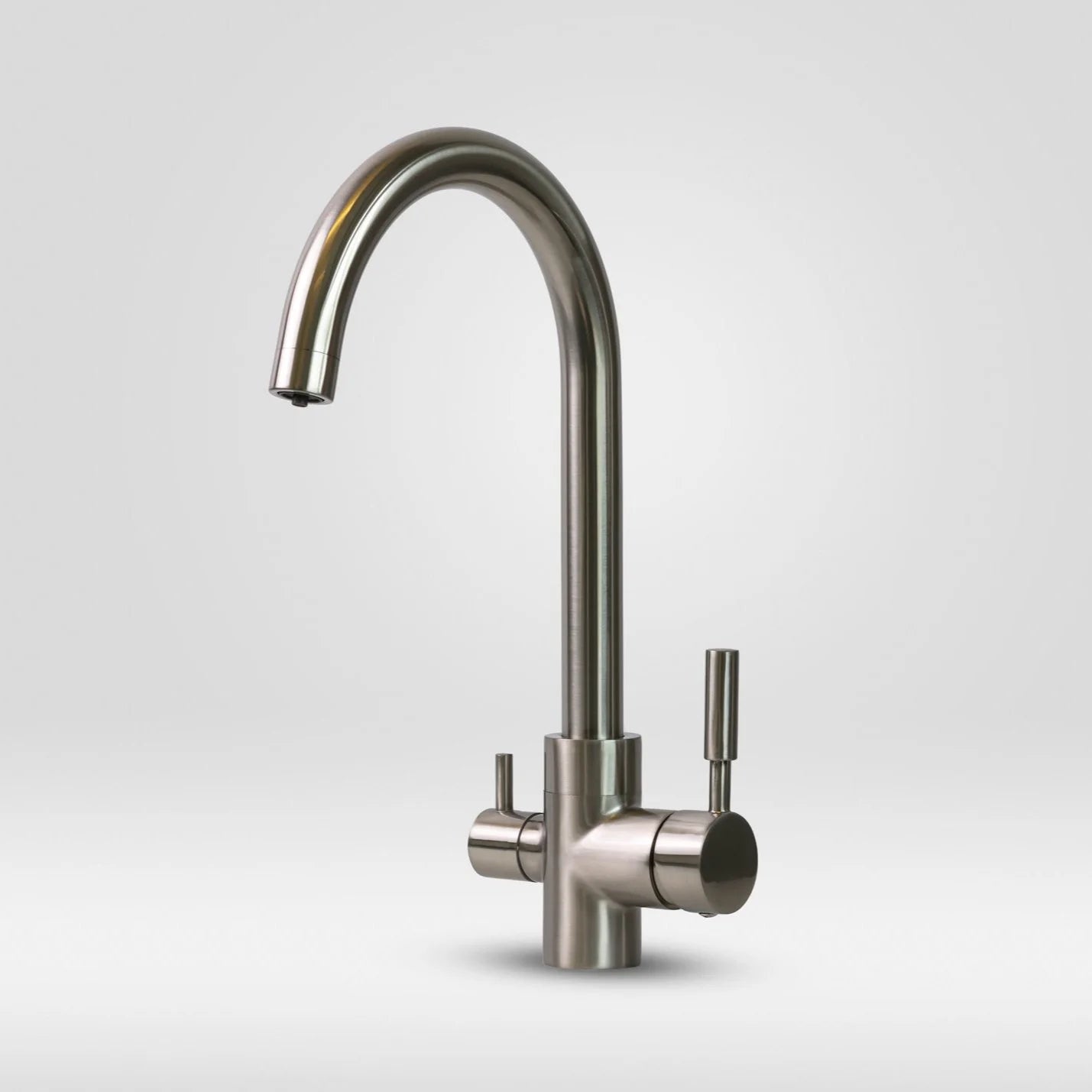
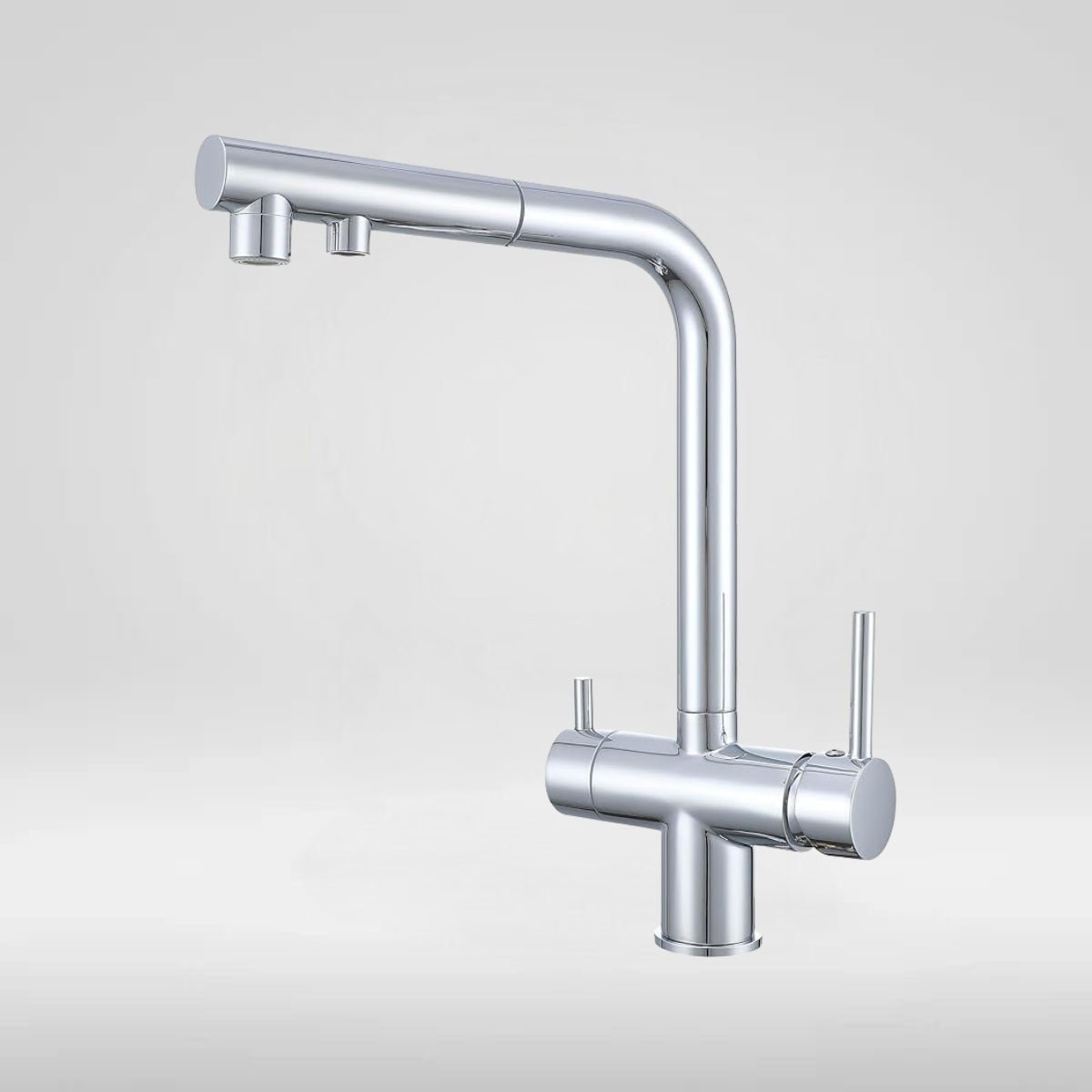
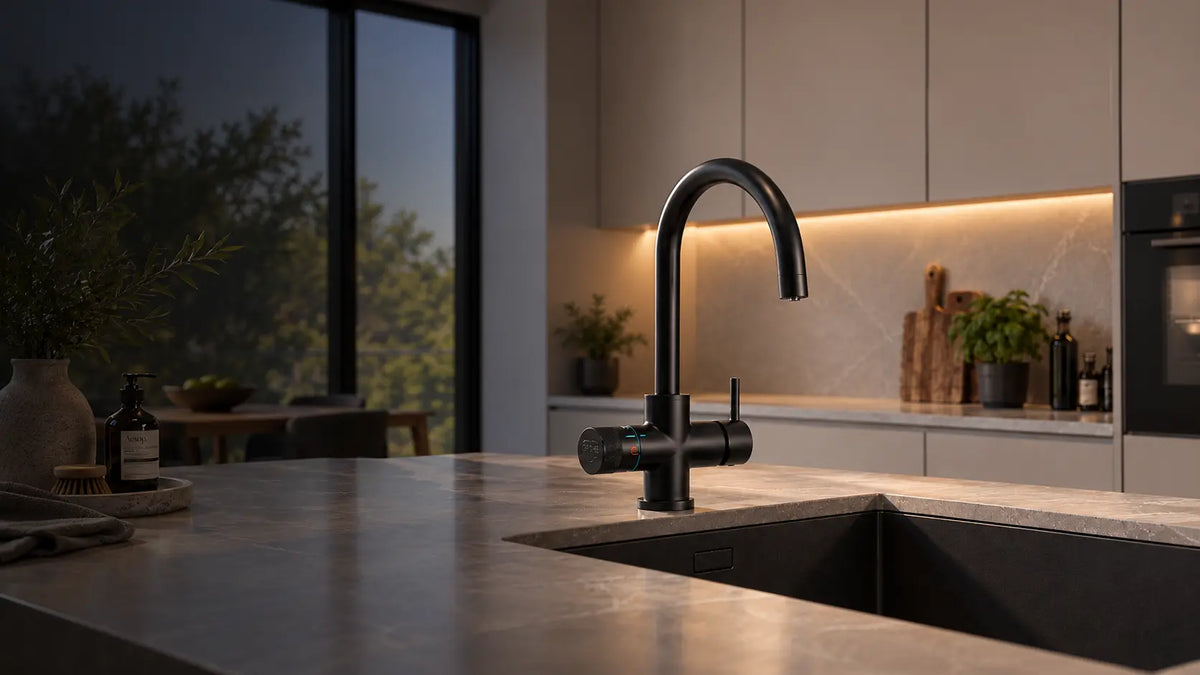
The cheapest route to real osmosis water starts at 465 euros. This is the AquaPure, a 1-way tap in which The Source filter system is included as standard. We do not sell that system separately: you buy a tap, and the system is included. Those who prefer a 3-way tap can choose the AquaFlow, AquaPulse, or AquaSplash for 495 euros, The Current for 640 euros, and The Stream or The Flow for 840 euros. The full series is available in the pure water taps collection.
Installation is then added. If you are handy yourself, you use the 49 euro DIY kit with John Guest hoses and fittings. Those who prefer not to do this let a PureAqua specialist do it; that is custom work, so that amount is not in this calculation. With the DIY kit, you end up at 514 euros in the first year, everything included.
After that, the filters become the recurring item. The complete filter set for The Source costs 149 euros and includes a sediment filter, an activated carbon block, and the RO membrane. PureAqua replaces all three filters every 12 months. Over five years, that adds four replacement sets, totaling 596 euros, in addition to the starter set included with the system.
For The Source, we calculate using the confirmed maintenance cycle: the complete set of three filters is replaced every 12 months. At 149 euros per set, that is 149 euros per year in replacement costs. The five-year calculation includes the starter set with the system; after that, we count four replacement sets.
There is another variant within this route that is often overlooked: the pure water countertop device of 495 euros. That unit is plug-and-play, so no screws go into your kitchen and there are no installation costs. For those living in a rental property, or who first want to experience whether they enjoy osmosis water, this is the cheapest honest starting point. The 4-in-1 tap of 1,948 euros also falls under this route, but you buy that for boiling and chilled water, not to save on purification costs.
Route 2: the subscription
The "Zorgeloos Zuiver Water" (Carefree Pure Water) subscription costs 29 euros per month with 299 euros in startup costs. This includes the tap of your choice, the filter system, the filters, and installation by a specialist. You are therefore not paying for the device, but for the outcome: pure water that keeps working, without you having to set a replacement date in your calendar.
Arithmetically, this is more expensive than buying in the first year: 299 plus twelve times 29 is 647 euros, versus 514 euros for buying. After three years, it is 1,343 euros versus 812 euros for buying; after five years, 2,039 euros versus 1,110 euros. Over five years, you pay approximately 929 euros extra for installation, filters that arrive automatically, and service that does not stop after the warranty period.
Whether that is wise does not depend on the calculation, but on your situation. Anyone who can pay the lump sum and does not mind a filter change is cheaper off buying. Those who prefer to pay in installments, or who know that maintenance in their household is guaranteed to be neglected, are buying primarily peace of mind with the pure water subscription. At PureAqua, we see that families with young children and tenants choose the subscription, and that buyers are more often homeowners who have just renovated a kitchen.
Prefer paying in installments over a lump sum?
The subscription includes the tap, filter system, filters, and installation for 29 euros per month. We are happy to calculate whether buying turns out to be more favorable in your case.
View the subscription Let us calculate it for youRoute 3: the premium station
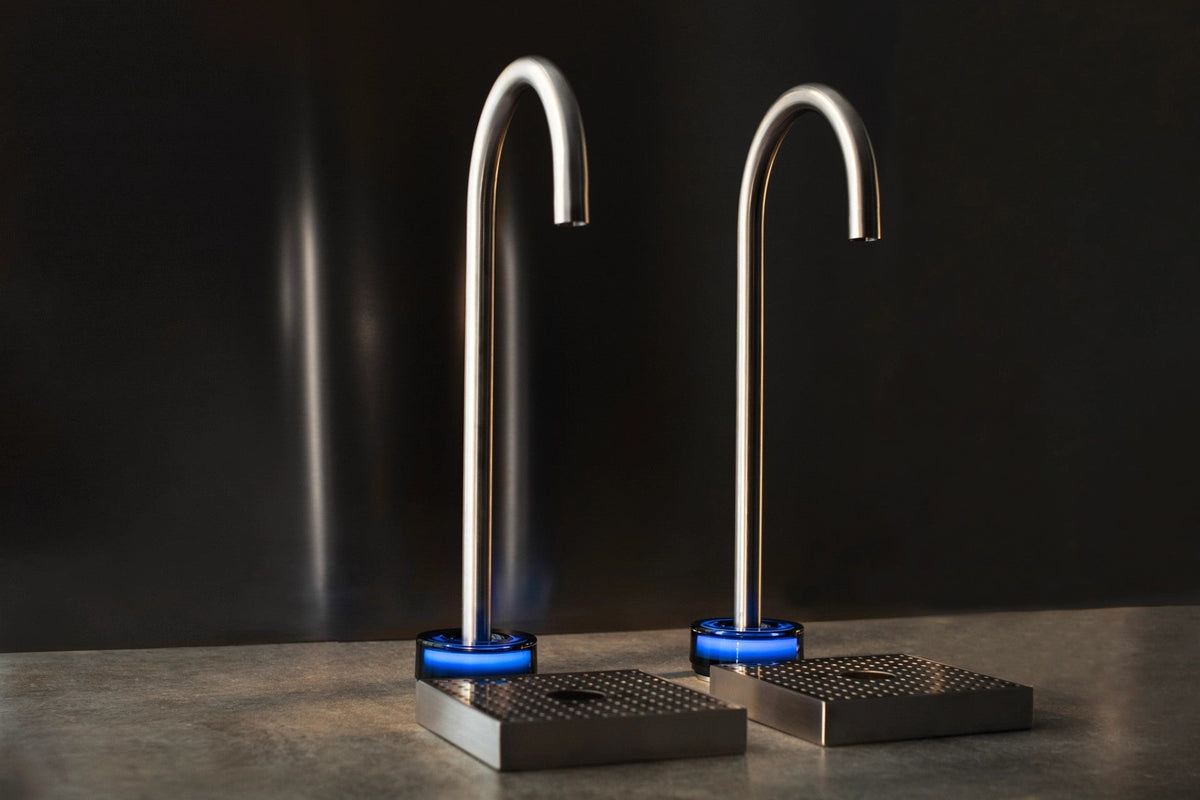
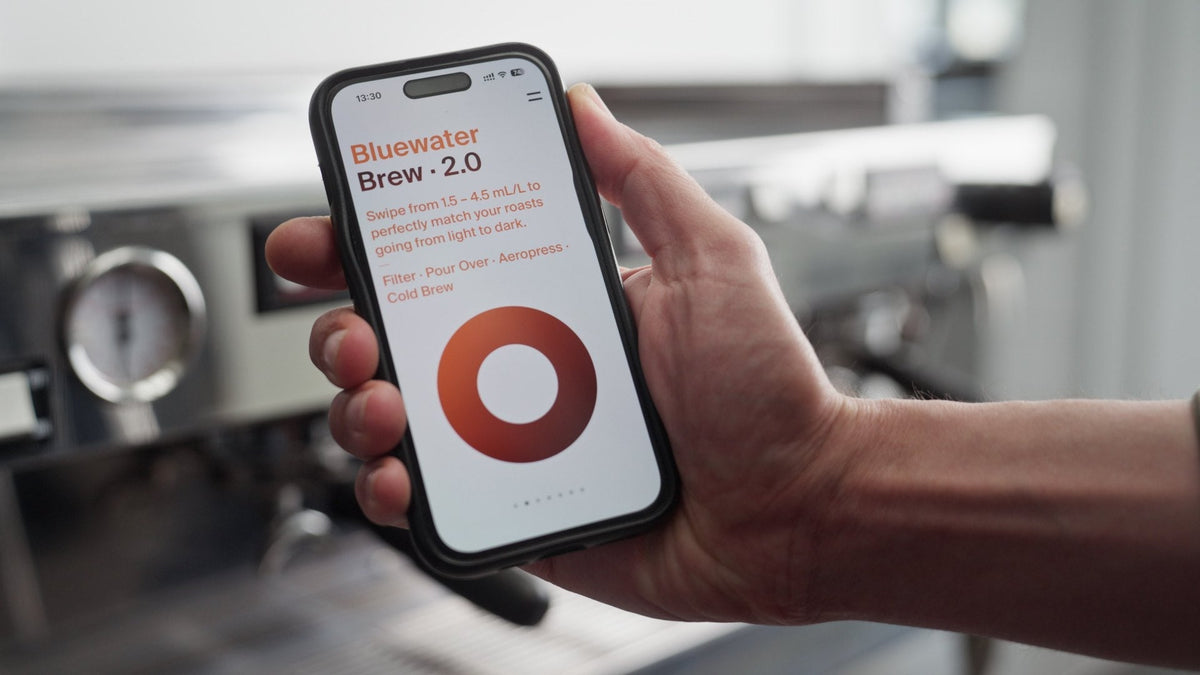
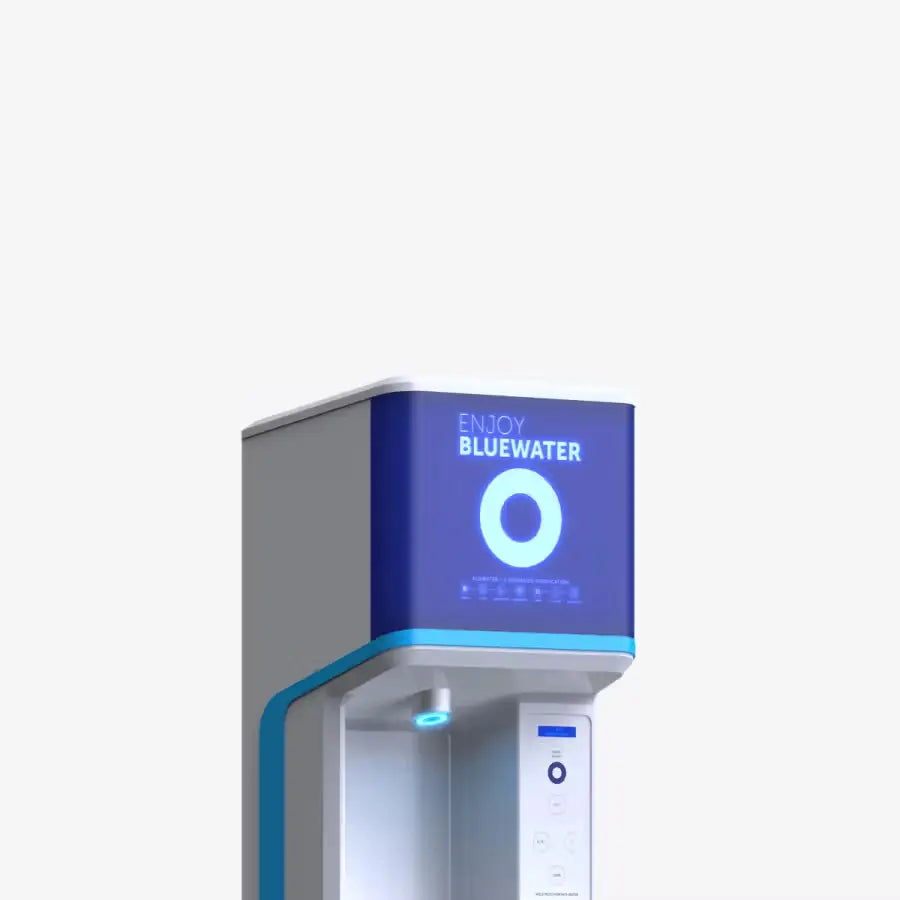
The premium level starts at 3,649 euros. This is the Bluewater Kitchen Station 1 with the Cleone purifier: a complete station with an RO tap, the Bluewater O, a control box, a Mineralizer with a dosing pump, and an app. With the Spirit purifier, that same station costs 5,699 euros, and with the PRO, 7,999 euros. What exactly is in that station and why the storage is roughly the same for all three is in our article on what you get for the entry price of the station; we have elaborated on which purifier you hang in it in the comparison of the brand's three purifiers.
PureAqua is an official Bluewater dealer, so we can deliver and install the station. A nice detail: Bluewater Netherlands is based in Leeuwarden and we are in Hallum, both in Friesland. Precisely because we make money on it, we are honest about what the recurring costs are, because those are much heavier at this level than most people expect.
There are two of them. The annual filter package costs 135.95 euros as a one-time purchase or 122.35 euros via subscription. The Liquid Rock minerals cost 90.95 euros per delivery or 81.86 euros via subscription, and you can have that delivery come monthly, every two months, or every three months. The latter is more important than it seems, because it completely determines the annual account.
| Mineral delivery frequency | Minerals per year | Filter package per year | Recurring per year |
|---|---|---|---|
| Every 3 months, with subscription | 327.44 euros | 122.35 euros | 449.79 euros |
| Every 2 months, with subscription | 491.16 euros | 122.35 euros | 613.51 euros |
| Every month, with subscription | 982.32 euros | 122.35 euros | 1,104.67 euros |
The Dutch Bluewater webshop does not state how long a mineral delivery lasts for an average household, and we are not going to make that up. Therefore, we have provided the full range here: between 449.79 and 1,104.67 euros per year in recurring costs, depending on the schedule you choose. In itself, that is more than the full purchase price of a PureAqua pure water tap, every single year. For the calculations below, we use the most favorable scenario, quarterly delivery with a subscription discount, so that the premium level is given the benefit of the doubt in this comparison.
What you get in return for that money is truly something. The Spirit and PRO remove up to 99.7 percent of contaminants with a water recovery rate of up to 80 percent, compared to up to 99 percent and 50 percent for the Cleone. And the Mineralizer doses with a pump: Bluewater ensures a constant 6 milligrams of magnesium per liter, compared to 0.46 milligrams per liter for a standard mineral filter, which furthermore decreases as the cartridge wears out. That is the brand's strongest technical argument, and it is the reason why we do indeed recommend the station to those who want the maximum.
We are an official Bluewater dealer
Are you considering the premium level? Request the station directly, or run your situation by us first. We will be honest about whether the entry-level option is already enough.
Request the Kitchen Station View the product pageThe calculation over 1, 3, and 5 years
This is where everything comes together. The purchase column assumes the 465-euro AquaPure, the 49-euro DIY kit, and a complete Source filter set of 149 euros that is replaced every 12 months. The subscription column assumes 299 euros in start-up costs plus 29 euros per month, with filters and installation included. The premium column assumes the station with Cleone at 3,649 euros plus 449.79 euros per year for filters and minerals, at the most favorable delivery schedule.
| Period | Buy from PureAqua | PureAqua subscription | Bluewater station | Difference between most and least expensive |
|---|---|---|---|---|
| After 1 year | 514 euros | 647 euros | 4,098.79 euros | 3,584.79 euros |
| After 3 years | 812 euros | 1,343 euros | 4,998.37 euros | 4,186.37 euros |
| After 5 years | 1,110 euros | 2,039 euros | 5,897.95 euros | 4,787.95 euros |
With the complete Source set for 149 euros every 12 months, the purchase route comes to 514 euros after 1 year, 812 euros after 3 years, and 1,110 euros after 5 years. The order does not change; after five years, the gap to the premium level remains over 4,700 euros.
What this table shows above all is that the premium column does not catch up after year 1, but rather pulls further away. With purchasing, the annual costs decrease the longer the device lasts; with the premium station, at least 449.79 euros are added every year. After ten years, the difference would therefore not be smaller, but larger. That is not a criticism of the brand; it is the consequence of dosed mineralization: a pump that adds something to every liter needs a supply every year.
What do you pay per liter then?
Total amounts mean little as long as you do not know how much water passes through. That is why we convert them to cents per liter, using a family of four who together drink and cook with 8 liters per day. That is 2,920 liters per year and 14,600 liters over five years.
| Route | Costs over 5 years | Price per liter | Relative to purchasing |
|---|---|---|---|
| Purchase, complete The Source set replaced annually | 1,110 euros | 7.6 cents | baseline |
| PureAqua subscription | 2,039 euros | 14.0 cents | 1.8 times |
| Bluewater station, quarterly delivery | 5,897.95 euros | 40.4 cents | 5.3 times |
| Bluewater station, monthly delivery | 9,172.35 euros | 62.8 cents | 8.3 times |
That last line is the honest answer to the question in the title. A premium water purifier costs you between 40 and 63 cents per liter over five years, based on average family consumption. That is not an absurd amount if you compare it to bottled water, but it is about five to eight times as much as the same period using the PureAqua purchase route, based on the assumptions used here.
If you consume more, the picture changes partly. A household that draws 25 liters per day through the pure water tap uses 9,125 liters per year, and then the premium route drops to about 12.9 cents per liter over five years. This is precisely why capacity is the real argument at this level, and purification percentage is not. We have worked out which purification level belongs to which consumption level by price category in our overview of the five levels into which the market is divided.
And the water itself? That costs almost nothing
In all the calculations above, one item is missing, and it is surprisingly small. The drinking water you purify costs, according to Vewin in 2026, an average of 2.05 euros per cubic meter excluding taxes and 2.71 euros per cubic meter including taxes. For those 2,920 liters per year, you therefore pay 7.91 euros, and over five years, 39.57 euros.
Put that next to the 5,897.95 euros for the premium route, and the ratio becomes clear: the water is about 0.7 percent of what you spend, the equipment the remaining 99.3 percent. With a water purifier, you are not buying water but a treatment process, and that is precisely the reason why the recurring costs of that treatment process weigh so heavily.
There is another nuance you should take into account with this choice: an osmosis system flushes part of the water away. With the Cleone, water recovery is 50 percent; with the SuperiorOsmosis models, it is up to 80 percent. At 50 percent recovery, your water consumption for the purified portion doubles, and then that 7.91 euros rises to about 15.82 euros per year. Still a negligible amount in the grand total, but something worth knowing. Milieu Centraal does not call tap water the most sustainable drink choice for nothing.
The cost items people forget
In the conversations we have, the same three surprises keep coming up. None of the three are large, but together they noticeably shift the comparison.
The mineral module
Reverse osmosis also removes calcium and magnesium from the water. Those who want them back can choose a separate mineral module from us, or the dosed version from Bluewater. That is not a health matter, as you get most of your minerals from food, but it is a flavor matter. The background and the measurements are in the article about a water filter that adds minerals.
Maintenance that gets neglected
A filter set that you do not replace costs no money, but it does cost performance. This is the item where the subscription pays for itself: the filters arrive automatically. If you buy, include the 20-euro maintenance package and record the replacement date somewhere. We see in practice that filter changes by purchasers happen later on average than the indication prescribes.
Installation
The 49-euro DIY kit covers a normal situation under a sink. If there is no connection, cupboard space is tight, or an extra hole has to be made in the countertop, it becomes custom work. At the premium level, that is even more true, because such a station simply requires more space. Ask about that in advance, because it is the only item in this article that we cannot price beforehand.
We show what a comparable calculation does in another product category in the article about what a water softener costs to purchase and use. The same pattern emerges there: consumption determines the outcome, not the price tag.
When is premium worth the money?
We sell both levels, so this is not a sales pitch but a balanced assessment. There are three situations where the premium level is truly logical in our experience, and a whole range where it is not.
It is logical if your usage is high and constant, because then the price per liter drops quickly and capacity becomes the real argument. It is logical if you also use the water for coffee or business purposes, where a constant mineral composition makes a measurable difference in extraction. And it is logical if dosed mineralization and flavor profiles are the deciding factors for you: 6 milligrams of magnesium per liter constantly is technically different from a cartridge that slowly empties.
It is not logical if you do it to get cleaner water. The difference between up to 99 and up to 99.7 percent is seven out of a thousand parts, and both levels run on the same principle. Anyone who just wants pure drinking water can get that from us starting at 465 euros, using the same membrane technology. And it is not logical if the budget is tight and the choice is therefore between premium and nothing: in that case, the cheapest route is by far the best.
Where the line lies depends, therefore, on consumption and usage, not conviction. If you want to see the disadvantages of osmosis honestly weighed against the advantages before choosing any level, they are listed in the article about where reverse osmosis falls short. And if you are simply looking for the right system for your home, start on our page about a water filter for home.
Frequently asked questions
What is the best water purifier for home?
For most Dutch households, an under-sink reverse osmosis system is the best choice because it stops up to about 99 percent of PFAS, microplastics, heavy metals, and limescale, among other things. At PureAqua, this starts at 465 euros for a pure water tap with the filter system included, or 29 euros per month via the subscription. A premium station of 3,649 euros and up is a sensible choice for high or business consumption, not because the water becomes significantly cleaner.
How much does 10,000 liters of tap water cost?
Approximately 27.10 euros. Vewin cites an average drinking water rate of 2.71 euros per cubic meter including taxes for 2026, and 10,000 liters is 10 cubic meters. Excluding taxes, it is 20.50 euros. For 9,000 liters, you pay 24.39 euros on the same basis. The water itself is therefore a negligible item in the costs of a water purifier.
What is normal water usage for 2 people?
As an industry agreement, Vewin uses a usage figure of around 100 liters per person per day by 2035, so for two people, this is on the order of 200 liters per day for everything combined: showering, washing, toilets, and cooking. Drinking and cooking account for only a few liters of that. For a family of four, we calculate 8 liters per day for drinking and cooking water, or 2,920 liters per year.
What does a filter set for a PureAqua system cost per year?
The complete filter set for The Source costs 149 euros and includes a sediment filter, an activated carbon block, and the RO membrane. The complete set of three filters for The Source is replaced every 12 months. At 149 euros per set, the annual replacement item is 149 euros. The maintenance package costs 20 euros. The filters are included in the 29-euro-per-month subscription.
What does a Bluewater Kitchen Station cost per year in maintenance?
Between 449.79 and 1,104.67 euros per year, depending on how often you have the minerals delivered. The annual filter package costs 135.95 euros as a one-time purchase or 122.35 euros via subscription. The Liquid Rock minerals cost 90.95 euros per delivery or 81.86 euros via subscription, to be delivered monthly, every two months, or every three months. With quarterly delivery and the subscription discount, it comes to 449.79 euros per year.
Is a more expensive water purifier cheaper per liter?
Only with high consumption. For a family of four using 8 liters per day, buying from PureAqua costs 7.6 cents per liter over five years, the subscription costs 14.0 cents, and a Bluewater station with quarterly delivery costs 40.4 cents. If 25 liters per day are used, the premium station drops to about 12.9 cents per liter. At that level, capacity is the real argument, not the purification percentage.
Can I purify water into drinking water myself?
Post-purifying tap water is different from making water from a ditch, a rain barrel, or a private well drinkable. You do the former with a filter on the tap or under the sink. The latter requires multiple steps plus quality monitoring and, according to the RIVM, is the responsibility of the owner. The systems in this article are intended for Dutch tap water.
Conclusion
A premium water purifier does not cost the amount on the price tag per year, but the sum of the purchase, filters, and minerals. Over five years, that is 1,110 euros for PureAqua if you buy it and 2,039 euros via the subscription, compared to approximately 5,898 euros for a Bluewater Kitchen Station 1 with Cleone at the most favorable delivery frequency. Per liter: 7.6 cents, 14.0 cents, and 40.4 cents for a family of four.
The difference lies almost entirely in the recurring costs. When buying, annual costs drop the longer the device lasts; at the premium level, at least 449.79 euros is added every year because metered mineralization requires stock. This does not make premium a bad choice, but a choice you make based on capacity, constant mineralization, or business use, and not on purity.
Our honest advice: start with your consumption, not your budget. If you know how many liters pass through your tap per day, the right route will become clear by itself. And if you don't know, we are happy to calculate it with you, even if the result is the cheapest system. Drink different, but with the numbers added up.
Get your annual costs calculated
Tell us your consumption and your kitchen situation. We will line up the three routes for you, including what it actually costs after five years.
Request free advice View pure water taps