Reading time: approximately 12 minutes
Short answer
A domestic water filter runs on your standard line pressure. In the Netherlands, this is almost always sufficient: PWN maintains a minimum pressure of 200 kPa, or approximately 2 bar, on the ground floor. If you notice a weak stream, start with the aerator on your tap and the main shut-off valve. Only once those are checked is a pressure-boosting pump worth considering.
In this article
- What is water pressure and what is considered normal?
- How much water pressure does a water filter require?
- How to tell if your pressure is too low
- Seven causes of low water pressure
- Increasing water pressure, step by step
- Which solution fits your situation?
- Do you lose pressure due to a water filter?
- Frequently asked questions
- Conclusion
What is water pressure and what is considered normal?
Water pressure is the force with which drinking water is pushed into your pipes. This pressure comes from the water utility company and is expressed in bar or kilopascals (kPa), where 100 kPa equals 1 bar. The higher the pressure, the faster your tap fills a glass and the firmer your shower stream feels.
Definition
Water pressure is the static pressure on your drinking water system, measured at the tap point. Water utility companies provide a minimum pressure on the ground floor; everything that happens afterwards, from pipe length to aerators, can lower that pressure before the water exits your tap.
Numbers are more helpful here than feelings. In their own FAQ, PWN mentions a minimum pressure of 200 kPa, or approximately 2 bar, on the ground floor. If you live higher up, pressure is lost: every ten meters of height costs you roughly 1 bar, simply because the water has to be pushed upward. This is why a complaint about a weak stream in a fourth-floor apartment is a very different story than the same complaint in a terraced house.
It is important to know: that minimum pressure is a supply agreement, not a guarantee that it will arrive at your tap with that same strength. Everything between the water meter and the tap point belongs to the homeowner. That is almost always where the cause of a disappointing stream lies.
Are you unsure if your pressure is sufficient for a water filter?
Tell us about your living situation and where your kitchen is located, and we will let you know in advance if an osmosis system is right for you.
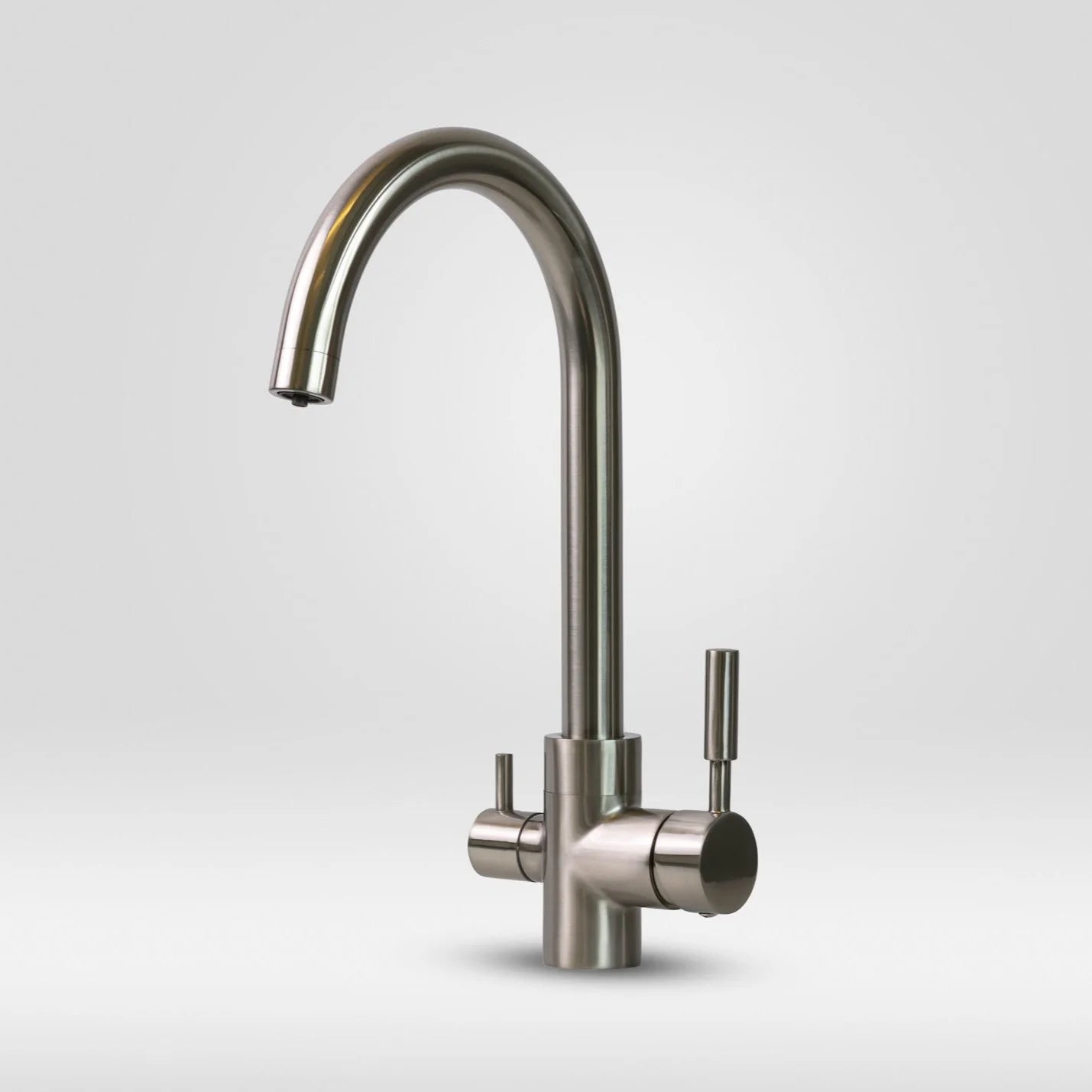
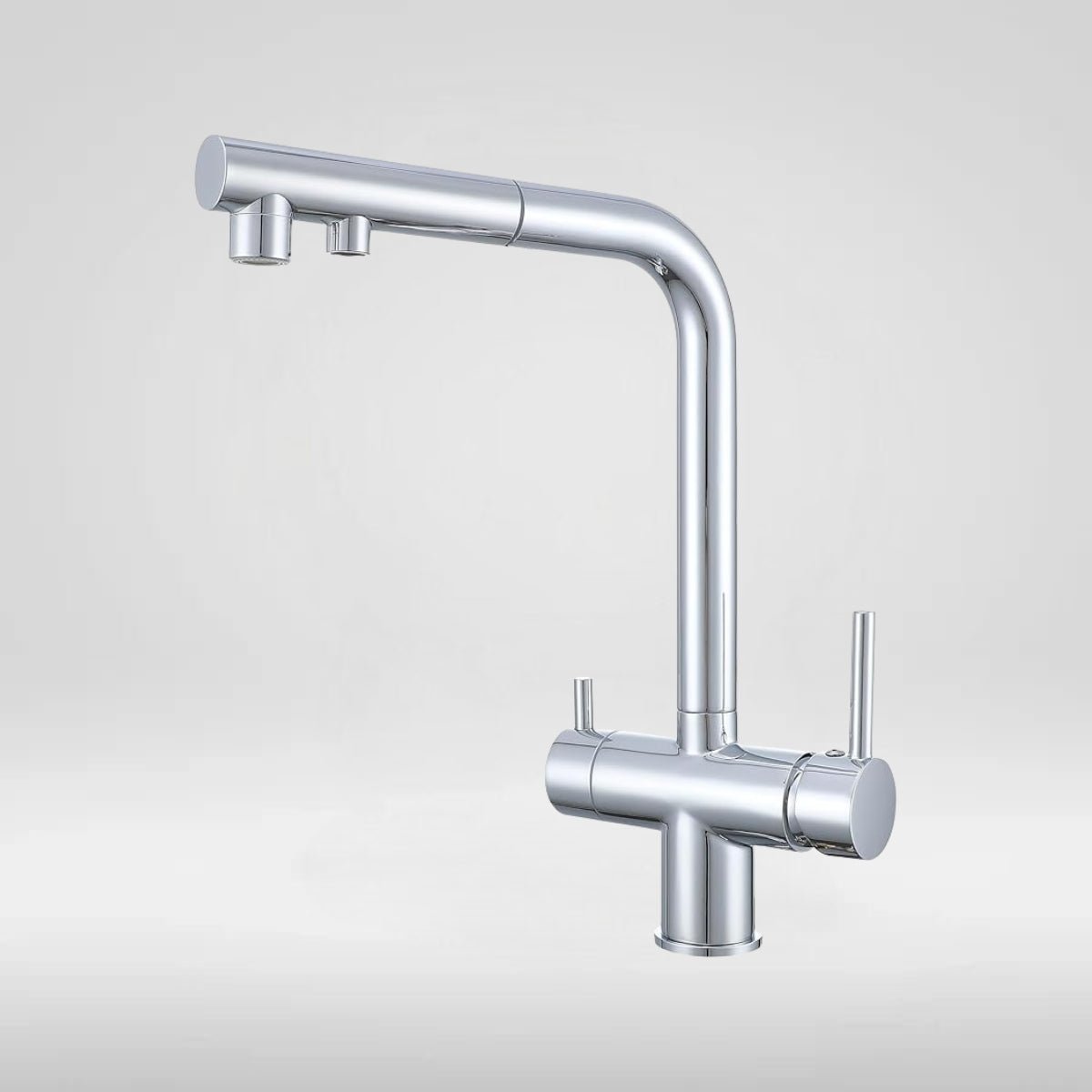
Request free advice View pure water tapsHow much water pressure does a water filter require?
That depends on the type of filter. A filter pitcher or a carbon cartridge works on gravity or minimal flow and, in practice, has no pressure requirement. A reverse osmosis system is a different story: pressure is literally the engine of the process there.
In reverse osmosis, water is forced against a semi-permeable membrane. The line pressure pushes water molecules through, while most of the dissolved solids are left behind and go to the drain with the wastewater. How this works exactly is explained on our page about the mechanism of reverse osmosis. Without sufficient pressure, little happens: the membrane lets through less water, and the proportion of wastewater increases.
The international standard for domestic osmosis systems, NSF/ANSI 58, therefore evaluates not just the membrane but the system as a whole, including the conditions under which it is tested. Pressure, temperature, and the condition of the pre-filters together determine what comes out of your tap. A good system under poor conditions will still perform poorly.
At PureAqua, we find that almost every Dutch kitchen is suitable for an osmosis system without an extra pump. The cases where we want to look into it beforehand are recognizable: high-rise apartments, old homes with narrow pipes, and houses that already have a water softener or pressure-reducing valve installed. If you first want to know which type of osmosis filter fits your kitchen, read that article and return here for the pressure question.
How to tell if your pressure is too low
Before you buy anything, you want to know if it is truly due to the pressure. Three checks provide an answer within ten minutes.
1. Compare multiple taps
Is the weak stream occurring at all tap points or just one? If it is just one tap, then the problem lies with that tap or the pipe leading to it, not your connection. That immediately saves you from an expensive search.
2. Perform the leak check
Vitens describes a three-step leak check: turn off all taps except for the main shut-off valve, turn off the dishwasher and washing machine, and then check your water meter. If the dials are still turning, you have a leak. This is the most important check, as a leak costs you not only pressure but also water.
3. Measure with a pressure gauge
A simple pressure gauge with a hose coupling can be screwed onto an outdoor tap or the washing machine tap. Measure twice: once with everything closed and once while a tap is fully open. The difference between the two says more than a single number, as a pressure that collapses as soon as you open a tap indicates a narrowing.
Note: a glass filling more slowly doesn't necessarily have anything to do with your connection. With an osmosis system, a slower flow rate is often the first sign that the pre-filters are clogging. Replace those first according to schedule, and only then judge whether the line pressure is the problem.
Seven causes of low water pressure
Vitens lists something very small as the most common cause: the aerator on the tap. Below are the seven causes we encounter in practice, from most to least likely.
- Clogged aerator: the filter screen in the tap spout becomes full of limescale and grit. Vitens advises unscrewing the tap head, removing the screen, and cleaning it with vinegar.
- Main shut-off valve not fully open: after repairs or moving in, the main valve is often left half-closed. It costs nothing to check.
- Height in the building: the minimum pressure applies on the ground floor. Every floor costs pressure.
- Equipment in the line: Evides explicitly states that a water softener with the required safety features easily causes about 70 kPa or 0.7 bar of pressure loss. If there is also a pressure-reducing valve, it adds to that.
- Multiple tap points at once: showering while the washing machine is filling and someone is watering the garden divides the same amount of water over three points.
- Leak or narrowing after the water meter: old, narrowed, or partially calcified pipes. These are the responsibility of the homeowner.
- Peak demand on the network: Vitens reports that in cases of extreme demand, the network sometimes runs at full capacity and distributes water as efficiently as possible so that no one goes without. Temporary and rare.
If you have a water softener in your utility closet, that 0.7 bar is worth considering. In our article on installing a softener at the water meter, you can read about the space and connections required, and why the location in the line is so critical.
Increasing water pressure, step by step
Work from cheap and simple to expensive and invasive. In that order, you are usually finished by step two or three.
Step 1: Descale the aerator
Unscrew the tap head, remove the screen, soak it overnight in cleaning vinegar, and rinse it. Costs: nothing. According to Vitens, this solves a large portion of complaints.
Step 2: Check main shut-off valve and isolation valves
Open the main shut-off valve fully, and do the same with the angle valves under your sink and behind the toilet. An angle valve that is half-closed gives exactly the impression of a weak tap.
Step 3: Rule out leaks
Perform the three-step leak check. If you find a leak before the water meter, that is a matter for your utility company; Vitens can be reached 24/7 for this at 0800 0359. If the leak is after the water meter, call a plumber or the property owner.
Step 4: Consider a pressure-boosting pump
If the pressure throughout the entire house remains too low, a pressure-boosting pump or hydro-pump is the standard solution. It is placed directly after the water meter in the utility closet, so all tap points benefit. This is explicitly not a DIY job: Vitens points out that any change to your tap water installation must comply with NEN 1006 standards, must include the correct backflow prevention, and you should only use devices with a quality statement recognized by the Dutch state.
Step 5: Choose a filter that doesn't depend on your line pressure
If renovating your plumbing is not an option, for example because you rent, then flip the question. A countertop model stands separately on your counter, does not need a connection to the water line, and is therefore unaffected by the pressure in your home. At PureAqua, this model costs 495 euros. How that works in practice is described in our article about pure water without a connection to your pipes.
Which solution fits your situation?
The table below compares the four routes, with the question that really matters: does the result depend on your line pressure?
| Solution | What it does | Sensitive to low pressure? | Indication |
|---|---|---|---|
| Descale aerator | Restores the stream at a single tap | Solves the problem | Free, ten minutes of work |
| Pressure-boosting pump | Increases pressure throughout the house | No, that is the goal | Installation by a certified installer, NEN 1006 |
| Osmosis system under the sink | Pure drinking water via its own tap | Yes, pressure drives the membrane | Included with a PureAqua pure water tap |
| Countertop osmosis | Pure drinking water without connection | No, stands apart from your pipes | 495 euros, no technician needed |
The financial picture for all four is modest compared to bottled water. According to Vewin, you will pay 2.05 euros per cubic meter for tap water in 2026, excluding taxes, and 2.71 euros including them. That is a fraction of a cent per liter, even after you have filtered it.
Prefer pure water without the hassle of pressure and pipes?
With the Carefree Pure Water subscription, you pay 29 euros per month with a 299 euro startup cost, including tap, system, filters, and installation by a specialist.
View the subscription View the Countertop RODo you lose pressure due to a water filter?
This is the question we get asked most often, and the answer is reassuring: nothing changes for your regular kitchen tap. An osmosis system is connected to a branch of the cold water line and provides pure water via its own tap with a separate channel. Your main tap continues to operate at full line pressure.
What is true: the pure water tap itself provides a gentler stream than you are used to. That is not a defect but the nature of the system, because that water comes from the filter and not directly from the pipe. Those who want to see the full trade-offs regarding osmosis will also find the point about rinse water and space under the cabinet in our overview of the downsides of osmosis.
What you should pay attention to is the location in the pipe. A system connected behind a water softener or behind a pressure reducing valve receives the remaining pressure and not the full amount. That is precisely the kind of detail that is considered during installation; the full step-by-step plan is in our article on installing an osmosis system under the sink. At PureAqua, such an installation takes 1 to 1.5 hours; those who prefer to do it themselves can use the DIY installation kit for 49 euros.
Finally, maintenance. A membrane that lasts longer than intended behaves like low water pressure: slower filling, lower output, changing taste. At PureAqua, we replace a membrane on average every 2 to 3 years, and the pre-filters more often. That is the cheapest way to keep your pressure up to par.
Frequently asked questions
Can I increase the water pressure myself?
Partially. What you can do yourself: clean the aerator of your tap, check if the main tap is fully open, and perform the leakage check from your utility provider. That solves most complaints. If the pressure remains low, it concerns the connection or the pipe, and then calling your drinking water company or a certified installer is the next step. A pressure booster pump is something you have installed; you don't just buy it separately.
What to do if the water pressure is too low?
Work from small to large. First unscrew the aerator and descale it with vinegar, then check the main tap, then see if it affects all taps or just one. If the wheels of your water meter are turning while all taps are closed, you have a leak. If it affects the entire street, check the water outage website. Your utility company is available 24 hours a day.
Can I install a water pressure booster myself?
Technically you can, but a pressure booster is part of your drinking water installation, which is subject to regulations. Utilities point out that every modification to your tap water installation must comply with the foundations of NEN 1006 and that you should only use appliances with a quality statement recognized by the Dutch state. Therefore, leave installation to a certified installer.
What is the cause of low water pressure in my water pipe?
In most households, it is a clogged aerator or a main tap that is not fully open. Next are long or thin pipes, being on a high floor in the building, multiple taps open at the same time, and equipment in the line such as a water softener with protection, which according to water companies can easily cause about 70 kPa or 0.7 bar pressure loss. During extreme peak demand, the network itself may also be strained.
What water pressure does a reverse osmosis system need?
A household osmosis system runs on your regular line pressure. In the Netherlands, this is more than sufficient: water companies, for example, maintain a minimum pressure of 200 kPa or approximately 2 bar on the ground floor. At PureAqua, we see that almost every Dutch kitchen is suitable without an extra pump. If you are in doubt because you live high up or have a long pipe, have your situation assessed in advance.
Will I notice less water pressure at my kitchen tap after installing a water filter?
No. An osmosis system is connected to a branch of the cold water line and provides pure water via its own tap with a separate channel. Your regular kitchen tap continues to operate at full line pressure. The pure water tap itself always provides a gentler stream, because it draws filtered water from the system and not directly from the pipe.
What happens to my osmosis filter if the water pressure is too low?
The output drops and the proportion of rinse water increases, because there is less pressure left to force water through the membrane. You will notice it by a glass filling up more slowly. Note: exactly that same appearance is also associated with clogging pre-filters. Replace the pre-filters according to schedule first, and then judge whether it is really due to the pressure.
Conclusion
Water pressure is rarely the reason a water filter does not work. In the Netherlands, the drinking water company provides a minimum pressure of approximately 2 bar on the ground floor, which is more than sufficient for a household osmosis system. If your tap is still complaining, in nine out of ten cases it lies in your own installation: a clogged aerator, a main tap that is half closed, or equipment in the line that takes away 0.7 bar.
Therefore, work in that order. Descale the sieve, check the taps, perform the leakage check and rule out a leak. If it remains too low at all taps, then a pressure booster pump is the solution, installed by a certified installer according to NEN 1006. And if you want pure water without tying yourself to the pressure in your house, then a countertop model is the simplest route.
Pure water from your own tap, without surprises
Our specialists will take a look at your kitchen, your pipes, and your pressure in advance. Drink different.
Request free advice View pure water taps