Reading time: approximately 12 minutes
Short answer
An osmosis filter is not a separate filter, but a set of filters surrounding a reverse osmosis membrane: a pre-filter for particles, a carbon filter for chlorine and taste, the membrane that blocks up to approximately 99 percent of dissolved solids, and a post-filter for taste. If you want a fixed tap point in the kitchen, choose an under-sink system with its own faucet. If you do not want to connect anything, a countertop model is the simplest route.
In this article
- What is an osmosis filter?
- How does an osmosis filter work, step by step
- What does an osmosis filter remove, and what doesn't it?
- Which variant should you choose: under-sink, countertop, or faucet
- The options side-by-side
- How often do you replace the filters?
- What does osmosis water cost per liter?
- What should you pay attention to when choosing?
- Frequently asked questions
- Conclusion
What is an osmosis filter?
The word "osmosis filter" suggests a single cartridge you screw in somewhere, and that is precisely why so many people order the wrong one. An osmosis filter is a filter line of three to five stages, only one of which does the real work: the reverse osmosis membrane. The other stages exist to protect that membrane and to refine the taste of the water. If you only buy the membrane, it will clog up within weeks. If you only buy the pre-filters, you will hardly stop any dissolved solids.
Definition
An osmosis filter is the total assembly of filter stages in a reverse osmosis system: one or more pre-filters, a semipermeable membrane with pores on the order of a ten-thousandth of a micrometer, and a post-filter. The membrane allows water molecules to pass through while retaining dissolved salts, metals, and organic compounds, which are flushed down the drain with a portion of the water.
The distinction between filtering and osmosis is not just cosmetic. A classic filter pitcher or carbon filter works via adsorption: substances stick to the carbon material. Reverse osmosis works through physical separation under pressure, which also leaves behind substances that would not stick to carbon. If you want that comparison in detail, we have explained which technique in a filter faucet removes what.
The international performance standard for household osmosis systems is NSF/ANSI 58. That standard exists precisely because the efficiency of a membrane depends on pressure, temperature, and the state of the pre-filters, and not just on the membrane itself. At PureAqua, we see that customers who understand this distinction almost never regret their choice, while those who base their decision on a single part often return within a year.
Not sure which system suits your kitchen?
Send us your situation, and we will take a look at the space under the sink, your water hardness, and the number of tap points. Or view the faucets with the system included immediately.
Request free advice View the pure water faucetsHow does an osmosis filter work, step by step
In an osmosis system, water always follows the same route. Each stage has a task, and each stage has its own lifespan. The latter is the reason you buy a filter set and not individual cartridges.
Stage 1: the sediment or pre-filter
The first filter catches sand, rust flakes, and suspended particles. This is not a luxury, but protection: without a pre-filter, these particles would end up on the membrane and clog the narrow channels. Dutch tap water is clean, but not free of particles, and particularly after work on the mains, a lot comes loose temporarily.
Stage 2: the activated carbon filter
Activated carbon removes chlorine, chlorine compounds, and many odor and taste substances from the water. This filter is also there to protect the membrane, as free chlorine damages the membrane material. In the Netherlands, this is less of an issue than in many other countries: Waternet states that we try to use as little chlorine and other chemical agents as possible here, whereas chlorination is standard in many European countries.
Stage 3: the reverse osmosis membrane
This is where the real work happens. Line pressure forces water against a semipermeable membrane; water molecules pass through, while most of the dissolved solids do not. That remaining fraction is flushed to the drain with waste water. In this way, a well-functioning system removes up to approximately 99 percent of the dissolved solids from your drinking water, including limescale, heavy metals, microplastics, and PFAS. How exactly that separation occurs is detailed step-by-step on our page about how reverse osmosis works.
Stage 4 and optional stage 5: post-filter and mineral filter
After the membrane, the water passes through a final carbon filter, which removes any residual taste. Optionally, a mineral filter follows, which adds calcium and magnesium back into the water. That is a taste preference, not a necessity: you mainly get minerals from food, not from water. Those who doubt whether osmosis water without minerals is wise will find the nuance in our article on the downsides of reverse osmosis.
What does an osmosis filter remove, and what doesn't it?
An osmosis filter has a broad range of action, and that is precisely its strength and its weakness. It does not distinguish between substances you would rather get rid of and substances that did not bother you. It removes the following to a high degree:
- Limescale: calcium and magnesium, the substances that turn your kettle white. According to Vitens, Dutch tap water averages around 8 dH, which is soft to moderately hard.
- PFAS: the Netherlands Nutrition Centre (Voedingscentrum) mentions more than 4,700 types of PFAS, and the RIVM concluded that PFAS levels in drinking water from river water must be reduced.
- Heavy metals: including lead from old internal pipes. The RIVM maintains a standard of 5 micrograms per liter for lead and points to lead pipes in buildings from before 1960.
- Nitrate, sulfate, and sodium: according to Dunea, the standard for sodium in drinking water is 150 milligrams per liter, and taste complaints arise above approximately 200 milligrams.
- Microplastics and pharmaceutical residues: particles and molecules that are larger than the pore size of the membrane.
And here is what it does not remove, or not reliably: dissolved gases such as carbonic acid partially pass through the membrane, and an osmosis filter is not a disinfectant. Those who want to drink water from an unreliable source need a different approach; the WHO evaluates household water treatment separately for bacteria, viruses, and protozoa for this reason.
Honesty is important: Vitens states that filtering for health reasons is not necessary in the Netherlands, and the RIVM reports that people ingest more than three times as much PFAS through food than through drinking water. You choose an osmosis filter at PureAqua, therefore, not out of fear, but for taste, limescale-free water, and the convenience of no longer lugging bottles around.
Which variant should you choose: under-sink, countertop, or faucet
The question "which osmosis filter" is in practice almost always the question "which configuration". The membrane is comparable in all cases; what differs is where the system is placed, how the water reaches your glass, and whether a technician is required.
Under-sink system with its own faucet
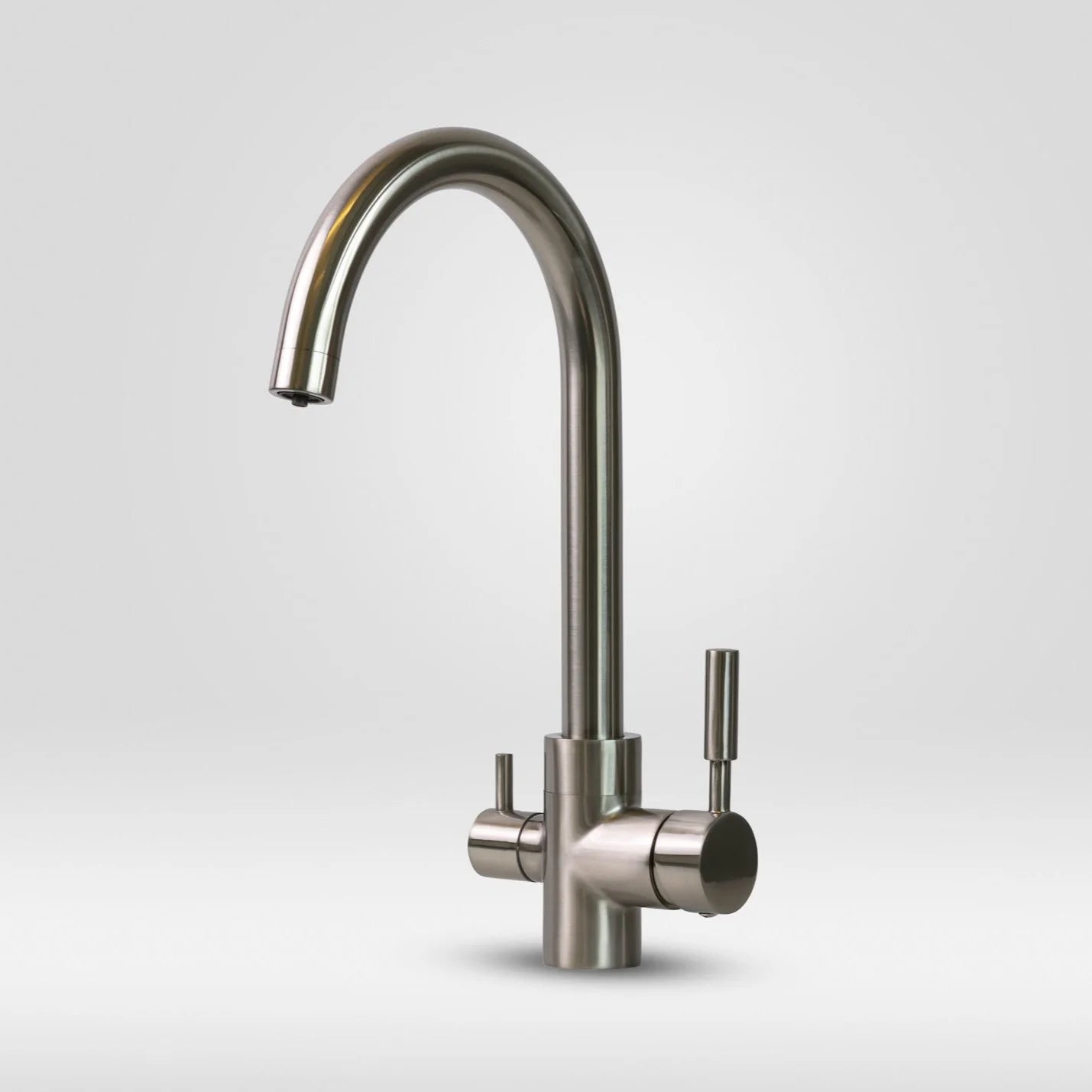
The system hangs out of sight under the sink, and the purified water runs via its own line to a separate tap point. This is the tidier and more hygienic route because filtered water does not mix with hot or unfiltered water. At PureAqua, in this case, you buy a pure water faucet, and the filter system "The Source" is included as standard. Faucets range from approximately 149 euros for the entry-level model to approximately 840 euros for the design versions.
Countertop: osmosis without installation
A countertop model stands on the counter, does not require a water line connection, and does not need a drain connection. You fill a reservoir, and the device does the rest. At PureAqua, this model costs 495 euros and is available separately, without a technician. If you are renting, about to renovate, or do not want a hole in your countertop, this is often the most sensible choice. We have detailed separately when osmosis water without connection is the better route.
The 4-in-1 faucet: everything from one tap point
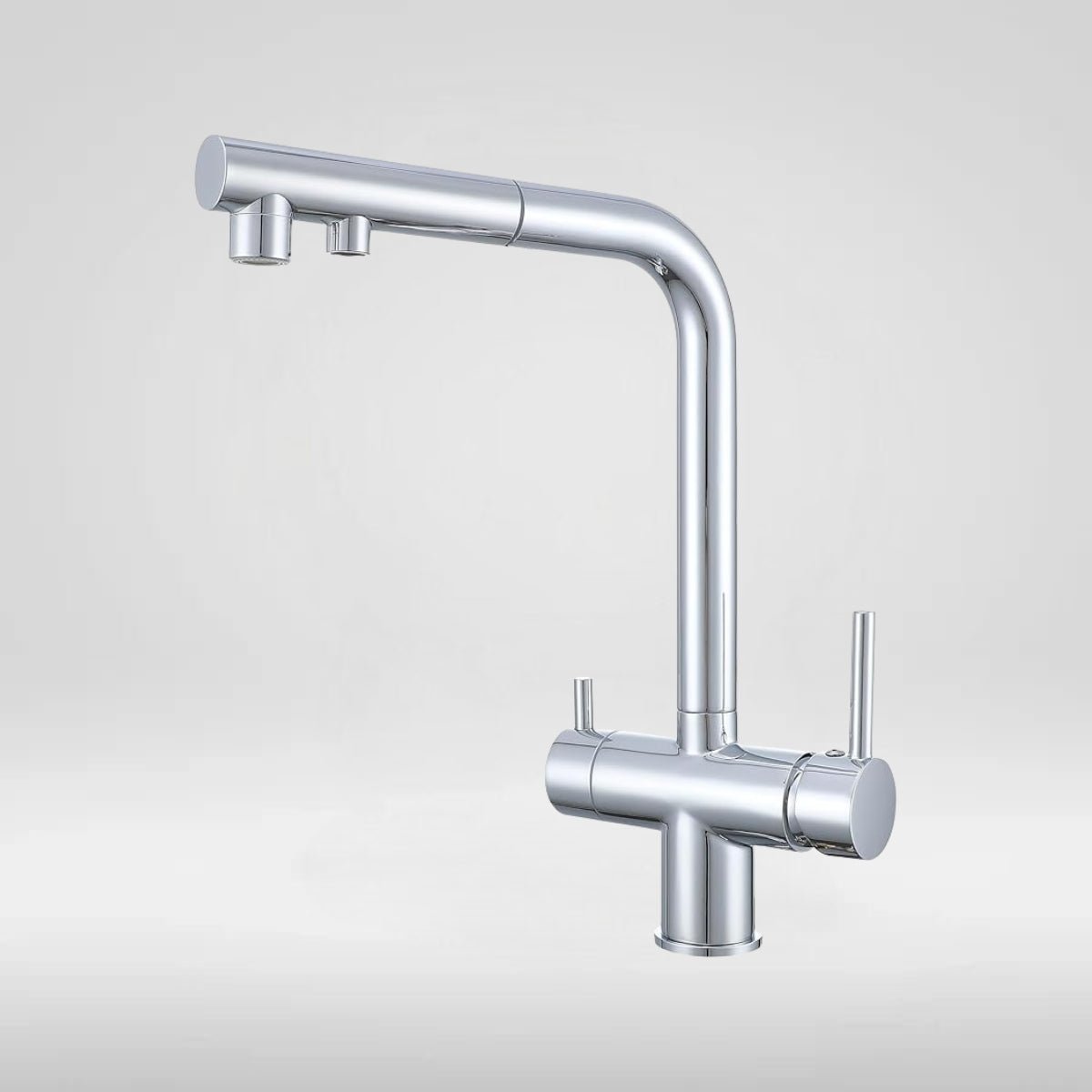
If you want only one faucet in your countertop and still have filtered water in every form, the PureAqua 4-in-1 faucet is the solution: hot and cold, filtered water, filtered boiling water, and filtered chilled water from the same tap point. This faucet works with reverse osmosis itself and therefore replaces a boiling water faucet. Important to know: you cannot combine an existing Quooker with The Source, because that requires a large pressurized tank that this system does not have.
The options side-by-side
| Option | Installation | Purification | Price indication | Suits |
|---|---|---|---|---|
| Under-sink RO with pure water faucet | By a specialist, or yourself with the 49 euro installation kit | Full osmosis, up to approx. 99 percent of dissolved solids | Faucet from approx. 149 euros, system included | Fixed kitchen, lots of drinking water, desire for a sleek tap point |
| Countertop RO | None, plug and play | Full osmosis | 495 euros | Rental property, renovation, no space under the sink |
| PureAqua 4-in-1 faucet | By a specialist | Full osmosis, also for boiling and chilled water | See the product page | One tap point for everything, replacement for a boiling water faucet |
| Carefree subscription | Included | Full osmosis, filters for 12 months included | 29 euros per month, 299 euros startup | Those who do not want to think about maintenance |
| Filter pitcher with carbon filter | None | Adsorption only: taste and chlorine, no limescale or salts | Low initial cost, ongoing filter costs | Those who only want to improve taste |
The bottom row is not there for no reason. Most people who look for an osmosis filter are actually comparing it to the pitcher already in their fridge, and those are two different products. We have calculated that comparison in our article on which home osmosis system fits best.
Osmosis water without a technician and without drilling holes
The Countertop RO sits on your countertop, requires no plumbing, and delivers the same osmosis water. Unpack, fill, dispense.
View the Countertop RO View the 4-in-1 tapHow often do you replace the filters?
The pre-filters and the post-filter are consumables; the membrane lasts longer. PureAqua sizes its filter sets for twelve months of use, and therefore a filter set for one year is included as standard with the subscription. Separately, a filter set for The Source 50 costs approximately 75 euros for two pieces and approximately 149 euros for the three-piece set, with a maintenance package of 20 euros added.
Exactly how long the membrane lasts depends on your water hardness, your usage, and whether the pre-filters have been replaced on time. There is no general figure for this, and anyone who says otherwise is selling you an assumption. Ask about your specific situation; that is one of the things PureAqua's free advice is intended for.
What you definitely don't want to do is leave filters in for too long. A clogged pre-filter reduces the pressure on the membrane and thus the purification, and a saturated carbon filter will eventually release the substances it has captured. Vitens explicitly points out that a poorly maintained filter can lead to bacterial growth, resulting in odor and taste complaints.
What does osmosis water cost per liter?
Start with the water itself, because that is surprisingly cheap. According to Vewin, the drinking water rate in 2026 is on average 2.05 euros per cubic meter excluding taxes and 2.71 euros per cubic meter including taxes. That amounts to approximately 0.0027 euros per liter, or just over a quarter of a cent.
The costs of osmosis water therefore lie almost entirely in the system and the filters, not in the water. For an under-sink system, count on a filter set of approximately 149 euros per year, plus the rinse water that goes down the drain. With the subscription, you pay 29 euros per month, or 348 euros per year, which includes filters, installation, and maintenance. Those who want to calculate this against bottled water and tap water from the store will find the full price comparison per liter in our article on buying vs. making your own osmosis water.
What should you look out for when choosing?
In practice, these points determine whether you remain satisfied, and they are rarely found on a product page of a marketplace seller:
- Recognized quality declaration: Vitens advises only buying a system with a quality declaration recognized by the Dutch state, and points out that any modification to your installation must comply with the foundations of NEN 1006.
- Backflow prevention: a connection to the drinking water pipe should have proper protection against backflow. This is not a detail, but a requirement.
- Space under the sink: measure in advance. Besides the system, there is usually a siphon, a trash can, and sometimes a boiler there too.
- Availability of filters: a system with exotic cartridges will be a problem in three years. Choose a supplier that keeps the sets in stock.
- Flow and storage: how many liters per day does the system deliver, and do you dispense from a storage tank or directly? This determines whether you can fill a pan all at once.
- Maintenance: DIY or outsourced: do you want to do it yourself, or do you take the subscription that includes filter replacement?
If you then run into the question of what you are actually going to use all that pure water for, that is a nicer problem to have. From coffee and tea to plants, an aquarium, and cleaning windows without streaks: we have listed the uses for osmosis water at home.
Frequently asked questions
Is osmosis water good to drink?
Yes. Osmosis water is safe drinking water; it just contains almost no dissolved minerals anymore. This is not an objection, as you get calcium and magnesium primarily from food and not from water. If you still want the minerals back for the taste, a mineral filter adds them back after the membrane.
How often do you have to replace an osmosis filter?
You replace the pre-filters and the carbon filter approximately annually; PureAqua sizes the filter sets for twelve months of use and the subscription includes a set for one year. The membrane lasts longer, but exactly how long depends on your water hardness, your usage, and whether the pre-filters have been replaced on time.
Is boiled water the same as osmosis water?
No. Boiling kills bacteria and viruses but does not remove dissolved substances: limescale, nitrate, PFAS, heavy metals, and medicine residues remain and become slightly more concentrated due to evaporation. An osmosis filter physically separates those substances. Boiling and osmosis therefore solve two different problems.
Can I wash glasses with osmosis water?
Yes, and that is exactly why window cleaners and the hospitality industry use it. Because there is virtually no dissolved limescale and salt left in it, the water does not leave white spots or streaks when it dries. The same effect makes osmosis water suitable for windows, car paint, and glassware from the dishwasher.
What does 1 liter of osmosis water cost?
The water itself costs almost nothing: at a drinking water rate of 2.71 euros per cubic meter including taxes, it is approximately 0.0027 euros per liter. The real costs are in the system and the filters. With the carefree subscription of 29 euros per month, filters, installation, and maintenance are included.
Can you make osmosis water yourself?
Only with a reverse osmosis system, not by boiling or using a filter pitcher. At home, you need an under-sink system with its own tap or a countertop model for this. Both deliver the same osmosis water; the difference lies in the installation, the space in your kitchen, and the amount you can dispense per day.
Conclusion
An osmosis filter is a filter line, not just a cartridge: pre-filter, carbon filter, membrane, and post-filter, with a mineral filter as a taste option. The membrane does the heavy lifting and removes up to about 99 percent of dissolved substances from your drinking water, from limescale and lead to PFAS and microplastics. The rest of the stages exist to protect that membrane and finish the taste, which is precisely why you buy a set and not an individual part.
The choice you really make is the setup. An under-sink system with its own pure water tap is the neat, permanent solution; a 495-euro countertop model is the path without a mechanic; and the 4-in-1 tap provides everything from a single point. Regardless of the variant, look for a recognized quality declaration, proper backflow prevention, and the availability of filter sets, because that determines whether you will still be happy with it in three years. And choose your system for the right reasons: not out of concern for Dutch tap water, which is safe according to the water companies, but for the taste, lime-free water, and the convenience of never having to carry bottles again. Drink different.
Choose your osmosis filter without the guesswork
Get a pure water tap with the filter system included, or go for the subscription that covers filters, installation, and maintenance. This way, osmosis remains a choice and not a chore.
View the pure water taps View the subscription