Reading time: approximately 13 minutes
Quick answer
The best moment to install a water softener in a new-build home is around the time of completion. Pipes, taps, water heaters, and appliances are still completely free of limescale, and there are no finished surfaces that need to be opened up. Expect to pay between 1,699 and 2,348 euros for the unit plus about 299 euros for installation. If your entire street or project is being completed at the same time, you can purchase collectively through the PureAqua Collective, where the discount increases along with the number of participants.
A new-build home is the only time in a house's life when everything is still brand new. No limescale rings in the shower cubicle, no clogged aerators, no washing machine heating element covered in a gray layer. That is precisely why the demand for a water softener arises in new builds, and precisely why that question is often asked at the wrong time: only after the keys are already in hand and the kitchen has been installed.
This article walks through the new-build situation as it actually happens. It covers the best time to install the unit, where the connection point is in a new-build utility closet, what to arrange with the contractor before completion, whether you can pay for it from a construction account, and what is possible if dozens of homes in your neighborhood are being completed simultaneously. At PureAqua, we see that the latter situation—an entire street receiving keys within a few months—makes the biggest difference.
On this page
- Water softeners in new builds: what does it mean?
- Why completion is the best moment
- Measure first: is your water actually hard enough?
- Where does the unit go in a new-build home?
- What to arrange with the contractor before completion
- Can you pay for a water softener from a construction account?
- What does a water softener cost for a new build?
- Joep or AquaCell in a new-build utility closet
- New-build neighborhood: purchasing collectively with the neighbors
- Apartment or Homeowners' Association (VvE): what are the possibilities?
- Points of attention and common mistakes
- Frequently asked questions
- Conclusion
Is your street or project being completed soon?
You don't have to do this alone. With the PureAqua Collective, a neighborhood, homeowners' association, or new-build project can purchase together in one go, and the discount grows with the number of participants. Registering one contact person is enough.
Register your new-build project Request free adviceWater softeners in new builds: what does it mean?
Definition
A water softener in a new build is a central device placed directly after the water meter in the new home, removing calcium and magnesium from the incoming tap water before it enters the rest of the house. Technically, it is no different from a softener in an existing home, but the timing is different: the unit is installed before any limescale has had a chance to build up anywhere in the system.
The technology for new builds and existing construction is identical. A resin bed exchanges calcium and magnesium ions for sodium ions and periodically cleans itself with brine. If you want to see how this process works from the inside, read how a water softener works; this article sticks to what differs in the new-build situation. If you prefer the step-by-step explanation of ion exchange and regeneration in blog format, that is described separately.
The practical difference lies in three things. First, nothing has built up yet, so you start with a clean system rather than one that you can only protect against further limescale. Second, the utility closet is open and the pipes are still accessible, making installation require less work and less hacking or breaking. Third, the purchase coincides with all other decisions surrounding completion, meaning the costs can be factored in all at once.
Why completion is the best moment
Limescale buildup is cumulative. Every liter of hard water that passes through a boiler, a central heating combi-boiler, a washing machine, or a dishwasher leaves behind a small amount of calcium carbonate, and that amount does not disappear on its own. Anyone installing a softener after living in a house for three years is protecting a system that has already accumulated three years of deposits. Anyone installing it at completion is protecting a system with zero deposits.
That difference is greatest in appliances that heat water, because limescale settles faster as the water gets hotter. In a new-build home, this concerns the hot water supply, the dishwasher, the washing machine, and increasingly the heat pump boiler. The latter is almost standard in new builds and usually has a large storage tank—the exact type of device where deposits accumulate.
Then there is the practical side. At completion, the utility closet is empty, the floor finishing has not yet been installed, and the installer can access the cold water pipe immediately after the water meter without detours. Six months later, there is a washing machine, laminate flooring, and a cupboard. The intervention is not impossible then, but it is more expensive and messier.
Completion in sight? Have your situation calculated in advance
Send your completion date, your postal code, and a photo of the utility closet drawing, and you will know in advance if it will fit and what it will cost. If it concerns multiple homes at once, register the project immediately as a collective.
Purchase collectively with your neighborhood Request free adviceMeasure first: is your water actually hard enough?
This is the step that sellers in this market consistently skip, and it should be at the top of the list. There is little point in investing in a device if the water at your new address already comes out of the tap soft.
The numbers matter. The Drinking Water Decree stipulates a total hardness between 1 and 2.5 mmol per liter, which corresponds to approximately 5.6 to 14 degrees German hardness (dH). The Dutch average is around 8 dH. Waternet is explicit about this: water between 8 and 12 dH is called average, and only above 12 dH do you speak of hard water. That same drinking water company points out that water softener manufacturers often write that water above 4 dH is already hard, calling that incorrect.
Dunea provides water of 1.42 mmol per liter, or 7.9 dH, and uses the scale: 0 to 4 very soft, 4 to 8 soft, 8 to 12 average, 12 to 18 fairly hard, and 18 to 30 hard. Vitens adds that drinking water companies are now softening hard water themselves almost everywhere before it enters the mains.
Practically, this means the following. Request the hardness at your new postal code from your drinking water company before you order anything. If you are in the zone up to about 8 dH, a softener is a choice of comfort, not a necessity. If you are above that, toward 12 dH or higher, it becomes a financial consideration where the new-build timing really works to your advantage. We prefer to calculate that trade-off honestly rather than sell you a device that brings your water from 7 to 5 dH.
Where does the unit go in a new-build home?
The rule is simple: as close as possible after the water meter, on the cold water pipe, before the branch to the rest of the house. Everything after the unit gets soft water, everything before it does not. In a new-build home, the water meter is almost always in the utility closet in the hallway or in a technical room next to the utility closet.
A new-build utility closet, however, is small and tightly organized, with a fixed layout for electricity, water, data, and sometimes the heat pump unit. The four things you need:
- Space in width, depth, and height: for the Joep, count on 48 cm high, 27 cm wide, and 48.5 cm deep. The AquaCell, at 20.5 cm wide, is even narrower, which can make the difference in a cramped utility closet.
- A drain: a softener with salt discharges flush water after every regeneration. Without a drain point in or near the utility closet, it becomes more difficult, although not unsolvable. Our article on what to do if there is no drain at the water meter lists the possible routes.
- A power outlet: only necessary for an electronically controlled unit like the Joep. The AquaCell operates entirely hydraulically and does not require electricity.
- Backflow prevention: mandatory, not optional. See the next chapter.
The latter is the reason why a new-build utility closet requires prior consultation and not improvisation afterward. The regulations regarding placement in the utility closet and the alternatives are covered more extensively in our article on where a water softener is allowed to be placed in the utility closet.
What to arrange with the contractor before completion
This is the part that saves money, and it only takes one conversation. Put the following points on paper and present them to your contractor or installer well before the utility closet is finished.
1. Ask for a free meter of piping after the water meter
A softener is placed between two points in the cold water pipe. If no straight section of pipe is kept clear immediately after the meter, the installer will have to cut and make solder or press connections later in a space that is already finished. A piece of free pipe in the design costs nothing and saves work later.
2. Have a drain point included in or next to the utility closet
Including a drain during construction is a fraction of the work it takes afterward. Ask for a drain point at a height where a flush hose can discharge with natural gravity flow. Even if you are still doubting about the softener itself, this point is cheap and keeps the door open.
3. Ensure there is a grounded power outlet in the utility closet
If you choose an electronically controlled unit, this is necessary. If you eventually choose the hydraulic AquaCell, you won't use it, and it hasn't cost you anything.
4. Discuss backflow prevention and NEN 1006
Any modification to the drinking water installation must comply with the principles of NEN 1006, and a softener requires appropriate backflow protection. Vitens explicitly mentions this and also advises only buying a device with a quality declaration recognized by the Dutch state. Evides calculates that a softening installation, including the required protection, causes about 70 kPa, or 0.7 bar, of pressure loss. In a new-build home with a rain shower on the first floor, that is a figure to take into account in advance, not afterward.
5. Ask if the contractor is willing or permitted to do the installation themselves
Some builders do not accept modifications by third parties before the official handover, due to warranty and liability reasons. That is not a problem, but it is something you want to know. In practice, we then schedule the installation shortly after the handover and before you move in, which yields virtually the same result.
A note on a brand-new installation: even in a new-build home, it is recommended to flush the drinking water pipes thoroughly for the first few months after commissioning. New pipes and faucets can release slightly more metals at first; the Netherlands Nutrition Centre (Voedingscentrum) recommends flushing for 3 months for new pipes and 10 seconds if only the faucet is new. A water softener does not change that; it is simply a matter of flushing.
Can you pay for a water softener using a construction deposit?
This is the question that tops the list on Google, yet it is not answered properly on any of the pages in the top ten. The honest answer: it depends on your lender, and you can simply ask them in advance.
A construction deposit is a part of your mortgage that is set aside for work on the home. Lenders have their own terms and conditions for this, which vary by bank and mortgage type. What generally increases the chance of approval is that a water softener is a permanent, fixed fixture in the home installed by a professional, backed by an invoice in your name and address. What decreases the chance is treating it as a loose appliance, like a washing machine.
Therefore, do three things, in this order. First, ask your mortgage advisor or lender whether permanent home installations can be paid for from your deposit and what supporting documents they require. Then, request a quote in your name and for the address of the new-build home, with the installation specified separately. Only submit it once you know it fits within the terms and conditions. We are not financial advisors and cannot assess what your bank will accept, but we do provide the quote in the format that banks typically require.
If it cannot be paid through the deposit, it remains a purchase like any other. The benefit of a new-build is that the amount falls within the same period as the rest of the furnishings, allowing you to weigh it all at once against, for example, the kitchen or bathroom faucets.
What does a water softener cost in a new-build?
The purchase price does not change due to new construction; the installation costs and the avoided damage do. At PureAqua, the Joep water softener starts at 1,699 euros, with installation by a specialist for 299 euros extra. The AquaCell water softener is 2,348 euros and operates entirely without electricity. Those who are handy can install the Joep themselves using the included manual, although the handover period is usually busy enough.
On the usage side, salt is the main factor. The Joep is designed with an extremely fine resin with a large contact surface, resulting in approximately 15 kg of regeneration salt per person per year. For a family of four, that is around 60 kg of salt, with the device requiring A-class salt (NF, EN 973, EN 1408, 99.8% sodium chloride). In addition, every regeneration process consumes flush water, and with a drinking water rate of 2.71 euros per cubic meter including taxes, this is a cost you can calculate rather than estimate.
The full calculation, including payback time through reduced descaling, less detergent, and a longer lifespan for appliances, can be found on our page about water softener pricing. If you prefer a blog with calculation examples, read what a water softener truly costs and how the annual expenses relate to the purchase.
One benefit specific to new builds is hard to quantify in money but is very real: you never have to have an existing boiler or central heating system descaled because no scale buildup occurs. In existing homes, that is often the very reason people call us.
Joep or AquaCell in a new-build utility cupboard
For most new-build households, we recommend the Joep, primarily due to its price-quality ratio and economical salt usage. The AquaCell remains the premium choice for those who do not want or cannot have electricity in the utility cupboard.
| Point | Joep | AquaCell | Why this matters in new construction |
|---|---|---|---|
| Price | from 1,699 euros | 2,348 euros | Both fall into the period when the kitchen and floor are also being paid for |
| Installation | 299 euros by specialist, DIY allowed | by specialist | Scheduling around the handover date instead of planning later |
| Electricity required | yes, power outlet nearby | no, fully hydraulic | Determines whether you have an outlet installed in the cupboard now |
| Dimensions | 48 x 27 x 48.5 cm | 20.5 cm wide | New-build utility cupboards are tight and compactly organized |
| Flow rate | up to 5 m3 per hour without pressure loss | suitable for the entire home | Relevant for two bathrooms or a rain shower |
| Salt usage | approx. 15 kg per person per year | depends on usage | Recurring expense, and the reason for collective salt delivery |
| Smart functions | self-regulating, mini-regeneration during peak use, leak detection | hydraulically regulated based on water use | Leak detection in a new home with finished floors |
| Warranty | 1 year all-in, 2 years on parts, 20 years on the resin | 5 years all-in service | Aligns with the warranty period on the home |
If you are still deciding between brands and models outside our range, the overview of the criteria for comparing water softeners will help. And if you want to know how many years such a device lasts before needing replacement, you can find that in the article on the lifespan of a water softener.
No keys yet, but already arranged soft water
If you buy individually, you choose the device and we plan the installation around your handover date. If your street participates, the same device becomes cheaper for everyone via the collective.
Start a collective in your neighborhood Buy water softenerNew-build neighborhood: group purchasing with neighbors
In a new-build project, not just one home gets the keys, but a block, a street, or an entire phase at once. That is a situation you never have in existing construction: dozens of households with the exact same utility cupboard, the same pipe diameter, the same water hardness, and virtually the same handover date. That is precisely the time to buy together instead of each on your own.
That is what PureAqua Collective is for. It works like this:
- One contact person is enough. A residents' committee, a buyers' association, a Homeowners' Association (VvE) in formation, or just one resident who takes the initiative can submit the request.
- PureAqua sets up the collective. We create a dedicated page with the products, tiered discounts, and a closing date. Participants cannot create this themselves.
- Residents receive a personal invitation. You log in with a code from that email, without a password.
- The discount grows. The more residents participate, the higher the discount, and the final rate applies to all participants at the end, even those who signed up first.
The application form asks for the expected handover dates of the first and last homes, among other things. That is no coincidence: based on that, we schedule the installations in blocks so that a technician visits multiple homes in one street in a day rather than driving back and forth ten times.
One request, the whole street benefits
Provide the name of your neighborhood, VvE, or project, the number of homes, and the expected handover. We will set up the collective and invite the residents. You don't have to convince anyone to get started.
Request a collectiveCollective salt delivery: the hassle that disappears
A water softener requires salt, and hauling bags of salt is the most frequently mentioned annoyance for people who own one. In a collective, PureAqua can, by arrangement, periodically deliver salt to a central location in the neighborhood, such as an interior courtyard or a shared storage area, so all participating households are replenished at once. This can be discussed per collective and is not standard in every project, but it removes exactly the recurring chore that owners complain about. What else is involved in maintenance is in our overview of what maintenance a softener requires per year.
Apartment or VvE: what are the options?
New-build apartments form their own category, and here it is important to distinguish between two things that are often conflated in the market.
Collective purchasing means that a group of residents orders together, but each household gets their own device inside their own home, after their own water meter. This does not affect the communal installation and is perfectly feasible in an apartment complex, provided there is a space with a drain near the water meter in the home.
Collective softening means one central installation that treats the water for the entire complex. That is something different, and it comes with conditions: Vitens indicates that collective softening requires permission from the drinking water company. In a new-build complex, this goes through the VvE and the installer, and it is a discussion you want to have before the handover, not after.
If you rent in a new-build complex, you need permission from the landlord for any modification to the drinking water installation. That is not necessarily a no, but it is a question that must be asked first. And if the VvE does not cooperate with a central solution, the route per home remains open, even if only with a small group of residents who sign up together as a collective.
Points of attention and common mistakes
An honest account also mentions the trade-offs. The most important points, in brief:
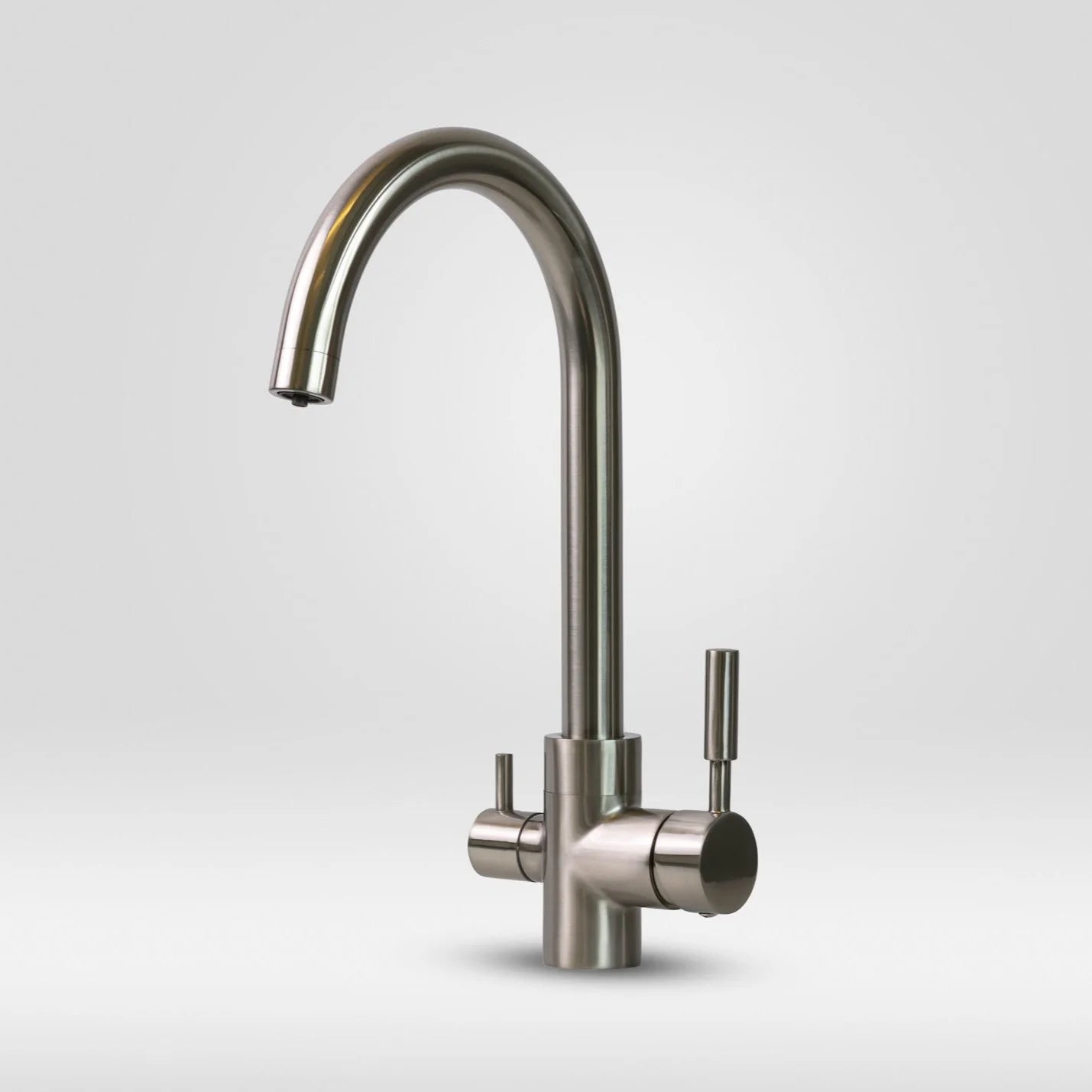
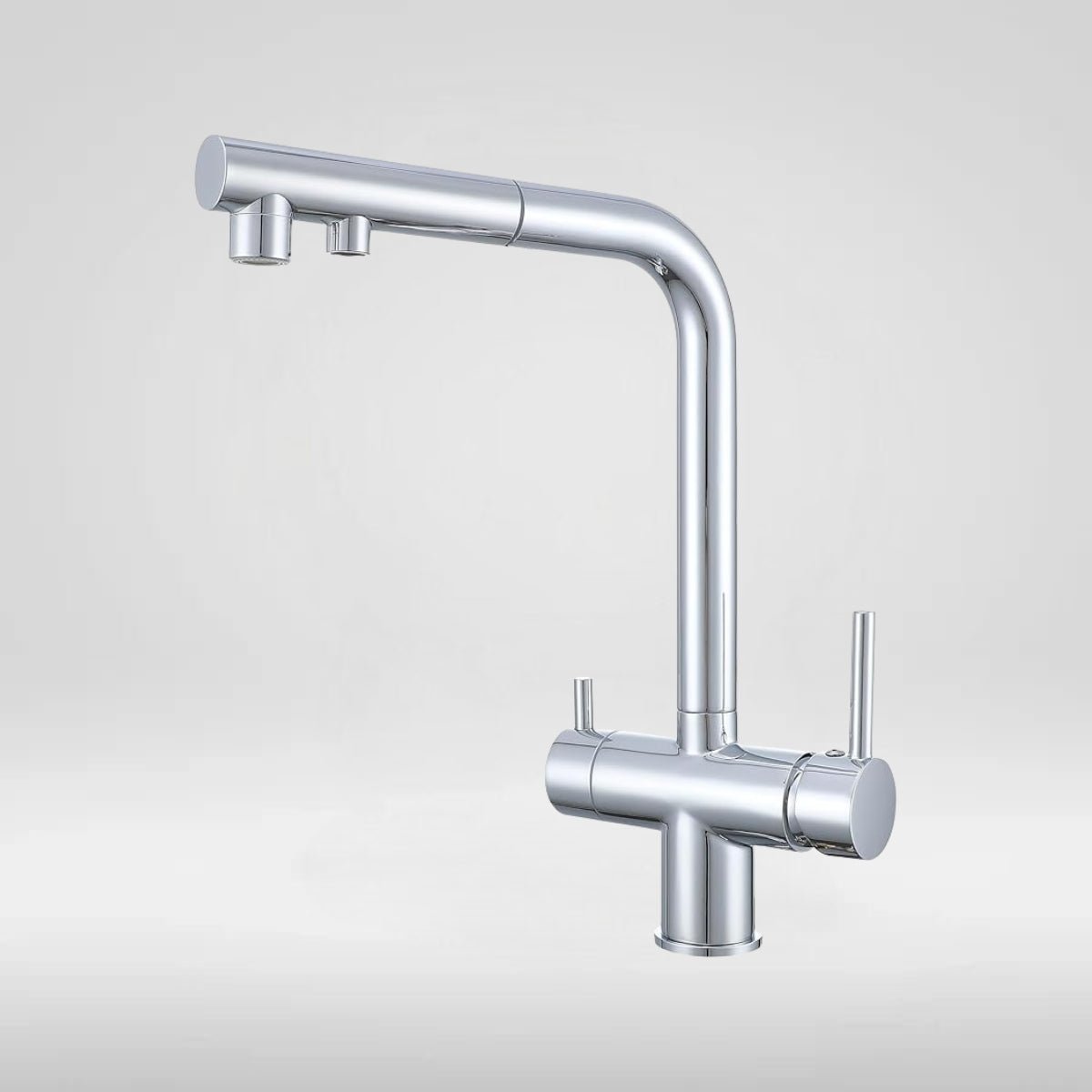
- Soft water is not filtered drinking water. A softener reduces hardness and does nothing else regarding PFAS, drug residues, or taste. Those who want pure drinking water need a reverse osmosis water faucet for that. These are two different solutions side by side, not replacements for each other.
- Sodium instead of calcium. With ion exchange, sodium is returned to the water. The Drinking Water Decree sets a standard of 150 mg sodium per liter, with taste complaints occurring from about 200 mg per liter. Therefore, do not set the residual hardness to zero, but leave some hardness in.
- Maintenance is not optional. Vitens warns that a poorly maintained softener can promote bacterial growth, leading to odor and taste complaints. A service check is essential; for the Joep, this is a check-up and service every 36 months.
- Include pressure loss in the design. The mentioned 0.7 bar is a factor when sizing the hot water pipe to the upper floor.
- Not every home benefits. With water at or below 8 dH, the effect is limited. We have written down the full list of disadvantages associated with softening separately, so you have a complete picture for your decision.
Frequently Asked Questions
Can I finance a water softener through a construction deposit?
That depends on your lender. A construction deposit is intended for work on the property, and a water softener is a permanent installation connected by a professional, which works to your advantage. Terms vary by bank and mortgage type, so check with your mortgage advisor in advance and request a quote addressed to you and the address of the new-build home, with the installation specified separately. PureAqua is not a financial advisor and cannot determine what your bank will accept.
Does a water softener really make sense?
That depends entirely on the water hardness at your address. Dutch tap water averages around 8 dH, and according to Waternet, it is only considered "hard" above 12 dH; furthermore, drinking water companies soften hard water themselves almost everywhere. If you are above 12 dH, you will clearly notice the difference in limescale, appliances, and soap consumption. If you are at or below 8 dH, it is a choice of comfort rather than a necessity. Therefore, always check the hardness of your new postal code first.
What does a water softener cost, including installation?
At PureAqua, the Joep costs from 1,699 euros with 299 euros for installation by a specialist, so approximately 1,998 euros fully installed. The AquaCell costs 2,348 euros and is installed by a specialist. On top of this are annual operating costs: for the Joep, count on about 15 kg of regeneration salt per person per year plus flush water, which can be easily calculated at a drinking water rate of 2.71 euros per cubic meter including taxes.
Has the Consumers' Association (Consumentenbond) recommended a water softener?
We prefer not to refer to tests that we cannot verify, and we are not aware of any current public recommendation for one specific model. A better and verifiable benchmark is the advice from the drinking water companies themselves: Vitens advises buying only a device with a quality statement recognized by the Dutch state, with proper backflow prevention, and in accordance with the principles of NEN 1006. That is a stricter criterion than a star rating.
What are the top 5 best water softeners?
A general top five does not exist, because the best softener depends on your water hardness, household size, space near the water meter, and whether power and drainage are available. Instead, compare based on measurable points: capacity relative to the number of residents, annual salt consumption, whether power is required or not, dimensions, maintenance interval, and warranty. Within our range, households usually choose the Joep from 1,699 euros, or the AquaCell for 2,348 euros if there is no power supply in the meter cupboard.
Is a water softener worth the money?
In the case of hard water and a new home, the calculation is most favorable because you prevent limescale build-up from the very first liter rather than mitigating existing scale. The savings come from less descaling, using less detergent and cleaning products, and a longer lifespan for your water heater, dishwasher, and washing machine. For water around 8 dH, the payback period is longer and you are primarily purchasing comfort. Calculate it using your own hardness and usage before you decide.
Can the water softener be installed before completion?
Sometimes, but many builders do not allow intervention by third parties before official completion due to warranty and liability concerns. Ask your contractor about this in time. If it is not possible, we will schedule the installation shortly after completion and before you move in. The result is virtually the same: the device is in place before the first liters of hard water have passed through the plumbing.
Conclusion
With new construction, timing is everything. Around the time of completion, the meter cupboard is empty, the piping is exposed, the plumbing is still lime-free, and the cost can be integrated with the rest of your home setup. If you wait three years, you will be protecting a system that already has scale build-up and you will pay more for the same job.
Start with the water hardness. If it is around or below 8 dH at your new address, a softener is for comfort rather than a necessity; if it is above 12 dH, it becomes a serious calculation. Then, add five things to your contractor's list: a free section of pipe, a drainage point, a power outlet, backflow prevention according to NEN 1006, and the question of whether work can be performed before completion.
And look around you. If your entire street is being completed within a few months, that is the moment to do it together instead of everyone acting individually. At PureAqua, we see that a collective in a new development not only lowers the price but also makes planning easier, and with the possibility of salt delivery to a central location, it immediately removes recurring hassle.
Start your new home lime-free, and do it together
Register your neighborhood, homeowners' association (VvE), or new-build project for a collective purchase, or ask for no-obligation advice for your completion date first.
Register your neighborhood with PureAqua Collectief Request free advice