Reading time: about 12 minutes
Short answer
Maintaining a water softener comes down to three things: checking and topping up the salt tank every month, cleaning the salt reservoir once a year and recalculating the hardness setting, and a service visit by a specialist every 2 to 5 years. An average family uses 1 to 2 bags of 25 kilos of salt every two months, which works out at 6 to 12 bags a year. A service visit costs roughly 50 to 175 euros in the Netherlands. Most of the work you can do yourself.
In this article
- What does maintaining a water softener involve?
- Topping up salt: how much, how often and which type
- Setting the hardness and rechecking it every year
- Cleaning the salt bridge, brine tank and resin
- The maintenance calendar per period
- What does water softener maintenance cost?
- Doing it yourself or calling in a specialist
- Common problems and how to solve them
- When maintenance becomes more expensive than replacement
- Frequently asked questions
- Conclusion
Definition
Maintaining a water softener is the set of actions that keeps the resin beads in the unit able to keep exchanging calcium and magnesium: topping up salt so the unit can regenerate, keeping the brine tank free of clumping and dirt, making sure the hardness setting matches your actual water hardness, and having the valves, the drain and the backflow protection checked periodically.
What does maintaining a water softener involve?
A water softener is one of the few appliances in the house that cleans itself. That is exactly why its maintenance is so limited, and also why people forget about it. To understand what you are maintaining, it helps to know what happens during regeneration: resin beads capture calcium and magnesium and swap them for sodium, and as soon as they are full the unit flushes itself clean with a salt solution from the salt tank.
From that follow exactly four maintenance points, and there are no more than four:
- Salt: without salt in the tank the unit cannot regenerate and within a few days it delivers hard water again, with no fault or error message.
- A clean salt tank: clumping and sediment keep the water away from the salt, so regeneration fails while the tank looks full.
- The right setting: if the hardness is set too high you use unnecessary salt; set too low, limescale gets through.
- Technology and safety: valves, seals, the drain and the backflow protection need a professional eye every few years.
That last point is not a detail. Water utility Vitens points out explicitly that a poorly maintained softener brings risks, including bacterial growth inside the unit with smell and taste complaints as a result. The same water utility advises, in its explanation of water filters and softeners, to use only units with a quality declaration recognised by the Dutch state, with proper backflow protection, and to have the installation comply with the principles of NEN 1006. Maintenance is therefore not only about comfort, it is also about water safety.
Not sure whether your unit is still set up correctly?
Our specialists will look at your water hardness, your salt consumption and the settings of your current softener with you, free of charge. No sales pitch, just an honest assessment.
Ask for free advice View the water softenersTopping up salt: how much, how often and which type
This is by far the most frequently asked question and the answer is less vague than most sites suggest. At PureAqua we see an average family come out at 1 to 2 bags of 25 kilos of softener salt every two months, so roughly 6 to 12 bags a year. The harder your water and the more litres you use, the more often the unit regenerates and the faster the tank empties.
The rule of thumb for the salt level
Look in the tank every month and top up as soon as the salt drops below halfway. The salt must always sit above the water level in the tank, because brine only forms where water and salt meet. Do not fill to the brim: an overfull tank actually increases the chance of a salt bridge, the crust covered in the next section.
Which salt should go in?
Use softener salt in tablet form, also called regeneration salt. That is virtually pure sodium chloride with a high purity percentage, so hardly any residue is left behind. The performance standard for domestic softeners, NSF/ANSI 44, describes exactly this principle: a cation exchanger that regenerates with sodium or potassium chloride and thereby lowers the hardness caused by calcium and magnesium. Coarse road salt, dishwasher salt or table salt do not belong in there; they contain anti-caking agents or impurities that foul the tank.
What that salt does to your water
For every degree of hardness removed, roughly 8.5 milligrams of sodium per litre ends up in your water. With Dutch mains water averaging 8 °dH, the figure Waternet gives and which is only called truly hard from 12 °dH, you stay comfortably below the standard of 150 milligrams of sodium per litre from the Drinking Water Decree, as Dunea sets it out. The full weighing-up of sodium, flush water and costs is in our overview of what salt, flush water and sodium actually cost you.
If you would rather not lug bags at all, look at the salt-free alternatives. Do not count your blessings too soon: our article on the difference between ion exchangers and salt-free units explains why only ion exchange actually lowers the hardness.
Setting the hardness and rechecking it every year
This is the maintenance point almost nobody mentions and the one that costs you the most money. At installation, your water hardness was entered into the unit. If the hardness of your mains water changes, for instance because your water company adjusts the source or the treatment, that setting no longer matches. Set too high means unnecessary regenerations and therefore unnecessary salt; set too low means limescale simply slipping through.
Ask your water company for your current hardness once a year. The spread in the Netherlands is wide: WMD quotes a legal range of 1 to 2.5 mmol per litre, or 5.6 to 14 °dH, and Dunea itself supplies water at 1.42 mmol per litre, which is 7.9 °dH. According to Vitens, hardness is determined by calcium and magnesium, and the water companies already soften hard water almost everywhere before it reaches you.
Check the residual hardness too. A properly adjusted domestic unit does not deliver zero degrees, but around 4 to 8 °dH of residual hardness via the blending valve. That is deliberate: fully decalcified water is more aggressive towards pipe materials. If you measure zero, that is a setting error and not a performance.
The Flemish Environment Agency goes a step further in its guidance on water softeners and advises first checking whether your tap water is too hard at all, because in many cases a softener turns out not to be necessary. That is honest advice, and it applies just as much at the annual check: maintain a unit for the hardness you really have, not for the hardness the sales brochure assumed.
Cleaning the salt bridge, brine tank and resin
Recognising and breaking a salt bridge
A salt bridge is clumped salt forming a hard crust above the water. The tank looks full, but the water does not reach the salt and regeneration quietly fails. It is the most common fault on a water softener. You recognise it by three signals at once: the salt level does not drop for weeks, limescale streaks come back on taps and glassware, and the unit gives no message at all.
You break it with a wooden or plastic handle: push gently through the crust, from top to bottom, until you feel it give way. Do not use a metal object that could puncture the tank. If you run into the crust regularly, you are probably topping up too high or the unit stands in a damp, cold space.
Emptying the brine tank every year
Once a year you really clean out the salt reservoir. Put the unit on bypass, let the salt run out or scoop it out, siphon off the remaining water and rinse the tank with lukewarm water and, if needed, a mild soap. On the bottom you will often find a layer of brownish-grey sediment: those are the impurities from years of salt. Rinse the tank twice, put it back and fill with fresh tablets. Allow 30 to 60 minutes of work.
Resin cleaner: necessary or not?
Here the advice diverges, and that explains why "resin cleaner water softener" gets around 170 searches a month in the Netherlands. Many manufacturers advise an annual resin cleaning to get iron, manganese and organic material off the beads. Other units, including the AquaCell that PureAqua supplies, are built in such a way that this cleaning is not needed. In short: follow the manual for your unit and not the general tip from a sales site. If you have iron-rich or discoloured water, cleaning is needed sooner than with clear mains water.
If your water smells or tastes unusual after a period of standing still, for instance after a holiday, flushing is the first step. Vitens advises opening several taps at once for a few minutes. If the smell remains, that is a reason to have the softener checked and not to ignore it.
The maintenance calendar per period
The full schedule is below. Print it out if you like and stick it to the inside of the meter cupboard door; in practice that works better than a reminder in your phone.
| When | What you do | Time | Yourself or a specialist |
|---|---|---|---|
| Every month | Check the salt level, top up below halfway, check that the salt sits above the water | 5 minutes | Yourself |
| Every quarter | Feel for a crust on the salt and break it, compare salt consumption with the previous quarter, assess limescale streaks on taps | 10 minutes | Yourself |
| Every year | Empty and clean the salt reservoir, measure the residual hardness, compare the hardness setting with the current value from your water company, check the drain hose and the floor for leaks | 30 to 60 minutes | Yourself |
| Every 2 to 5 years | Service visit: control valve, seals, brine valve, injector, backflow protection and resin checked | 1 to 2 hours | Specialist |
| When moving house or renovating | Have the bypass, connection and protection reassessed against the principles of NEN 1006 | By appointment | Specialist |
Note the difference in interval between brands. The manufacturer of the AquaCell advises the first service visit only five years after purchase, while other suppliers come round after two or three years. That difference lies in how the unit is built, not in how careful the owner is. So always ask about the recommended service interval when buying; over ten years that easily saves two full visits.
What does water softener maintenance cost?
The annual bill consists of four items, and three of them you can influence yourself.
- Salt: 6 to 12 bags of 25 kilos a year. Buying it yourself at a DIY store or online saves a lot compared with salt supplied under a service contract.
- Flush water: regeneration uses water. At a drinking water rate of 2.71 euros per cubic metre including taxes, the figure Vewin quotes for 2026, that item stays at a little over 3 euros a year for an average household.
- Electricity: zero on a hydraulic unit that works without power, such as the AquaCell. On an electronically controlled unit, a few euros a year.
- Service visit: on the Dutch market the rates, measured on the first page of search results in September 2026, run between roughly 50 and 175 euros per visit, depending on the type of unit and exactly what is replaced.
Spread a service visit of 129 euros over three years and you come to 43 euros a year. Together with salt and flush water, the total maintenance item stays under 200 euros a year for most households. That is the context missing from the discussion about purchase prices: at PureAqua the AquaCell costs 2,348 euros and the Joep starts at 1,699 euros, and over a service life of fifteen years the maintenance weighs against that only modestly.
Prefer a unit with as little maintenance as possible?
The AquaCell works hydraulically and therefore without power, and needs no annual resin cleaning. That leaves you one task: topping up salt. 100 days on trial and 2 years of all-in warranty.
View the AquaCell Compare all softenersDoing it yourself or calling in a specialist
The honest split: about 90 percent of the maintenance you do yourself, and altogether that costs you less than two hours a year. For the remaining 10 percent you need someone with tools and knowledge of the installation.
| Task | Do it yourself | Why or why not |
|---|---|---|
| Topping up salt and checking the level | Yes | Open the lid, bag in, done |
| Breaking a salt bridge | Yes | Only with a wooden or plastic handle |
| Cleaning the salt reservoir | Yes | Use the bypass, lukewarm water and mild soap, never aggressive products |
| Reading the hardness and measuring residual hardness | Yes | With a test strip or the figure from your water company |
| Readjusting the blending valve | Rather not | Adjusting it wrongly gives zero degrees or unnecessary salt consumption |
| Control valve and seals | No | Requires dismantling under pressure and brand-specific parts |
| Backflow protection and drain | No | Legally bound to the principles of NEN 1006 |
That last point is not negotiable. If there is no proper drain near the water meter in your situation, that is an installation question and not a maintenance job; we described earlier what to do when there is no drain beside your water meter.
Common problems and how to solve them
Almost every fault announces itself first as a change in salt consumption. Anyone who notes that figure each quarter sees problems coming months earlier than someone waiting for limescale streaks.
The salt level stops dropping
Nine times out of ten this is a salt bridge. Break the crust and see whether consumption picks up again within two weeks. If the level stays put, the unit is not drawing brine and the brine valve or the injector is fouled. That is work for a specialist.
Salt consumption rises without you using more water
Then the resin is losing capacity, or the hardness is set too high. Check the setting first, because that is free. If consumption stays high, the resin is nearing the end of its life, and that is exactly the moment when the calculation in how many years such a unit lasts becomes relevant.
There is too much water in the salt tank
A brine tank should contain a limited amount of water. If the salt is half submerged without the level dropping, the brine valve is not closing properly or the drain is blocked. Put the unit on bypass and call an engineer before the tank overflows.
Limescale comes back while there is salt in the tank
Check in this order: is the bypass accidentally open, is the hardness setting correct, and is there a salt bridge. Only when those three are in order is it the resin’s turn. If you mainly notice it on your appliances, also read how to get rid of the limescale layer that is already in there, because a softener does not dissolve existing deposits by itself.
The water smells or tastes different
First flush several taps for a few minutes, as the water utility advises. If the complaint remains, a softener that has stood idle for a long time is a possible cause, and that is exactly the risk Vitens warns about with poor maintenance. Have the unit checked in that case.
When maintenance becomes more expensive than replacement
At some point carrying on with repairs is no longer thrift. Three signals together mark the tipping point, and it is emphatically the combination that counts, not any one of them.
- An age above twelve years: by then the seals in the control valve have thousands of regenerations behind them.
- Two repairs within three years: if their combined cost exceeds a quarter of a new unit, you are effectively buying a new softener in instalments.
- Structurally higher salt consumption: a unit demanding 20 percent more salt at the same water consumption costs you that extra every year again.
Work it out soberly. Two service visits of 150 euros plus 25 percent extra salt per year will, over five years, easily cost you the amount that brings a new entry-level model into the house, and then you have warranty and a fresh resin filling again. At PureAqua we see that customers who did keep the calendar use their unit for years longer on average than customers who only act once the limescale streaks return.
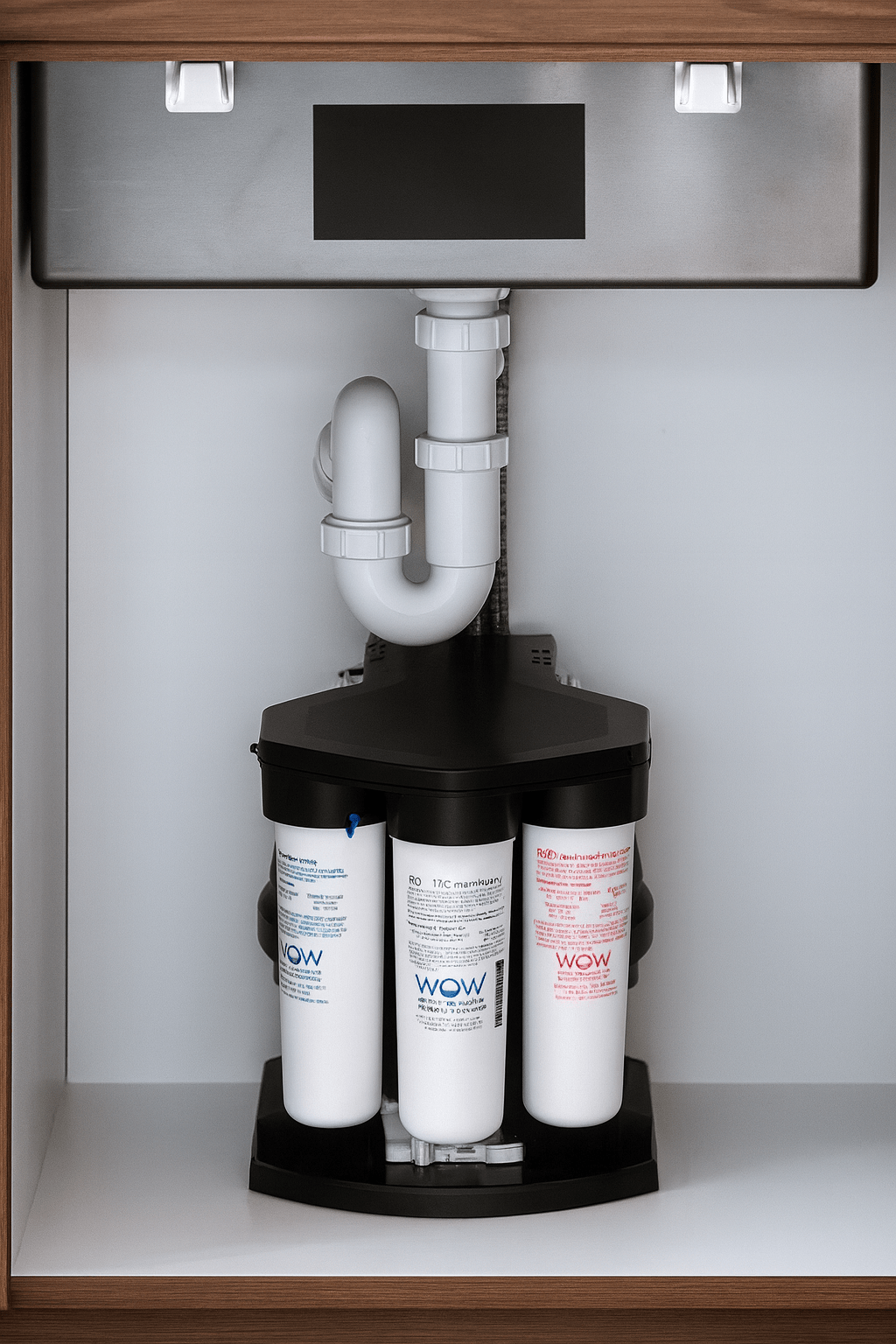
An important distinction. A water softener lowers the hardness of all your mains water, but it does not turn it into filtered drinking water. PFAS, nitrate, lead and pharmaceutical residues pass straight through. If you want those out, reverse osmosis is the technique that holds back up to around 99 percent of such substances, via a pure water tap or the standalone pure water appliance at 495 euros that sits on the worktop without installation.
Frequently asked questions
Can you maintain a water softener yourself?
Yes, most of it. Topping up salt, checking the salt level, breaking a salt bridge, cleaning the salt reservoir once a year and rechecking the hardness setting are all things you do yourself, less than two hours a year in total. What not to do yourself: opening the control valve, replacing seals, readjusting the blending valve and anything to do with the backflow protection or the drain, because that is bound to the principles of NEN 1006.
How often should you maintain a water softener?
Check the salt level monthly, watch for clumping and salt consumption each quarter, clean the salt reservoir and recheck the settings once a year, and have a service visit by a specialist every 2 to 5 years. The service interval differs per brand: some manufacturers advise after two years, the manufacturer of the AquaCell only after five. Follow the manual for your unit.
How much does water softener maintenance cost?
A service visit by an installer costs roughly 50 to 175 euros in the Netherlands, depending on the unit and the parts replaced. On top of that come 6 to 12 bags of 25 kilos of softener salt a year and a little over 3 euros of flush water at a rate of 2.71 euros per cubic metre. If you spread the service visit over three years, the total maintenance item stays under 200 euros a year for most households.
What are the most common problems with water softeners?
The salt bridge comes first: clumped salt that makes the tank look full while the water never reaches the salt. After that come a fouled brine valve leaving too much water in the salt tank, a wrongly set hardness that wastes salt, leaking seals in the control valve after thousands of regenerations, and resin losing capacity through iron or manganese. Almost all of these problems show up first as a change in salt consumption.
How long does salt last in a water softener?
At PureAqua we see an average family use 1 to 2 bags of 25 kilos every two months, so roughly 6 to 12 bags a year. The harder your water and the more litres you use, the more often the unit regenerates and the faster the tank empties. Check monthly and top up as soon as the salt drops below halfway. If the tank runs empty, the unit keeps passing water but stops softening.
How should I maintain my water softener?
In four steps. One: check the salt tank every month and top up with softener salt in tablet form, so the salt sits above the water level. Two: each quarter, feel whether a crust has formed on the salt and break it with a wooden or plastic handle. Three: empty and clean the salt reservoir once a year with lukewarm water, and recheck the hardness setting with your water company at the same time. Four: have the unit checked by a specialist every 2 to 5 years for valves, seals, drain and backflow protection.
Conclusion
Maintaining a water softener is little work, but it is work you cannot skip. Five minutes a month at the salt tank, an hour a year on the brine tank and the settings, and every few years a specialist on the technical side: that is all there is to it. The biggest saving is not in skipping that service visit, but in noting down your salt consumption, because that figure gives away almost every problem before the limescale returns.
And keep the distinction sharp. A water softener protects your pipes, your appliances and your glassware from limescale. For genuinely pure drinking water, free of PFAS, nitrate and heavy metals, you choose reverse osmosis. At PureAqua we regularly recommend the combination: soft water throughout the house, and pure water from a separate tap in the kitchen. Drink different.
Soft water and pure drinking water arranged in one go
Ask for advice without obligation on combining a water softener with a pure water tap, or choose the carefree subscription that already includes filters, installation and maintenance for 29 euros a month.
View the subscription Ask for free advice