Reading time: approximately 12 minutes
Short answer
Filtered water flows through a separate faucet because osmosis water must not be allowed to mix with unfiltered or hot water, because it has its own much lower pressure after the membrane, and because a short, dedicated line is more hygienic. This is why a pure water faucet has its own channel, and sometimes its own faucet hole.
In this article
- Why does filtered water flow through a separate faucet?
- What is a separate faucet for filtered water?
- Four reasons not to send it through your mixer faucet
- 1-way, 3-way, or 4-in-1: what is the difference?
- Comparing the five setups
- Faucet holes, space, and installation
- What does a separate faucet for filtered water cost?
- Which setup fits your kitchen?
- Frequently asked questions
- Conclusion
Why does filtered water flow through a separate faucet?
Because filtered water is different from the water in the rest of your pipes, and that difference disappears as soon as you let the two mix. A standard mixer faucet is specifically built to mix: hot and cold combine in the faucet body and leave the faucet as a single stream. If you send osmosis water through it, you immediately dilute it again with unfiltered water and lose the purity for which you purchased the system.
On top of that, there are three technical reasons: the pressure behind an osmosis membrane is a fraction of your line pressure, a filter line that is flushed daily remains more hygienic than a line where water sits stagnant, and Dutch installation regulations set requirements for how you connect a filter to your drinking water supply. These four points together explain why almost every serious reverse osmosis system is supplied with its own tap point.
Anyone typing this question into Google rarely finds an answer. The three highest-ranking Dutch pages for this keyword in August 2026 were a brand category, a webshop category, and a product page, with an average of 1,474 words of specifications and prices between 416.17 euros and 605 euros. They show which faucets are available, but none of the three explains why that separate tap point exists at all. We are filling that gap here.
Not sure how many faucet holes you have?
Send us a photo of your sink and your base cabinet, and we will tell you which setup fits your kitchen.
Ask for free adviceWhat is a separate faucet for filtered water?
Definition
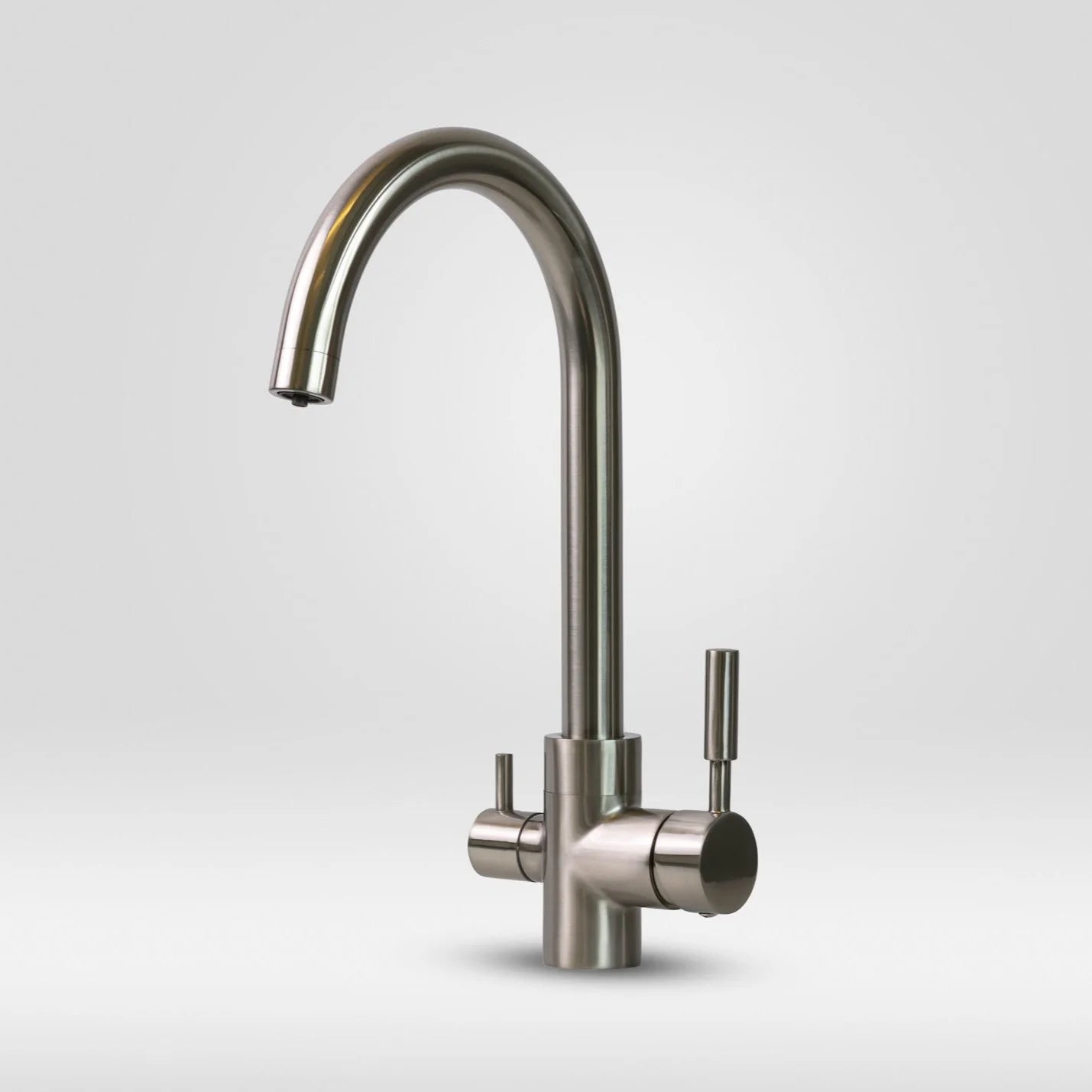
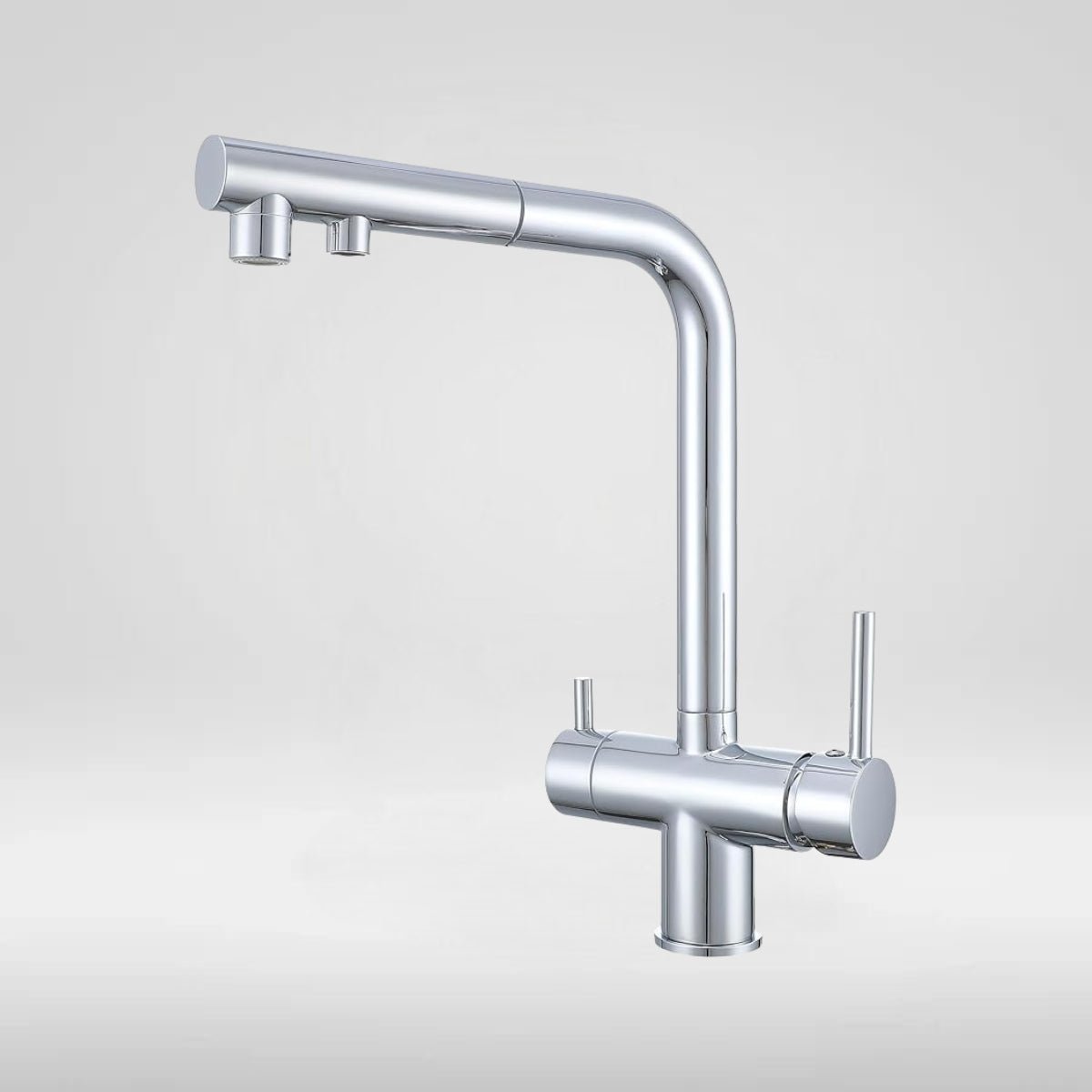
A separate faucet for filtered water is a tap point with its own water channel connected directly to a filter system under the sink, separate from the hot and cold water pipes. This can be a standalone faucet next to your existing mixer faucet, or a single faucet body where the filtered water has a completely separate channel and its own lever.
In practice, you see two versions. With the first, you drill a second hole in your countertop, and a slender, often smaller faucet is placed next to it: the classic 1-way tap point. With the second, you keep just one faucet in one hole, but there are two separate channels inside with two controls, where one lever mixes hot and cold and the other opens only the filtered water. That is the 3-way faucet.
The important word in both cases is "separate." The filtered water does not touch the hot water anywhere, not even in the final piece of the spout. At PureAqua, we see that this is precisely the point where customers lose interest in cheap solutions: a little filter that you screw into your existing mixer faucet sounds more elegant, but it provides mixed water by definition. How a filter faucet works internally and which substances such a faucet does and does not block is explained in detail in our article on the operation of a filter faucet.
Four reasons not to send it through your mixer faucet
1. Mixing undoes your purification
Reverse osmosis removes up to approximately 99 percent of dissolved substances from water, from limescale and heavy metals to PFAS and microplastics. The international performance standard for this is NSF/ANSI 58, which deals specifically with household osmosis systems. If you subsequently mix that result with unfiltered tap water, the gain disappears proportionately: half-and-half means that half of everything you removed is back in there.
A mixer faucet cannot prevent that, because mixing is literally its function. There is no setting in which a standard faucet body guarantees that no drop of unfiltered water gets in. A dedicated channel with its own spout is the only construction in which you can be sure of what enters your glass.
2. Warm water damages the membrane
An osmosis membrane is a synthetic film with pores smaller than a nanometer. That film is made for cold tap water. Warm water degrades it and significantly shortens its lifespan, which is why an osmosis system is always connected to the cold water line. If you were to send filtered water through your mixer faucet, the membrane would suddenly be in a line through which hot water can also flow, with backflow being a real risk.
3. The pressure behind the membrane is different
The water that comes through an osmosis membrane, the permeate, has much less pressure than the water going in. A pure water faucet is designed for this: a gentle stream that fills a carafe in half a minute. A standard mixer faucet expects full line pressure and provides a sputtering, unusable stream with a low supply.
That pressure difference also explains why you don't just hang an osmosis system on any existing faucet. Technically, it can only be done with a large pressure tank that keeps the pressure after the membrane at the right level, and such a tank makes the installation more expensive and takes up quite a bit of the already tight space under your sink. The PureAqua system The Source does not have that pressure tank and is therefore not compatible with a boiling water faucet like the Quooker.
4. Hygiene and Dutch installation regulations
This is the point that is not on any sales page, even though the water utility company is explicit about it. Vitens warns that bacterial growth can occur on a filter that is poorly maintained, leading to odor and taste complaints, and advises buying only devices with a quality statement recognized by the Dutch government. Vitens mentions two strict installation requirements: the correct backflow prevention and the premise that any modification to your drinking water installation must comply with the foundations of NEN 1006.
A separate faucet helps with both. The filter line is short, runs only in one direction, and is flushed daily as you use it to fill your glasses and pans. A filter you hang in the middle of your main line, by contrast, sits stagnant for most of the day. And because the filtered circuit remains physically separated from your hot water line, backflow prevention is much easier to get right. Incidentally, Vitens also honestly states that filtering is not necessary for the safety of Dutch tap water; you choose it for the taste, for lime-free water, or to remove specific substances.
1-way, 3-way, or 4-in-1: what is the difference?
As soon as you know that the filtered water needs its own channel, the only question left is about the shape. There are three ways to get that channel into your kitchen, plus one solution where you don't modify a faucet at all.
The 1-way pure water faucet
A slender faucet that only provides filtered water and is placed next to your existing mixer faucet. Your existing faucet remains untouched, which is convenient if it is still good or was expensive. You do need a second faucet hole for it. In the PureAqua range, these are models like the AquaPure for 465 euros and the AquaFlow, AquaPulse, and AquaSplash for 495 euros; the compact The Wave is 149 euros. The full series is available under all pure water faucets.
The 3-way pure water faucet
One faucet in one hole, with three flows: hot, cold, and filtered. Two separate channels run inside, and the filtered water exits via its own lever. This is the neatest solution for those who do not want to drill a second hole and still don't want a second faucet on the countertop. Models like The Surge and The Swell start around 590 euros, The Essence is 635 euros, and The Current is 640 euros; The Stream and The Flow are 840 euros. They are listed together in the pure water faucets collection, where the filter system is included with the faucet as standard.
The 4-in-1 faucet
The most comprehensive version: hot and cold water, filtered water, filtered boiling water, and filtered chilled water from a single faucet body. The PureAqua 4-in-1 faucet contains its own reverse osmosis and thus replaces the function of a boiling water faucet. For those who already have a Quooker and still want filtered water, this is the best alternative, precisely because the osmosis system and the boiling water come from the same design. The difference with the better-known 3-in-1 version, which provides boiling but not filtered water, is explained in our article on what a fourth function adds to your faucet.
Not modifying a faucet: the Countertop RO
If you don't want or aren't allowed to change anything in your kitchen, there is a fourth route. The Countertop RO for 495 euros is an osmosis device that stands on the countertop, which you fill with a pitcher and which works without installation. You don't need a second faucet hole, a drill, or any modification to your plumbing, which makes it the standard choice in rental homes. We compare other devices in this category in our overview of devices that create pure water.
Comparing the five setups
| Setup | Faucet holes | What comes out | Where it fits |
|---|---|---|---|
| 1-way pure water faucet | Extra hole next to existing faucet | Only osmosis water, completely separate | Existing mixer faucet is good and can stay |
| 3-way pure water faucet | One hole, existing faucet is replaced | Hot, cold, and osmosis water from one faucet | Sleek countertop without a second faucet |
| 4-in-1 faucet | One hole, existing faucet is replaced | Hot, cold, filtered, filtered boiling, and filtered chilled | Replacing a boiling water faucet |
| Countertop RO | None, sits on the countertop | Osmosis water per pitcher | Rental home or no space under the sink |
| Carbon filter in the mixer faucet | None, uses existing faucet | Mixed water, chlorine and taste removed | Only taste improvement, no purification |
The last row deserves a side note. A carbon filter in the main line is the cheapest solution and the only one where you don't get a separate tap point, but it primarily tackles chlorine, odor, and taste. What it does not do is block dissolved salts, nitrate, heavy metals, or PFAS; you need a membrane for that. The RIVM monitors the PFAS situation in Dutch drinking water separately, and that is precisely the type of substance where the distinction between carbon and osmosis matters.
Faucet holes, space, and installation
The practical question that always arises after the technical one: can it fit in my kitchen? Three things determine that.
The countertop. Drilling a second hole is a routine job in stainless steel, plastic, and wood. It can also be done in granite, composite, and ceramic, but requires the right drill bit and more caution; sometimes a 3-way tap in the existing hole is simply the wiser choice. Many sinks already have a second pre-drilled hole covered with a cap, originally intended for a soap dispenser.
The space under the sink. An undersink system requires space next to the siphon. This is usually not a problem, unless there is already a waste bin drawer or a water softener. If you want to know what an osmosis system requires from your base cabinet and what trade-offs are involved, you can read about it in the overview of the downsides of osmosis.
The connection itself. The system connects to the cold water pipe with a branch, a shut-off valve, and a drain connection for the rinse water. PureAqua standardly has this done by a specialist; those who are handy can use the 49-euro DIY installation kit. That is more than just convenience: as shown above, the modification must comply with the principles of NEN 1006 and the requirements regarding backflow prevention, which is exactly what an installer is for.
Prefer having everything arranged at once
Tap, filter system, filters for a year, and installation by a specialist: 29 euros per month with a 299-euro start-up fee.
View the subscriptionWhat does a separate tap for filtered water cost?
The water itself costs almost nothing. According to Vewin, you pay an average of 2.71 euros per cubic meter of drinking water in 2026, including taxes, which is approximately 0.003 euros per liter. The costs of a separate tap therefore lie entirely in the tap, the system, and the filters.
At PureAqua, a 1-way tap starts at 149 euros for The Wave, with most priced between 465 euros and 495 euros; 3-way taps range from 590 euros to 840 euros. An important detail in the sales model: the undersink system The Source cannot be purchased separately, but is included as standard with a pure water tap. Therefore, you do not pay twice. The 495-euro Countertop RO is separate and does not require a tap.
For maintenance, you pay for a filter set. A set of two filters costs 75 euros, a set of three 149 euros. Those who prefer not to keep track of anything can choose the "Zorgeloos Zuiver Water" (Carefree Pure Water) subscription: 29 euros per month with a 299-euro start-up fee, including a tap of your choice, the filter system, filters for twelve months, and installation by a specialist.
Compare that to bottled water and the calculation quickly shifts: one bottle per day means hauling, paying for, and discarding over 350 bottles per year. Milieu Centraal calls tap water the most sustainable beverage choice you can make, and a separate tap is exactly the way to make that tap water delicious and scale-free.
Which setup fits your kitchen?
Your kitchen is brand new and the tap looks great
Then you don't want to replace that tap. Choose a 1-way pure water tap in the same finish, so that the two taps side-by-side form a cohesive unit. PureAqua offers stainless steel, chrome, black, gunmetal, and gold, so matching is almost always possible.
You are going to renovate or update your kitchen anyway
Then a 3-way tap is the logical choice: one hole, one tap, three flows. Include the filtered water in the design right away, as drilling an extra hole in a newly installed composite countertop is much less pleasant than having it done beforehand.
You have a Quooker or want boiling water
Boiling water and osmosis water come from the same design or from two separate tap points at PureAqua, never from a converted Quooker. The 4-in-1 tap replaces the boiling water tap and additionally provides filtered, filtered boiling, and filtered chilled water. If you really want to keep your Quooker, a separate 1-way tap next to it is the clean solution.
You are renting, or you are not allowed to drill
Then every tap option is ruled out, and the Countertop RO remains. No hole, no modifications to the plumbing, and when you move, you simply take it with you.
Your concern is limescale throughout the house
Then a separate drinking water tap only solves half your problem. A tap point treats one location; limescale on your glassware, in your dishwasher, and in your central heating system requires a central water softener. According to Vitens, the average hardness in the Netherlands is around 8 dH, which is soft to moderately hard; water companies only refer to it as hard water above 12 dH. Many households therefore primarily have a drinking water need and not a softener problem.
Frequently Asked Questions
What are the disadvantages of filtered water?
With reverse osmosis, there are three: the membrane removes minerals such as calcium and magnesium in addition to contaminants, rinse water goes down the drain, and the system requires space under your counter plus a filter change. The mineral point is the least significant, as you get minerals primarily from food and a mineral filter can add them back if desired. Space and maintenance are the real trade-offs.
Is filtered water better than tap water?
Not safer, but different. Both Waternet and Vitens state that Dutch tap water does not need to be purified to be safe. Filtered water is scale-free, more neutral in taste, and free of substances that may be present in trace amounts, such as PFAS and medication residues. You choose it for taste and comfort, not because tap water would be unsafe.
Can I turn ditch water into drinking water?
Not with a household osmosis system. Such a system is designed for water that already meets drinking water standards and is not tested for surface water containing bacteria, viruses, algae, and sludge. For unknown water, you need a filter explicitly rated for microorganisms. A separate osmosis tap is for your tap water, not for the ditch behind your garden.
Is drinking filtered water good for you?
Osmosis water is safe to drink daily, and there is no reason to drink less of it than tap water. What it does not do is add a health benefit: in practice, you get your calcium and magnesium from your food, not your glass. In practice, the effect is that people noticeably drink more water as soon as it tastes better from the tap, and that is the gain.
Is Bar le Duc tap water?
No, Bar le Duc is sold as bottled water and not as re-bottled tap water. More interesting is the price comparison: according to Vewin, tap water costs about 0.003 euros per liter, while for bottled water you easily pay a hundred times that, plus the bottles themselves. A separate tap for filtered water is the way to eliminate the taste issue without the bottles.
Is the water filter from Action any good?
A cheap filter pitcher or faucet filter does what a carbon filter can: remove chlorine, odors, and some flavorings. What it does not do is stop dissolved salts, nitrates, heavy metals, or PFAS, because that requires a membrane. More important than the brand is maintenance, as Vitens specifically warns against bacterial growth on filters that are left on for too long.
Conclusion
A separate tap for filtered water is not a design choice but a technical necessity. Mixing undoes the purification, hot water damages the membrane, the pressure behind the membrane does not match a standard mixer tap, and the Dutch installation rules regarding backflow prevention and NEN 1006 are much easier to meet with a separate circuit. Everything that comes after that is just about form.
That form depends on two things: how many tap holes you have or want to create, and whether your existing tap can stay. If it stays, a 1-way tap point is the neat solution. If you are going to renovate, a 3-way tap is the sleekest. If you also want boiling water, the 4-in-1 tap does everything from a single design. And if you are not allowed to change anything in your kitchen, the Countertop RO provides the same water without turning a single screw. PureAqua is happy to help you see which of the four fits your kitchen. Drink different.
See which tap fits your kitchen
1-way, 3-way, or 4-in-1, in five finishes, with the filter system included as standard.
View the pure water taps