Reading time: approximately 12 minutes
Short answer
Making rainwater drinkable is technically possible, but it requires four steps: collection, sediment filter, activated carbon, and disinfection. Boiling alone is not enough. For private drinking water, the standards of the Drinking Water Decree (Drinkwaterbesluit) apply according to the RIVM, and the owner is personally responsible. Filtering tap water is cheaper and safer.
In this article
- What is actually in rainwater?
- Are you allowed to make your own drinking water from rainwater?
- How to make rainwater drinkable in four steps
- Is boiling enough to drink rainwater?
- What does it cost and does your roof produce enough?
- Four routes to pure water compared
- What should you choose instead?
- Frequently asked questions
- Conclusion
What is actually in rainwater?
Rainwater is quite pure when it falls from the sky: it is soft, contains almost no limescale, and has no minerals. The problem begins as soon as it touches something. On the way from your roof tiles through the gutter to the rain barrel, the water picks up particles, bird droppings, leaf debris, and substances from building materials. That is the crux of the story: it is not the rain that is the risk, but the route.
Milieu Centraal points this out explicitly in their step-by-step plan for disconnecting your downspout: impregnated wood and uncoated metals such as zinc and copper can contaminate the collected water. That collected water is intended for the garden, not for the tap.
Definition
Making rainwater drinkable means treating collected rainwater so that it meets drinking water quality standards. This requires at least four steps: clean collection, coarse and fine filtration, removing organic substances with activated carbon, and microbiological disinfection. A single filter is by definition not enough.
What can still be in it falls into roughly three categories: Bacteria and other microorganisms, which multiply rapidly in a warm rain barrel. Suspended particles and organic material, which bacteria actually feed on. And dissolved substances: heavy metals from roofing, and in areas with heavy traffic or agriculture, residues from the air. The latter group is the most difficult, as a sieve or a carbon filter does not stop dissolved substances. For that, you need a technique that works at a molecular level, and that is exactly what reverse osmosis does.
For comparison: with tap water, that entire chain is already managed and checked for you. If you want to know how strict that process is, our article on how Dutch tap water is monitored explains what standards apply and who oversees them.
Prefer pure water without your own water factory?
Tell us what your kitchen looks like and what you want to remove from your water, and we will be happy to provide you with non-binding advice.
Request free advice View the pure water tapsAre you allowed to make your own drinking water from rainwater?
You are allowed to use water from your own source for your household, but rules apply, and the responsibility lies entirely with you. The RIVM refers to such installations as "private abstractions": systems with which you extract your own water for drinking or for supply to third parties. That water is not supplied by a public water utility and therefore falls under the responsibility of the owner.
The drinking water must meet the quality standards of the Drinking Water Decree and the Drinking Water Regulation, under the supervision of the Human Environment and Transport Inspectorate. Since the implementation of the European Drinking Water Directive in 2023, the RIVM distinguishes between large and small private abstractions: large abstractions are required to conduct a risk assessment, while small ones are not. However, both must monitor a number of new substances.
Why this strictness? Because the consequences are concrete. The RIVM explains that contaminated water can lead to mild to severe symptoms, such as diarrhea, vomiting, or fever. The recommended working method consists of three interrelated steps: know your system, perform a risk analysis, and measure. The latter is the part that private individuals almost always skip, yet it is exactly the part that helps you determine if your installation is still working properly.
The connection is the real risk
There is another point that is missing in most articles and that goes beyond your own health. Anyone who pipes rainwater through their home must keep it completely separated from the public drinking water network. Vitens mentions this in their drinking water safety guidelines: proper connection and sound management of systems are of great importance to prevent health risks, and the legal requirements of the Drinking Water Act, the Drinking Water Regulation, and NEN 1006/A3 apply here.
If that goes wrong, rainwater could backflow into the drinking water network, and then it is no longer just your problem. That is the reason why water utility companies encourage rainwater systems for the garden and the toilet, but not for the tap.
How to make rainwater drinkable in four steps
If you still want to do it, for example for a holiday home or as an emergency supply, the chain looks like this. Do not skip any step, because each step catches something that the previous one lets pass.
1. Clean collection
It starts at your roof. A leaf catcher in the downspout keeps leaves and twigs out, and a first-flush diverter lets the first liters of a downpour, which contain most of the dirt, simply flow into the sewer or the garden. Check which materials the water touches along the way: Milieu Centraal lists impregnated wood and uncoated zinc and copper as contaminants. A closed, dark tank is better than an open rain barrel, because light and heat allow algae and bacteria to grow.
2. Sediment filter
After that, the water passes through a sediment filter, usually in two stages: first around 20 microns, then around 5 microns. This removes sand, rust, and suspended particles. An important detail: this filter does not microbiologically clean the water, but it does protect everything that comes after it. Without a sediment filter, an activated carbon filter or a membrane will clog up within weeks.
3. Activated carbon
An activated carbon filter binds organic substances, odors, and tastes. This is the step that makes water that smells like the roof gutter neutral again. What activated carbon does not do is stop dissolved salts and heavy metals, and a carbon filter itself is a place where bacteria can settle if you leave it in too long. Replacing it is not an option; it is maintenance.
4. Disinfection or reverse osmosis
The final step is the decisive one. A UV lamp renders bacteria and viruses harmless but only works with clear water and a bulb that you replace annually. An ultrafiltration membrane of around 0.02 microns physically blocks microorganisms. If you also want to get rid of dissolved substances, reverse osmosis is the only route: according to the NSF/ANSI 58 standard, that membrane blocks substances at a molecular level. At PureAqua, The Source removes up to approximately 99 percent of, among other things, PFAS, microplastics, heavy metals, and limescale in this way.
Pay attention to a precondition that surprises many people: an osmosis membrane needs pressure. That pressure doesn't come naturally from a rain barrel, so you need a pump. How much pressure exactly is explained in our article about how many bars a water filter needs.
Whatever you take from this: this is the same logic behind a filter for emergency situations, only permanent and with a maintenance obligation.
Is boiling enough to drink rainwater?
No, and this is the most persistent misunderstanding surrounding this topic. Boiling kills bacteria, viruses, and parasites, which is exactly what a boil-water advisory is intended for. However, boiling does nothing for dissolved substances. Heavy metals, PFAS, and residues from roofing remain in the water after boiling, and because some of the water evaporates, their concentration even becomes slightly higher.
In short: boiling solves the microbiological problem but not the chemical one. In an emergency situation, boiled rainwater is better than nothing. As a permanent drinking water supply, it is insufficient.
There is another practical objection. Boiling water all day costs energy and time, and you have to cool and store it afterward. Storing it brings its own risks: how long water remains drinkable and why is explained in our article on the shelf life of water in a pitcher or bottle. With rainwater, which already contains more organic material, things go wrong faster than with tap water.
What does it cost and does your roof produce enough?
First, calculate the yield. One millimeter of rain on one square meter of roof is exactly one liter of water. A roof surface of 60 square meters yields approximately 600 liters during a 10-millimeter downpour, minus what evaporates and disappears into the first-flush diverter.
Compare that with your consumption. According to Vewin, the drinking water sector is aiming for 100 liters per person per day by 2035, and that is a savings goal, so current consumption is higher. For a family of four, 100 liters per person means 400 liters per day, or more than 145,000 liters per year. That 600 liters from a heavy downpour would last them a day and a half. So, it works for drinking and cooking, but not as a replacement for your entire household, which is exactly why drinking water companies recommend rainwater for the garden and the toilet.
Then the costs. According to Vewin, tap water will cost 2.05 euros per cubic meter excluding taxes and 2.71 euros including in 2026. That is 0.0027 euros per liter. The 1,000 liters of drinking and cooking water a family uses per year cost less than 3 euros in tap water. Setting up a private purification chain next to that, with sediment filters, activated carbon, a UV lamp that must be replaced annually, a pump, and periodic laboratory checks, is never financially viable based on drinking water alone.
Vitens puts the most useful conclusion most clearly: let rainwater seep into the ground, because that is how it becomes groundwater, from which drinking water companies then make drinking water. Vitens mentions rain barrels, infiltration crates, wadis, and rainwater tanks for the garden and flushing the toilet, with an explicit reference to the drinking water safety guidelines for tank systems.
Pure water without a tank, pump, and UV lamp
With reverse osmosis on your tap water, you get the same purity without having to manage your own installation.
View the pure water device View the subscriptionFour routes to pure water compared
| Route | What it does | What it costs | Maintenance and risk |
|---|---|---|---|
| Fully purifying rainwater | From rainwater to drinking water quality, in four steps | Tank, filters, pump, UV, and periodic checks | High: annual UV lamp, filter replacements, separation from the drinking water mains, personal responsibility according to the RIVM |
| Rainwater for garden and toilet | Saves drinking water for non-potable applications | Rain barrel or tank, sometimes municipal subsidies | Low to medium: for tank systems, follow drinking water safety regulations |
| Boiling tap water | Kills microorganisms, leaves dissolved substances behind | Energy only | Low, but not a solution for PFAS, metals, or limescale |
| Tap water with reverse osmosis | Removes up to approximately 99 percent of, among other things, PFAS, microplastics, heavy metals, and limescale | Pure water tap with The Source included, Countertop RO sold separately, or a subscription for 29 euros per month with 299 euros in startup costs | Low: change filter set, or everything included via the subscription |
The pattern in that table is the core of this topic. The technology you ultimately need to make rainwater truly drinkable is the same technology you can apply to tap water. The only difference is that with tap water, you start with a source that is already checked, while with rainwater, you are starting with a source whose quality you must monitor yourself. Anyone who wants to see the pros and cons of osmosis for themselves can also find the points where the technology is less robust in our overview of the downsides of reverse osmosis.
What should you choose instead?
The honest advice depends on why you are here.
- You want to save drinking water: collect rainwater for the garden and toilet. That is where most household water goes, and it does not require drinking water quality.
- You want to be prepared for an emergency: focus on supplies plus a filter, not a permanent rainwater installation. An emergency filter and a few jerrycans are cheaper and more reliable.
- You want to be off-grid or have a vacation home without a connection: then the four-step chain including disinfection is the minimum requirement, and count on laboratory testing and structural maintenance.
- You mainly want water that is purer than what currently comes out of your tap: then filter your tap water. You are then using a controlled source and can still remove dissolved substances using reverse osmosis.
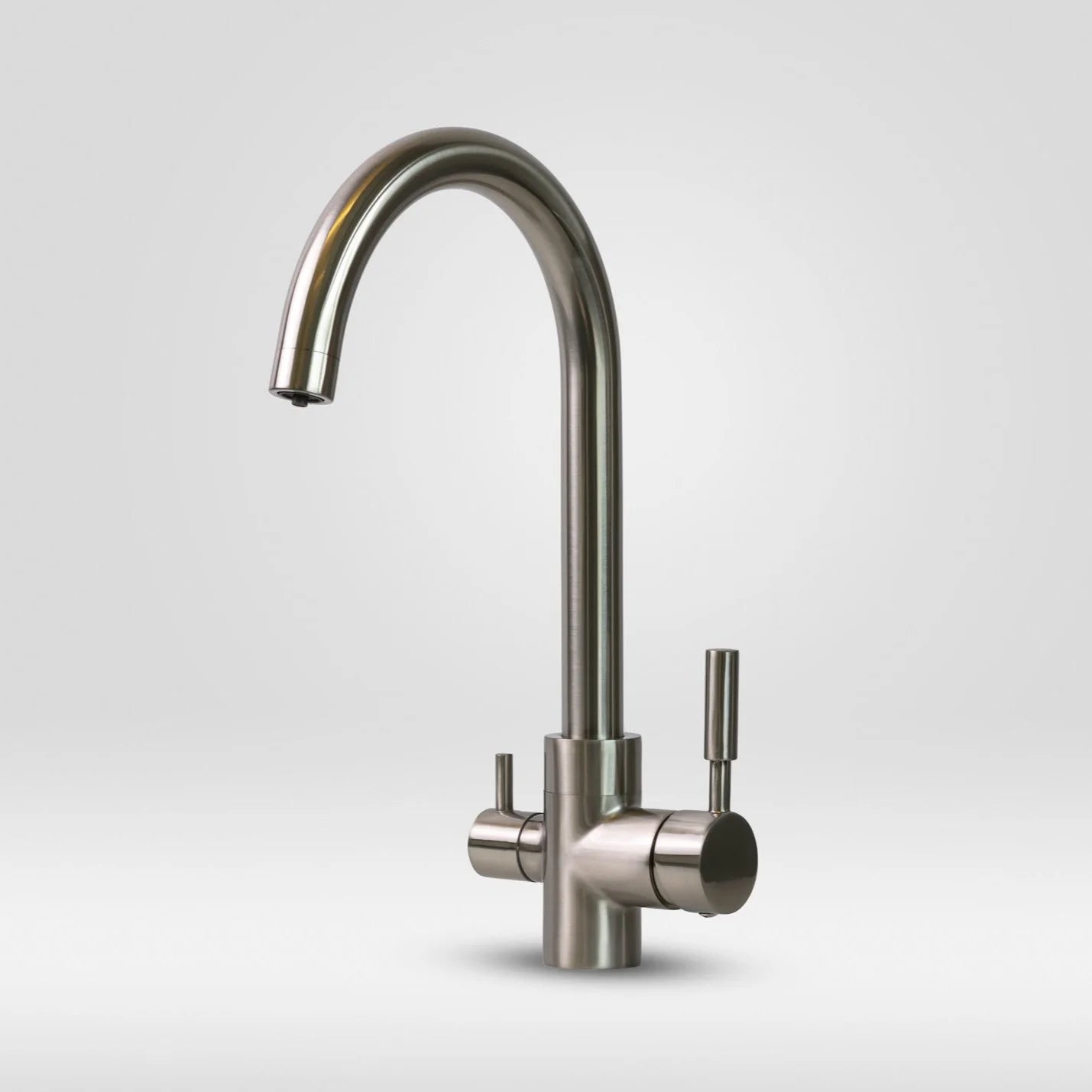
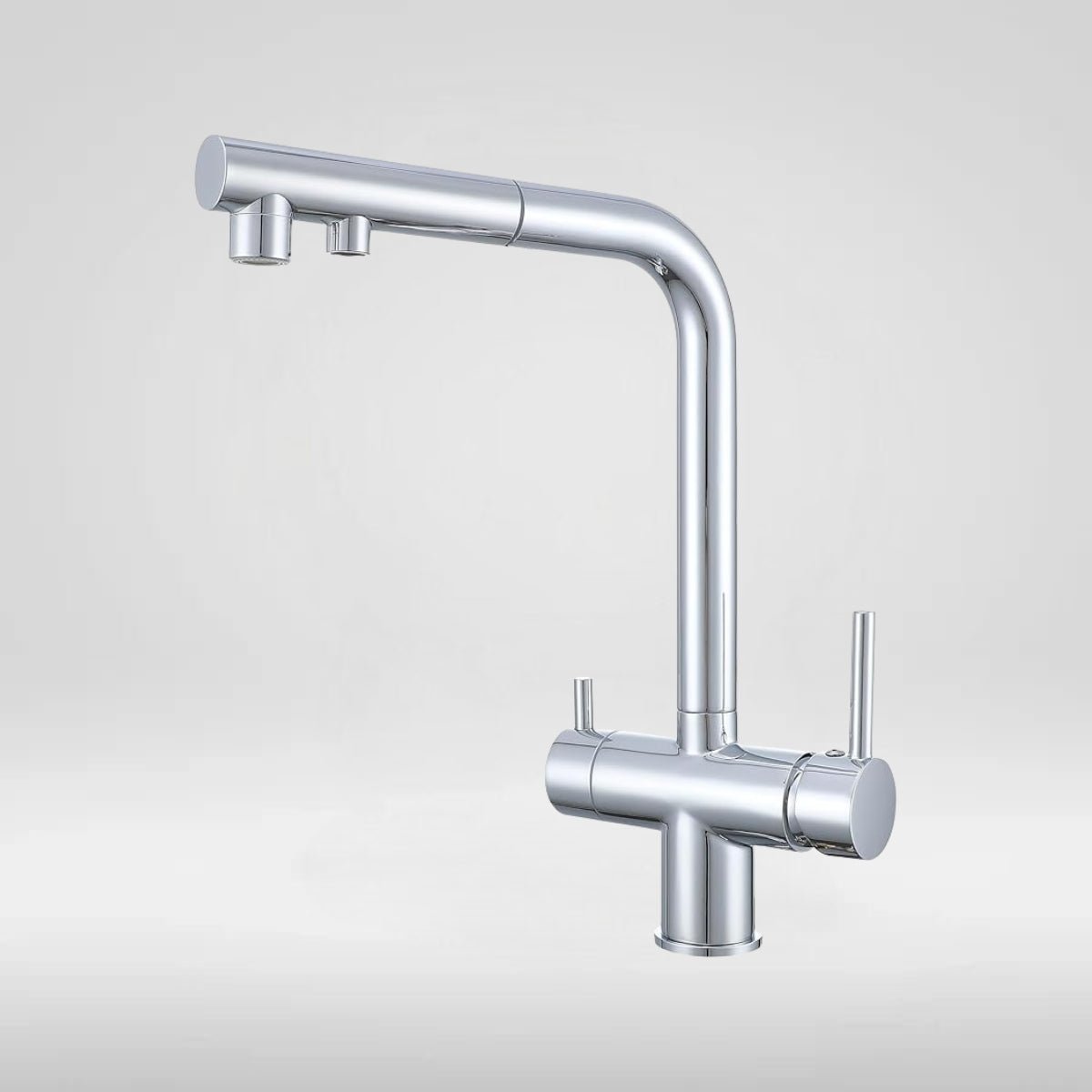
At PureAqua, we see that customers who come in with a question about rainwater almost always end up with the latter. What they are actually looking for is water without limescale, without PFAS, and without plastic bottles, and it turns out that it is faster and cheaper to obtain this from your own tap than from your own tank. A pure water tap has The Source included as standard, the Countertop RO works without installation, and the 4-in-1 tap provides hot, cold, filtered, and filtered boiling water from a single spout. According to Milieu Centraal, tap water is also the most sustainable drink choice, and that remains true even when you filter it.
If you are still doubting between technologies, our article on the difference between a water filter, a water purifier, and reverse osmosis sets them side by side.
Frequently asked questions
Can you boil and drink rainwater?
Boiling makes rainwater microbiologically safer, but not drinkable according to standard requirements. Bacteria, viruses, and parasites are killed, while dissolved substances like heavy metals and PFAS remain. Because some of the water evaporates, their concentration even increases slightly. In an emergency, boiled rainwater is better than nothing; as a permanent drinking water supply, it is insufficient.
How can I purify rainwater?
In four steps. Collect it cleanly using a leaf catcher and a first-flush diverter, then filter it with a sediment filter of approximately 20 and then 5 microns, remove odors and organic substances with activated carbon, and finally disinfect it with a UV lamp or a membrane of around 0.02 microns. If you also want to get rid of dissolved substances, reverse osmosis is the only technique that does so at a molecular level. A single filter is never enough.
Am I allowed to make my own drinking water from rainwater?
You may do so for your own household, but the responsibility rests entirely with you. The RIVM calls such installations private water supplies: the water is not provided by a drinking water company and must meet the quality standards of the Drinking Water Decree and the Drinking Water Regulation, subject to supervision by the Human Environment and Transport Inspectorate. If you supply third parties, additional obligations apply. Furthermore, according to Vitens, the system must remain completely separated from the drinking water network in accordance with the Drinking Water Act and NEN 1006/A3.
Can water in a rain barrel go bad?
Yes. A rain barrel is kept warm and often in the light, which is an ideal environment for algae and bacteria. Leaf debris, bird droppings, and sand on the bottom provide food for microorganisms, causing the water to smell and become visibly cloudy. For the garden, this is not a problem, but for drinking, it is. A closed, dark tank remains usable much longer than an open barrel.
How can I purify the water in my rain barrel?
Start at the root cause: cover the barrel, install a leaf catcher, and flush out the sediment annually. For garden use, that is enough. If you also want to use the water for flushing the toilet, follow the drinking water safety guidelines from Vitens to ensure the system remains separated from the drinking water network. It only becomes drinkable with the full chain of sediment, activated carbon, and disinfection.
What happens if you drink rainwater?
A single sip from a clean rain barrel usually ends well, but the risk is real. The RIVM describes that contaminated water can cause mild to severe symptoms, such as diarrhea, vomiting, or fever. Vulnerable groups such as young children, the elderly, and people with a weakened immune system are at higher risk. Contact your GP if you experience symptoms after drinking rainwater.
Is rainwater better than tap water because it contains no limescale?
Rainwater does indeed have an advantage regarding limescale: it is naturally soft and contains virtually no calcium or magnesium. But that advantage does not outweigh the microbiological and chemical risk of the route via your roof. If you want soft water without limescale from a controlled source, you can achieve the same with reverse osmosis on your tap water, which retains up to approximately 99 percent of substances including limescale, PFAS, and heavy metals.
Conclusion
Making rainwater drinkable is technically possible, but rarely wise in practice. The rain itself is clean; the roof, the gutter, and the barrel make it unreliable. You need four steps, of which disinfection and potentially reverse osmosis are the decisive ones, and boiling alone only solves half the problem.
On top of that comes the responsibility. The RIVM fully attributes water from a private supply to the owner, using the standards of the Drinking Water Decree as a benchmark, and Vitens requires a strict separation from the drinking water mains in accordance with NEN 1006/A3. Compare that to the tap water price of 0.0027 euros per liter, and the math quickly goes the other way.
The practical answer is therefore: use rainwater where it works excellently—in the garden and for the toilet—and filter your drinking water at the tap. At PureAqua, we do this with reverse osmosis that stops up to approximately 99 percent of substances including PFAS, microplastics, heavy metals, and limescale, with installation by a specialist and a filter set that you change yourself or via our subscription. Pure water, without needing your own water factory in the garden. Drink different.
Pure water from your own tap
View the pure water taps with filter system included, or let us help you think about what fits your situation.
View the pure water taps Request free advice