Reading time: approximately 12 minutes
Short answer
For an emergency kit, choose a portable filter that removes bacteria and parasites from surface water, such as a hollow-fiber filter or a gravity filter. Such a filter does not remove viruses or chemical contaminants. Therefore, first ensure a supply of tap water, count on 3 liters per person per day, and use the filter as a second layer.
In this article
- What is a water filter for your emergency kit?
- First supply, then a filter
- What does a survival filter block and what doesn't it?
- Four types of water filters compared
- Why reverse osmosis at home fills the gap
- Filtering ditch water and rainwater: is that safe?
- Checklist: what to look for when buying?
- Frequently asked questions
- Conclusion
What is a water filter for your emergency kit?
Definition
A water filter for an emergency kit is a portable filter that mechanically purifies untreated water, for example from a ditch, pond, or rain barrel, into water that you can drink. Most models work with hollow fibers: bundles of thin tubes with microscopic pores that block bacteria and parasites while water flows through them via suction, squeezing, or gravity. They work without electricity and without chemicals.
On the Dutch market, the prices of these filters vary widely. In Google search results for the keyword "water filter emergency kit," there are models ranging from 9.29 euros to 59.95 euros, with claims of 1,000 liters to 5,000 liters of filter capacity. More expensive systems, such as a jerrycan with a built-in filter for an entire family, approach 499 euros. What you are buying differs enormously, while the product names are barely distinguishable from each other.
Important to know: such a filter is intended for an exceptional situation. In the Netherlands, under normal circumstances, controlled drinking water comes out of the tap, legally established in the Drinking Water Decree and enforced by the RIVM. Feel free to read once more why Dutch tap water is safe under normal circumstances. You buy an emergency filter for the moment that certainty is temporarily lost.
Pure water, every day and not just in an emergency
An emergency filter sits in the cupboard 364 days a year. An osmosis system on your countertop is used every day.
View the Countertop ROFirst supply, then a filter
The webshops at the top of Google start immediately with the filter. That is the wrong order. Drinking water companies advise starting with a supply of tap water, because that is the cleanest and cheapest water you can get. Vitens calculates 3 liters per person per day for drinking and cooking, so 9 liters per person for three days and 36 liters for a family of four.
That supply doesn't have to cost anything. You fill clean, sealable bottles with tap water and store them in a cool, dark place. Brabant Water advises refreshing that emergency supply every 6 months. For water that you simply store in the refrigerator, WML maintains a shelf life of up to 7 days in a sealed, clean bottle. If you want to know exactly how that works, you can read in detail how long tap water remains drinkable in bottles, jugs, and the refrigerator.
Do the math and the ratio becomes clear. According to Vewin, drinking water cost an average of 2.71 euros per cubic meter in 2026, including taxes. That is 0.27 cents per liter. The 36-liter emergency supply for a family of four therefore costs about 10 cents. A 30-euro filter only adds value to that once those 36 liters have run out.
The order we recommend
- Layer 1: 3 liters of tap water per person per day, at least three days, refresh every six months.
- Layer 2: a portable filter for bacteria and parasites, for when the supply runs out.
- Layer 3: boiling or chemical tablets if the water looks questionable and you don't have a filter that handles viruses.
- Layer 4: a fixed purification system at home, which you use every day and which also removes chemical contamination.
What does a survival filter block and what doesn't it?
This is the point where almost all sales pages remain vague. A portable filter works mechanically: everything larger than the pores is left behind, everything smaller flows through. This means that the three groups of pathogens are not treated equally. The World Health Organization therefore evaluates household water treatment separately for bacteria, viruses, and protozoa, precisely because not every technology tackles all three.
What a hollow-fiber filter does in practice:
- Bacteria and parasites: are blocked. This is what these filters are made for.
- Viruses: are a lot smaller and slip through the fibers unless the filter has an additional treatment with iodine, chlorine, or UV.
- Suspended dirt and turbidity: are removed, making the water clear. Clear is not the same as clean.
- Chlorine, taste, and odor: only if there is a layer of activated carbon inside.
- PFAS, nitrate, heavy metals, and medication residues: remain. These substances are dissolved in the water and pass through the fibers without issue.
The latter is not a given. The RIVM sees PFAS in drinking water as a point of concern that requires additional purification. A filter sold with "filters 99.99 percent" almost always refers to 99.99 percent of the bacteria, not the dissolved chemistry. Those who want to see the percentages per substance side-by-side will find the same comparison for the countertop filter pitcher in our article about what a carbon cartridge achieves in terms of removal percentages.
Four types of water filters compared
The "water filter" category contains four technologies that have little to do with each other. They differ in what they block, how fast they work, and where they belong.
| Type | What it blocks | What it is for | Indication price |
|---|---|---|---|
| Hollow-fiber filter (straw, squeeze bottle) | Bacteria, parasites, suspended dirt. No viruses, no dissolved chemistry. | On the go, in a bag, per person | 9 to 40 euros |
| Gravity filter (bag or jerrycan) | Same as above, but in liters at a time without suction | Family or group, longer period | 50 to 500 euros |
| Activated carbon filter (pitcher, cartridge) | Chlorine, taste, odor, some pesticides. No PFAS in small cartridges. | Improving taste of tap water | 25 to 60 euros |
| Reverse osmosis (home) | Up to approx. 99 percent of dissolved substances: PFAS, nitrate, heavy metals, microplastics, limescale | Daily drinking water at home | from 495 euros or 29 euros per month |
At PureAqua, we see that people starting with an emergency kit eventually arrive at this table with a different question: not which filter fits in the backpack, but what water comes out of the tap the rest of the year. In our overview of which filter technology fits which situation, we further explain that choice.
Not sure which solution suits your home?
Briefly tell us your situation, and we will think along with you without obligation regarding supplies, filters, and a permanent solution.
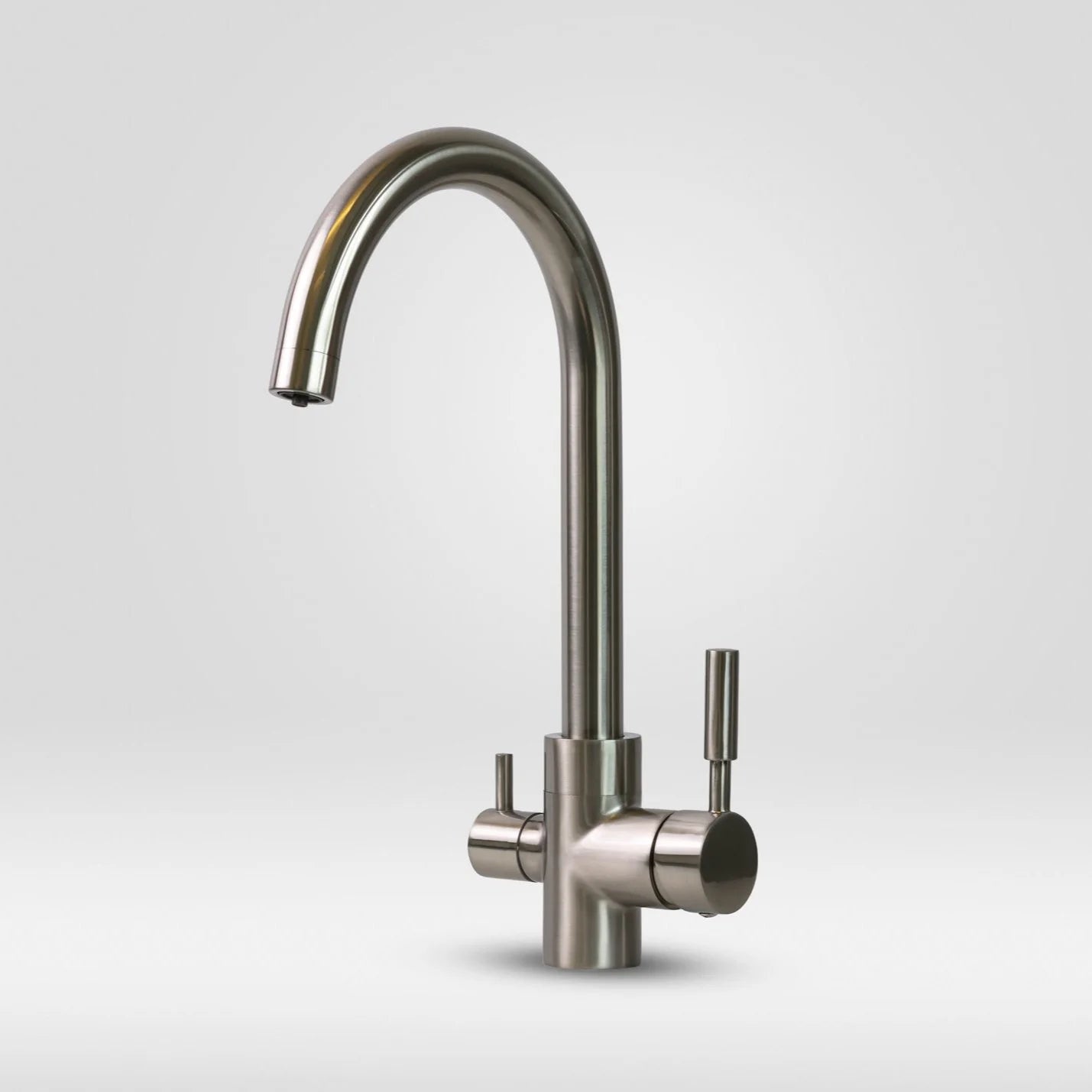
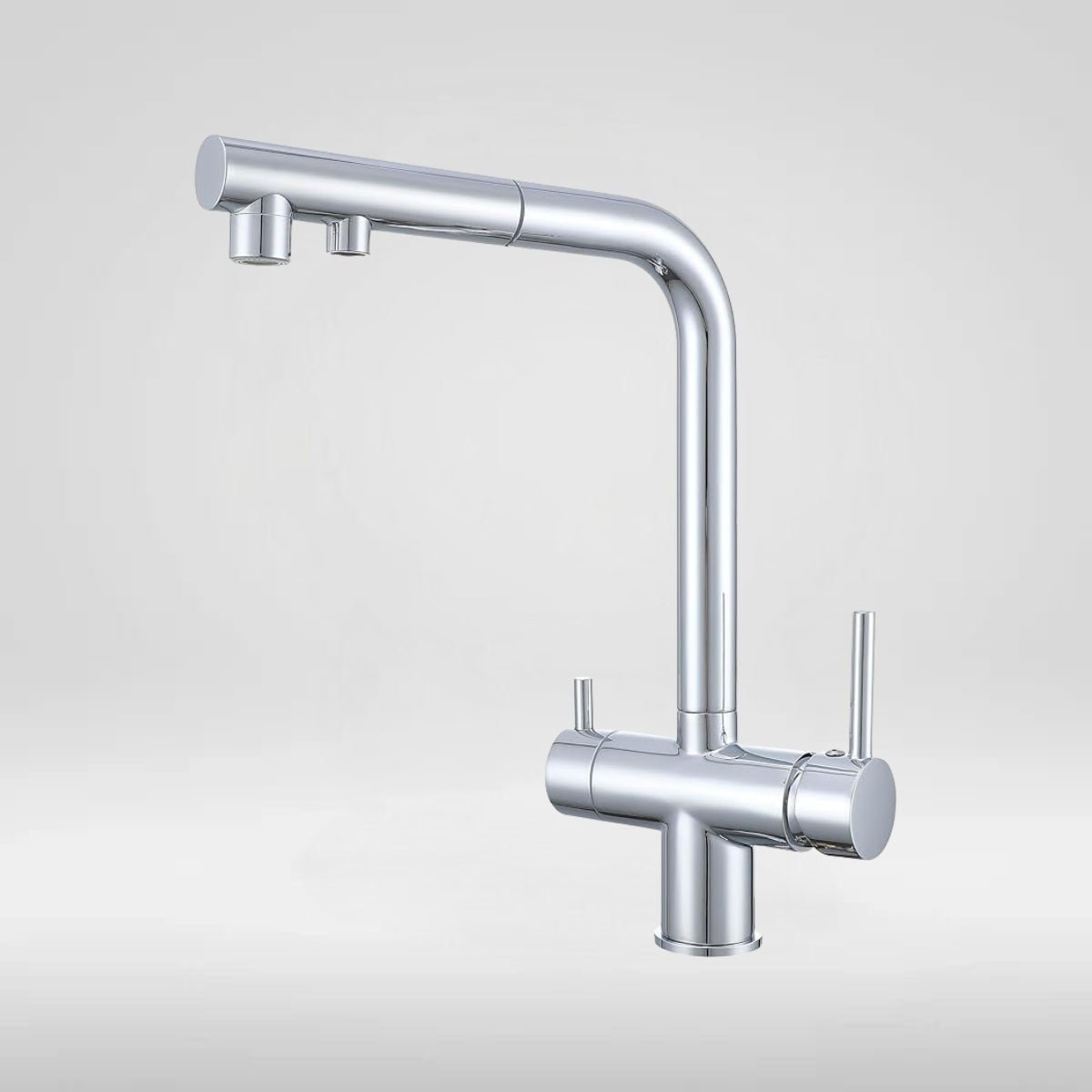
Request free advice View pure water faucetsWhy reverse osmosis at home fills the gap
A portable filter and an osmosis system solve two different problems. The portable filter handles biology: it makes unreliable surface water drinkable without electricity. Reverse osmosis handles chemistry: it presses water under pressure through a membrane that blocks dissolved substances. How that works exactly is explained on our page about the operation of reverse osmosis.
The difference lies in the scale of what is blocked. Where hollow fibers block particles, an osmosis membrane also blocks dissolved molecules. As a result, up to approximately 99 percent of substances like PFAS, nitrate, heavy metals, microplastics, and limescale disappear. The international standard for this type of system is NSF/ANSI 58, written for exactly this application.
Practically, that means the following. The Countertop RO from PureAqua costs 495 euros, sits on the countertop without installation, and only needs a power outlet. If you want it invisible under the sink, the system is included by default with a pure water faucet. If you prefer to pay in installments with maintenance included, there is the Carefree Pure Water subscription for 29 euros per month with a 299-euro start-up fee, including faucet, system, filters for twelve months, and installation by a specialist.
Staying honest is important: an osmosis system runs on water pressure and the countertop variant on electricity. If the power or water pressure fails, your osmosis system will also fail. That is exactly why the two complement each other and do not replace each other. Why people purify their drinking water in the first place is explained on the page why filter water.
Filtering ditch water and rainwater: is that safe?
"Water filter for ditch water" is searched for about 880 times a month in the Netherlands, so the question is alive. The honest answer is: partially. A good hollow-fiber filter removes the bacteria and parasites from ditch water, and that is exactly what makes you sick in the first few days. What it does not do is remove the substances that are present in Dutch surface water: manure and nitrate from agriculture, residues of crop protection products, and industrial discharges.
Rainwater from a barrel is a slightly different story. It is chemically cleaner than ditch water, but it washes over your roof, past leaves, moss, and bird droppings. Filtering it is wise, but here too: the filter handles the biology, not what dissolves into it from a bitumen roof.
Practical order for turbid water
- Let the water stand for half an hour first so that sand and silt settle.
- Pour it off carefully through a clean cloth or coffee filter, so that your filter does not immediately clog up.
- Filter it afterwards with your emergency filter.
- If you are in doubt about viruses, bring the filtered water to a boil for a minute after all or use purification tablets.
- Store the result in a clean, sealed bottle and drink it within a day.
According to Milieu Centraal, tap water in the Netherlands is the cheapest and most sustainable source of drinking water. Filtering ditch water is an emergency measure, not an alternative to a filled jerrycan in the closet.
Checklist: what to look for when buying?
The product names in the search results are very similar and say little. These seven points do:
- Listed pathogens: does it explicitly state which groups are removed, or just a percentage without explanation? "99.99 percent" alone is not a specification.
- Capacity in liters: 1,000 to 5,000 liters is standard. Calculate how many days that is for your household, at 3 liters per person per day.
- Flow rate: a straw is fine for one person, but excruciatingly slow if you are with four. A gravity system refills itself in the meantime.
- Frost resistance: hollow fibers can freeze and break if they are stored wet in a shed or car. You cannot see a broken fiber filter from the outside.
- Shelf life unused: check if the filter has an expiration date and note it with your emergency supplies.
- Cleanable or disposable: dismantlable filters last longer, but require maintenance.
- Independent certification: a reference to a recognized standard or test carries more weight than a marketing claim on the box.
Set a reminder in your calendar to refresh your supplies every six months and check the filter at the same time. That single moment makes the difference between an emergency kit that works and a box you never opened again.
Frequently Asked Questions
What is the best water filter for an emergency?
For a family, a gravity filter is usually the best choice: you hang up a bag or jerrycan and liters of filtered water flow out at once, without power and without needing to suck. For one person on the go, a hollow-fiber filter or squeeze bottle suffices. Both remove bacteria and parasites, but not viruses or dissolved chemicals. The best emergency water therefore remains a stock of tap water, with the filter as a second layer.
Which water filter in case of war?
In the event of a prolonged disruption of the water supply, three things matter simultaneously: stock, capacity, and shelf life. Count on 3 liters per person per day, choose a gravity filter with a capacity of at least 1,000 liters so you are not dependent on a single straw, and provide a second purification method such as boiling or tablets for viruses. A filter that requires electricity is not a good first choice in such a situation.
How do you purify ditch water into drinking water?
In four steps. First, let the water settle, pour it through a cloth or coffee filter to remove sand and silt, then filter it with a hollow-fiber filter, and if you are unsure about viruses, bring it to a boil for one minute. This removes bacteria and parasites. Dissolved substances like nitrates, PFAS, and pesticide residues will remain, as a portable filter is not designed for that.
How do I store water in my emergency kit?
Fill clean, well-sealable bottles or jerrycans with tap water and store them in a cool, dark place, not directly on concrete. Vitens calculates 3 liters per person per day, so 9 liters per person for three days and 36 liters for a family of four. Brabant Water advises refreshing the supply every 6 months. Do not use bottles that previously held soft drinks or juice, as sugar residues feed bacterial growth.
Does bottled water have an unlimited shelf life?
No. Water does not spoil like food, but in an opened or not perfectly clean bottle, bacteria can grow and the taste degrades. WML maintains a maximum of 7 days for tap water in a closed, clean bottle. For an emergency supply in sealed jerrycans, refreshing every six months is the practical rule. Unopened store-bought bottled water has an expiration date that primarily concerns taste and packaging.
How can I store drinking water for long periods?
Use food-safe jerrycans made of opaque material, fill them to the brim with tap water, close them tightly, and store them in a cool, dark place. Write the filling date on the can and refresh it every six months. Place the cans on a shelf or pallet rather than directly on the floor, and keep cleaning agents and fuel far away, as plastic is permeable to odors. A filter adds to your reach once the supply runs out.
Conclusion
A water filter in your emergency kit is wise, but it is the second step, not the first. Start with 3 liters of tap water per person per day for at least three days, refresh that stock every six months, and only then choose a filter. For one person, that is a hollow-fiber filter; for a family, a gravity system. Know what you are buying: those filters remove bacteria and parasites, not viruses or dissolved chemicals.
For the other 364 days of the year, the question is entirely different. If you want daily water without PFAS, nitrates, heavy metals, and limescale, then reverse osmosis is the technology that does that, up to approximately 99 percent and according to the NSF/ANSI 58 standard. At PureAqua, we see that customers find exactly that combination appealing: a filled jerrycan and a filter in the cupboard for the unlikely event, and pure water from your own tap for every day. Drink different.
Pure water from your own tap
Osmosis water without installation on the countertop, or invisibly under the sink with a designer faucet.
View the Countertop RO View the subscription