Reading time: approximately 12 minutes
Short answer
Yes, you can be allergic to water, but it is extremely rare. The condition is called aquagenic urticaria: itchy bumps measuring 1 to 3 mm that develop within minutes of skin contact with water, regardless of its temperature. For the vast majority of people who experience itching or rashes after showering, water itself is not the culprit. The cause is usually a dry skin barrier, hot water, soap residue, or the limescale in hard water. The latter is the only factor you can do something about yourself.
In this article
- What exactly is a water allergy?
- How rare is a true water allergy?
- Aquagenic urticaria or aquagenic pruritus?
- What does your skin usually react to?
- What is in Dutch tap water?
- Itching after showering: four common causes
- When should you see a GP?
- Water allergy, hard water, or dry skin: the differences
- What can you do about your water?
- Frequently asked questions
- Conclusion
What exactly is a water allergy?
A water allergy in the medical sense is called aquagenic urticaria. It is a form of physical hives: your skin does not react to a substance, but to an external stimulus. In this condition, that stimulus is water. It does not matter whether the water is cold, lukewarm, or hot, and it also does not matter whether it is rainwater, swimming pool water, sweat, or tap water.
Definition
According to the dermatological reference work Huidziekten.nl, aquagenic urticaria is a rare form of physical urticaria in which itchy papules of 1 to 3 mm develop after contact with water, regardless of its temperature.
That last sentence is the key to the entire topic. If your skin only reacts to warm water, then by definition it is not aquagenic urticaria. If your skin only reacts in the shower but not in the rain, then it is likely not that either. And if you only experience symptoms after half an hour instead of within a few minutes, that does not fit the profile either. This is exactly why the diagnosis is so rare: the symptom pattern is strictly defined, whereas the complaint "my skin itches after showering" is very broad.
What happens in the skin during a true water allergy is not yet fully understood. The common explanation is that water in contact with the top layer of the skin releases a substance that triggers mast cells to release histamine. That histamine causes the bumps and itching, just like with ordinary hives. It is therefore not an allergy to the water molecule itself, but a reaction triggered by water.
Curious about what is in your tap water?
We will take a look at your water hardness for free and tell you honestly if filtering or softening will make a difference in your situation.
Request free adviceHow rare is a true water allergy?
So rare that there is no Dutch patient registry for it. Huidziekten.nl classifies the condition among the rare forms of physical urticaria, and professional literature refers to individual case descriptions rather than statistics on prevalence. For comparison: ordinary hives are very common. Thuisarts.nl, the patient information site for Dutch GPs, describes hives as a complaint that goes away on its own without damaging the skin, usually within a few days.
That discrepancy explains why this search query is so popular and yet so often answered incorrectly. News articles about the few people with a true water allergy get a lot of reach, making the topic seem more familiar than it is. Anyone who itches after showering and starts searching will encounter those stories and recognize something in them. In practice, the chance that your itching is caused by aquagenic urticaria is about as small as the chance of being struck by lightning.
What is common, however, is itching or a tight feeling after contact with water. There is almost always a more common explanation for that, which is explained further on in this article. It is therefore not a matter of "making it up": the complaint is real, only the cause is rarely the water itself.
Aquagenic urticaria or aquagenic pruritus?
There are two conditions that resemble each other and are often confused in articles. The distinction is simple and useful to know, because it determines what a doctor will investigate.
Aquagenic urticaria: you can see it
With aquagenic urticaria, visible bumps appear. They are small, itch intensely, and usually develop within 20 to 30 minutes after water contact. They are mainly found on the torso, neck, and arms, and usually disappear within an hour after the skin is dry. It is a true form of urticaria, with histamine as an intermediate step.
Aquagenic pruritus: you feel it, but don't see anything
With aquagenic pruritus, you feel intense itching, tingling, or a burning sensation after contact with water, without any bumps or rashes being visible. Strictly speaking, this is not an allergy. The symptom can occur on its own, but can also be associated with an underlying condition, which is exactly why a GP will often want to look into this further.
The practical difference for you: grab your phone and take a photo of the itchy area within ten minutes of showering. If you see clear bumps in the photo, you are in the urticaria territory. If you only see somewhat red, shower-flushed skin without raised areas, then the chance is much greater that it is a matter of dry skin or aquagenic pruritus. Take that photo with you to your GP, because the complaint will usually have disappeared by the time of the consultation.
What does your skin usually react to?
If it is almost never the water itself, then what is it? In the vast majority of cases, it is a combination of four factors that are all present in the shower at the same time.
- Heat: hot water dilates the blood vessels in the skin and washes away the fatty layer that retains moisture. This creates a tight, itchy feeling that only emerges a quarter of an hour later.
- Soap and shower gel: cleansing agents remove not only dirt but also the skin's natural oils. For sensitive skin, this is enough to cause irritation, even without an allergy to a specific ingredient.
- Limescale in hard water: soap dissolves poorly in hard water, leaving a film of soap scum on your skin. That film pulls and itches.
- A weakened skin barrier: with eczema, dry skin, or in winter, the protective layer is thinner. Everything mentioned above then affects the skin more severely.
Chlorine is often cited as the culprit in the Netherlands, which is usually incorrect. Waternet explains that in the Netherlands, we actually use as little chlorine and other chemical agents as possible to purify drinking water, whereas chlorination is standard in many other European countries. As a result, Dutch tap water generally comes out of your tap without chlorine. If you smell or taste chlorine at home after work on the pipes, that is a temporary exception. Anyone who looks into what exactly is in Dutch tap water and what is not will see that the picture presented in foreign articles simply does not apply here.
What is in Dutch tap water?
Dutch drinking water is subject to three layers of rules simultaneously: the European Drinking Water Directive, the Drinking Water Act, and the Drinking Water Decree. The latter decree states exactly which substances may be present and in what quantities, and the RIVM monitors the legal quality standards. Water companies measure daily and must demonstrate to the government that they remain within the standards.
Two things are particularly relevant for your skin, neither of which is on the risk list.
Water hardness varies greatly by postcode
Limescale is not a pollutant, but it is the substance most often associated with skin complaints. How much you have depends entirely on where you live. Waternet reports a hardness of 8 German degrees (dH) for Amsterdam and only considers water hard from 12 dH upwards. Brabant Water measures 5.71 to 6.16 dH in Eindhoven, while it ranges from 5.0 to 11.2 dH in their entire supply area. You can look up your own value by postcode on your water company's website, for example via Vitens or Evides.
Below about 8 dH, you notice little of limescale in the bathroom. Above that, you see it on your shower screen and in the amount of soap you need, and it is precisely that extra soap that is a known cause of itching. We explain how limescale binds and how you can remove it in our article about how a water softener removes limescale from your tap water.
Lead pipes in older homes
If you live in a building from before 1960, there may still be lead pipes. Small particles of lead can enter your drinking water through these pipes, which, according to the RIVM, can be harmful to health. Lead does not cause skin complaints and therefore has nothing to do with itching after showering, but it is a reason to take your drinking water seriously if you live in such a property.
Itching after showering: four common causes
Go through these four before thinking about an allergy. Together, they explain the vast majority of cases, and you can change something yourself for three out of the four.
1. Showering too hot and too long
The most common cause, and also the easiest test. Shower with lukewarm water instead of hot for a week and keep it under five minutes. If the itching largely disappears, you have your answer. Hot water dissolves skin oils faster the higher the temperature.
2. Soap residue on the skin
Especially in hard water, soap rinses away poorly. What remains is not foam but soap scum, a thin layer that pulls at the skin as soon as it dries. Using less product and rinsing longer often helps within a few days.
3. A dry skin barrier
With eczema, a tendency to dry skin, or simply in winter, the protective layer is thinner. Moisturizing within three minutes of drying off, while the skin is still damp, locks in that moisture. This is standard advice for dry skin and works better than moisturizing later in the day.
4. Hard water
Above about 10 dH, you measurably need more soap for the same result, and more remains on your skin. This is the only one of the four where the composition of your water truly plays a role, and at the same time the only one for which a technical solution exists.
Hard water at home? First see what it really is.
At PureAqua, we always start with your water hardness and your situation, not with a product. If you are below 8 dH, we will simply tell you.
View water softeners Speak to an expertWhen should you see your GP?
This article is about water, not diagnoses. For medical matters, your GP is the right place to go, and Thuisarts.nl is the most reliable Dutch source to help you prepare for that visit. In any case, book an appointment in the following situations.
- Bumps upon any contact with water: this includes rain, sweat, or cold water, occurring within minutes. That pattern is not characteristic of dry skin.
- Itching without visible rash that keeps coming back: aquagenic pruritus can be associated with an underlying condition and warrants investigation.
- Symptoms that persist for more than a few weeks despite lukewarm showering, using less soap, and applying daily moisturizer.
- Shortness of breath, a swollen tongue, or a swollen face: in these cases, it is no longer just a skin issue. Call a doctor immediately.
A GP will often perform a simple provocation test: holding a wet cloth at body temperature against your upper back for about 20 minutes to see if bumps appear without the influence of heat or cold. This differentiates water as a trigger from temperature as a trigger. Do not experiment with this yourself if you have ever had a severe reaction.
Water allergy, hard water, or dry skin: the differences
This table compares the three explanations side-by-side based on practical characteristics. If you recognize your pattern in one of the columns, you will know exactly where to investigate further.
| Characteristic | Aquagenic urticaria | Reaction to hard water or soap | Dry skin |
|---|---|---|---|
| Frequency | Very rare, isolated cases | Common, depends on your postcode | Very common, especially in winter |
| When | Within 20 to 30 minutes after any contact with water | After showering or washing up, as the skin dries | Mainly in the evening and in dry air |
| Also with rain or sweat | Yes, always | No | No |
| Visible | Bumps of 1 to 3 mm | Red, tight skin without distinct bumps | Flaking, fine cracks |
| Reacts to lukewarm showering | No | Partially | Yes, clearly |
| Reacts to softer water | No | Yes, less soap needed | Partially |
| What to do about it | Go to the GP | Soften water, use less soap, rinse better | Moisturize, shower shorter and cooler |
What can you do about your water yourself?
A filter or softener will not change a genuine water allergy, and we will not claim that here. However, you can do something about the limescale in your water, and about what you drink as well. These are two different solutions for two different problems, and that distinction is surprisingly often confused online.
Softer water throughout the home
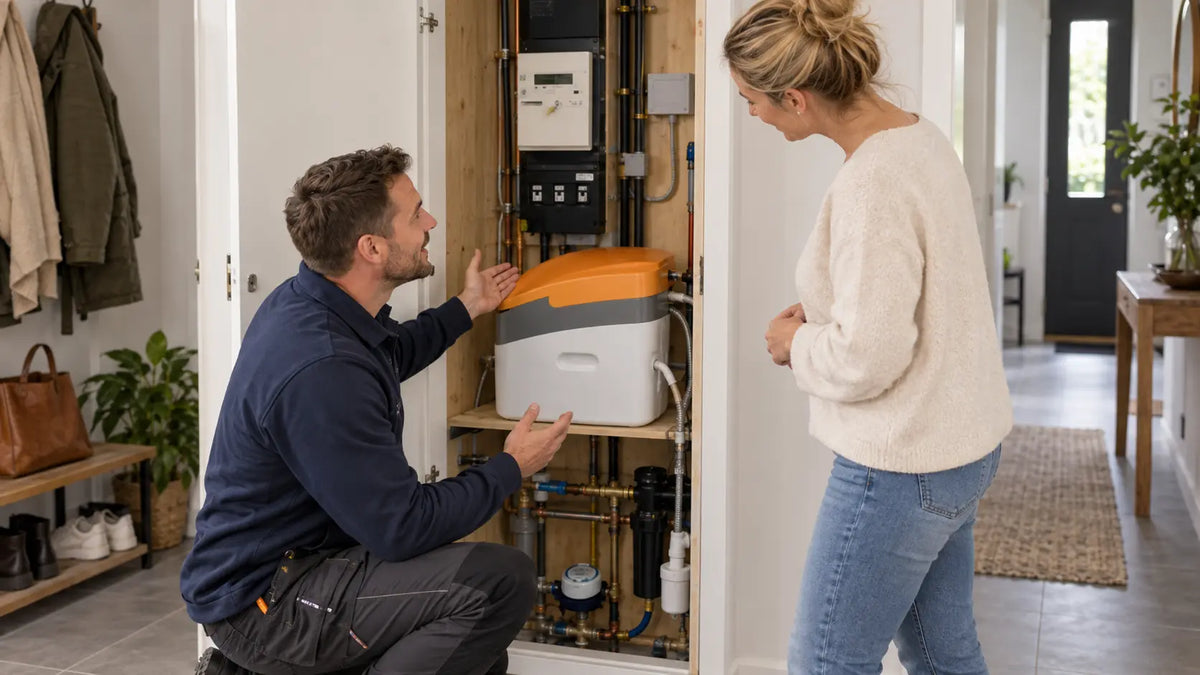
A water softener works on your main supply line, thereby treating all the water in the home, including your shower. It exchanges calcium and magnesium for sodium, meaning less limescale soap is left on your skin and you can get by with less soap. At PureAqua, we see that people with complaints in the bathroom ask about this first. Our AquaCell for 2,348 euros works without electricity, while the Joep for 1,699 euros is the more compact choice. The article on which softener suits your household lists the criteria. If you are below 8 dH, we simply advise against it.
Purer water from the tap
If you don't want softer but purer water, reverse osmosis is the technology for you. A membrane blocks up to about 99 percent of, among other things, PFAS, microplastics, heavy metals, and limescale, measured according to the NSF/ANSI 58 standard. This is a solution for your drinking water, not for your shower: an RO system sits under the kitchen sink and provides water through a separate tap. You can read about how such a setup looks in the explanation of filtering tap water via a separate filter tap.
In short: a softener tackles limescale throughout the house and can alleviate skin complaints in the bathroom. Reverse osmosis tackles the quality of your drinking water and changes nothing about your shower. Those who want both combine them, and those in doubt start with a free hardness check at the explanation of why filter water.
Two things you encounter online that do not work as promised: a showerhead filter only treats the last bit of pipe and hardly changes your hardness, and a small magnetic device on the pipe does not lower your hardness at all. If you want softer water, it must be done through ion exchange. That is less exciting, but it is what happens measurably.
Frequently asked questions
What does a water allergy look like?
As small, itchy bumps of 1 to 3 mm that appear shortly after skin contact with water, usually on the torso, neck, and arms. The skin around them may appear red. It is characteristic that it happens at any water temperature and also with rain or sweat, and that the bumps fade away as soon as the skin is dry. If you mainly see flaking or tight, red skin without elevations, that points more to dry skin or soap residue than to aquagenic urticaria.
How many people are allergic to water?
There are no reliable Dutch figures because the condition is too rare for a registry. Huidziekten.nl calls aquagenic urticaria a rare form of physical urticaria, and in professional literature, there are isolated case reports rather than percentages. Common hives, on the other hand, are an everyday occurrence. The practical conclusion: the chance that your itching after showering is caused by a true water allergy is very small.
What is the cause of itching from water?
In most cases, not the water itself, but the combination of high water temperature, soap or shower gel, limescale in hard water, and a dry skin barrier. Hot water dissolves the fat layer of your skin, and in hard water, limescale soap remains that pulls at the skin when drying. Only with aquagenic urticaria and aquagenic pruritus is water itself the trigger, and those are rare conditions that must be diagnosed by a doctor.
Is it good to drink water during an allergic reaction?
Drinking water is fine during an allergic reaction and helps keep your hydration levels up, but it does not stop the reaction. Even people with aquagenic urticaria can usually drink water, as the reaction occurs on the skin and not in the gastrointestinal tract. In case of severe symptoms such as shortness of breath, a swollen tongue, or a swollen face, drinking is not the solution: call a doctor immediately.
Can someone be allergic to water?
Yes, but rarely, and strictly speaking, it is not an allergy to the water molecule. With aquagenic urticaria, contact with water initiates a reaction where mast cells release histamine, which causes the itchy bumps. It happens at any temperature and from any water source, including rain and sweat. If your skin only reacts to hot shower water, that falls outside this diagnosis.
Can tap water cause allergic symptoms?
Dutch tap water complies with the Drinking Water Decree and in principle contains no chlorine, as water companies purify naturally as much as possible here. Still, tap water can cause complaints that resemble an allergy: hard water with high calcium content leaves limescale soap on your skin, which feels tight and itchy. That is irritation, not an allergic reaction. If you go from hard to soft water, that type of itching often disappears within a few weeks.
Conclusion
Being allergic to water is possible, but almost no one is. Aquagenic urticaria is a rare form of physical hives with a strictly defined pattern: small bumps within minutes, at any temperature, and with any water source. If your complaint does not fit that, the cause is almost certainly in the area of hot showers, soap residue, a dry skin barrier, or the limescale in hard water.
The latter is the only part where technology makes a difference. If you live in an area with 10 dH or more, softer water throughout the home provides noticeably less soap usage and less tight-feeling skin. If you live below 8 dH, such as in large parts of Amsterdam and Brabant, we will honestly say that you are better off adjusting your shower habits than your installation. And if the complaint persists despite everything, go to your GP with a photo of the bumps.
That is why at PureAqua we always start with your hardness and your story, and only then with a solution. Pure, soft water from your own tap, without hassle and without empty promises. Drink different.
Want to know how hard your water is first?
Request a free check. We look at your postcode, your complaints, and your kitchen, and tell you honestly if you need anything.
Request free advice View the pure water taps