Reading time: approximately 11 minutes
Short answer
A water filter on your shower head catches rust, sand, and other particles and can remove chlorine, but Dutch tap water does not contain chlorine by default. Your water hardness does not change either: a cartridge does not soften the water. If you want soft water throughout your entire home, a central water softener is the only technology that achieves this.
In this article
- Does a water filter on your shower head work?
- What exactly is a shower filter?
- What is in Dutch shower water?
- Why your hardness remains the same
- Shower filter or central softener
- What does it cost per year?
- Skin and hair: what can you expect?
- Which choice suits your situation?
- Frequently asked questions
- Conclusion
Does a water filter on your shower head work?
Partially, and probably not for the problem you bought it for. A shower filter sits between the hose and the shower head and traps particles: rust flakes, sand grains, and silt from the pipes. That works demonstrably, as you can see from a discolored cartridge. However, such a filter does not solve the two things that bother most Dutch people about their shower water: limescale and dry skin.
This is due to a distinction that almost no webshop explains. Filtering removes substances from water that are not dissolved, or binds them to an activated carbon granule. Softening removes dissolved calcium and magnesium ions from the water and replaces them. Limescale is dissolved. A cartridge of a few centimeters in your shower hose does not do the latter, no matter how many filter layers the packaging promises.
The market certainly exists: in the Netherlands, "water filter shower" is searched for about 480 times per month, and the variations "shower head water softener" and "shower water softener" are each searched for about 480 times per month as well. What you find in the Google results is almost exclusively product offerings. In August 2026, the Dutch results primarily showed shower filters between 22.95 euros and 29.95 euros, with one stainless steel outlier at 155.90 euros. An independent explanation of what such a device can and cannot do was missing.
Are you unsure if your water is really hard?
Tell us your zip code and your complaints, and we will tell you honestly whether softening will yield any results in your home.
Request free adviceWhat exactly is a shower filter?
Definition
A shower filter is a small cartridge that you screw between the shower hose and the shower head. It usually contains a sieve, activated carbon granules, and mineral granules that remove particles and some chemical contaminants from the water just before it touches your skin. It only treats the last few dozen centimeters of your plumbing.
Most models advertise "15 layers" or "17 stages." That sounds impressive, but they are layers within a cartridge of at most eight centimeters, through which water rushes at eight to ten liters per minute. Contact time is the determining factor in water treatment: the shorter the water is in contact with the filter material, the less happens. A central water softener has a resin bed of dozens of liters; a shower filter has a handful of granules.
What a shower filter actually does in practice:
- Keeps particles out: rust, sand, and silt that come loose after work on the pipes.
- Binds chlorine: the activated carbon absorbs free chlorine, which is especially relevant in countries where chlorine is added by default.
- Dampens odor and taste: if there is a chlorine smell in your bathroom, it will largely disappear.
And what it does not do: reduce your water hardness, prevent limescale on your shower wall, or counter limescale in your boiler and washing machine. The latter is logical, as the filter is located after all those appliances. If you want to understand which technology does tackle limescale, read how ion exchange removes calcium from your tap water.
What is in Dutch shower water?
Here lies the biggest misunderstanding of the entire category. Almost all shower filters are sold on their ability to remove chlorine, as that is the argument that works in the United States, France, and Spain. In the Netherlands, that argument largely does not apply: our water companies purify water without adding chlorine by default. Chlorine is only used here in exceptional cases, for example after a pipe break with a risk of contamination. The RIVM describes how strictly the quality of Dutch tap water is monitored.
What is present, and what you do notice, is limescale. According to Vitens, the hardness of Dutch tap water averages around 8 German degrees of hardness, which is considered soft to moderately hard. This varies regionally: in parts of Brabant, 5 to 11 dH has been measured. Above approximately 12 dH, we speak of hard water, which is the threshold above which you will really start to see limescale on your shower wall and glass.
Waternet explains on its page about the quality of drinking water that you do not need to purify the tap water yourself to drink it safely. At Vitens, senior water quality advisor Theo Hofman says the same thing about filtering and softening: it is not necessary for health. That is a fair starting point. You soften and filter in the Netherlands for comfort, taste, and to protect your appliances, not because the water would be unsafe.
Pay attention to the claim "removes chlorine up to 99 percent". That is technically true and largely meaningless in the Netherlands, because there is usually no chlorine in your tap water to remove. A seller who uses this as a primary argument is selling you an American problem.
Why your hardness remains the same
Limescale in water is calcium and magnesium in dissolved form. These ions are smaller than anything a sieve or activated carbon granule can stop. To get them out of the water, you need one of two techniques: ion exchange, where a resin bed trades calcium and magnesium for sodium, or reverse osmosis, where water is pressed under pressure through a membrane that leaves almost everything behind.
The mineral granules in the cartridge
Many shower filters contain KDF granules or calcium sulfite granules. These are there to chemically break down chlorine, not to reduce hardness. If you measure the hardness before and after the filter with a test strip, you will read the same number of degrees. This is exactly the same pattern as with the magnetic boxes sold as a limescale solution: read here what a magnet around your water pipe does and does not do.
The filter is in the wrong place
Even if a shower filter did soften, it sits at the last point of your plumbing. Your boiler, washing machine, dishwasher, faucets, and central heating system have already had the water by then. Limescale damage mainly occurs during heating, and that all happens upstream. A central softener is located directly after the water meter and therefore protects the entire home. The Flemish Environment Agency adds a sober nuance: first check if your water is actually too hard, because a softener is often not necessary.
Shower filter or central softener
Below are the three routes compared that people consider when searching for "water filter shower." The prices of the shower filters come from the Dutch Google results in August 2026; the PureAqua prices come from our own assortment.
| What you get | Shower filter on the head | Central water softener | Pure water tap with reverse osmosis |
|---|---|---|---|
| Reduces water hardness | No | Yes, in the entire home | Yes, but only at that one tap point |
| Stops particles and rust | Yes | Partially, via the pre-filter | Yes |
| Removes PFAS and heavy metals | No | No | Yes, up to about 99 percent |
| Protects boiler and washing machine | No | Yes | No |
| Less limescale on shower wall and glass | No | Yes | No |
| Purchase price | 22.95 to 155.90 euros | 1,699 euros (Joep) to 2,348 euros (AquaCell) | From 465 euros, or 29 euros per month with 299 euros startup |
| Recurring costs | About 100 to 150 euros per year for cartridges | Salt and periodic maintenance | Filter set, or included with the subscription |
| Installation | Screw on yourself, 5 minutes | Professional at the water meter | Specialist under the sink, or plug and play on the counter |
The table makes the choice factually simple. If your complaint is about limescale, the shower filter column is empty. If your complaint is about what you drink, the softener column is empty, because softened water is still not filtered drinking water. That distinction is important enough to read separately: we explain it at what a softener does not solve for you.
Tackling limescale at the source
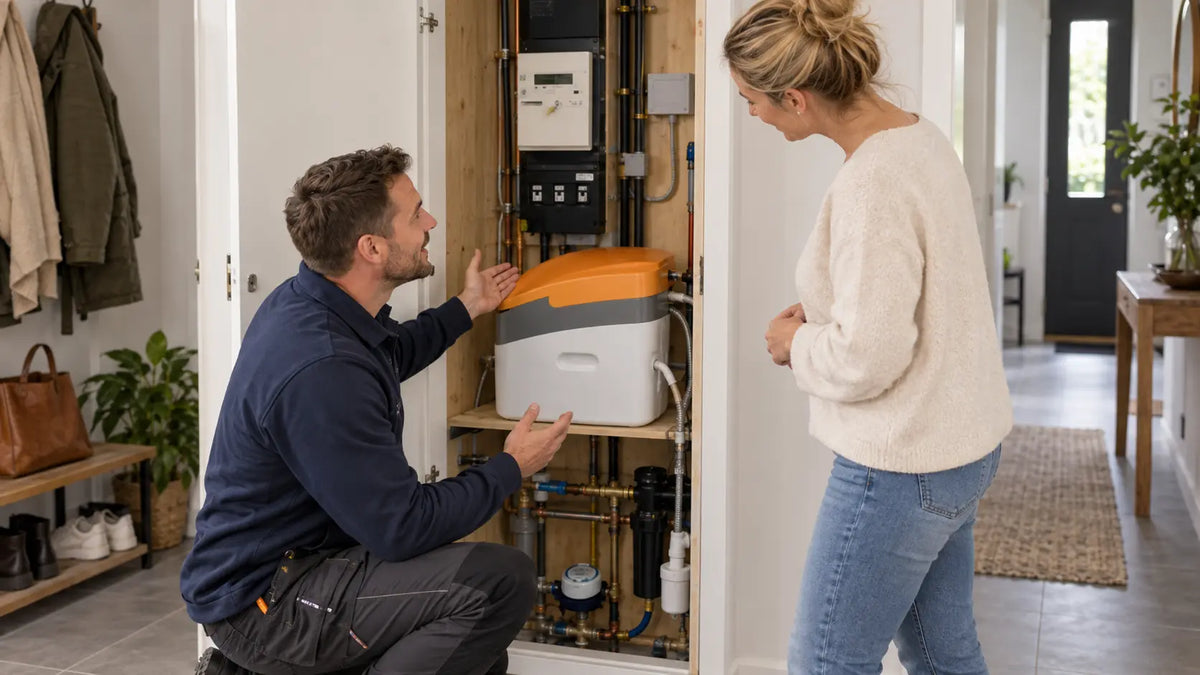
A softener after the water meter protects your shower, your boiler, and your washing machine at the same time.
View the water softenersWhat does it cost per year?
A shower filter looks cheap, and that is exactly why it so often ends up in a shopping cart. The calculation turns out differently as soon as you look a year ahead. Manufacturers recommend replacing the cartridge every two to three months, and for an average shower-head usage by a family, that is not an exaggerated recommendation: the filter material becomes saturated.
- Four to six cartridges per year at an average price of about 25 euros amounts to 100 to 150 euros per year, per shower.
- Two bathrooms therefore means 200 to 300 euros per year, and then not a gram of limescale has disappeared.
- Over five years, that adds up to 500 to 750 euros for one shower, compared to the one-time purchase of a Joep water softener of 1,699 euros that treats the whole house.
At PureAqua, we see that customers who start with a shower filter come back after about a year with the same complaint. The limescale ring on the glass wall is still there, the towels still feel stiff, and the cartridge has been replaced three times. The question asked is then almost always the same: should I not have looked immediately at the place where the water comes in?
Skin and hair: what can you expect?
Shower filters are sold on social media with promises of less acne, softer hair, and fewer flakes. Be cautious with your expectations here, and especially be so with yourself. We make no medical promises, and you can view a seller who does so with healthy suspicion.
What can be explained: hard water reacts with soap to form lime soap, and that layer remains on your skin and in your hair. That is the reason your skin can feel tight after showering in a lime-rich area. If you solve that by introducing less lime into the water, the lime soap disappears. A shower filter does not lower the hardness and therefore does not change that reaction. We wrote earlier about skin that feels tight after showering and what the water has to do with that.
If you want to do something about your shower water without immediately installing a softener, take a look at your soap usage first. With soft water, you need significantly less shampoo and soap for the same result, and that is one of the few effects that customers notice almost immediately after installing an AquaCell water softener.
Which choice fits your situation?
You are a tenant and are not allowed to change anything in the pipes
Then a shower filter is the only option you are allowed to install yourself, and it is worth the money for particles and rust, for example in a building with old pipes. Do not expect any limescale effect from it. Also, ask your water company for your water hardness, because if it is below 8 dH, there is probably nothing to worry about.
You have hard water, own your home and have visible limescale
Then a central water softener is the only solution that actually removes your complaint. Choose based on capacity, maintenance, and whether you have a power connection near the water meter. We have listed the criteria in comparing devices based on measurable properties. Vitens rightly points out that you should only buy a device with a quality declaration recognized by the Dutch state and that the installation must comply with the principles of NEN 1006.
Your concern is what you drink, not what you shower with
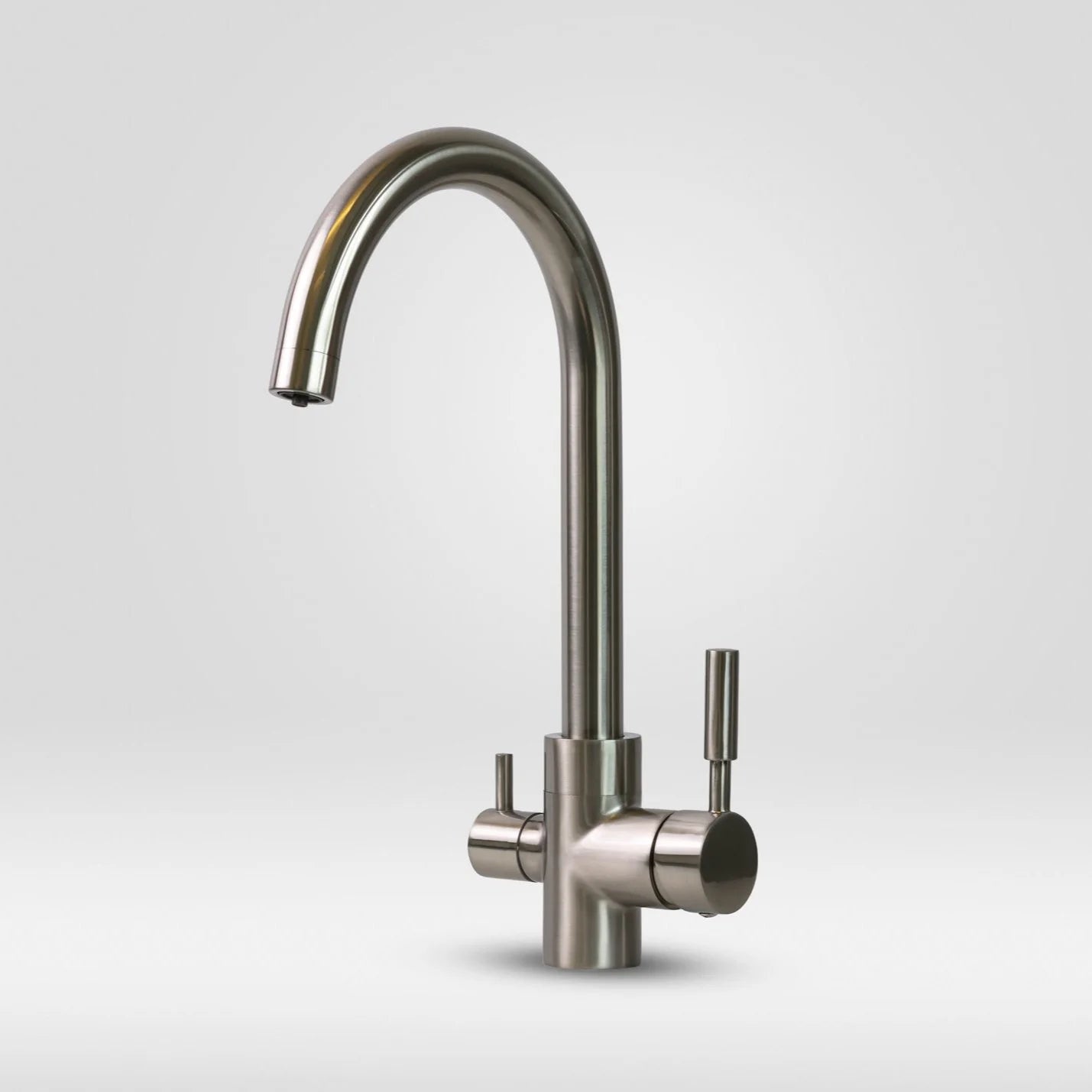
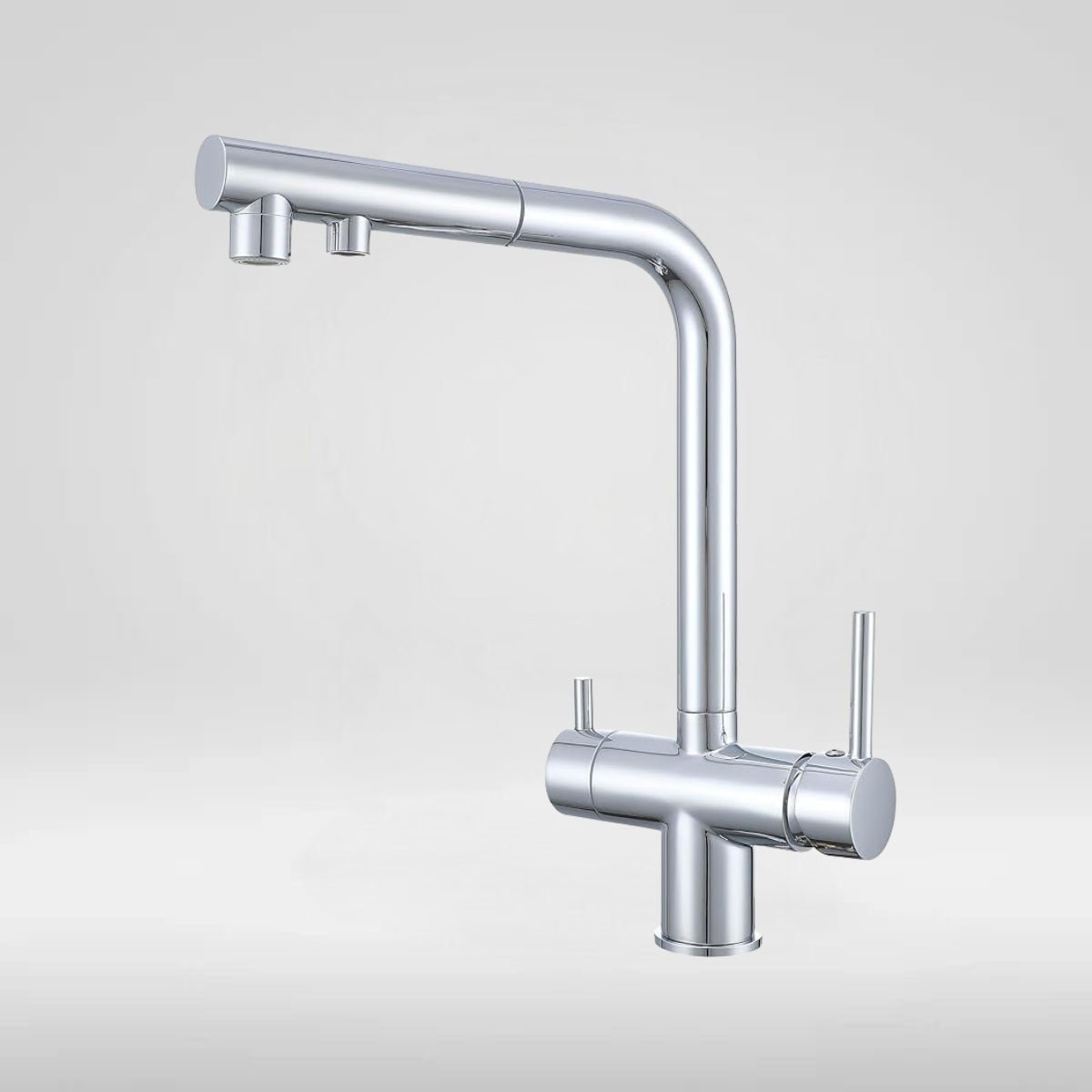
Then the shower is the wrong place to start. For drinking water, reverse osmosis is the technology that goes further: the membrane blocks up to about 99 percent of, among other things, PFAS, microplastics, heavy metals, and limescale, according to the NSF/ANSI 58 standard. At PureAqua, that system is standard with a pure water tap, or you can take the separate Countertop RO which sits on the countertop without installation. We explain why you would want that on the page about filtering water at home.
Prefer pure drinking water to a cartridge on your shower head
A pure water tap with reverse osmosis gives you water every day that has truly been filtered. Drink different.
View the pure water taps View the subscriptionFrequently asked questions
What are the best shower filters?
Evaluate a shower filter on three measurable points: the replacement frequency specified by the manufacturer, the costs per cartridge, and whether there is an independent test behind the claims. In the Dutch results of August 2026, prices ranged between 22.95 euros and 155.90 euros. More expensive did not automatically mean better; the difference was mainly in the housing, stainless steel versus plastic, and not in what is removed from the water.
Is a water filter really necessary?
Not for the safety of your tap water. Waternet and Vitens both state that you do not need to purify Dutch tap water yourself to drink it safely. You choose a filter for taste, for comfort, or to remove specific substances such as PFAS and microplastics from your drinking water. The same applies to the shower: you are buying comfort, not safety.
Do shower filters really work?
For particles such as rust and sand, they work demonstrably, which you can see from a discolored cartridge. They also work for chlorine, but that is rarely relevant in the Netherlands because water companies here do not add chlorine as standard. They do not work for limescale: dissolved calcium and magnesium pass through every sieve and every carbon granule, so your water hardness remains exactly the same.
What is the best water filter against limescale?
No filter works against limescale in the entire house, but a water softener with ion exchange does, such as the Joep for 1,699 euros or the AquaCell for 2,348 euros. For lime-free drinking water at one tap point, reverse osmosis works, which in addition to limescale also stops PFAS and heavy metals. Filtering and softening are two different techniques for two different problems.
Is the water filter from Action good?
A cheap cartridge from a discount store does technically the same thing as a more expensive one: stops particles and binds chlorine. The difference lies in the lifespan and the seal, because leaking connections are the most reported complaint with the cheapest models. More important than the brand is that you should not expect any effect on your water hardness from any shower cartridge.
What are the top 5 water filters?
A classification based on technology is more useful than a brand list. From light to heavy: a sieve filter catches particles, a carbon filter absorbs chlorine and taste substances, a filter jug combines carbon with a bit of ion exchanger, a water softener reduces the hardness in your whole house, and reverse osmosis goes the furthest with up to about 99 percent removal. Choose your problem first, then the product.
Conclusion
A water filter on your shower head is a fine particle catcher and a mediocre solution to the problem for which most people buy it. It does not reduce your water hardness, it is located after all the appliances that suffer from limescale, and the chlorine argument with which it is sold barely applies in the Netherlands. Add 100 to 150 euros in cartridges per year to that, and the calculation quickly tilts.
Therefore, start with one figure: your water hardness. If it is around the Dutch average of about 8 dH, you can probably spend your money better on something else. If it is above 12 dH and you see limescale on your glass, a central water softener is the only route that changes the whole house. If your concern is what you drink instead of what you shower with, then reverse osmosis at the kitchen sink is the place to start. PureAqua is happy to help you with an honest assessment of which of the three yields results in your home.
Want to know what actually helps in your home?
Our advisors look at your hardness, your meter cupboard, and your complaint, and also tell you when you don't need anything.
Ask for free advice