Reading time: approximately 11 minutes
Short answer
Buying osmosis water in the Netherlands costs about 0.02 euros per liter at a filling station for window cleaners, up to 1.35 euros per liter in 10-liter jugs. Making it yourself with a reverse osmosis system costs approximately 0.10 euros per liter for daily use, and provides water that you can actually drink.
In this article
- What exactly is osmosis water?
- Where can you buy osmosis water?
- What does 1 liter of osmosis water cost?
- Can you make osmosis water yourself?
- Buying or making it yourself: where is the tipping point?
- Not all osmosis water is drinking water
- What do you use osmosis water for?
- Buying advice: which route suits you?
- Frequently asked questions
- Conclusion
What exactly is osmosis water?
Definition
Osmosis water is water that has been forced under pressure through a semipermeable membrane, leaving behind up to about 99 percent of dissolved substances. What remains is water without limescale, heavy metals, PFAS, or microplastics, with a TDS value close to zero in a high-quality system. In Dutch, it is also called "RO-water," after the English term reverse osmosis.
This purity is precisely why osmosis water is in such high demand. Window cleaners use it because mineral-free water leaves no limescale streaks on glass. Aquarium owners use it to build up their water parameters themselves. And more and more households are simply using it for drinking, because the membrane blocks the substances that people are concerned about. At PureAqua, we see that this latter group is growing the fastest.
Do not confuse osmosis water with distilled or demineralized water. All three are low in minerals, but they are produced in different ways and differ in their residual content. We have written out the difference between demineralized water, distilled water, and osmosis water separately, because those bottles are often sold side-by-side on the same shelf at the hardware store. If you want to know how the membrane itself works, our page on the operation of reverse osmosis explains it step by step.
Osmosis water from your own tap, without the heavy lifting
No jerrycans in the car and no jugs in the utility room. Place the Countertop RO, plug it in, and tap.
View the Countertop ROWhere can you buy osmosis water?
There are four routes to obtain osmosis water in the Netherlands, and they differ significantly in price, quantity, and whether the water is suitable for drinking. Search behavior clearly shows this: in addition to "buy osmosis water" with approximately 1,900 searches per month, people specifically search for Action, Gamma, Praxis, Karwei, and Hornbach, and for "buy osmosis water window cleaning." These are four different needs behind a single search term.
1. An osmosis water filling station nearby
This is the cheapest route and, at the same time, the least known. Scattered throughout the country are filling stations set up primarily for window cleaners and solar panel cleaners, many of them open 24 hours a day. The rates appearing in the search results in August 2026 are around 2 euros for 100 liters, or approximately 0.02 euros per liter. A car wash filling station charged 2 euros for 80 liters. You do have to drive there yourself and bring your own jerrycans.
2. The aquarium and saltwater store
Aquarium specialty stores provide osmosis water by the liter in your own jerrycan. In Google product results for August 2026, they charge 0.20 to 0.25 euros per liter, and a large saltwater aquarium store reports usually having about 5,000 liters in stock. That is ten times more expensive than a filling station, but the quality is generally better controlled because aquarium water requires precise values.
3. The hardware store and supermarket
At Praxis, Gamma, Karwei, and Hornbach, you will almost never find a bottle labeled "osmosis water," but you will find demineralized water, starting at approximately 2.29 euros per bottle. Chemically, this is close, but it is intended for irons and batteries, not for drinking. This is the reason why "buy osmosis water Action" and "buy osmosis water Gamma" together still generate nearly 1,000 searches per month, even though the answer in the store is actually "demineralized water."
4. Online in cans and bottles
The most expensive route. Osmosis water in a 10-liter can costs 13.50 euros online, which is 1.35 euros per liter. A 5-liter bottle of demineralized water costs 3.95 euros, or 0.79 euros per liter, and multipacks on bol.com range between 13.95 and 16.73 euros. Add shipping and weight to that: 20 liters of water weighs 20 kilos, and you have to lug that inside every week.
What does 1 liter of osmosis water cost?
There is a factor of 67 difference between the cheapest and most expensive way to obtain a liter of osmosis water. That is the figure that appears in almost no article on this topic, even though it determines the entire choice. Below are all the routes compared, with prices as they appeared in Dutch search results and product results in August 2026.
| Route | Price per liter | Suitable as drinking water? | Practical aspect |
|---|---|---|---|
| Window cleaner filling station | approx. 0.02 euros | No, not offered as drinking water | Drive yourself, own jerrycans, often open 24 hours |
| Aquarium store per liter | 0.20 to 0.25 euros | Usually not intended as drinking water | Limited opening hours, own jerrycans |
| Demineralized water hardware store | from approx. 0.46 euros | No, intended for iron and battery | Available everywhere, small quantities |
| 5-liter bottle online | approx. 0.79 euros | No, usually technical water | Delivered, lots of plastic per liter |
| 10-liter can online | approx. 1.35 euros | No, usually technical water | Delivered, heavy, most expensive option |
| Make it yourself with own system | approx. 0.10 euros over 5 years | Yes, designed for drinking water | One-time purchase, then only filters |
The tap water your system uses as raw material is virtually free in that last row. According to Vewin, the drinking water rate in 2026 is 2.71 euros per cubic meter, including taxes. That is 0.27 cents per liter. Even if a system uses three liters of tap water to make one liter of osmosis water, that raw material costs you less than 0.8 cents per liter. How much rinse water is added and what you can do about that is described in our overview of the disadvantages of reverse osmosis and how to solve them.
Can you make osmosis water yourself?
Yes, and it is simpler than most people think. Making osmosis water requires no installer and no renovations: a system with a membrane, water pressure, and a drain for rinse water is enough. There are three practical variants, and the difference mainly lies in installation and what you see standing in your kitchen.
On the countertop, without installation
The Countertop RO from PureAqua costs 495 euros and works plug-and-play: place it, fill or connect it, and tap. There is no plumber involved, making it suitable for a rental home or a kitchen where you don't want to make any changes. One filter set lasts up to a year. We have detailed separately how osmosis water without installation works in practice, including the points of attention.
Under the sink, with your own tap
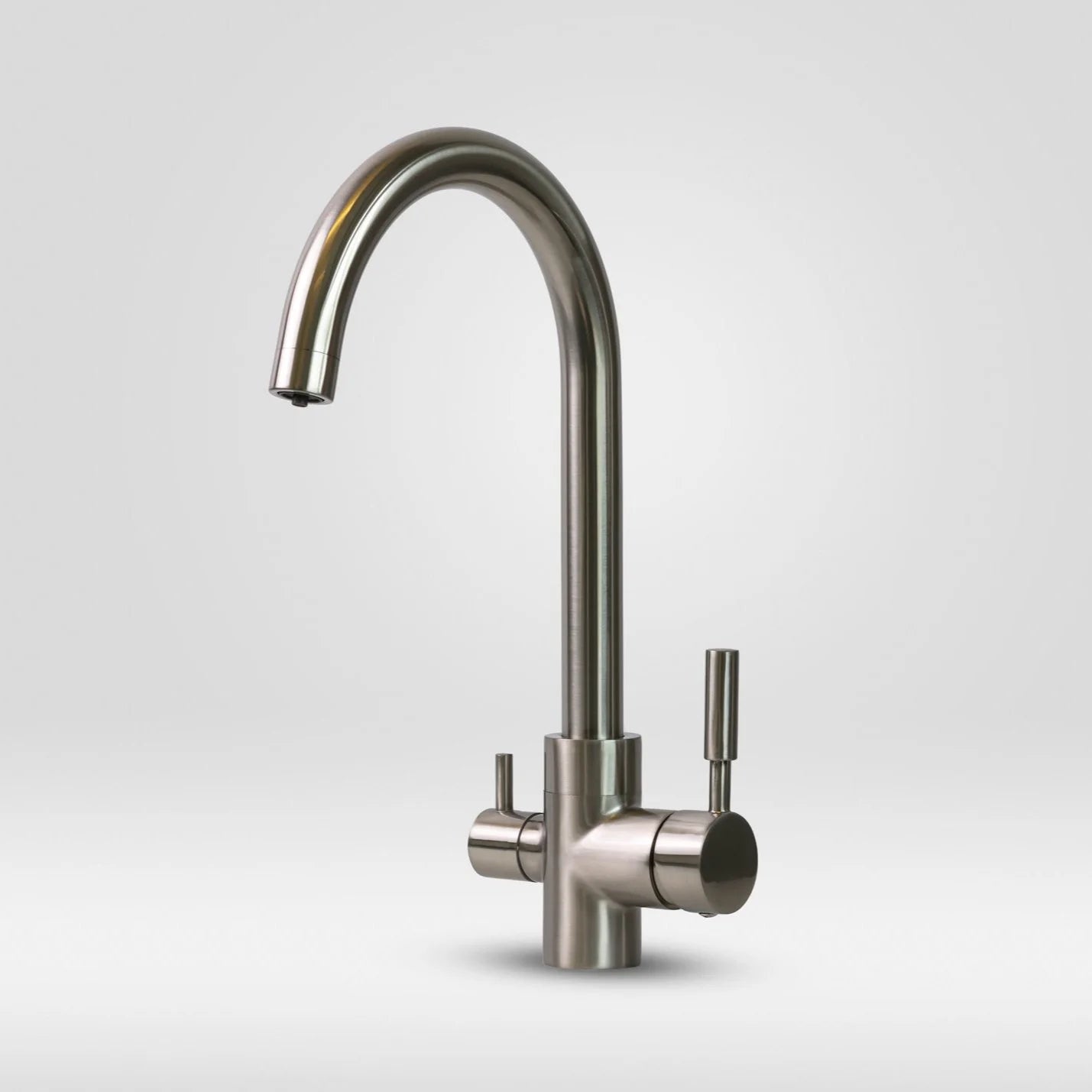
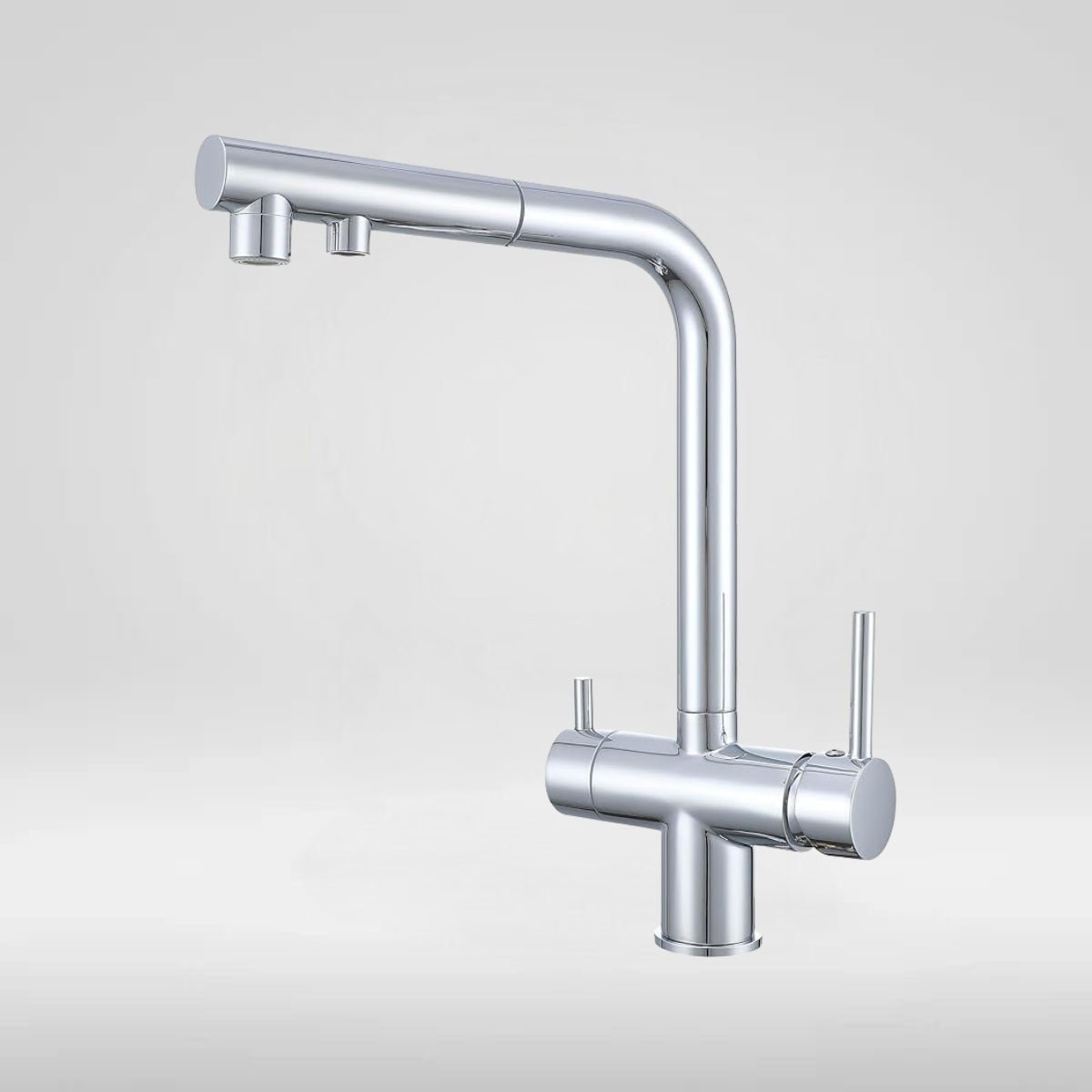
If you don't want anything standing on the countertop, the system goes under the sink and the osmosis water flows upward via a separate tap. At PureAqua, you buy this route as a pure water tap, with the filter system included as standard and installation by a specialist. Those who also want boiling and chilled water from the same tap can choose the 4-in-1 tap. If you are doubting between the variants, our article on which pure water device fits your kitchen will help.
Via a subscription, without an upfront cost
If you don't want to invest all at once, the Pure Water Subscription exists: 29 euros per month with 299 euros in start-up costs, including a tap of your choice, the filter system, the filters for twelve months, and installation by a specialist. You then pay per month instead of per liter, and maintenance is no longer your concern.
For every system, pay attention to certification. The standard specifically regarding reverse osmosis drinking water systems is NSF/ANSI 58. A system that tests against this has been evaluated for material safety, structural integrity, and actual removal performance. Cheap 44.95 euro sets from online shops almost always lack such a declaration.
Not sure which route fits your home?
Tell us how much water you use per day and what your kitchen looks like. We will calculate it together with you.
Ask for free advice View the subscriptionBuying or making it yourself: where is the tipping point?
No one in the search results calculates this, so we do it for you. We take a household that uses 3 liters of osmosis water per day for drinking and cooking. That is 1,095 liters per year.
- Buying at the aquarium store: 1,095 liters at 0.20 euros is 219 euros per year, every year again.
- Buying in 10-liter cans: 1,095 liters at 1.35 euros is 1,478 euros per year. That is more than the most expensive system we sell.
- Making it yourself with the Countertop RO: 495 euros one-time. Divided over five years and 5,475 liters, the hardware costs 0.09 euros per liter, plus 0.27 cents per liter for tap water.
The tipping point is thus well over two years if you currently fill up at the aquarium store: 495 divided by 219 is 2.3 years. If you currently buy cans online, the system is earned back in approximately four months. Only against a filling station at 0.02 euros per liter does your own system never pay for itself purely financially, and that is logical: that water is not intended as drinking water, and you are not accounting for the kilometers and your own time.
Larger households reverse this picture even further. At 6 liters per day, 2,190 liters per year, the 348-euro-per-year subscription costs 0.16 euros per liter, including tap, system, filters, and maintenance. Buying in cans at that same volume would cost 2,957 euros per year.
There is also a non-financial argument. According to Milieu Centraal, tap water is the most sustainable beverage choice there is, precisely because it involves no packaging and no transport. Every liter of osmosis water you make yourself instead of driving home in plastic counts toward that.
Not all osmosis water is drinking water
This is the most important point of this article, and it appears in virtually no search results. Osmosis water that you tap at a dispensing station, a car wash, or a cleaning supplier is sold there as technical water for window cleaning. Some providers literally state that the water from their machines is not drinkable. This is not about the membrane, which works fine, but about the chain thereafter: storage tanks, hoses, dispensing columns, and your jerrycan are not managed as a drinking water installation.
For drinking water in the Netherlands, legal requirements apply from the Drinking Water Act and the Drinking Water Decree, which the RIVM oversees. A system in your own kitchen is located after that controlled supply: it receives water that already meets the standards and removes the remaining dissolved substances from it. That is a fundamentally different situation than a tank with presumably pure water whose origin you do not know. The World Health Organization emphasizes that storage and distribution are just as crucial for water quality as the treatment itself.
Do you want osmosis water to drink? Then choose a route that is designed and certified for it. If you only want it to clean your windows streak-free or to fill your aquarium, then a local dispensing station is a great and cheap choice.
What do you use osmosis water for?
The reason you are looking for osmosis water determines which route is logical. These applications are the most common:
- Windows and solar panels: water without minerals dries without limescale streaks, so polishing afterward is not necessary. Here, it is about liters, not drinking quality.
- Aquarium: you build up the water values yourself with salts and minerals, starting with a clean base.
- Iron, steam cleaner, and batteries: without limescale, nothing gets clogged. Demineralized water from the hardware store suffices here.
- Car washing: no drying spots on paint and glass, not even in the sun.
- Drinking, coffee, and tea: here, it is not about liters but about safety and taste, and therefore about certification and management.
The complete overview with the points of attention per application can be found in our article about all the places where osmosis water is useful in the home. Or compare it first with a simpler solution and read what a filter jug does and does not remove from your water.
Limescale is the immediate trigger for many households. You can check the water hardness for your postcode with your water company, for example at Vitens. If you are in an area with hard water, osmosis water will noticeably change the taste of your tea and the appearance of your kettle.
Buying advice: which route suits you?
Four situations, four choices. Find yours and you are ready.
- You clean windows or clean solar panels: look for a dispensing station nearby. Approximately 0.02 euros per liter cannot be beaten, and drinking quality is not relevant here.
- You occasionally need a few liters, for example for the steam cleaner: buy demineralized water at the hardware store. From approximately 2.29 euros per bottle, no investment needed.
- You want to drink osmosis water every day and don't want to renovate: the Countertop RO of 495 euros is the shortest path. At 3 liters per day, you will break even in just over two years compared to buying, and much faster if you currently have canisters delivered.
- You want pure water with a sleek kitchen, or don't want to invest all at once: choose a pure water tap with a system included, or the subscription of 29 euros per month.
If you are still in doubt between different systems, our buying guide on what to look for when choosing an osmosis system summarizes the criteria: purity, flow rate, maintenance, minerals, and installation.
Frequently Asked Questions
What does 1 liter of osmosis water cost?
That depends entirely on where you get it. At a dispensing station for window cleaners, you pay about 0.02 euros per liter, at an aquarium store 0.20 to 0.25 euros per liter, and in 10-liter jugs online about 1.35 euros per liter. If you make it yourself with your own system of 495 euros, a liter costs about 0.10 euros over five years at 3 liters per day, including the tap water as raw material.
Is boiled water the same as osmosis water?
No. Boiling kills bacteria and viruses but does not remove dissolved substances. Limescale, nitrate, PFAS, heavy metals, and medicine residues remain in the water after boiling, and evaporation even concentrates them slightly. Reverse osmosis works the exact opposite way: the membrane blocks up to about 99 percent of those dissolved substances. Boiled water and osmosis water therefore solve two different problems.
How do I get osmosis water?
There are four routes: a local osmosis water dispensing station with your own jerrycan, an aquarium or saltwater store that taps by the liter, demineralized water in bottles from the hardware store, or osmosis water in canisters delivered online. The fifth and, for daily drinking water, most practical route is making it yourself with a reverse osmosis system in your kitchen, for example, a countertop model without installation or an under-sink system with a separate tap.
Can I wash windows myself with osmosis water?
Yes, and that is exactly what most dispensing stations in the Netherlands were set up for. Because osmosis water contains almost no minerals, no limescale streaks remain when it dries, so polishing or squeegeeing is not necessary. Work with a telescopic pole and a brush, rinse from top to bottom, and simply let the glass dry. For this application, you do not need drinking water quality, so the cheapest source is the logical choice.
Can I make osmosis water myself?
Yes. You need a reverse osmosis system, water pressure from the tap, and a drain for the rinse water. A countertop system like the Countertop RO of 495 euros can be placed on the countertop without installation. If you want nothing visible, the system goes under the sink and the water runs to the top via a separate pure water tap. It won't work without a membrane: boiling, filtering with a jug, or a carbon filter does not produce osmosis water.
What do professional window cleaners add to their water?
As a rule, nothing. The idea is precisely that there is as little as possible in the water, because every dissolved substance can leave a streak. What professionals do, however, is polish the osmosis water further with a deionization filter, which uses ion exchange to remove the last ions to a TDS value around zero. Dispensing stations therefore often provide RO/DI water: first the membrane, then the resin column. Soap or rinse aid is never added.
Conclusion
Buying osmosis water is cheap to almost absurdly expensive, depending on where you get it: from 0.02 euros per liter at a dispensing station to 1.35 euros per liter in canisters online, a difference of a factor of 67. For windows, aquariums, or irons, buying is often the smartest choice, because there, only the price per liter counts.
If you want to drink osmosis water, the calculation shifts. Then it is not just about price, but also about certification and who manages the chain after the membrane. At 3 liters per day, an own system of 495 euros is earned back in just over two years compared to tapping at the aquarium store, and in about four months compared to having canisters delivered. From that point on, a liter costs you about 0.10 euros and you never have to lug heavy bottles again. That is, for us, the core of Drink different: pure water straight from your own tap.
Stop lugging liters
Pure osmosis water from your own tap or from your own countertop, with advice and installation by PureAqua.
View the pure water taps View the Countertop RO