






Reading time: approximately 13 minutes
Short answer
Filtering groundwater into drinking water is possible, but never with a single filter. You need four steps: a laboratory analysis of your own source, iron and manganese removal, a carbon filter for taste and organic substances, and a disinfection step against bacteria. Reverse osmosis is then the final treatment that removes nitrates, heavy metals, and PFAS. Without an initial analysis, you do not know which steps you need, and you may end up filtering for the wrong things.
In this article
- Can you filter groundwater into drinking water?
- What is in groundwater?
- Start with a water analysis, not a filter
- The filter steps summarized
- Where does reverse osmosis fit into this?
- Which step removes what?
- What does the law say about private extraction?
- What does it cost, and when is it worth it?
- Groundwater, rainwater, or ditch water?
- Frequently asked questions
- Conclusion
Can you filter groundwater into drinking water?
Yes, and it happens on a large scale every day. According to their own explanation on making drinking water, the water utility WMD in Drenthe uses 100 percent groundwater as its raw material. That water does not simply go into the pipes: it is aerated, filtered, and checked before it comes out of your tap. Those exact steps are why the question "can I do this at home too" deserves a nuanced answer.
The short answer is: technically, you can, but not with a single filter and not without knowing what is in your source. Groundwater from a well on one plot can have a completely different composition than groundwater five hundred meters away, because the soil layer above it determines what dissolves into it. A filter that removes iron does nothing against nitrates, and a carbon filter does nothing against bacteria.
At PureAqua, we receive this question mainly from people with a tiny house, a holiday home outside the public water network, or a farm with an old well. The pattern is always the same: people buy a filter first and then wonder if the water is safe. That is the wrong order, and it is also the most expensive one.
Are you unsure if your water is safe to drink?
Tell us what source you have and what you want to achieve. We will provide free advice, even if the conclusion is that you are better off connecting to the municipal water supply.
Request free advice View the pure water deviceWhat is in groundwater?
Definition
Groundwater is rainwater and river water that has percolated through soil layers and collected there. Along the way, it dissolves whatever it encounters: lime, iron, manganese, salts, and—depending on surface usage—fertilizers and pesticides. Therefore, groundwater is not inherently clean; it has only been filtered by sand and clay.
Four groups of substances determine what you need to do for almost every well.
Iron and manganese
These are the two classics of every groundwater source. They are dissolved and therefore invisible as long as the water is not exposed to oxygen, but as soon as it comes out of the tap, they oxidize and you get brown or black flakes. According to Dunea, the Drinking Water Decree applies a standard of 200 micrograms per liter for iron and 50 micrograms per liter for manganese, with a taste threshold for iron starting at approximately 100 to 200 micrograms per liter. Above 300 micrograms per liter, most people find the taste unacceptable. Anyone familiar with this effect from the public water supply will recognize the story of brown tap water caused by iron and manganese, though the concentration in untreated groundwater is often many times higher.
Lime and hardness
Groundwater that has percolated through lime-rich layers is hard. According to WMD, the Drinking Water Decree prescribes a total hardness between 1 and 2.5 millimoles per liter, or 5.6 to 14 degrees dH, and drinking water in Drenthe is around 8 degrees dH. Hardness is not a health problem but rather an appliance problem: boilers, heaters, and coffee machines become clogged.
Nitrate and pesticides
This is the silent category, as you cannot see, smell, or taste it. Every four years, the Netherlands reports to the European Union on groundwater quality via the RIVM's Nitrate Report, precisely because manure and agricultural usage affect what is underground. In sandy soils, measured values are structurally higher than in clay and peat. A shallow well in an agricultural area therefore requires different attention than a deep well in a wooded area.
Bacteria and other microorganisms
Deep groundwater is often microbiologically clean; shallow groundwater is not. A leaking well casing, a septic tank nearby, or a poorly sealed cover is enough. It is not without reason that the World Health Organization assesses household water treatment in its international evaluation scheme separately for bacteria, viruses, and protozoa: a device that stops bacteria does not automatically stop viruses as well.
Start with a water analysis, not a filter
This is the step that almost everyone skips and which determines all other choices. Without an analysis, you are buying blindly: you do not know if you need to remove iron, or specifically nitrate, or both, or if your source is microbiologically unsound and no single filter will solve the problem.
The RIVM treats a private source as a private extraction: an installation with which you extract water from the ground or surface water as drinking water yourself. That water falls under the owner's responsibility, must meet the quality standards of the Drinking Water Decree and the Drinking Water Regulation, and is subject to the supervision of the Human Environment and Transport Inspectorate. The RIVM mentions three steps: know your system, perform a risk analysis, and measure. If things go wrong, you can develop mild to severe symptoms such as diarrhea, vomiting, or fever according to the same source.
Practically, this means: have a laboratory analyze a sample before you buy anything. Ask at minimum for iron, manganese, hardness, nitrate, ammonium, chloride, pH, and a microbiological determination. If there is agriculture or industry in the area, have it checked for pesticides as well. Measure again after the installation is running, because only then do you know if it works.
A cheap home indication is a conductivity measurement, but understand its limitations. Such a meter only says something about the total amount of dissolved substances, not which ones. What a measurement in ppm does and does not say about your water is precisely the reason that a TDS measurement never replaces a laboratory analysis: a source with 150 ppm can be bacteriologically unsafe, while a source with 600 ppm might not be.
The filter steps summarized
A working setup is always a chain, and the order is fixed. Each step protects the next: if you put your reverse osmosis at the front, the membrane will clog within weeks due to iron.
Step 1: aeration and settling
Dissolved iron and manganese must first come into contact with oxygen so that they precipitate into particles you can catch. This is exactly what a water utility does before it filters. Without this step, the iron will slip through your sand filter in its dissolved state, and the water will still turn brown in the glass.
Step 2: mechanical filtration
A sand or sediment filter catches the formed flakes plus the sand that every well delivers. This is the cheapest step and simultaneously the step that keeps the rest of your installation alive. Replace or flush this filter according to schedule, because a saturated sediment filter will immediately cost you water pressure.
Step 3: activated carbon
Carbon handles taste, odor, chlorine, and part of the organic substances. It is not a barrier against salts, nitrates, or bacteria, and that misconception is persistent. How a carbon cartridge relates precisely to a membrane is explained in our article on what activated carbon does and does not take out of your water. In short: carbon improves the experience, osmosis changes the composition.
Step 4: disinfection
With a private source, this is not a luxury but the core of safety. UV light is the standard choice for household use, because it adds nothing to the water. The condition, however, is that the water is clear at that point, because suspended particles shield microorganisms from the lamp. That is why disinfection is always at the end, never at the beginning.
Step 5: final treatment for drinking water
The first four steps provide water that is clean and clear. However, they say nothing about nitrates, heavy metals, PFAS, or drug residues. Anyone who wants that certainty for the water they actually drink puts a membrane step after it. That is where reverse osmosis belongs.
Where does reverse osmosis fit into this?
Reverse osmosis forces water under pressure through a membrane with pores so fine that dissolved salts, heavy metals, nitrates, PFAS, and microplastics cannot pass through. The performance of such systems is internationally assessed against NSF/ANSI 58, the standard for household reverse osmosis systems. If you want to see step-by-step how it works, our page on how reverse osmosis works explains the membrane principle.
There is an honest caveat here, and we prefer to mention it ourselves rather than you finding out once the system is already installed. PureAqua's systems are designed for public tap water, not as a complete purification system for raw well water. A membrane cannot tolerate iron, sand, or bacteriologically contaminated supply. If you have a private source, the order is: first, a professionally built pre-treatment with aeration, filtration, and disinfection, and only then osmosis as the final step for your drinking water point.
For most households, the reality is actually different. Anyone who is simply connected to the public water network and wants to improve their drinking water does not need that whole pre-treatment: the water utility has already performed the iron, manganese, and disinfection steps. Then only the final step remains, and that is precisely why an osmosis system without installation on the countertop is such a practical solution for that situation. The difference between the filter types you can choose from for that purpose is outlined in our comparison of water filter, water purifier, and reverse osmosis.
Pure water from your own tap
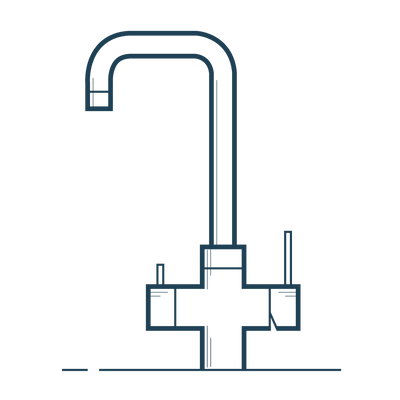
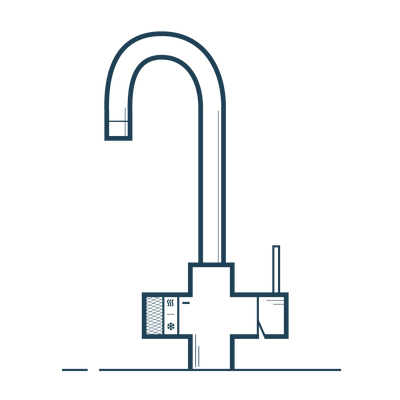
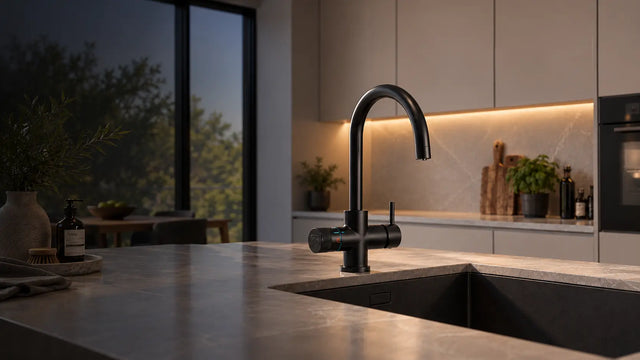
Are you connected to the municipal water supply? Then you do not need a well installation, only the final step. Our pure water taps deliver osmosis water from a faucet that fits in your kitchen.
View pure water tapsWhich step removes what?
This table is the core of the article. It shows why individual filters from a webshop rarely solve the entire problem, and why the combination does work.
| Step | Removes | Does not remove | Why you need it |
|---|---|---|---|
| Aeration and sedimentation | Converts dissolved iron and manganese into particles | Salts, nitrate, bacteria | Without this step, dissolved iron slips through everything |
| Sediment or sand filter | Sand, rust flakes, turbidity | Dissolved substances, microorganisms | Protects carbon, UV, and membrane from clogging |
| Activated carbon | Taste, odor, chlorine, some organic substances | Nitrate, salts, hardness, bacteria | Makes the water taste drinkable, but not safe in composition |
| UV disinfection | Neutralizes bacteria, viruses, and protozoa | Chemical substances, limescale, iron | The only step that ensures microbiological safety |
| Water softener | Calcium and magnesium, thus limescale | PFAS, nitrate, drug residues, bacteria | Protects your appliances, does not provide pure drinking water |
| Reverse osmosis | Up to approx. 99 percent of dissolved substances, including nitrate, heavy metals, and PFAS | Only works on pre-purified, clear water | The final step for the water you actually drink |
Pay attention to the last two rows, as that is where the most common misconception lies. A water softener and an osmosis system are often seen as alternatives, while they solve different problems. If you only want to get rid of limescale throughout your home, take a look at the water softeners. If you want pure drinking water, that is a separate step at your drinking water point. We explain why filtering makes sense in general, even for tap water, on our page about why you filter water.
What does the law say about private water extraction?
Drinking water in the Netherlands is strictly regulated. The RIVM summarizes the regulations regarding drinking water in the Drinking Water Act and the Drinking Water Decree, which contain the legal quality requirements. These requirements do not only apply to water companies: your own source must also comply with them if you use the water as drinking water.
Since the implementation of the European Drinking Water Directive in 2023, the RIVM distinguishes between large and small private water supplies, where only the large ones must prepare a formal risk assessment. Just because a small supply does not have that obligation does not mean the quality standards do not apply. The responsibility lies with you as the owner.
There is a second legal layer that can surprise people: the moment you connect your own extracted water to your home installation. Vitens points out in the points of attention for drinking water safety that proper connection and good management of these types of systems are of great importance to prevent health risks, with NEN 1006 and the Drinking Water Regulation as a framework. Specifically: private water and tap water must never be able to touch each other. A backflow preventer is not a detail in this regard, but the separation between your installation and the public network.
What does it cost, and when does it pay off?
This is where the calculation that is rarely made honestly comes in. Compare the costs of a private purification system with what tap water costs. According to Vewin, the drinking water rate in 2026 is on average 2.05 euros per cubic meter excluding taxes and 2.71 euros per cubic meter including taxes. A cubic meter is one thousand liters. For the water an average household drinks per day, you are talking about pennies.
A complete private water supply with aeration, filtration, UV, and post-treatment involves purchase, electricity, filter replacement, annual laboratory checks, and maintenance. These costs continue year after year, and the checks are not optional: without measuring, you do not know if your installation is still doing what it should do.
The honest conclusion: if you have a tap water connection, purifying groundwater yourself is rarely the cheapest or safest route for drinking water. Groundwater is then mainly interesting for the garden, flushing the toilet, or washing the car, where drinking water quality is not required. If you do not have a connection, then a good private installation is not a luxury but a necessity.
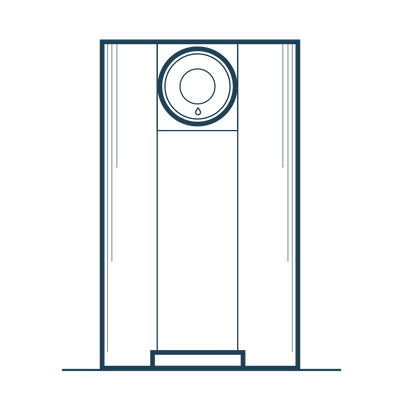
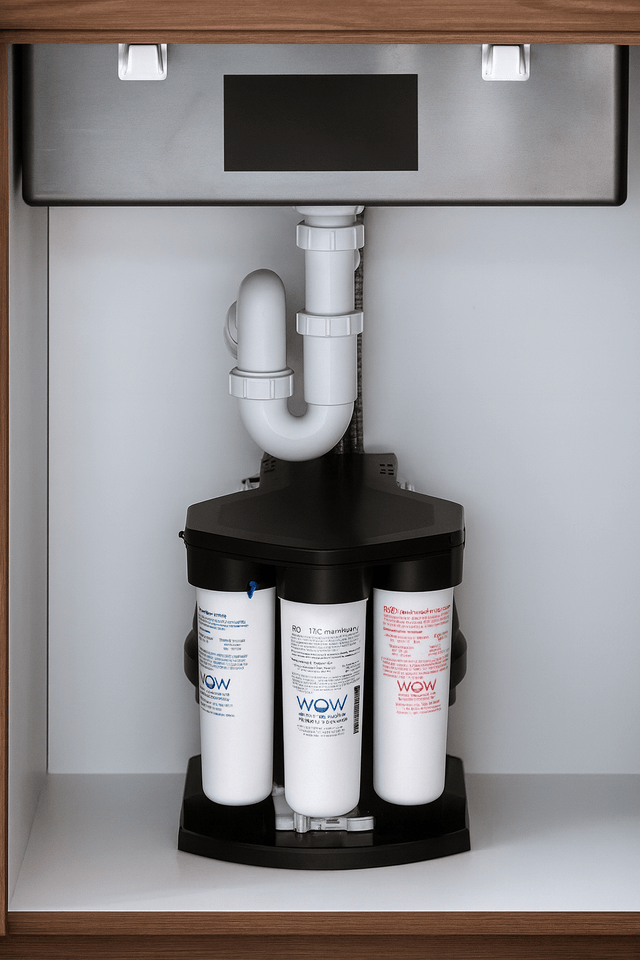
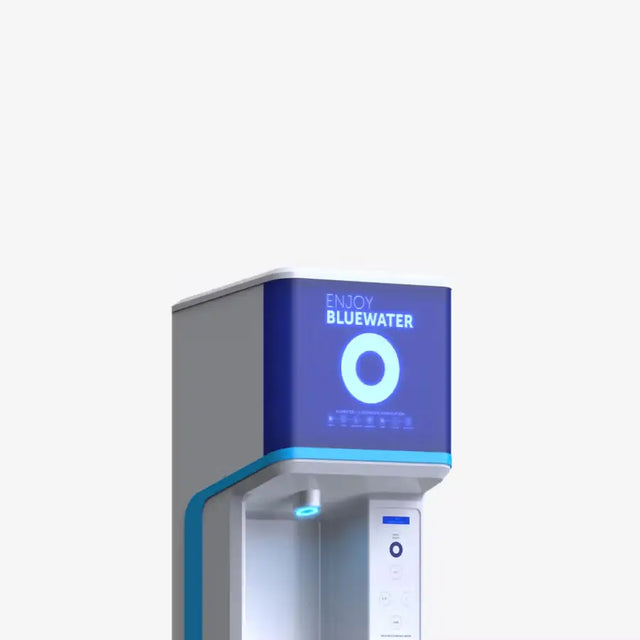
At PureAqua, customers with a tap water connection therefore almost always choose the simple route. That is either the pure water device on the countertop, without installation and without intervention in your plumbing, or a pure water tap with the filter system underneath. Those who prefer not to pay a lump sum choose the "Zorgeloos Zuiver Water" (Carefree Pure Water) subscription for 29 euros per month with 299 euros in startup costs, including the tap, filter system, filters for twelve months, and installation by a specialist. All systems come with a 100-day trial and 2-year warranty.
Groundwater, rainwater, or ditch water?
People who ask this question are usually considering more than one source. They differ significantly in risk and what they require in terms of purification.
Groundwater is the most stable source. The composition barely changes throughout the year, the temperature is constant, and deep groundwater is often microbiologically sound. The challenge lies in iron, manganese, hardness, and, depending on the environment, nitrate.
Rainwater is exactly the opposite: few minerals and soft, but it flushes your roof, your gutter, and all the dirt on them along with it. Roofing materials are a factor here. We have detailed what is involved in making collected rainwater safe to drink in a separate article, including why boiling alone is not sufficient.
Ditch water and other surface water is the most difficult category for home use. Variable composition, high organic material content, algae, potential upstream discharges, and high microbiological load. Water companies can handle this just fine with a long purification line; at home, it is a completely different story. For emergency situations, there are portable filters, and it is good to know what they do and do not stop in an emergency kit before you rely on them.
Frequently Asked Questions
Can I turn groundwater into drinking water?
Yes, but only with a chain of steps and after a laboratory analysis of your own source. You need aeration, filtration, activated carbon, and a disinfection step, with reverse osmosis as post-treatment for your drinking water point. The RIVM classifies such an installation as a private water supply: the water must comply with the standards of the Drinking Water Decree, and the responsibility lies with the owner.
How can I purify groundwater into drinking water?
In five steps and in this order. Aerate the water so that dissolved iron and manganese precipitate, capture those particles with a sand or sediment filter, remove taste and organic substances with activated carbon, disinfect with UV on clear water, and set reverse osmosis as the final step for the water you drink. If you reverse the order, the osmosis membrane will clog within weeks.
Can I turn ditch water into drinking water?
Technically it is possible, but it is the most difficult source for home use. Surface water varies greatly in composition, contains a lot of organic material and algae, and is heavily microbiologically contaminated. You would need at least sedimentation, multi-stage filtration, and reliable disinfection, plus regular monitoring. For structural drinking water, groundwater or a tap connection is almost always the wiser choice.
How do you purify rainwater into drinking water?
Collect it from a clean roof, let it settle, filter it mechanically, remove taste and organic substances with carbon, and then disinfect. Milieu Centraal points out that impregnated wood and uncoated metals such as zinc and copper in the roof and gutter can contaminate the collected water. Rainwater is soft and mineral-poor, which makes it tasteless and susceptible to bacterial growth during storage.
Which is better, water purification tablets or filters?
They do different things. Tablets disinfect: they kill microorganisms but change nothing about iron, limescale, nitrate, or heavy metals, and they leave a chemical taste. Filters remove particles and dissolved substances but do not all disinfect. For short-term emergency use, tablets are practical; for a permanent source, you want filtration plus a fixed disinfection step such as UV.
Is filtered groundwater hard, and do I need to soften it?
Often yes. The Drinking Water Decree, according to WMD, maintains a total hardness between 1 and 2.5 millimoles per liter, or 5.6 to 14 degrees dH, and groundwater from lime-rich layers is at the higher end of that scale. A water softener solves limescale in your entire home but does not provide pure drinking water: PFAS, nitrate, and drug residues remain. That remains a separate step.
Conclusion
Filtering groundwater into drinking water is not a product but a process. It starts with a laboratory analysis, because without knowing what is in your source, you are buying blind. Then follows a fixed chain: aeration, mechanical filtration, activated carbon, disinfection, and as a final step, reverse osmosis for the water you actually drink. If you skip a step, you are moving the problem instead of solving it.
If you have a tap water connection, be honest about the math. According to Vewin, tap water costs an average of 2.71 euros per cubic meter including taxes and has already been de-ironed, de-manganized, and disinfected. That leaves only one step to bring your drinking water to the level you want, and that step does not cost a well installation. Groundwater is then especially useful for the garden and the toilet.
If you do not have a connection, have the installation designed by someone who has read your analysis, comply with NEN 1006 and backflow protection, and measure again after everything is running. That is the difference between water that looks clean and water that you know is safe. Drink different, but drink with the figures to back it up.
Pure drinking water without the hassle
Osmosis water from your own tap, with installation, filters, and service arranged. 100-day trial and 2-year warranty.
View the subscription Request free advice




 Filtered drinking water
 Boiling water from the tap
 Less limescale at home
 Water for my business


